Last updated: 16/01/2026 (14:00 UTC+1)
Thematic Cluster: RIDS – International Relations, Defence and Security
Authors: Yaël LOPEZ-TORRES, Ismail BOUHIOUL, Farida SETITI
Published Date: December 17, 2025
- Reminder of the facts
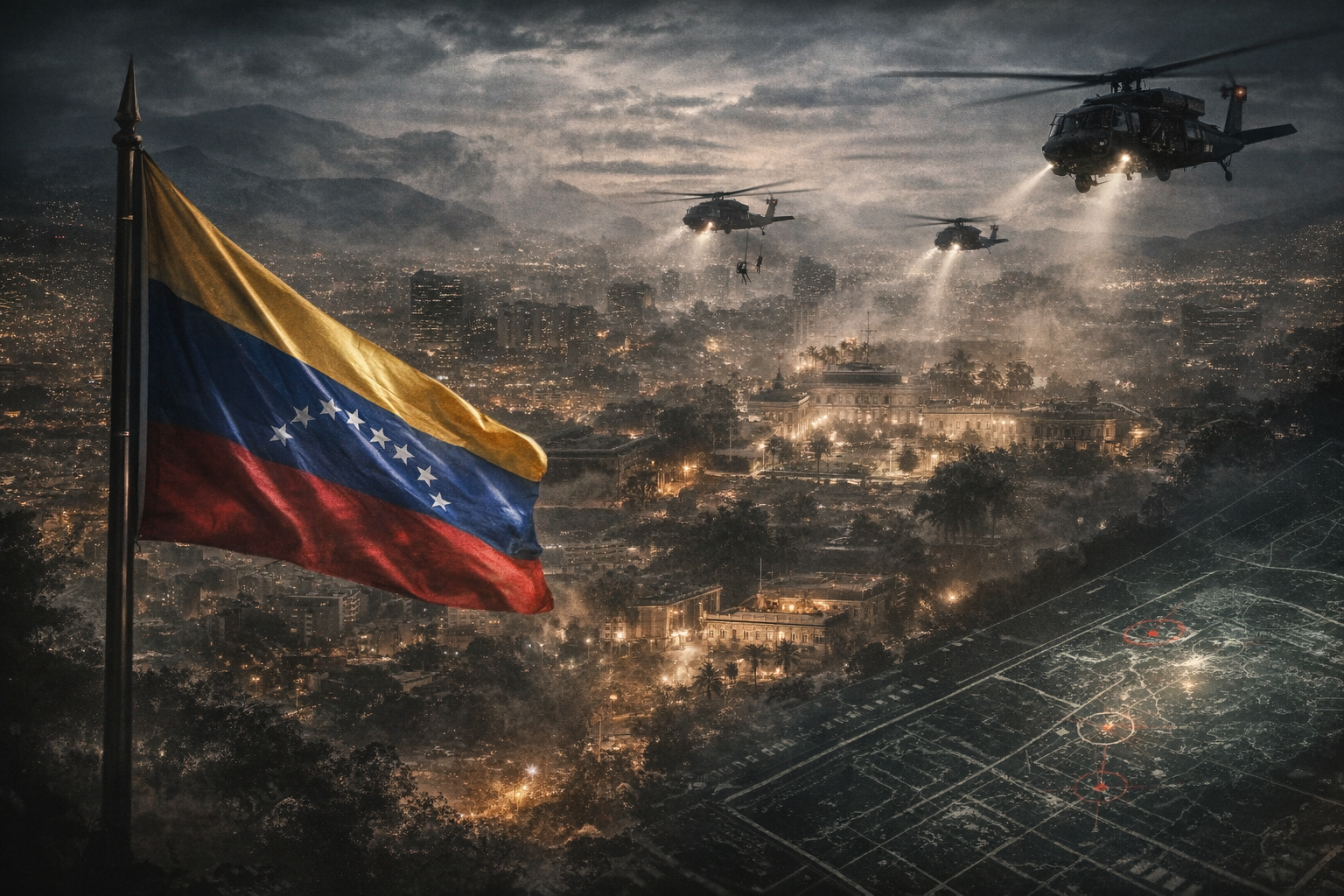
On the night of Friday, January 2 to Saturday, January 3, between 2:00 a.m. and 3:00 a.m. (Caracas time),Venezuelan President Nicolas Maduro and his wife Cilia Flores were arrested in their residence, while they were sleeping, by U.S. special forces.
Moments earlier, powerful explosions shook Caracas and its outskirts, marking the launch of a major U.S. military operation, dubbed « Operation Absolute Resolve. »
According to military sources relayed by France Info, about 150 planes and helicopters, accompanied by drones and fighter jets, entered Venezuelan airspace at the darkest night.
The strikes targeted several military installations, including the Fuerte Tiuna complex, where Nicolás Maduro resided.
The presidential couple was captured, exfiltrated by helicopter, then transferred to a U.S. warship before being flown to the United States.
Footage released by US authorities shows Nicolás Maduro handcuffed, escorted by DEA agents, upon his arrival in New York, where he was incarcerated at the Metropolitan Detention Center in Brooklyn.
At 5:21 a.m. (Eastern Time), U.S. President Donald Trump announced the capture on his Truth Social network, praising the success of the operation and saying that no U.S. soldiers had been killed.
Contrary to institutional practice, the US Congress was not informed in advance, raising legal questions in the United States.
- Charges and legal proceedings
Appearing Saturday night in a federal court in New York, Nicolás Maduro pleaded not guilty to the charges against him, mainly related to drug trafficking.
Charges include:
- Narco-terrorism
- Importation of cocaine
- Weapons offences
The Trump administration also accuses Nicolás Maduro of leading the « Cartel de los Soles », designated as a terrorist organization, although the existence of this structure is disputed by some experts. The U.S. Department of Justice later reframed the accusation as a « clientelist system » and a « culture of corruption » fueled by drug money.
During his first appearance on Monday, January 5 in a Manhattan court, Maduro said: « I am the president of the Republic of Venezuela and I have been kidnapped here since Saturday, January 3 », before being interrupted by the judge, who asked him to limit himself to confirming his identity.
Judge Alvin Hellerstein ordered Nicolás Maduro to remain in detention in New York. A new hearing is scheduled for March 17.
- Human toll of the operation
- At least 80 Venezuelans have been reported, and several dozen injured.
- 32 Cuban military and intelligence agents killed, according to Havana
Cuban authorities say the agents were involved in the security of the Venezuelan president.
- Political situation in Venezuela
Vice President Delcy Rodríguez was sworn in as interim president for a period of 90 days, with the possibility for the National Assembly to extend her term for another six months.
Delcy Rodríguez called the U.S. military operation an « illegal and illegitimate kidnapping » and « foreign aggression. »
However, Donald Trump has declared that the United States will « lead the country » until the establishment of a transition deemed acceptable, threatening Delcy Rodríguez with the same fate as Nicolás Maduro if he refuses to cooperate.
The Venezuelan military has recognized Delcy Rodríguez as interim president.
The Venezuelan Supreme Court denounced « American piracy » and demanded the immediate release of Nicolás Maduro.
The president of the National Assembly, Jorge Rodríguez – brother of Delcy Rodríguez – announced that he would use « all possible procedures » to obtain the return of Nicolás Maduro to Venezuela.
On the opposition side, María Corina Machado calls on the armed forces to recognize Edmundo González Urrutia as the legitimate president, believing that he won the July 2024 presidential election according to independent polls.
- Social climate
In Caracas, the climate is marked by high uncertainty and social tension:
- About 2,000 Maduro supporters demonstrated to demand his release
- Several thousand opponents celebrated his fall
The population oscillates between confusion, fear and relief.
- Release of political prisoners
On January 8, Jorge Rodríguez announced the immediate release of a « significant number » of Venezuelan and foreignpolitical prisoners. The Venezuelan human rights group Foro Penal reported that as of 14 January it had verified 76 releases. However, this group estimates that there are still more than 800 political prisoners.
Donald Trump has announced the cancellation of a second wave of attacks against Venezuela, due to the release of political prisoners.
- A long-planned operation
The American intervention is part of a gradual escalation since December:
- Announcement of a total blockade of oil tankers carrying Venezuelan oil
- Deployment of approximately 15,000 U.S. troops and several warships to the Caribbean Sea
- Repeated strikes on drug-linked vessels (more than 100 dead since September)
- Infiltration of Maduro’s entourage by the CIA in mid-December
The exfiltration operation lasted 2 hours and 29 minutes.
- The Monroe Doctrine back at the center of American discourse
Donald Trump justified the intervention by reactivating the Monroe Doctrine, which he renamed « Donroe ».
Established in 1823 by President James Monroe, this doctrine was initially intended to prevent European interference in the American continent.
Under President Theodore Roosevelt – with the corollary Roosevelt – it became a foundation of American interference in Latin America.
The revival of this doctrine is part of the United States’ national security strategy, dated November 2025.
Donald Trump says he wants to guarantee total American domination of the Western Hemisphere.
This doctrine and the military intervention in Caracas sends a clear signal to Russia, China and Iran:
Russia: disruption of the military arsenal and cooperation with Venezuela, including the supply of defense systems and weapons (S-300, aircraft, anti-aircraft missiles, military training).
China: impact on mining and strategic investments in the Orinoco Arc, a region rich in lithium, cobalt and other minerals needed for technology and clean energy.
Iran: Questioning of military and energy cooperation with Venezuela, particularly in terms of oil technology and logistical support for air operations.
- Extension of American threats
Within hours of the operation:
- Colombia: Explicit threats against President Gustavo Petro.
- Cuba : calls for regime change.
- Mexico : Safety warnings.
On January 9, during an interview with the television channel Fox News, Donald Trump announced ground attacks on drug cartels.
A photo released by the White House shows Donald Trump with the words « FAFO » (Fuck Around And Find Out).
- Greenland in Washington’s sights
Donald Trump reaffirmed his desire to control Greenland, citing national security in the face of Russia and China.
He threatened Denmark with high tariffs if it refused.
Danish Prime Minister Mette Frederiksen recalled that « Greenland belongs to the Greenlanders ».
France expressed its solidarity with Denmark, recalling that borders cannot be changed by force or threat.
On 14 January, the US, Danish and Greenlandic authorities held a meeting that resulted in a formal declaration of « fundamental disagreement ». The next day, a European military mission arrived on the island of Greenland.
- International reactions and international law
On January 5, the UN Security Council held an emergency meeting to discuss the U.S. military action against Venezuela and the capture of its president, Nicolás Maduro.
UN Secretary-General António Guterres denounced a « dangerous precedent » and a violation of international law.
At the Council meeting, most Latin American countries, as well as Spain, agreed on a position in favour of peace and respect for international law, national sovereignty and the UN Charter.
For their part, Argentina and Paraguay supported the U.S. military intervention in Venezuela.
U.S. legal experts call the operation an illegal use of force.
Miami Mayor Eileen Higgins has called for the restoration of temporary protected status for Venezuelans.
On January 14, Brazilian President Luiz Inacio Lula Da Silva and Russian President Vladimir Putin held a telephone conversation in which they agreed to mobilize their efforts to ease tensions in Latin America and coordinate their actions in international forums such as the UN and the BRICS bloc.
- European reactions
- France: Initially, President Emmanuel Macron expressed his support for a political transition in Venezuela on Platform X. Afterwards, President Macron clarified that the method used by the United States was neither supported nor approved by France.
- United Kingdom and Germany : reminder of respect for international law.
- Economic and geopolitical consequences
Oil markets
- Oil prices fall (Brent < $60)
- Anticipation of a future return of Venezuelan oil to the markets
Venezuela holds about 17% of the world’s proven reserves, but its production remains very limited.
Financial Markets
- Equity markets rise
- Bitcoin at $93,000
- Gold above $4,400 per ounce
- Sharp rise in European defence stocks (Rheinmetall, Saab)
Geopolitical implications
- Colombia and Mexico: increased economic and political pressure on security and migration.
- Cuba: Precariousness of political and economic life in a state of emergency.
- China: temporary loss of control over the transportation of strategic minerals and influence over Venezuelan infrastructure.
- Russia: demonstration of American military superiority and disruption of the local arsenal and strategic cooperation.
- Iran: impact on energy and military cooperation with Venezuela.
- Prospective scenarios
Scenario 1: U.S.-led cooperation and transition
After the capture of Nicolás Maduro, a transitional government was installed, led by Delcy Rodríguez or a chosen representative under American supervision.
The United States plays an active role in security, military reorganization, and management of strategic resources, including oil, minerals, and critical infrastructure.
- Policy implications:
The legitimacy of the new government depends heavily on international recognition and economic stability for the return of millions of Venezuelans who have left the country.
Venezuela could move closer to the United States, temporarily reducing the influence of Russia, China and Iran in the region.
The opposition could be integrated into the process to give the appearance of a democratic electoral transition, but with effective American control.
- Economic implications:
Venezuelan oil could gradually return to the global market, which could stabilize or lower Brent prices.
U.S. and European companies could win contracts in the energy and mining sectors, including for lithium, cobalt and nickel, which are needed for the advanced technology.
- Geopolitical implications:
Russia: loss of access to its weapons systems and military influence in Venezuela.
China: limitation of its presence on mining projects and strategic infrastructure (ports, pipelines).
Iran: disruption of energy and military cooperation, and reduction of its relays in Latin America.
This scenario reinforces the image of the United States as the policeman of the Western Hemisphere.
Scenario 2: Stalemate and protracted instability
Although the U.S. military operation was a tactical success, political control remained fragile.
The country could be plunged into latent social instability, with pro-Maduro groups and the military resisting the transition. The tension could spread throughout the region, involving armed groups located on the border between Venezuela and Colombia.
- Policy implications:
The absence of a stable government could lead to several parallel administrations, some recognized by some countries and others not.
Venezuela would become an indirect battleground for foreign powers, including Russia and China, which would seek to support local factions to protect their interests.
- Economic implications:
Oil production is still limited despite the American presence.
Financial markets remain volatile, with the risk of higher oil prices in the event of sabotage or strikes on infrastructure.
Foreign investors remain reluctant, slowing down economic reconstruction.
- Geopolitical implications:
Russia : could strengthen its support for pro-Maduro factions via military equipment or advisers.
China : could use its mining and industrial investments to create a parallel zone of influence despite the American presence.
Iran : could maintain a discreet role via technical consultants or clandestine energy cooperation.
The region could become a hotbed of prolonged instability, impacting the border between Venezuela and Colombia, as well as Brazil and the Caribbean, with the risk of increased migration and drug trafficking.
Scenario 3: International resistance and broader confrontation
Foreign powers (Russia, China, Iran) refuse to recognise the transition, accusing the United States of violating international law.
-Possibility of a parallel sanction against Venezuela and direct support for anti-American operations in the region.
- Policy implications:
Venezuela could become a symbol of anti-American resistance, strengthening the soft power of Russia and China in other Latin American countries.
U.S. diplomatic relations with several countries in the region could deteriorate, limiting their future room for maneuver.
- Economic implications:
Blocking or sabotaging exports of oil and strategic minerals.
Extreme volatility in global energy and rare metals markets.
Venezuela’s economic reconstruction could be almost impossible without international negotiations.
- Geopolitical implications:
Russia could use defense systems or mercenaries to threaten the U.S. presence.
China could secure its mining and port infrastructure investments, using the crisis to demonstrate its ability to counter the United States.
Iran could increase its strategic relations with anti-American factions, particularly through technological or energy exchanges.
Risk of indirect confrontation between the United States / Russia / China / Iran on Venezuelan territory, which could become an international flashpoint.
Conclusion
The capture of Nicolás Maduro is a major turning point in contemporary international relations.
While markets are anticipating economic benefits, political, legal and humanitarian uncertainties remain extremely high, both for Venezuela and for the regional and global balance.