


Series: Child Protection
Thematic Cluster: RIDS – International Relations, Defence and Security
Authors: Marine GOUAISBAUT, Ismail BOUGHIOUL
Published Date: January 25, 2026
- Purpose of the memo
This first thematic memo accompanies the timeline published on the website of La Ligne Fine – Institut.
It offers a commented overview of the major stages that have structured child protection in France, from the end of the eighteenth century to the most recent reforms.
Objectives:
- To provide stable benchmarks (dates, major laws, national measures).
- To highlight some historical turning points (judicialization, decentralization, children’s rights, mental health, governance).
- Serve as a common basis for the following memos (laws, devices, reports, territorial inequalities, etc.) and for the NS 2 / SSI grade.
- Historical milestones
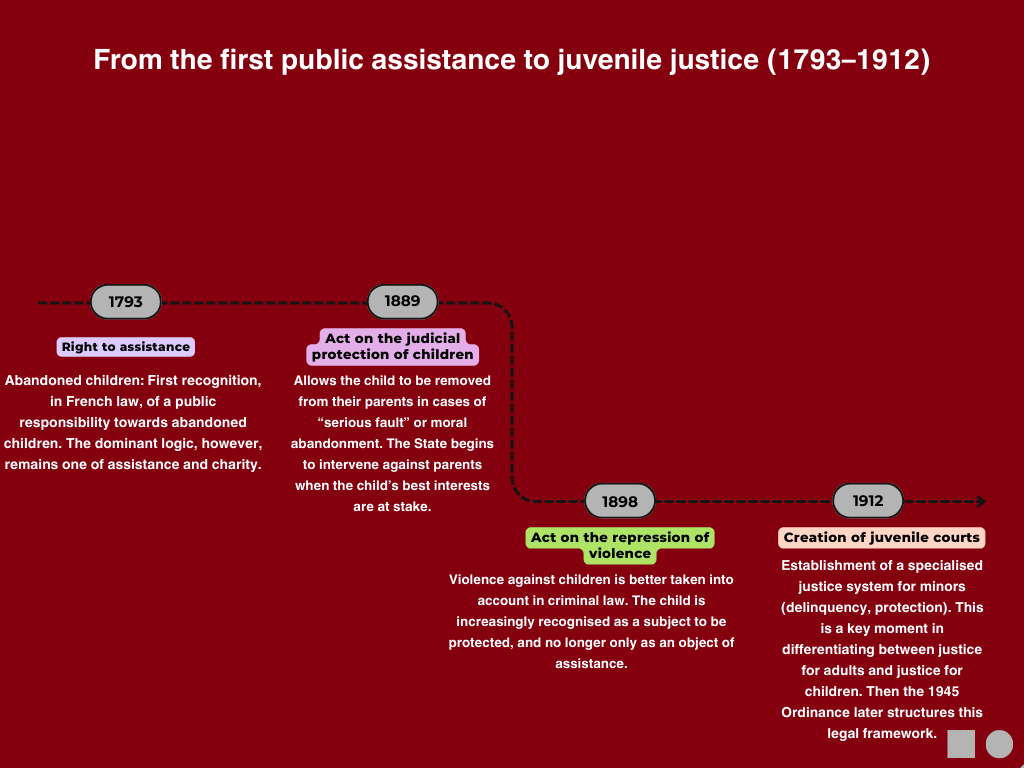
From Public First Aid to Juvenile Justice (1793–1912)
- 1793 – « Right to help » for abandoned children: First recognition, in French law, of public responsibilitytowards abandoned children. The dominant logic, however, remains that of assistance and charity.
- 1889 – Law on the judicial protection of children: Allows the child to be taken away from his parents in the event of « serious defect » or moral abandonment. The State begins to intervene against parents when the child’s interests are at stake.
- 1898 – Law on the Suppression of Violence: Violence against children is better taken into account in criminal law. The child is more recognized as a subject to be protected, no longer just as an object of assistance.
- 1912 – Creation of juvenile courts: Establishment of a specialized justice system for minors (delinquency, protection). This is a key moment in the differentiation between adult justice and juvenile justice.
The challenge of the period : a gradual shift from a logic of charity and relief to a logic of legal protection of the child, with an initial specialization of institutions (juvenile courts).
Construction of the welfare state and structuring of services (1956–1986)
- 1956 – Creation of the Child Welfare Service (ASE): Transformation of the former Public Assistance into an ASE, then under the supervision of the State via the DDASS. Children at risk are becoming a central object of social policies.
- 1964 / 1977 – Departmental Directorates of Health and Social Action (then of Health and Social Affairs): Establishment, then consolidation, of the DDASS, which coordinate:
- Maternal and Child Protection (PMI),
- Child welfare,
- School health.
We seek to articulate health, social and school around the child.
- 1970s – Dupont-Fauville Report & Professionalization: Reflections on a Comprehensive Reform of Child Protection. Arrival and rise in power of psychologists and social workers (1969–1972): the psycho-social dimension became central to the support of children and families.
- 4 June 1970 – Reform of parental authority: The law favours keeping the child in his or her family environment and makes educational assistance more flexible. The challenge is no longer just to place, but to support families.
- June 6, 1984 – Family Rights Act: Recognizes:
- the right of parents to be informed of social interventions,
- their right to participate in decisions concerning their child,
- the right of the child to be involved in measures that concern him/her,
- the possibility of challenging certain decisions of the ASE.
Paradigm shift: the child and his family are actors and no longer just objects of protection.
- 6 January 1986 – Strengthening of educational and psycho-social support: Emphasis placed on educational and psychological support, beyond the financial aspect alone. Child protection also becomes apolicy to support trajectories.
The stakes of the period : the rise of a structured social state, the professionalization of those involved, the first texts that affirmed the rights of families and the need to maintain family ties whenever possible.
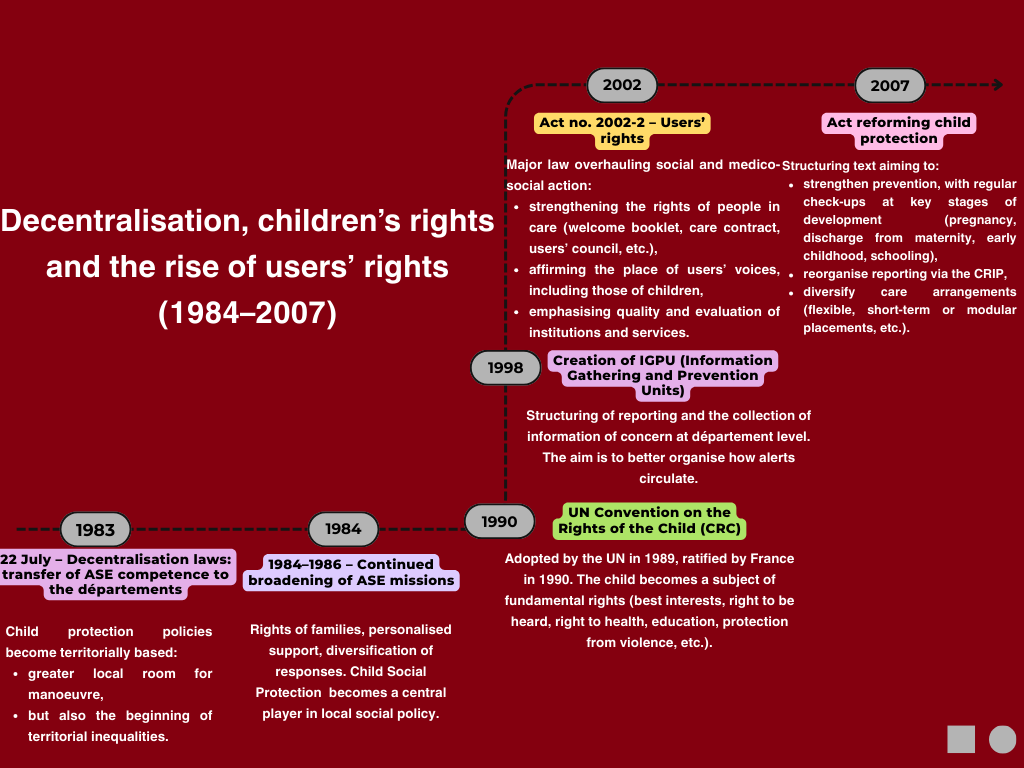
Decentralization, children’s rights and the rise of users (1983–2007)
- 22 July 1983 – Decentralisation laws: Transfer of ASE competence to the departments. Child protection policies are becoming territorialized :
- local room for manoeuvre,
- but also the beginning of territorial inequalities.
- 1984–1986 – Continued expansion of the ASE’s missions: family rights, personalisation of support, diversification of responses. ASE became a central player in local social policy.
- 1989 / 1990 – International Convention on the Rights of the Child (CRC): Adopted by the UN in 1989, ratified by France in 1990. The child becomes the subject of fundamental rights (best interests, the right to be heard, the right to health, education, protection against violence, etc.). → The CRC gradually fed into all subsequent reforms (see dedicated memo).
- 1998 – Creation of the CRIP (Collection, Information and Prevention Units): Structuring of the reporting and collection of worrying information at the departmental level. We are trying to better organize the circulation of the alert.
- Law No. 2002-2 (2 January 2002) – Users’ rights: Major law on the renovation of social and medico-social action:
- strengthening of the rights of the people welcomed (welcome booklet, residence contract, social life advice, etc.),
- affirmation of the place of the user’s voice, including the child,
- Highlighting the quality and evaluation of establishments and services.
- March 5, 2007 – Child Protection Reform Act: Structuring text that aims to:
- strengthen prevention, with regular check-ups at key moments of development (pregnancy, maternity discharge, early childhood, schooling),
- reorganize reports via the CRIP,
- diversify the modes of care (modular, punctual care, etc.).
The challenge of the period : the complex articulation between decentralisation (increased power of the departments) and the rise of fundamental rights (CRC, users). The system is becoming more participatory, but also more heterogeneous depending on the territory.
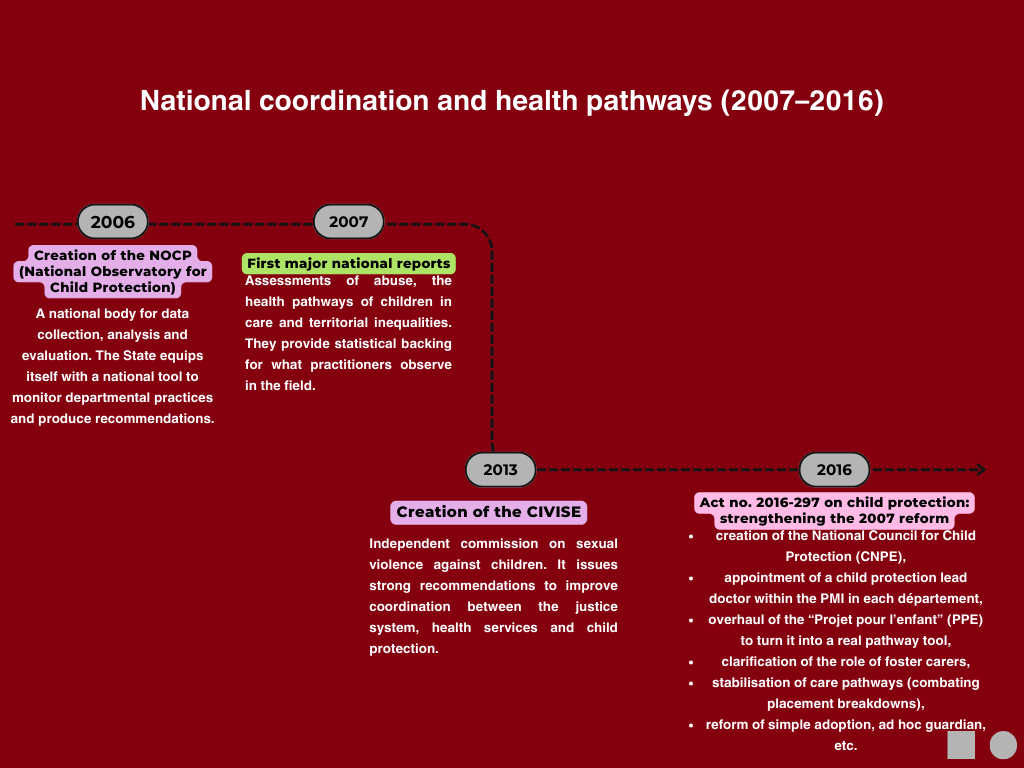
National coordination, pathway and health (2007–2016)
- 2007 – Creation of the ONPE (National Observatory for Child Protection): A body for data collection, analysis and evaluation. The State is equipping itself with a national tool to monitor departmental practices and produce recommendations.
- 2006–2012 – First structuring national reports: Evaluations on maltreatment, the health pathway of protected children and territorial inequalities. They give a statistical basis to intuitions in the field.
- 2010 – Launch of « Protected Health »: A system aimed at a coordinated care pathway for children in care (health check-ups, ASE/health joints, etc.). → Uneven application depending on the territory, but an important milestone in thinking about a health base.
- 2011 – Launch of Pégase (0–7 years old): A system focused on the health of young children in care, with check-ups and early detection of disorders.
- 2013 – Creation of the CIVISE: Independent Commission on Sexual Violence against Children. → It makes strong recommendations to improve coordination between justice, health and child protection.
- 14 March 2016 – Law No. 2016-297 on the protection of children: Reinforcement of the 2007 reform:
- creation of the National Council for Child Protection (CNPE),
- appointment of a PMI referring doctor for child protection in each department,
- redesign of the Project for the Child (PPE) to make it a real career tool,
- clarification of the role of family assistants,
- stabilisation of trajectories (fight against investment breakdowns),
- reform of simple adoption, ad hoc administrator, etc.
The issue of the period : the question of the path (of life, health, protection) becomes central. We are trying to better coordinate the State, departments, health and justice around children, while continuing to recognise their rights.
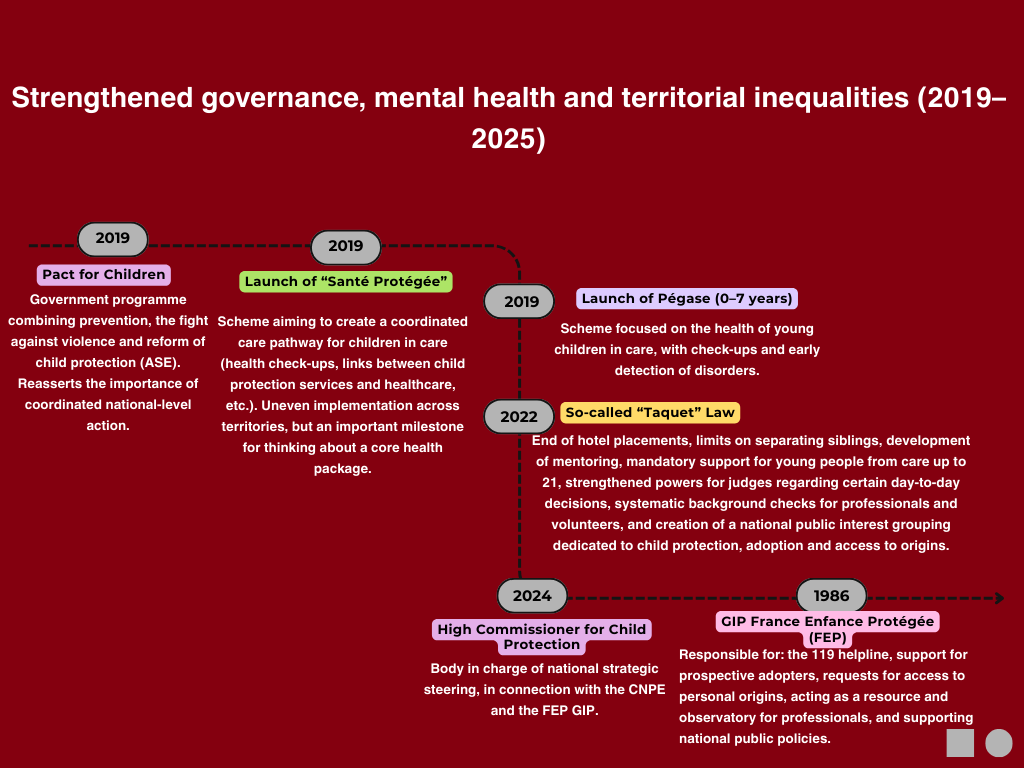
Strengthened Governance, Mental Health and Territorial Inequalities (2019–2025)
- 2019 – Pact for Children: Government programme linking prevention, fight against violence, and reform of the ASE. Reaffirms the importance of coordinated action at the national level.
- February 7, 2022 – The so-called « Taquet » law: Last major reform before 2025:
- an end to hotel placements for minors,
- prohibition of the separation of siblings (unless otherwise appropriate),
- generalization of mentoring/sponsorship,
- end of the ASE’s « dry exits »: support for 18–21 year olds, right of return, priority for social housing,
- person of trust, interview at 6 months after discharge,
- possibility for the judge to authorise non-usual acts by the receiving service,
- systematic background checks of professionals and volunteers,
- creation of a national GIP for child protection, adoption and access to personal origins (France Enfance Protégée),
- strengthening of the PMI as a pivotal player in public health.
- 5 January 2023 – GIP France Enfance Protégée (FEP): GIP in charge of:
- of the 119,
- support for adopters,
- requests for access to personal origins,
- a role as a resource and observatory for professionals,
- support for national public policies.
- 2024 – High Commission for Child Protection: National strategic steering body , in conjunction with the CNPE and the GIP FEP.
- 23 June 2025 – Law No. 2025-568: Text strengthening the role of the judicial authority on minors and parental responsibility.
- December 2025 – Draft law on the right to a lawyer for every child: Text adopted at first reading in the National Assembly, which aims to guarantee any child placed or subject to a protection measure the right to adedicated lawyer.
→At the time of the frieze, the text still has to be examined by the Senate: it is not yet a law in force, but an indicator of the evolution of mentalities.
The challenge of the period: strengthening national governance, increased attention to mental health and the quality of career pathways, while leaving strong territorial inequalities linked to decentralization to remain.
- What the frieze shows: three main movements
Implicitly, the frieze highlights three major dynamics:
From charity to children’s rights
- From the « right to help » (1793) to the CRC and recent laws, the child has gone from being an object of protection to a subject of rights.
From the central government to the departments… and return of the guarantor state
- Decentralisation in 1983: the departments become the pilots of the ASE.
- The following decades showed both local flexibility and the inequalities that this engendered.
- The national mechanisms (ONPE, CNPE, EFF, High Commission) reflect the return of a State that guaranteesfundamental rights.
From physical protection to the overall pathway (physical, mental, social health)
- Recent texts increasingly include:
- mental health,
- the quality of life courses (stability, siblings),
- support for young adults,
- the participation of children, families and professionals.
- Leads and open questions for the future
This frieze is not an end in itself; it raises several questions, which will structure the following memos and the NS 2 / SSI note:
- How have the major laws (2002, 2007, 2016, 2022) been effectively implemented in the departments?
- To what extent does decentralization produce inequalities in rights for children in care?
- How can a minimum national base (for example in terms of health and mental health) be articulated with the free administration of the departments?
- What are the effects of the increase in national reports (ONPE, CIVISE, etc.) on practices in the field?
- How can we better recognise and support the professionals (family assistants, educators, caregivers) who embody child protection on a daily basis?
- Memo 1’s place in the series
This Memo 1 provides the historical framework on which the following memos will be grafted:
- Memo 2: Declarations and CRC – the international construction of children’s rights
- Memo 3: From Public Assistance to ASE, DDASS, PMI
- Memo 4: Reforms 1970–1986: Parental Authority and Family Rights
- Memo 5 and following: recent major laws, health measures, governance, territorial inequalities, professions, etc.
The objective remains the same: to give the readers of La Ligne Fine – Institut solid tools of understanding, to better think – and tomorrow, transform – child protection in France.