Author: Margo LUYSSEN
Published date: February 4, 2026
General data
| Capital | Dakar | Head of State | Bassirou Diomaye FAYE, since March 2024 |
| Surface area | 196,712 km² | Nature of the plan | Republic |
| Population (2024) | 18,501,984 inhabitants, growth 2.3%/year | Currency | Central African CFA Franc (XOF) |
| Official language | French (official), national languages widely used: Wolof (43%), Pulaar (24%), Serer | GDP (current US$ billion) (2024) | 32.27 in 2024 with growth of 6.9, GDP per capita 1,744 |
| Religions | Islam (94%), Christianity (4%), Animism (0.5%) | Human Development Index (2022) | 169th |
Source: World Bank (2024)
Political and security situation
Senegal is going through a phase of political and security fragility unprecedented since the change of government in March 2024. If institutional stability remains assured in appearance despite a form of decision-making paralysis. The opposing political forces are reflected in an increased verticality of command and an expectation of political directives in military circles, in particular the Franco-Senegalese Intergovernmental Seminar (SIG), the holding of which remains uncertain, particularly in view of French political instability. On the bilateral level, the relationship with France is eroding.
After the questioning of the defence agreements and the scheduled withdrawal of French elements from Senegal (EFS) last July, it is now cooperation in the broad sense that seems to be weakened, under the effect of a lack of interest on the part of the partner and a strong desire for diversification. The Senegalese authorities, while reaffirming their attachment to France, are adopting a wait-and-see posture, marked by a desire to rebalance external partnerships and assert their national sovereignty.
The domestic security situation is deteriorating. In Dakar, the rise in assaults, burglaries and acts of corruption now goes beyond the simple feeling of insecurity. The authorities are struggling to stem this phenomenon, in a context of economic slowdown, rising unemployment and a decline in international aid. The latent xenophobia against foreign nationals (Malians, Guineans, Nigerians) illustrates a growing social tension. The action of a police force that is insufficiently paid and perceived as predatory further aggravates the population’s mistrust.
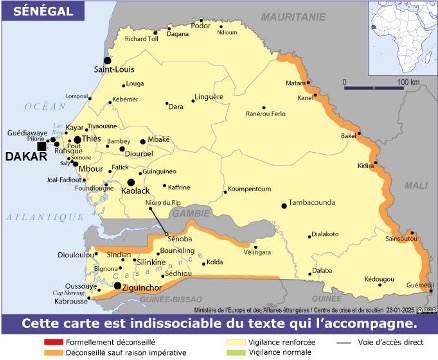
At the regional level, the jihadist threat in the east remains contained but real. JNIM-affiliated groups are seeking to expand influence to the Senegalese-Malian border, taking advantage of the security vacuum in southern Mali and the withdrawal of international forces. Senegal is strengthening its position in the Kédougou and Tambacounda region, but porous borders and increased migration flows increase the country’s vulnerability.
Finally, the Franco-Senegalese bilateral relationship is going through a period of mutual mistrust, where each public sequence must be considered with caution and discretion, in order to avoid any symbolic overexposure.
| Economic context | Growth | Inflation | Strategic sectors |
| 6.1 (2024), driven in particular by hydrocarbons | Sharp decline (5.9% in 2023 to 0.8% in 2024) | Agriculture, fisheries, tourism, hydrocarbons, telecommunications and infrastructure | |
| Issues and challenges | Public debt | Informal sector | Economic diversification |
| Sharp increase and poses a significant risk: 119% in 2024 | Remains dominant in employment: about 90% of the working population | Necessary needs for formal job creation, enhanced transparency and governance |
Economic indicators
Source: S&P and Moody’s (2024)
| Sovereign Credit Rating (S&P) | B- with a negative outlook | Long-term local currency (Moody’s) | Caa1 | Budget deficit | -11.7% of GDP |
An audit by the Court of Auditors, confirmed by the IMF, revealed that between 2019 and 2023, a hidden public debt of around $7 billion was accumulated. This audit led to a revision of the debt-to-GDP ratio: it has fallen from 74% to more than 118% currently. The country’s rating has also been revised downwards: B3 to Caa1 in Oct. 2025. As a result, the IMF’s $1.8 billion program was suspended, with disbursements put on hold until accounting discrepancies were resolved. Increased reliance on debt, unfavorable rates, and lack of access to conventional concessional financing are weighing on the growth trajectory.
A strong slowdown excluding hydrocarbons has been observed: only 2.7% (ANSD) in 2024. Nevertheless, thanks to the start of oil production, the economy has shown resilience, posting GDP growth of 6.7% (IMF), after 4.3% in 2023 and 4% in 2020. A similar dynamic is expected in 2025, with a growth peak of 8.4% driven by the exploitation of Sangomar oil and GTA gas.
Structural reforms are under way: reduction of tax exemptions, phasing out of untargeted energy subsidies, strengthening of public spending controls. The effects of this are already having visible social impacts. Shrinking fiscal space implies a tightening of public finances, which is likely to weigh on essential services, social investment, and public transfers, leading to rising dissatisfaction. The increase in debt and its higher servicing cost reduce the state’s ability to generate new public jobs or to strongly support the informal sector, which amplifies youth unemployment and precarious employment.
The austerity measures announced may increase the cost of living, especially for the most vulnerable. The use of regional high-interest markets increases debt servicing, diverting resources that could have been directed to education, health or social inclusion. In the long term, the « debt inheritance » creates a feeling of mistrust: trust in public institutions, in the discourse on economic recovery can be eroded, paving the way for latent or even active social tensions.
The country is very dynamic in terms of youth: strong demographic growth, young population, which can be an asset for the labour market and innovation provided that employment is structured. The role of the diaspora is important, the authorities are seeking to mobilize Senegalese abroad to finance national projects and alleviate public pressure (cf. diaspora bonds). The imbalance between growth and job quality, although growth is strong, the challenge is the creation of formal jobs, the rise in value added and the transformation of the economy. A new IMF financial agreement would be a source of hope for the government to recover.
Senegal is entering a pivotal period. The success of the new regime will depend on its ability to restore donor confidence and restore fiscal credibility without stifling domestic demand. The economic recovery could be based on the energy revenues expected from 2025-2026 (gas and oil), but their governance will be decisive in avoiding a rent effect or additional social tensions. In an unstable regional context, Dakar will seek to rebalance its external partnerships: the relationship with France, although weakened, could evolve towards more pragmatic cooperation, while the country diversifies its alliances towards Turkey, China and the Gulf states.
In the medium term, the central challenge will be to reconcile economic recovery, political sovereignty and social cohesion, to preserve the relative stability that still distinguishes Senegal in West Africa.