

Thematic Cluster: RIDS – International Relations, Defence and Security
Authors: Manil MEZACHE, Farida SETITI
Published Date: February 28, 2026
Elements of the situation
- Greenland once again becomes a subject of Euro-Atlantic cohesion: Nuuk reaffirms that the territory is non-transferable and explicitly anchors Greenland’s defence in the NATO framework[1]. Denmark and several Nordic and European partners lock in the framework of sovereignty and territorial integrity: decisions are the responsibility of Denmark and Greenland, in compliance with the United Nations Charter and international law[2][3][4].
- NATO responds with institutionalization: launch of « Arctic Sentry » (11 Feb. 2026), piloted via the Allied Chain of Command (JFC Norfolk), to consolidate and coordinate allied activities in the Arctic/Far North, against a backdrop of increased Russian activity and growing Chinese interest[5][6].
- The United States pursues concrete investments at Pituffik Space Base: a federal request provides for approach lighting, PAPI and related infrastructure[7][8]. Greenland is home to 25 of the 34 critical raw materials identified by the European Union, including strategic rare earths for defence, electronics and the energy transition. This resource-based dimension reinforces the geoeconomic centrality of the territory in a context of European dependence on supply chains dominated by China. This centrality is all the more strategic as several segments of rare earths and critical metals remain dominated by Chinese supply chains, reinforcing the challenge for the European Union to diversify its sources and secure Arctic alternatives.
- One point of vigilance: the « Geneva » sequence is highly publicized but the public officialization (mandate, participants, results) remains partial. This then presents a risk of over-interpretation and informational blurring[9][10].
- Analysis and implications
- From January to February 2026, the « Greenland » sequence highlights a triple dynamic linking the North Atlantic, Euro-Atlantic cohesion and industrial/diplomatic trajectories in Europe. On the one hand, the Greenlandic government publicly states that the territory is not « for sale » and that it cannot accept a US takeover in any form, while explicitly linking Greenland’s defence to the NATO framework[11].
- On the other hand, Copenhagen and several European partners are locking in the sovereignty/territorial integrity framework in order to reduce political ambiguity and contain intra-allied tension[12].
- At the same time, NATO is responding organisationally by launching « Arctic Sentry » (11 Feb. 2026), a multilateral initiative to coordinate allied presence and activities in the Far North, explaining two drivers: increased Russian activity and growing Chinese interest[13]. This institutionalization serves both operational efficiency and intra-Alliance political stability, by placing external threats at the heart of the common narrative. The episode cannot therefore be reduced to a conjunctural or media sequence: it is part of a long-standing American strategic continuity in the Arctic, now reactivated in a context of increased competition between great powers.
- Finally, the European Union is simultaneously consolidating industrial and coercive levers: ensuring the coherence of the defence industrial policy[14][15] and adjustments to the 2026 work programme of the European Defence Fund[16], while the Commission presents a 20th package of sanctions against Russia[17].
Why is Greenland so coveted?
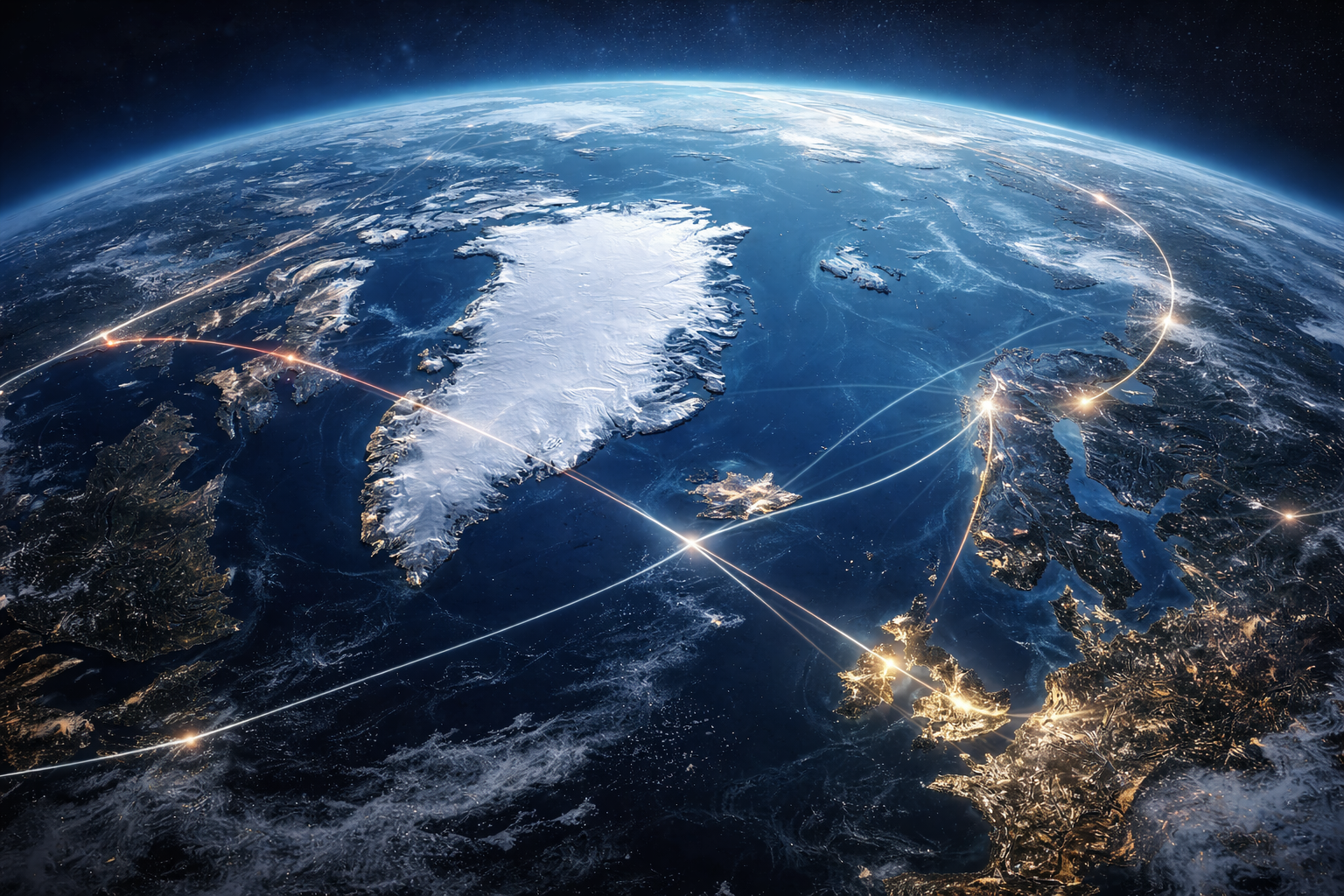
Greenland is a strategic pivot because it concentrates, in a single space, four structuring factors: geographical position, critical resources, climatic dynamics and military function. Located between North America, Europe and Russia, it is at the heart of emerging Arctic routes, which could shorten trade between Asia and Europe as melting ice changes maritime accessibility. The accelerated melting of Arctic sea ice is transforming a long-peripheral area into a strategic corridor. This climate dynamic acts as a paradoxical accelerator: it increases environmental vulnerability while reinforcing the geopolitical value of the region.
In terms of resources, Greenland is regularly described as a potential reservoir of critical raw materials — an argument used in the global competition for rare earths and strategic metals.
Militarily, Pituffik Space Base remains the main U.S. facility on the island, historically anchored in early warning and surveillance, with renewed importance in anti-missile and space [18][19]architectures. This importance is also linked to American reflections on a new-generation anti-missile system integrating polar radars, interceptors and a space component, in which Greenland’s geographical position offers a decisive early detection capacity in the face of polar trajectories.
Thus, the hypothesis of a resumption of American political pressure is explicitly linked to the rhetoric of national security and the prospect of a new-generation anti-missile shield, as well as to the security of resources and sea lanes. In this respect, the current debate is not a simple « media episode »: it is an indicator of the way in which power relations are being rearticulated in the Arctic.
Historical landmarks — origins and continuities
As early as 1867, as an extension of the Alaska Purchase, the United States considered acquiring Arctic territories in order to extend their strategic depth; Secretary of State William H. Seward raised the possibility of buying Greenland and Iceland.
During the Second World War, the German threat in the North Atlantic pushed Washington to strengthen its presence in order to prevent any enemy establishment and to secure the transatlantic routes. In the early 1950s, the creation of the Thule base — renamed Pituffik Space Base in 2023 — anchored Greenland in the American defense posture, particularly for air and space surveillance and early warning[20].
During the Cold War, Greenland was an essential link in the confrontation between the United States and the USSR: control of the passages linking the Arctic to the Atlantic, surveillance of Soviet submarine activities and integration into the North Atlantic system. After 1991, the American administrations adopted a more discreet approach, favouring cooperation with Denmark and multilateral frameworks. From the 2010s onwards, interest in the Arctic increased with the perception of a Chinese factor (infrastructure projects, investments), then a break in tone appeared during Donald Trump’s first term in office (2017–2021), with a media politicisation of the « acquisition » of Greenland.
Synthetic timeline (January–February 2026)
- Jan. 6, 2026 — Joint Statement on Greenland and Arctic Security
- Jan. 8, 2026 — Solicitation SAM.gov: approach lighting works, PAPI and related infrastructure in Pituffik.
- 12 Jan 2026 — Naalakkersuisut communiqué: rejection of a takeover and NATO anchoring.
- Jan. 18, 2026 — Media coverage of Pituffik’s work.
- 4 Feb. 2026 — Adjustments to the EDF’s 2026 work programme: simplification/WWTP.
- 5 Feb. 2026 – Commission statement on a 20th package of sanctions against Russia.
- 11 Feb. 2026 — NATO: Launch of « Arctic Sentry ».
- 12 Feb. 2026 — NATO: Announcements on new multinational capability cooperation projects.
- 14–17 Feb. 2026 — Preparations and media sequence around discussions in Geneva.
- 16 Feb. 2026 – Political declaration of support for Denmark and Greenland by several European partners.
Press review
- Sovereignty, international law and political reactions
The heart of the crisis is based on a framing conflict: on the one hand, American political signals evoking increased control of Greenland; on the other, a European legal-political lock-in recalling the non-transferability of the territory and the principles of territorial integrity. In our preparatory work, this tension is interpreted as a symbolic weakening of norms. The Charter of the United Nations prohibits the threat or use of force against the territorial integrity of a State, except in self-defence, with the explicit consent of the State concerned or with a mandate from the Security Council. The explicit mobilization of this framework by Copenhagen and several European partners aims to neutralize any logic of fait accompli upstream[21].
The Naalakkersuisut’s communiqué of 12 January 2026 is central: it explicitly rejects any American takeover and links the defence of Greenland to the NATO framework. On the Danish side, the joint declaration of 6 January 2026 insists on Arctic security ensured collectively with the Allies, including the United States, in accordance with the principles of the UN Charter. The « Greenlandic voices » dimension also appears in the debate: several analyses underline the risk of Nuuk’s marginalisation when the discussion is structured in a face-to-face relationship between the United States and Denmark, even though Greenlandic autonomy is substantial over internal affairs[22][23].
- Pituffik Space Base: infrastructure, exercises, posture signals
The most robust component in terms of primary sources concerns American investments in Pituffik. A federal request (January 8, 2026) provides for an approach lighting system (ALSF-1), PAPI indicators and related work, indicating a logic of logistical resilience in the Arctic environment. These elements are relayed by the specialized defense press, with a maximum budget estimate.
Operationally, NORAD (North American Aerospace Defense Command) announces Operation NOBLE DEFENDER 2026, including a deployment to Pituffik to test rapid projection and operations in the Arctic[24]. In addition, a summary by Air & Space Forces recalls the role of Pituffik (anti-missile warning, space surveillance, NORAD support) and places it in a trajectory of missions and exercises[25].
Finally, the renaming of Thule Air Base to Pituffik Space Base in 2023 materializes a desire to anchor local and a legitimizing communication, while reflecting the growing importance of the site in space missions[26].
- NATO: Arctic Sentry and Capability Adaptation
The « Arctic Sentry » initiative (11 February 2026) marks an organisational response, explicitly motivated by increased Russian activity and growing Chinese interest. It aims to strengthen and coordinate allied presence and stability in the Arctic/Far North.
In parallel, NATO announces (12 February 2026) new frameworks for multinational capability cooperation (high visibility projects), including drones and deep strike capabilities, illustrating a broader effort to modernise and interoperable.
These announcements fuel a recurring debate: the American demand for burden-sharing, and differences over what a « more European NATO » would mean. For the time being, the Greenland issue tends to reactivate this debate, while encouraging the Alliance to refocus its narrative on external threats[27].
- European Union: industrial defence tools and coercive leverage
On the industrial side, the EDIP (European Defence Industry Programme) is now legally anchored (Regulation (EU) 2025/2643) and is a structuring part of the European toolkit aimed at strengthening cooperation and the defence industrial base[28][29][30].
On the R&D/innovation side, the Commission announces changes to the 2026 work programme of the European Defence Fund, with an explicit objective of simplification, reduction of the administrative burden and support for SMEs/research organisations, in connection with STEP and the « Mini-Omnibus ».[31]
On the enforcement side, the Commission is presenting a 20th package of sanctions against Russia, targeting in particular circumvention capacities and segments related to energy, finance and trade. However, adoption depends on the Council, which means that the consolidated legal chronology must be followed[32][33].
- Geneva: a diplomatic background with little public transparency
The « Geneva » sequence (mid-February 2026) is widely covered by the press, but remains poorly documented by easily accessible joint communiqués. In this context, methodological caution is required: to distinguish between what is officially confirmed and what is reconstructed by media narratives. The sequence also highlights a risk of information jamming: in the absence of a formalized mandate or a consolidated joint press release, media coverage can produce divergent interpretations of the real nature of the discussions.
Greenland as a test of intra-Alliance cohesion
Greenland has three characteristics that make it an object of structural friction: territory of the Kingdom of Denmark (ally), critical monitoring/early warning platform (Pituffik) and object of political narrative around sovereignty. The dissonance between political signals (pressure/ownership) and defence trajectories (investments, exercises) can wear down cohesion, forcing Nuuk and Copenhagen to over-communicate on sovereignty to reduce uncertainty.
Arctic: shift from a technical to a political theatre
In the preparatory work, the melting of the ice is described as a paradoxical accelerator: a climatic catastrophe, but the opening of maritime routes and the facilitation of resource exploitation, making the Arctic more central to the power competition. This new centrality does not only concern the US/Russia rivalry: it also includes a growing Chinese presence in Arctic mining and infrastructure projects, as well as a European desire to secure its strategic supplies.
In this context, « Arctic Sentry » illustrates an organizational build-up intended to coordinate the Allied presence and refocus the narrative on the Russia/China competition
Critical Resources: Strategic Pressure on Supply Chains
Greenland is regularly presented as a potential reservoir of critical raw materials; The argument is particularly salient in view of China’s dominance in certain segments (rare earths). From a European point of view, the challenge is twofold: to secure access to strategic resources and to prevent geopolitical competition from destabilizing an area legally under the Kingdom of Denmark, and therefore indirectly connected to the EU. The potential concentration of 25 of the 34 critical raw materials identified by the European Union makes Greenland not only a strategic military area, but also an industrial and technological one. Competition for rare earths, which are essential for electric cars, defence systems and digital technologies, is accentuating this geo-economic pressure.
International Law: Narrative Fault Line
The legal framework does not extinguish competition: it structures narratives. The Danish and European positions explicitly mobilize the UN Charter and territorial integrity in order to disqualify, upstream, any logic of fait accompli. This legal mobilization also aims to protect the political unity of the Alliance: a sovereignty challenge between allies is, by its very nature, destabilizing.
Political caprice or starategic rationality?
While some media commentators have presented the sequence as an impulsive initiative, analysis of historical, geographical and industrial factors shows that it is part of a long-standing American strategic continuity. Greenland thus appears to be a revelation of the recomposition of power in the Arctic rather than a simple conjunctural episode.
Points of vigilance and follow-up
- EU sanctions: check if/ the 20th package has been formally adopted by the Council and access the consolidated legal texts.
- NATO/Arctic Sentry: Monitor the degree of operational formalization (timeline, national contributions, ISR command/sharing mechanisms) beyond the political announcement.
- Pituffik: monitor the contractual implementation of the work (budget levels, schedule), and the continuity of the exercises in the Arctic.
- Greenlandic voices: follow institutional debates (Nuuk/Copenhagen), including on international representation and local public perceptions.
- Geneva: distinguishing between official confirmations and media reconstructions; monitor the possible emergence of a joint communiqué or mandate documents.
[1] Naalakkersuisut, 12 Jan 2026: https://naalakkersuisut.gl/Nyheder/2026/01/1201_oqaaseqaat?sc_lang=da.
[2] Joint Statement Denmark, 6 Jan 2026: https://stm.dk/media/qo2dyzxy/erklaering-gl.pdf
[3] Nordic Declaration, 6 Jan 2026: https://www.regjeringen.no/en/whats-new/joint-statement-by-the-foreign-ministers-of-denmark-finland-iceland-norway-and-sweden-on-6-january-2026/id3145218/
[4] Extended Statement, 16 Feb. 2026: https://www.government.se/statements/2026/01/statement-by-denmark-finland-france-germany-the-netherlands-norway-sweden-and-the-united-kingdom/
[5] NATO, 11 Feb. 2026: https://www.nato.int/fr/news-and-events/articles/news/2026/02/11/nato-secretary-general-outlines-new-activity-arctic-sentry-ahead-of-defence-ministers-meeting
[6] SHAPE/ACO, Feb. 11, 2026: https://shape.nato.int/news-releases/Arctic-Sentry-2
[7] SAM.gov, Jan. 8, 2026: https://sam.gov/opp/92feee2438e44c03924583765b687a55/view
[8] Stars and Stripes, Jan 18, 2026: https://www.stripes.com/theaters/europe/2026-01-18/greenland-military-airfield-upgrades-20445795.html
[9] Ukrainian Presidency, 14 Feb. 2026: https://www.president.gov.ua/en/news/all
[10] Associated Press, Feb. 17, 2026: https://apnews.com/article/a2308f6af1d7817f8886013b921409eb
[11]Naalakkersuisut, 12 Jan 2026: https://naalakkersuisut.gl/Nyheder/2026/01/1201_oqaaseqaat?sc_lang=da
[12] Joint Statement Denmark, 6 Jan. 2026: https://stm.dk/media/qo2dyzxy/erklaering-gl.pdf; Extended Declaration, 16 Feb. 2026: https://www.government.se/statements/2026/01/statement-by-denmark-finland-france-germany-the-netherlands-norway-sweden-and-the-united-kingdom/
[13] NATO, 11 Feb. 2026: https://www.nato.int/fr/news-and-events/articles/news/2026/02/11/nato-secretary-general-outlines-new-activity-arctic-sentry-ahead-of-defence-ministers-meeting
[14] EDIP, Regulation (EU) 2025/2643: https://eur-lex.europa.eu/eli/reg/2025/2643/oj/eng
[15] Council of the EU, 8 Dec. 2025: https://www.consilium.europa.eu/en/press/press-releases/2025/12/08/european-defence-industry-programme-council-gives-final-approval/
[16] DG DEFIS, 4 Feb. 2026: https://defence-industry-space.ec.europa.eu/changes-edf-work-programme-simpler-procedures-and-expanded-investment-areas-2026-02-04_en
[17] European Commission, 5 Feb 2026: https://ec.europa.eu/commission/presscorner/detail/en/statement_26_318
[18] U.S. Space Force, Apr. 6, 2023: https://www.spaceforce.mil/news/article/3355840/thule-air-base-gets-new-name/
[19] Air & Space Forces, Jan. 20, 2026: https://www.airandspaceforces.com/us-military-greenland-space-force-norad/
[20] U.S. Space Force, Apr. 6, 2023: https://www.spaceforce.mil/news/article/3355840/thule-air-base-gets-new-name/
[21] Charter of the United Nations, Art. 2§4
[22] City St George’s / The Conversation, 23 Jan 2026: https://www.citystgeorges.ac.uk/news-and-events/news/2026/january/denmark-is-not-being-heard
[23] House of Commons Library, Jan 23, 2026: https://commonslibrary.parliament.uk/research-briefings/cbp-10472/
[24] NORAD, Feb. 6, 2026: https://www.norad.mil/Newsroom/Press-Releases/Article/4068189/norad-begins-operation-noble-defender-with-deployment-of-aircraft-to-pitu/
[25] Air & Space Forces, Jan. 20, 2026: https://www.airandspaceforces.com/us-military-greenland-space-force-norad/
[26] U.S. Space Force, Apr. 6, 2023: https://www.spaceforce.mil/news/article/3355840/thule-air-base-gets-new-name/
[27] Chatham House, Feb. 13, 2026: https://www.chathamhouse.org/2026/02/what-should-more-european-nato-look-us-and-europe-disagree
[28] EUR-Lex: https://eur-lex.europa.eu/eli/reg/2025/2643/oj/eng
[29] Council of the EU : https://www.consilium.europa.eu/en/press/press-releases/2025/12/08/european-defence-industry-programme-council-gives-final-approval/
[30] IAI, Dec. 23, 2025: https://www.iai.it/en/publications/c41/european-defence-industry-programme-last-piece-eu-defence-puzzle
[31] DG DEFIS, 4 Feb. 2026: https://defence-industry-space.ec.europa.eu/changes-edf-work-programme-simpler-procedures-and-expanded-investment-areas-2026-02-04_en
[32] Commission, 5 Feb. 2026: https://ec.europa.eu/commission/presscorner/detail/en/statement_26_318
[33] Council of the EU — timeline sanctions https://www.consilium.europa.eu/en/policies/sanctions-against-russia/timeline-packages-sanctions-since-february-2022/