


The European Coherence Gap
NGT Reform, Due Diligence and Invisible Governance Infrastructures in EU Sustainability Governance
Pôle thématique : RIDS – Relations internationales, Défense et Sécurité
Auteurs : Diana MOSNEANU, Alek UMONT
Date de publication : 15 mai 2026
Abstract
The European Union is undergoing a broader transformation of its sustainability and regulatory governance architecture, simultaneously pursuing innovation-oriented agricultural reform, sustainability-related due diligence, ESG accountability and externally oriented trade governance objectives across increasingly interconnected implementation environments.
While these objectives are not inherently contradictory, they generate emerging emerging tensions concerning the operational conditions required to preserve implementation stability, governance reliability and institutional coherence under conditions of accelerating regulatory adaptation.41,44,45 More specifically, these tensions concern the preservation of transparency, traceability, stability of verification conditions and reporting interoperability within governance environments increasingly dependent upon data-driven implementation infrastructures and complex architectures of proof.
The paper argues that contemporary European governance increasingly operates through what may be described as invisible governance infrastructures56,57,58,59: interconnected infrastructures of traceability, verification, interoperability, ESG reporting and due diligence implementation through which sustainability governance becomes operationally verifiable across transnational supply chains. Within this evolving governance environment, the effectiveness of regulatory systems depends not solely upon formal legal obligations, but upon the operational robustness of the informational and verification infrastructures enabling accountability, monitoring and implementation continuity across interconnected governance domains.
Against this backdrop, the paper develops the concept of the European coherence gap30,33,41,44,47, understood as the growing tension between expanding sustainability-related regulatory ambition and the operational capacity of governance systems to preserve coherent, interoperable and verifiable implementation conditions across interconnected regulatory domains.
The proposed NGT reform constitutes a particularly significant governance case within this broader transformation. The reform introduces a differentiated regulatory framework distinguishing between NGT1 and NGT2 plants. Whereas NGT2 products remain subject to stricter authorisation, traceability and risk-assessment requirements, NGT1 plants considered comparable to conventionally bred varieties would benefit from simplified regulatory procedures and reduced GMO-style labelling obligations. Although the reform is primarily justified through objectives relating to innovation, climate adaptation, competitiveness and agricultural resilience, it simultaneously raises broader governance questions concerning the compatibility between innovation-oriented regulatory flexibility and the operational conditions required for credible sustainability governance, due diligence implementation and interoperability across interconnected agri-food governance systems.
Methodologically, the analysis develops a Governance Capacity under Regulatory Transition framework37,38,81,82combined with a Governance Process Mapping Methodology designed to evaluate how evolving transparency conditions may affect implementation credibility, governance interoperability and institutional trust across interconnected sustainability governance systems. Due diligence is conceptualised not merely as a compliance obligation, but as a sequential governance architecture dependent upon informational continuity across interconnected implementation stages.
The paper argues that the principal tensions associated with the evolving NGT framework emerge not primarily through formal legal contradiction, but through the growing difficulty of maintaining coherent and reliable implementation conditions across interconnected governance systems undergoing simultaneous regulatory adaptation.
Beyond the NGT case itself, the analysis situates these developments within broader transformations affecting contemporary European governance, where implementation systems increasingly rely upon private certification mechanisms, governance-through-data architectures and operational verification infrastructures distributed across interconnected public and private governance environments. In this context, the EU–Mercosur Agreement functions as an external governance stress test revealing the extent to which the credibility of contemporary EU sustainability governance increasingly depends upon operationally coherent systems of traceability, verification and implementation oversight across interconnected transnational governance environments.
The paper concludes that the long-term credibility of the European Union’s sustainability governance model will increasingly depend not solely upon regulatory ambition or normative standard-setting capacity, but upon the ability of European governance systems to preserve the operational coherence, interoperability and resilience of the infrastructures through which sustainability governance becomes practically verifiable, monitorable and institutionally credible.
Keywords:
European coherence gap; invisible governance infrastructures56-59; NGT governance; governance capacity under regulatory transition; sustainability governance; due diligence; implementation credibility; traceability governance; governance interoperability; EU–Mercosur.
- Introduction – The European Coherence Gap
The ongoing reform of the European Union’s regulatory framework on New Genomic Techniques (NGTs) has largely been presented as a strategic adaptation intended to support agricultural innovation, climate resilience and the long-term competitiveness1,4,6 of the European agri-food sector. Institutional and public debates surrounding the reform have consequently focused primarily on biotechnology governance, food security, sustainability objectives and the reduction of agricultural inputs.2,17,18,25
Yet the significance of the evolving NGT framework extends beyond biotechnology governance alone. The reform unfolds within a broader strategic context in which the European Union seeks simultaneously to strengthen agricultural resilience, preserve technological competitiveness and maintain the credibility and operational coherence of a regulatory model increasingly grounded in sustainability, accountability, transparency and Responsible Business Conduct (RBC). Under conditions of accelerating geopolitical, environmental and economic transformation, agricultural innovation is progressively becoming associated not solely with productivity objectives, but also with broader questions relating to strategic autonomy, technological sovereignty5,7,47,52 and the capacity of European governance systems to maintain operational control over critical agri-food infrastructures and regulatory standards across interconnected global supply chains.
Within this broader governance environment, the European Union increasingly operates through complex sustainability and accountability architectures linking trade governance, ESG-related reporting systems, due diligence obligations, traceability infrastructures, certification systems and implementation-monitoring mechanisms across interconnected governance domains.12-14,22,33,75
Contemporary European governance therefore no longer functions exclusively through the production of legal norms. Increasingly, it also depends upon operational infrastructures through which governance-relevant information is generated, verified, circulated and rendered actionable across interconnected implementation systems.
The present paper conceptualises these systems as invisible governance infrastructures56-58. These infrastructures include traceability mechanisms, supplier-verification systems, ESG-reporting architectures, certification arrangements, interoperability frameworks, monitoring systems and governance-data infrastructures that sustain the practical credibility of sustainability governance across interconnected supply chains.34,52,54,62,63
Although frequently operating in the background of regulatory systems, such infrastructures increasingly constitute the operational foundations upon which implementation credibility, accountability and institutional trust depend within contemporary European governance environments.
At the same time, the European Union continues to strengthen its external sustainability and due diligence agenda through trade governance instruments and corporate-accountability frameworks. The EU–Mercosur framework10,11,19,64,66,68 further illustrates the extent to which contemporary EU trade governance increasingly relies upon operationally credible systems of safeguards, traceability, SPS oversight, implementation monitoring and accountability across transnational agri-food supply chains. In this respect, sustainability governance increasingly depends not solely upon normative commitments, but upon the institutional capacity to preserve coherent infrastructures of verification and operational proof across interconnected governance environments.
Recent institutional communications issued by the European Commission and Commissioner for Agriculture and Food Christophe Hansen have repeatedly underlined the importance of operational safeguards, implementation oversight and the protection of Geographical Indications within the EU–Mercosur framework.10,11,20,68 This institutional positioning demonstrates that the European Union itself increasingly recognises transparency, traceability and governance credibility as essential operational conditions underpinning sustainable trade governance and supply-chain accountability.
Against this backdrop, an emerging governance tension becomes visible concerning the compatibility between expanding sustainability-related governance ambitions and evolving internal regulatory reforms affecting operational transparency conditions within agri-food supply chains.30,33,41,47
As contemporary governance systems become increasingly dependent upon stable implementation conditions across interconnected regulatory domains, tensions emerge where continuous regulatory adaptation risks destabilising governance coherence and institutional reliability. The central issue is therefore not one of direct legal contradiction between regulatory instruments, but of operational coherence between governance systems increasingly dependent upon interoperable traceability, verification and reporting infrastructures.1,12,22
Instruments such as the Corporate Sustainability Due Diligence Directive (CSDDD) primarily establish governance obligations for economic operators rather than direct constraints upon legislative classification choices adopted by EU institutions.12-15,68Nevertheless, from an implementation and governance perspective, the evolving NGT framework may generate tensions between innovation-oriented regulatory flexibility and the operational governance conditions required to sustain traceability systems, supplier verification, ESG-related reporting and accountability mechanisms across interconnected agri-food governance environments.11,33,38,62,63
The present analysis therefore approaches the NGT reform not primarily as a sectoral question of biotechnology governance, but as a broader governance challenge emerging under conditions of accelerating regulatory and technological transition.37,40,52,82,84More specifically, the paper examines whether contemporary European governance systems can preserve interoperability coherence, implementation credibility and institutional trust while simultaneously pursuing innovation, sustainability, competitiveness and external governance objectives across increasingly interconnected governance environments.
Within this context, the paper introduces the concept of the European coherence gap.30,33,41,47 The European coherence gaprefers to the growing tension between expanding sustainability-related regulatory ambitions and the operational capacity of governance systems to preserve coherent, interoperable and verifiable implementation conditions across interconnected governance domains.13 From this perspective, the central governance challenge confronting the European Union concerns not innovation itself, but whether innovation-oriented regulatory flexibility can remain sufficiently governed, operationally coherent and institutionally credible to preserve trust, accountability and implementation resilience across interconnected sustainability governance systems.
The paper contributes to emerging scholarship on sustainability governance and European regulatory governance by conceptualising the evolving NGT framework as a governance stress test for contemporary European implementation systems. More specifically, the analysis develops a Governance Capacity under Regulatory Transition framework37,38,40,81,82,83,84 combined with a Governance Process Mapping Methodology designed to examine how modifications affecting operational transparency conditions may generate implementation pressures, interoperability gaps and governance-fragmentation dynamics across interconnected sustainability governance systems. In this context, due diligence is conceptualised not merely as a compliance obligation, but as a sequential governance architecture dependent upon informational continuity across interconnected implementation stages.
The analysis is structured around three interrelated governance concepts: regulatory coherence, implementation credibility and trust architecture. Regulatory coherence refers to the compatibility and mutual consistency between governance instruments operating across interconnected policy and regulatory domains.30,41,45
Implementation credibility refers to the capacity of governance systems to translate regulatory commitments into operationally verifiable, monitorable and enforceable outcomes across institutional and supply-chain environments.42,43,83,84
Trust architecture refers to the institutional legitimacy generated by transparency, traceability, verifiability and accountability mechanisms operating across interconnected implementation environments.34,52,54,63
Viewed through this analytical lens, the evolving NGT framework functions as a broader governance stress scenario revealing structural tensions within contemporary European governance systems increasingly dependent upon invisible governance infrastructures56-58, interoperability architectures and data-dependent governance.52,54,62 The central governance question therefore concerns whether the European Union can preserve governance coherence and implementation credibility if evolving regulatory flexibility weakens some of the visibility conditions required for effective due diligence across interconnected agri-food supply chains.
Accordingly, the central research question guiding the present analysis is the following:
To what extent can the European Union preserve governance coherence, implementation credibility and institutional reliability while simultaneously pursuing innovation-oriented regulatory adaptation across interconnected sustainability governance systems?
1. European Commission, Proposal for a Regulation of the European Parliament and of the Council on Plants Obtained by Certain New Genomic Techniques and Their Food and Feed COM(2023) 411 final, 5 July 2023.
2. European Commission, Impact Assessment Report Accompanying the Proposal on New Genomic Techniques SWD(2023) 412 final.
3. European Commission, ‘Questions and Answers on New Genomic Techniques’ (2023).
4. European Commission, Building the Future with Nature: Boosting Biotechnology and Biomanufacturing in the EU COM(2024) 137 final.
5. European Commission, ‘European Economic Security Strategy’ JOIN(2023) 20 final.
6. European Commission, ‘Long-Term Competitiveness of the EU: Looking Beyond 2030’ COM(2023) 168 final
7. European Commission, Strategic Foresight Report 2023: Sustainability and People’s Wellbeing at the Heart of Europe’s Open Strategic Autonomy COM(2023) 376 final.
10. European Commission, ‘EU-Mercosur Trade Agreement’ (European Commission 2024).
11. European Commission, ‘Questions and Answers on the EU-Mercosur Partnership Agreement’ (European Commission 2024).
12. European Commission, ‘Corporate Sustainability Due Diligence Directive (CSDDD)’ (2024).
13. Directive (EU) 2022/2464 as regards Corporate Sustainability Reporting (CSRD).
14. Regulation (EU) 2023/1115 on Deforestation-Free Products (EUDR).
15. European Commission, European Sustainability Reporting Standards (ESRS) (2023).
- European Parliament Research Service (EPRS), New Genomic Techniques and the Future of EU Agri-Food Governance (2024).
18. European Food Safety Authority (EFSA), Applicability of Existing Guidelines for the Risk Assessment of New Genomic Techniques (2022).
19. Council of the European Union, EU–Mercosur Agreement — Political and Sustainability Dimensions (2024).
20. DG AGRI, Geographical Indications and Sustainability in EU Trade Governance (2024).
21. OECD, OECD Guidelines for Multinational Enterprises on Responsible Business Conduct (OECD Publishing 2023).
22. OECD, OECD Due Diligence Guidance for Responsible Business Conduct (OECD Publishing 2018).
23. OECD, OECD-FAO Guidance for Responsible Agricultural Supply Chains (OECD Publishing 2016) 27–39; John Braithwaite and Peter Drahos, Global Business Regulation (CUP 2000).
26. OECD, Innovation, Agricultural Productivity and Sustainability in Europe (OECD Publishing 2023).
30. Giandomenico Majone, Regulating Europe (Routledge 1996).
31. Giandomenico Majone, Dilemmas of European Integration (OUP 2005);
33. Julia Black, ‘Decentring Regulation: Understanding the Role of Regulation and Self-Regulation in a “Post-Regulatory” World’ (2001) 54 Current Legal Problems 103.
34. Julia Black, ‘Constructing and Contesting Legitimacy and Accountability in Polycentric Regulatory Regimes’ (2008) 2 Regulation & Governance137. (polycentric governance).
37. Christopher Ansell and Jacob Torfing (eds), Handbook on Theories of Governance (Edward Elgar Publishing 2016).
38. Christopher Ansell and Alison Gash, Collaborative Governance Regimes (Georgetown University Press 2018).
40. Jonathan Zeitlin, ‘EU Experimentalist Governance in Times of Crisis’ (2016) 43 West European Politics 1073.
41. Joanne Scott and David M Trubek, ‘Mind the Gap: Law and New Approaches to Governance in the European Union’ (2002) 8 European Law Journal 1.
42. Mark Bovens, Deirdre Curtin and Paul ’t Hart (eds), The Real World of EU Accountability (Oxford University Press 2010).
43. Mark Bovens, Thomas Schillemans and Paul ’t Hart, The Oxford Handbook of Public Accountability (OUP 2014);
44. Orly Lobel, ‘The Renew Deal: The Fall of Regulation and the Rise of Governance in Contemporary Legal Thought’ (2004) 89 Minnesota Law Review 342.
45. Colin Scott, ‘Regulation in the Age of Governance: The Rise of the Post-Regulatory State’ in Jacint Jordana and David Levi-Faur (eds), The Politics of Regulation (Edward Elgar 2004).
46. David Levi-Faur, ‘The Global Diffusion of Regulatory Capitalism’ (2005) 598 The ANNALS of the American Academy of Political and Social Science 12;
47. Vivien A Schmidt, Europe’s Crisis of Legitimacy (OUP 2020).
52. Henry Farrell and Abraham Newman, Underground Empire (Henry Holt 2023).
53. H. Farrell and A. Newman, ‘Weaponized Interdependence: How Global Economic Networks Shape State Coercion’ (2019) 44 International Security 42.
54. Julie E Cohen, Between Truth and Power: The Legal Constructions of Informational Capitalism (Oxford University Press 2019).
55. Frank Pasquale, The Black Box Society (Harvard University Press 2015).
56. Susan Leigh Star, ‘The Ethnography of Infrastructure’ (1999) 43 American Behavioral Scientist 377.
58. Geoffrey C Bowker and Susan Leigh Star, Sorting Things Out: Classification and Its Consequences (MIT Press 1999).
61. Saskia Sassen, Territory, Authority, Rights (Princeton University Press 2006).
62. A. Edwards, ‘Datafied Governance and Regulatory Interoperability in the European Union’ (2022) 45 Journal of European Public Policy 1334.
63. Michael Power, The Audit Society: Rituals of Verification (Oxford University Press 1997).
64. Lorand Bartels, Human Rights and Sustainable Development Obligations in EU Free Trade Agreements (Cambridge University Press 2020).
66. Olivier De Schutter, Trade in the Service of Sustainable Development (Bloomsbury 2015).
68. Joanne Scott and Sangeeta Khorana, ‘The EU and Global Sustainable Development Governance’ (2015) 52 Common Market Law Review 1145.
75. Kenneth W Abbott and Duncan Snidal, ‘Strengthening International Regulation Through Transnational New Governance’ (2009) 42 Vanderbilt Journal of Transnational Law 501.
81.Claudio M Radaelli and Fabrizio De Francesco, ‘Regulatory Impact Assessment’ in Robert Baldwin, Martin Cave and Martin Lodge (eds), The Oxford Handbook of Regulation (Oxford University Press 2010).
- Michael Howlett and M Ramesh, Studying Public Policy (4th edn, Oxford University Press 2022).
83. Jeffrey Pressman and Aaron Wildavsky, Implementation (3rd edn, University of California Press 1984).
84. Michael Hill and Peter Hupe, Implementing Public Policy (3rd edn, Sage 2014).
89. Mariana Mazzucato, The Entrepreneurial State (Penguin 2018).
- Theoretical and Conceptual Framework
The evolving European Union framework on New Genomic Techniques (NGTs) raises governance questions that extend well beyond biotechnology regulation and agricultural innovation policy. Although existing debates have largely concentrated on scientific risk assessment, precautionary regulation and the innovation potential of genomic technologies,1,18,88,89 less attention has been devoted to the operational consequences of regulatory transition for sustainability governance, due diligence implementation and supply-chain accountability systems.22,23,33,45,75,84
The present analysis starts from the premise that contemporary European governance increasingly functions through dense implementation ecosystems whose effectiveness depends upon transparency, traceability, verification continuity, reporting interoperability and governance-data accessibility across interconnected regulatory domains,40,51,61 Sustainability governance, in this setting, cannot be assessed solely by reference to formal legal obligations or normative commitments. Its effectiveness increasingly depends upon the operational robustness of the infrastructures through which regulatory commitments become monitorable, verifiable and institutionally credible across transnational governance systems33,22,41,44 depends not solely upon formal legal obligations or normative commitments, but equally upon the operational robustness of the infrastructures supporting implementation across transnational governance systems.
This paper conceptualises these operational systems as invisible governance infrastructures. The term refers to the informational, technical and institutional architectures through which governance-relevant information is generated, circulated, verified and operationalised across interconnected implementation environments. These infrastructures include traceability mechanisms, ESG-reporting architectures, supplier-verification systems, certification arrangements, interoperability frameworks, digital monitoring tools and accountability-oriented implementation mechanisms distributed across public and private governance systems.12-15,21,22,55-58,61,62
The analytical importance of these infrastructures becomes more pronounced as European governance moves toward data-dependent regulation, hybrid implementation ecosystems and increasingly interoperability-based forms of accountability. In such environments, implementation coherence depends not merely upon the presence of regulatory obligations, but upon the capacity of governance systems to preserve reliable informational conditions across multiple implementation stages.33,37,39,62
Within this broader transformation, the European Union increasingly operates not only as a normative power capable of producing regulatory standards, but also as a verification power whose credibility depends upon the capacity to monitor, trace, verify and demonstrate compliance across interconnected governance environments.48-53 The credibility of European sustainability governance therefore rests not only upon regulatory ambition, but upon the existence of operational infrastructures capable of sustaining implementation continuity, accountability and institutional trust across complex supply-chain systems.41,51,62
This shift is especially significant because the Union is simultaneously expanding sustainability-related governance obligations through instruments such as the Corporate Sustainability Due Diligence Directive, ESG-reporting frameworks, sustainability-oriented trade governance and supply-chain accountability system.12-15,67 These instruments increase dependence upon supplier verification, traceability continuity, monitoring systems and interoperable governance-data architectures across interconnected governance domains.21-23,62,75
Against this background, the paper introduces the concept of the European coherence gap. This concept captures the growing tension between the expansion of sustainability-related regulatory ambition and the operational capacity of governance systems to preserve coherent, interoperable and verifiable implementation conditions under accelerating regulatory transition. The coherence gap does not necessarily arise from direct legal contradiction between regulatory instruments. It emerges where governance systems expand accountability obligations while other regulatory reforms reduce, fragment or reconfigure some of the transparency and traceability conditions upon which implementation systems depend.29,32,40,43,46
The evolving NGT framework represents a particularly revealing case within this broader transformation. Its significance lies not only in the scientific classification of genomic techniques, but in its potential effects upon informational visibility within agri-food governance systems increasingly dependent upon traceability infrastructures, due diligence mechanisms and interoperable reporting systems,1,17,22,23 The reform therefore makes visible a broader governance question: whether innovation-oriented regulatory flexibility can remain compatible with the operational infrastructures required for credible sustainability governance, supplier verification and accountability across transnational supply chains.
The paper consequently treats the NGT reform as a governance stress test. The analysis does not seek to demonstrate formal legal incompatibility between innovation governance and sustainability-related due diligence obligations. Rather, it examines whether regulatory flexibility may weaken some of the operational conditions necessary for traceability continuity, verification capacity and implementation credibility across interconnected agri-food governance systems. 22,23,32,61,62
Methodologically, the paper develops a Governance Capacity under Regulatory Transition Framework designed to assess how evolving transparency conditions may affect governance systems dependent upon traceability continuity, verification capacity, reporting interoperability and implementation coordination.35–37,80–83 The framework integrates governance-capacity analysis, implementation theory, governance-through-data scholarship, sustainability-governance literature and polycentric governance theory into a unified analytical model for evaluating operational coherence under conditions of regulatory transition. 36,51,53,76,82,83
The broader contribution of the chapter is therefore conceptual rather than merely descriptive. It situates NGT reform within a wider transformation of European governance in which sustainability systems increasingly depend upon invisible governance infrastructures capable of sustaining downstream visibility, interoperability, verification continuity and implementation credibility across interconnected regulatory environments. 29,46,51,60
1. European Commission, Proposal for a Regulation of the European Parliament and of the Council on Plants Obtained by Certain New Genomic Techniques and Their Food and Feed COM(2023) 411 final, 5 July 2023.
12. European Commission, ‘Corporate Sustainability Due Diligence Directive (CSDDD)’ (2024).
13. Directive (EU) 2022/2464 as regards Corporate Sustainability Reporting (CSRD).
14. Regulation (EU) 2023/1115 on Deforestation-Free Products (EUDR).
15. European Commission, European Sustainability Reporting Standards (ESRS) (2023).
17. European Parliament Research Service (EPRS), New Genomic Techniques and the Future of EU Agri-Food Governance (2024).
18. European Food Safety Authority (EFSA), Applicability of Existing Guidelines for the Risk Assessment of New Genomic Techniques (2022).
21. OECD, OECD Guidelines for Multinational Enterprises on Responsible Business Conduct (OECD Publishing 2023).
22. OECD, OECD Due Diligence Guidance for Responsible Business Conduct (OECD Publishing 2018).
23. OECD, OECD-FAO Guidance for Responsible Agricultural Supply Chains (OECD Publishing 2016) 27–39; John Braithwaite and Peter Drahos, Global Business Regulation (CUP 2000).
30. Giandomenico Majone, Regulating Europe (Routledge 1996).
31. Giandomenico Majone, Dilemmas of European Integration (OUP 2005);
33. Julia Black, ‘Decentring Regulation: Understanding the Role of Regulation and Self-Regulation in a “Post-Regulatory” World’ (2001) 54 Current Legal Problems 103.
34. Julia Black, ‘Constructing and Contesting Legitimacy and Accountability in Polycentric Regulatory Regimes’ (2008) 2 Regulation & Governance137.
37. Christopher Ansell and Jacob Torfing (eds), Handbook on Theories of Governance (Edward Elgar Publishing 2016).
40. Jonathan Zeitlin, ‘EU Experimentalist Governance in Times of Crisis’ (2016) 43 West European Politics 1073.
41. Joanne Scott and David M Trubek, ‘Mind the Gap: Law and New Approaches to Governance in the European Union’ (2002) 8 European Law Journal 1.
42. Mark Bovens, Deirdre Curtin and Paul ’t Hart (eds), The Real World of EU Accountability (Oxford University Press 2010).
43. Mark Bovens, Thomas Schillemans and Paul ’t Hart, The Oxford Handbook of Public Accountability (OUP 2014);
44. Orly Lobel, ‘The Renew Deal: The Fall of Regulation and the Rise of Governance in Contemporary Legal Thought’ (2004) 89 Minnesota Law Review 342.
45. Colin Scott, ‘Regulation in the Age of Governance: The Rise of the Post-Regulatory State’ in Jacint Jordana and David Levi-Faur (eds), The Politics of Regulation (Edward Elgar 2004).
46. David Levi-Faur, ‘The Global Diffusion of Regulatory Capitalism’ (2005) 598 The ANNALS of the American Academy of Political and Social Science 12;
47. Vivien A Schmidt, Europe’s Crisis of Legitimacy (OUP 2020).
49. Ian Manners, ‘Normative Power Europe: A Contradiction in Terms?’ (2002) 40 Journal of Common Market Studies 235.
50. Ian Manners, ‘The European Union as a Normative Power’ (2009) 2 European Foreign Affairs Review 51. Chad Damro, ‘Market Power Europe’ (2012) 19 Journal of European Public Policy 682.
52. Henry Farrell and Abraham Newman, Underground Empire (Henry Holt 2023).
53. H. Farrell and A. Newman, ‘Weaponized Interdependence: How Global Economic Networks Shape State Coercion’ (2019) 44 International Security 42.
54. Julie E Cohen, Between Truth and Power: The Legal Constructions of Informational Capitalism (Oxford University Press 2019).
55.Frank Pasquale, The Black Box Society (Harvard University Press 2015).
56. Susan Leigh Star, ‘The Ethnography of Infrastructure’ (1999) 43 American Behavioral Scientist 377.
57. Susan Leigh Star and Karen Ruhleder, ‘Steps Toward an Ecology of Infrastructure’ (1996) 7 Information Systems Research 111.
58. Geoffrey C Bowker and Susan Leigh Star, Sorting Things Out: Classification and Its Consequences (MIT Press 1999).
59. Bruno Latour, Reassembling the Social (Oxford University Press 2005).
61. Saskia Sassen, Territory, Authority, Rights (Princeton University Press 2006).
62. A. Edwards, ‘Datafied Governance and Regulatory Interoperability in the European Union’ (2022) 45 Journal of European Public Policy 1334.
63. Michael Power, The Audit Society: Rituals of Verification (Oxford University Press 1997).
68. Joanne Scott and Sangeeta Khorana, ‘The EU and Global Sustainable Development Governance’ (2015) 52 Common Market Law Review 1145.
75. Kenneth W Abbott and Duncan Snidal, ‘Strengthening International Regulation Through Transnational New Governance’ (2009) 42 Vanderbilt Journal of Transnational Law 501.
77. Elinor Ostrom, Governing the Commons (Cambridge University Press 1990).
79. Oran R Young, Institutional Interplay: Biosafety and Trade (United Nations University Press 2008).
80. Biermann et al.
81. Claudio M Radaelli and Fabrizio De Francesco, ‘Regulatory Impact Assessment’ in Robert Baldwin, Martin Cave and Martin Lodge (eds), The Oxford Handbook of Regulation (Oxford University Press 2010). 82. Michael Howlett and M Ramesh, Studying Public Policy (4th edn, Oxford University Press 2022).
83. Jeffrey Pressman and Aaron Wildavsky, Implementation (3rd edn, University of California Press 1984).
84. Michael Hill and Peter Hupe, Implementing Public Policy (3rd edn, Sage 2014).
87. M. Eliantonio and A. Volpato, ‘The Regulation of New Genomic Techniques in the European Union: Innovation, Precaution and Governance Challenges’ (2023) 14 European Journal of Risk Regulation 221.
88. David Vogel, The Politics of Precaution (Princeton University Press 2012).
- Governance Systems under Regulatory Transition
The evolving European Union framework on New Genomic Techniques (NGTs) should be understood not merely as a sectoral reform in biotechnology governance, but more fundamentally as part of a broader transformation affecting contemporary governance systems under conditions of accelerating regulatory, technological and geopolitical change. 1,5,7,88
Within increasingly complex governance environments, regulatory systems are required simultaneously to support innovation, preserve economic competitiveness, respond to climate pressures and maintain the operational credibility of sustainability-oriented governance architectures across interconnected policy domains. 38,40,47
This broader transformation has significant implications for the manner in which governance capacity is conceptualised within contemporary European governance systems. Governance capacity no longer concerns solely the administrative ability to produce regulatory rules or ensure formal legal compliance. Rather, it increasingly refers to the capacity of governance systems to preserve operational coherence, implementation reliability and institutional accountability while adapting continuously to evolving technological, environmental and economic conditions.35-37,45 Under conditions of permanent regulatory adaptation, governance effectiveness increasingly depends upon institutional resilience: namely the ability of implementation systems to remain functionally coherent despite ongoing regulatory transformation and growing systemic complexity.
Such dynamics have long been recognised within implementation theory, which emphasises that the effectiveness of public policy depends not solely upon legislative adoption, but equally upon the practical capacity of institutions to sustain implementation across fragmented organisational and regulatory environments. 83,84 Classical implementation scholarship demonstrates that governance failures frequently emerge not from the absence of regulatory ambition, but from the inability of governance systems to preserve informational continuity, coordination mechanisms and sufficiently stable implementation conditions across multiple institutional levels. 83
These challenges become particularly significant within contemporary European governance systems increasingly characterised by adaptive and data-intensive forms of governance. Sustainability governance, due diligence systems and accountability-oriented implementation frameworks progressively rely upon interconnected operational infrastructures capable of generating, verifying and circulating governance-relevant information across transnational governance environments.52,54,62 In this context, governance increasingly functions through what the present paper conceptualises as invisible governance infrastructures: operational architectures composed of traceability systems, verification mechanisms, interoperability frameworks, certification systems, governance-data infrastructures and monitoring arrangements distributed across interconnected public and private governance environments. 56-58
The growing importance of such infrastructures reflects a broader structural transformation affecting the European regulatory state. Governance legitimacy increasingly derives not solely from the capacity to establish regulatory norms, but also from the capacity to preserve stable implementation conditions capable of sustaining operational trustworthiness over time.30,31,42Contemporary governance systems must therefore reconcile two potentially conflicting imperatives. On the one hand, institutions are required to remain sufficiently adaptive to respond to technological acceleration, climate instability, geopolitical fragmentation and intensifying strategic competition4,7,29.On the other hand, implementation systems require continuity, predictability and interoperability in order to preserve accountability, coordination and institutional reliability across interconnected governance domains.
This tension between adaptability and stability constitutes one of the central structural pressures affecting contemporary European governance systems. As governance systems become progressively more adaptive and innovation-oriented, implementation architectures may simultaneously become more vulnerable to fragmentation, informational discontinuity and coordination asymmetries. Governance resilience consequently depends not merely upon the capacity to accelerate regulatory adaptation, but equally upon the capacity to preserve sufficiently coherent operational infrastructures capable of sustaining implementation continuity during periods of regulatory transition.
The issue acquires particular strategic significance within the broader European objective of strengthening technological sovereignty and strategic autonomy across critical sectors, including agriculture and food systems.5,7,47The concept consequently extends beyond formal legal compliance and focuses instead upon the practical capacity of governance systems to preserve reliable implementation conditions over time. Agricultural innovation increasingly forms part of wider European efforts to preserve technological independence, food-system resilience and operational control over strategically important infrastructures within global supply chains. 52,61,89 Yet the acceleration of innovation-oriented governance simultaneously increases dependence upon implementation systems capable of preserving verification reliability, institutional coordination and accountability continuity across interconnected sustainability governance environments.
Against this broader background, the present paper introduces the concept of the European coherence gap. The European coherence gap refers to the growing tension between expanding sustainability-related governance ambitions and the operational capacity of governance systems to preserve sufficiently coherent, interoperable and verifiable implementation conditions under accelerating regulatory transition.30,33,41,44,47 Importantly, this tension does not necessarily emerge through direct legal contradiction between regulatory instruments. Rather, it progressively emerges where governance systems expand accountability expectations while simultaneously altering some of the operational conditions upon which implementation reliability depends.
Polycentric and multi-level governance dynamics further intensify these pressures. Contemporary European governance increasingly operates through hybrid implementation ecosystems combining public authorities, private certification systems, voluntary standards, digital monitoring architectures and transnational accountability mechanisms functioning simultaneously across interconnected governance environments. 37,75-77 Under conditions of uneven regulatory adaptation, governance ecosystems may progressively experience fragmentation where transparency conditions, reporting standards and verification mechanisms evolve asymmetrically across sectors, Member States and supply-chain actors. 34,79,80 As harmonised implementation conditions weaken, governance systems may become increasingly dependent upon fragmented private compliance architectures, proprietary verification infrastructures and differentiated certification systems designed to compensate for declining interoperability within public governance frameworks. 33,34,75 Over time, these developments may generate uneven implementation burdens, asymmetric access to governance infrastructures and differentiated compliance capacity across interconnected sustainability governance systems.27,38,61
Viewed through this analytical lens, the evolving NGT framework represents a particularly revealing governance case because it illustrates the broader structural tensions emerging when innovation-oriented regulatory adaptation intersects with governance systems increasingly dependent upon operational continuity, implementation resilience and institutional reliability across interconnected implementation environments. 1,17,22,23 The central governance challenge raised by the evolving NGT framework therefore concerns not innovation itself, nor the scientific legitimacy of differentiated regulatory approaches toward genomic technologies. More fundamentally, it concerns whether adaptive regulatory governance can remain sufficiently operationally coherent to preserve implementation credibility, accountability and institutional trust across increasingly complex European sustainability governance architecture. 30,38,40,
1. European Commission, Proposal for a Regulation of the European Parliament and of the Council on plants obtained by certain new genomic techniques and their food and feed COM(2023) 411 final, 5 July 2023.
2. European Commission, Impact Assessment Report Accompanying the Proposal on New Genomic Techniques SWD(2023) 412 final.
7. European Commission, Strategic Foresight Report 2023: Sustainability and People’s Wellbeing at the Heart of Europe’s Open Strategic Autonomy COM(2023) 376 final.
9. European Commission, Long-term Vision for the EU’s Rural Areas COM(2021) 345 final; 8. European Commission, Farm to Fork StrategyCOM(2020) 381 final.
30. Giandomenico Majone, Regulating Europe (Routledge 1996).
34. J. Black, ‘Constructing and Contesting Legitimacy and Accountability in Polycentric Regulatory Regimes’ (2008) 2 Regulation & Governance137.
35. R. Baldwin, M. Cave and M. Lodge, Understanding Regulation: Theory, Strategy and Practice (2nd edn, Oxford University Press 2012).
36. Martin Lodge and Kai Wegrich, Managing Regulation: Regulatory Analysis, Politics and Policy (Palgrave Macmillan 2012).
37. Christopher Ansell and Jacob Torfing (eds), Handbook on Theories of Governance (Edward Elgar Publishing 2016).
41. J. Scott and D. Trubek, ‘Mind the Gap: Law and New Approaches to Governance in the European Union’ (2002) 8 European Law Journal 1.
46. David Levi-Faur, ‘The Global Diffusion of Regulatory Capitalism’ (2005) 598 The ANNALS of the American Academy of Political and Social Science 12;
52. Henry Farrell and Abraham Newman, Underground Empire (Henry Holt 2023).
53. H. Farrell and A. Newman, ‘Weaponized Interdependence: How Global Economic Networks Shape State Coercion’ (2019) 44 International Security 42.
62. A. Edwards, ‘Datafied Governance and the Transformation of Regulatory Interoperability in Europe’ (2022) 45 Journal of European Public Policy1334.
63. M. Power, The Audit Society: Rituals of Verification (Oxford University Press 1997).
77. E. Ostrom, Governing the Commons (Cambridge University Press 1990);
78. V. Ostrom, C. Tiebout and R. Warren, ‘The Organization of Government in Metropolitan Areas’ (1961) 55 American Political Science Review831.
83. J. Pressman and A. Wildavsky, Implementation (3rd edn, University of California Press 1984).
84. M. Hill and P. Hupe, Implementing Public Policy (3rd edn, Sage 2014).
- Governance Capacity under Regulatory Transition Framework
In order to operationalise the analysis developed throughout the present paper, this section introduces a Governance Capacity under Regulatory Transition Framework (GCRTF) designed to evaluate the ability of governance systems to preserve implementation coherence, institutional reliability and operational resilience under conditions of accelerating regulatory transformation. 35-37,81,82 The framework proceeds from the premise that contemporary governance systems increasingly operate in environments characterised by continuous adaptation, overlapping regulatory pressures and expanding implementation complexity across interconnected policy domains.
Traditional approaches to governance effectiveness have frequently focused upon legislative production, formal compliance mechanisms or institutional competence understood in predominantly administrative terms.35,36 While such dimensions remain important, they no longer fully capture the structural pressures affecting contemporary sustainability governance systems. Governance effectiveness increasingly depends upon the capacity of institutions to sustain stable implementation conditions while simultaneously adapting to evolving technological, geopolitical, environmental and economic pressures. 45,47 Governance capacity must therefore be understood not as static administrative capability, but as the dynamic ability of governance systems to absorb regulatory change without generating fragmentation, operational instability or declining implementation credibility.
Broader scholarship concerning adaptive governance, implementation resilience and governance under conditions of complexity provides an important theoretical foundation for this analytical approach.37,38,77 Contemporary governance systems increasingly confront situations in which regulatory adaptation itself becomes permanent rather than exceptional. Institutions are required to respond continuously to innovation pressures, market transformation, geopolitical instability and expanding sustainability expectations while preserving sufficiently coherent implementation environments across interconnected governance domains. Governance resilience consequently depends not merely upon regulatory flexibility, but upon the capacity to maintain continuity, coordination and institutional trust during ongoing regulatory transition.
Governance capacity is therefore conceptualised as a multidimensional governance-performance construct concerned with the operational resilience of implementation systems under conditions of systemic transformation. 35,36,45 Governance systems remain effective only insofar as they are capable of preserving coherence between evolving regulatory objectives and the infrastructures through which implementation becomes operationally achievable. Governance failure consequently emerges not solely through legal contradiction or institutional paralysis, but also through the gradual erosion of interoperability, implementation continuity and verification reliability across interconnected governance environments.
Implementation theory provides an additional analytical foundation for this approach. Classical implementation scholarship has long demonstrated that governance outcomes depend not solely upon formal legislative adoption, but equally upon the practical capacity of institutions to sustain implementation across fragmented organisational settings and multi-level governance structures.83,84
Regulatory systems frequently encounter implementation gaps where coordination mechanisms weaken, informational continuity becomes unstable or governance actors lack sufficiently coherent operational infrastructures to translate legal obligations into credible implementation outcomes.83
Contemporary European sustainability governance intensifies these pressures because implementation increasingly depends upon complex and partially decentralised governance ecosystems combining public regulation, private certification systems, transnational reporting architectures and hybrid accountability arrangements operating simultaneously across interconnected governance environments.38,39,75 Governance systems consequently rely upon operational infrastructures capable of preserving continuity, comparability and coordination across increasingly complex implementation architectures.
Against this broader background, the Governance Capacity under Regulatory Transition Framework is structured around five interrelated governance dimensions: transparency capacity, verification capacity, reporting interoperability, implementation coordination and market governance resilience. These dimensions do not function as isolated governance variables. Rather, they collectively capture the operational conditions required for sustainability governance systems to remain coherent and institutionally reliable under conditions of regulatory acceleration.
Transparency capacity refers to the ability of governance systems to preserve sufficiently accessible, reliable and operationally usable informational conditions across interconnected implementation environments. 22,23,42 Transparency is approached here not merely as a normative principle of disclosure, but as a structural governance condition underpinning implementation continuity, monitoring reliability and accountability across interconnected governance systems. Within the context of the evolving NGT framework, transparency capacity becomes particularly significant because regulatory simplification associated with certain categories of NGT1 plants may alter downstream visibility conditions across agri-food governance environments.1,2,17,88 The central governance issue therefore concerns whether implementation systems can preserve sufficient informational continuity to sustain credible due diligence and accountability processes under evolving regulatory conditions.
Verification capacity concerns the ability of governance actors to sustain credible assessment, monitoring and validation processes across increasingly complex governance ecosystems.21-23,38 Contemporary sustainability governance increasingly requires institutions, economic operators, certification bodies and monitoring systems to verify sustainability-related claims, assess supply-chain risks and maintain operationally reliable accountability processes across transnational governance environments. 12-16Verification systems may experience growing pressure where informational continuity weakens or implementation standards evolve unevenly across governance domains. Governance systems may consequently become increasingly dependent upon fragmented private verification architectures designed to compensate for declining interoperability within public implementation infrastructures.34,52,75,76
Reporting interoperability refers to the capacity of governance systems to maintain compatibility and operational connectivity between reporting architectures, governance-data infrastructures and implementation systems distributed across multiple regulatory domains.15,16,62 Contemporary implementation systems increasingly rely upon interoperable informational architectures capable of sustaining accountability across multiple governance levels.52,54 Reduced interoperability may generate fragmented implementation conditions, inconsistent reporting standards and asymmetrical governance capacity across sectors, Member States and supply-chain actors. 34,40,80 Implementation coordination concerns the ability of governance systems to preserve coherent interaction between regulatory authorities, implementation bodies, monitoring infrastructures and supply-chain actors operating across multiple governance levels.37-39 This dimension acquires particular significance within governance environments increasingly characterised by hybrid implementation ecosystems combining public regulation with private certification systems and transnational accountability mechanisms. 39,75 Coordination pressures may intensify where implementation systems evolve unevenly or where governance actors rely upon incompatible operational standards and verification procedures across interconnected governance domains.
Market governance resilience refers to the ability of governance systems to preserve balanced implementation conditions while limiting excessive dependency, concentration dynamics or asymmetrical access to governance infrastructures within increasingly technology-intensive governance environments. 35,36,71 Increasing implementation complexity may contribute to uneven governance capacity across market actors, particularly where access to technological, financial and administrative resources remains asymmetrically distributed.35,81,82
Governance resilience therefore concerns not solely market competition in economic terms, but also the broader capacity of governance systems to preserve balanced and institutionally sustainable implementation conditions across interconnected governance ecosystems.
Taken together, these five dimensions form the basis of what the paper conceptualises as a Governance Capacity under Regulatory Transition Index (GCRTI).81,82 The index is not intended as a rigid quantitative instrument in a strictly econometric sense. Rather, it functions as a comparative governance-assessment framework designed to identify implementation pressures, fragmentation risks, interoperability weaknesses and operational vulnerabilities emerging during periods of regulatory transformation.35,81,82
Broader structural tensions affecting the adaptive capacity of contemporary European governance systems become particularly visible through the evolving NGT framework.30,40,47 The analytical objective is not to determine whether innovation-oriented regulatory reform should occur, but to evaluate whether governance systems remain capable of preserving implementation coherence while accountability expectations, due diligence obligations and sustainability-related governance demands continue to expand simultaneously across interconnected governance environments. 12,13,22,88
An additional component of the model consists of an implementation-gap logic comparing the governance conditions required for credible sustainability implementation with the operational capacity of governance systems to preserve those conditions during periods of accelerating regulatory adaptation.83,84,87 Particular attention is directed toward situations in which evolving transparency conditions generate implementation pressures affecting verification reliability, reporting continuity, monitoring stability and accountability capacity across interconnected governance systems.
The concept of the European coherence gap occupies a central analytical role throughout the present framework. The coherence gap emerges where expanding sustainability-related governance ambitions progressively exceed the operational capacity of governance infrastructures to preserve coherent, interoperable and verifiable implementation conditions across interconnected regulatory domains. 30,34,41,47 Governance systems may consequently become increasingly dependent upon fragmented private compliance architectures, differentiated certification systems and proprietary verification infrastructures designed to compensate for declining coordination capacity within public implementation frameworks. 34,52,75
A broader structural transformation affecting contemporary European governance systems ultimately becomes visible through the evolving NGT framework. Sustainability governance increasingly depends not solely upon the production of regulatory norms, but upon the operational resilience of governance infrastructures underpinning implementation continuity, institutional reliability and long-term governance credibility across interconnected regulatory environments.52,54,62,63
1. European Commission, Proposal for a Regulation of the European Parliament and of the Council on Plants Obtained by Certain New Genomic Techniques and Their Food and Feed COM(2023) 411 final, 5 July 2023.
2. European Commission, Impact Assessment Report Accompanying the Proposal for a Regulation on Plants Obtained by Certain New Genomic Techniques SWD(2023) 412 final, 5 July 2023.
5. European Commission, European Economic Security Strategy JOIN(2023) 20 final.
12. European Commission, Corporate Sustainability Due Diligence Directive Directive (EU) 2024/1760.
13. Directive (EU) 2022/2464 as regards Corporate Sustainability Reporting (CSRD).
15. European Commission, European Sustainability Reporting Standards (ESRS) (2023).
16. European Financial Reporting Advisory Group (EFRAG), ESRS Implementation Guidance (2024).
17. European Parliament Research Service (EPRS), New Genomic Techniques and the Future of EU Agri-Food Governance (2024).
21. OECD, OECD Guidelines for Multinational Enterprises on Responsible Business Conduct (OECD Publishing 2023).
22. OECD, OECD Due Diligence Guidance for Responsible Business Conduct (OECD Publishing 2018).
23. OECD-FAO, Guidance for Responsible Agricultural Supply Chains (OECD Publishing 2016).
26. OECD, Concentration in Seed Markets and Agricultural Governance (OECD Publishing 2022).
27. OECD, SMEs and Responsible Business Conduct (OECD Publishing 2022).
30. Giandomenico Majone, Regulating Europe (Routledge 1996).
33. Julia Black, ‘Decentring Regulation: Understanding the Role of Regulation and Self-Regulation in a “Post-Regulatory” World’ (2001) 54 Current Legal Problems 103.
34. Julia Black, ‘Constructing and Contesting Legitimacy and Accountability in Polycentric Regulatory Regimes’ (2008) 2 Regulation & Governance137.
35. Robert Baldwin, Martin Cave and Martin Lodge, Understanding Regulation: Theory, Strategy and Practice (2nd edn, Oxford University Press 2012).
36. Martin Lodge and Kai Wegrich, Managing Regulation: Regulatory Analysis, Politics and Policy (Palgrave Macmillan 2012).
37. Christopher Ansell and Jacob Torfing (eds), Handbook on Theories of Governance (Edward Elgar Publishing 2016).
38. Christopher Ansell and Alison Gash, Collaborative Governance Regimes (Georgetown University Press 2018).
39. Jonathan Zeitlin, ‘The Rise of Experimentalist Governance in the European Union’ in Charles Sabel and Jonathan Zeitlin (eds), Experimentalist Governance in the European Union (Oxford University Press 2010).
40. Jonathan Zeitlin, ‘EU Experimentalist Governance in Times of Crisis’ (2016) 43 West European Politics 1073.
41. Joanne Scott and David M Trubek, ‘Mind the Gap: Law and New Approaches to Governance in the European Union’ (2002) 8 European Law Journal 1.
42. Mark Bovens, Deirdre Curtin and Paul ’t Hart (eds), The Real World of EU Accountability (Oxford University Press 2010).
45. Colin Scott, ‘Regulation in the Age of Governance: The Rise of the Post-Regulatory State’ in Jacint Jordana and David Levi-Faur (eds), The Politics of Regulation (Edward Elgar 2004).
47. Vivien A Schmidt, Europe’s Crisis of Legitimacy (Oxford University Press 2020).
52. Henry Farrell and Abraham Newman, Underground Empire (Henry Holt 2023).
54. Julie E Cohen, Between Truth and Power: The Legal Constructions of Informational Capitalism (Oxford University Press 2019).
56. Susan Leigh Star and Karen Ruhleder, ‘Steps Toward an Ecology of Infrastructure’ (1996) 7 Information Systems Research 111.
61. Saskia Sassen, Territory, Authority, Rights (Princeton University Press 2006).
62. A. Edwards, ‘Datafied Governance and Regulatory Interoperability in the European Union’ (2022) 45 Journal of European Public Policy 1334.
63. Michael Power, The Audit Society: Rituals of Verification (Oxford University Press 1997).
71. Dani Rodrik, Straight Talk on Trade (Princeton University Press 2017).
75. Kenneth Abbott and Duncan Snidal, ‘Strengthening International Regulation Through Transnational New Governance’ (2009) 42 Vanderbilt Journal of Transnational Law 501.
76. Kenneth Abbott and others, ‘International Organizations as Orchestrators’ (2015) 31 Cambridge Journal of International Affairs 1.
80. Frank Biermann and others, ‘The Fragmentation of Global Governance Architectures’ (2009) 9 Global Environmental Politics 14.
81. Claudio M Radaelli and Fabrizio De Francesco, ‘Regulatory Impact Assessment’ in Robert Baldwin, Martin Cave and Martin Lodge (eds), The Oxford Handbook of Regulation (Oxford University Press 2010).
82. Michael Howlett and M Ramesh, Studying Public Policy (4th edn, Oxford University Press 2022).
83. Jeffrey Pressman and Aaron Wildavsky, Implementation (3rd edn, University of California Press 1984).
84. Michael Hill and Peter Hupe, Implementing Public Policy (3rd edn, Sage 2014).
87. Fabrizio Cafaggi and Katharina Pistor (eds), Regulatory Capabilities and Transnational Governance (Edward Elgar 2013).
88. M. Eliantonio and A. Volpato, ‘The Regulation of New Genomic Techniques in the European Union: Innovation, Precaution and Governance Challenges’ (2023) 14 European Journal of Risk Regulation 221.
- Methodological Approach
Methodologically, the paper departs from conventional doctrinal analyses of biotechnology regulation by examining the operational architecture through which sustainability governance is implemented across interconnected regulatory systems.37,45,81 Rather than focusing exclusively upon legal classification, regulatory competence or scientific risk assessment, the analysis investigates how regulatory transition affects implementation continuity, governance coordination and institutional reliability across interconnected sustainability governance environments.30,40,46
The analytical approach combines three complementary dimensions: regulatory-coherence analysis, governance-process analysis and infrastructure-oriented implementation analysis. Regulatory-coherence analysis examines the compatibility between evolving innovation-oriented regulatory reforms and broader sustainability-accountability frameworks operating across European governance systems.30,41 Governance-process analysis focuses upon the sequential organisation of implementation systems through which due diligence, reporting, monitoring and accountability obligations become operationally executable across transnational governance environments. 83,84 Infrastructure-oriented analysis examines the operational infrastructures underpinning implementation continuity, including traceability systems, verification architectures, reporting mechanisms and interoperability arrangements distributed across public and private governance ecosystems.52,54,62
The methodological framework proceeds from the assumption that contemporary sustainability governance increasingly depends upon implementation architectures extending beyond formal legal obligations alone. Governance effectiveness is therefore analysed through the operational capacity of institutions and implementation systems to preserve informational continuity, verification reliability and coordination stability across interconnected governance domains.22,23,84 The analysis focuses specifically upon how informational outputs generated at one implementation stage subsequently function as operational inputs for downstream governance processes. This sequential logic allows the paper to identify where evolving transparency conditions associated with the proposed NGT framework may generate implementation pressures affecting monitoring continuity, verification stability and accountability reliability across interconnected governance systems.
In order to operationalise this analytical structure, the paper develops a Governance Process Mapping Methodology designed to examine the propagation of implementation pressures across interconnected sustainability governance environments.81,82 The methodology conceptualises due diligence implementation as a sequential governance architecture composed of seven interconnected stages:
- Supply-chain identification;
- Traceability and visibility systems;
- Supplier verification;
- Risk assessment;
- Monitoring and reporting;
- ESG and due diligence compliance;
- Accountability and remediation mechanisms.
The analytical significance of this model lies in the operational interdependence linking each stage of the implementation process. The framework therefore evaluates how disruptions affecting transparency continuity or verification reliability within one governance domain may generate indirect implementation effects across adjacent sustainability-accountability systems increasingly dependent upon interconnected informational infrastructures. 79,80
Figure 1 — Sequential Due Diligence Architecture under Contemporary Sustainability Governance
A sequential governance process dependent upon traceability, verification and informational continuity across interconnected supply-chain systems.
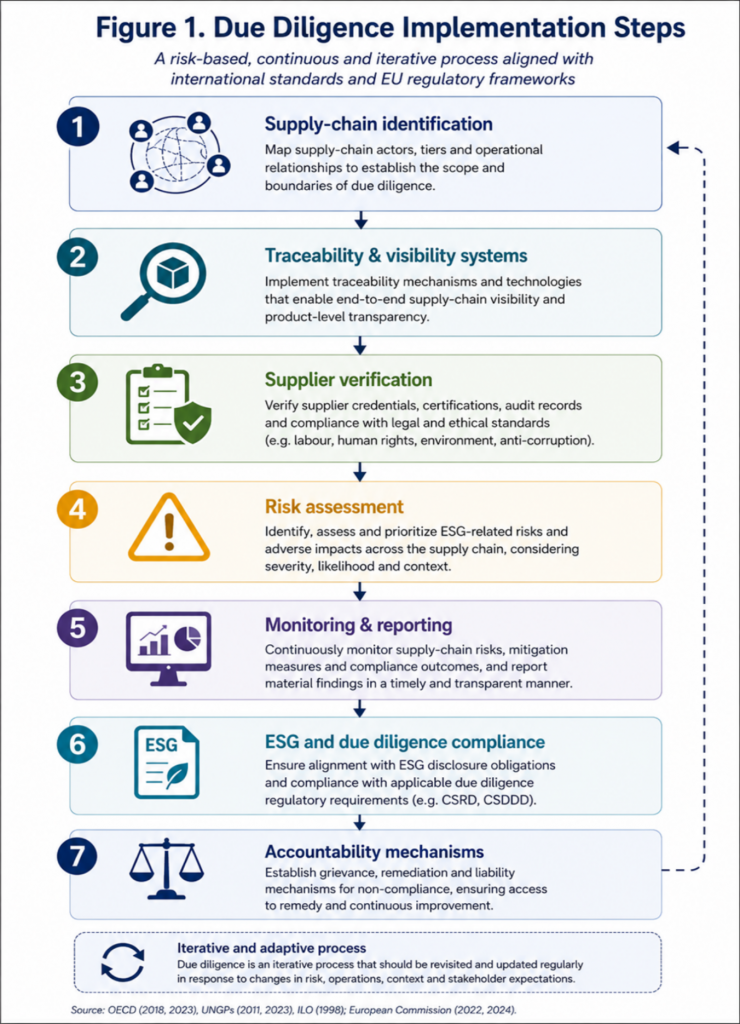
Source: Author’s elaboration based on OECD Due Diligence Guidance for Responsible Business Conduct (2018), OECD-FAO Guidance for Responsible Agricultural Supply Chains (2016), UN Guiding Principles on Business and Human Rights (2011), and EU sustainability governance frameworks.
A sequential governance architecture dependent upon implementation continuity, verification stability and informational coordination across interconnected supply-chain systems. The paper additionally incorporates a governance-fragmentation analysis designed to identify situations in which regulatory adaptation generates increasing dependence upon fragmented private compliance architectures, differentiated verification systems and asymmetrical implementation capacity across governance actors.34,75,87 While Figure 1 conceptualises due diligence as a sequential governance workflow, the broader analytical framework developed throughout the paper examines how implementation pressures emerging within one governance domain may generate indirect operational effects across adjacent sustainability accountability system increasingly dependent upon shared informational infrastructures.
The analytical significance of these governance frictions lies in the fact that contemporary sustainability governance increasingly operates through interconnected and partially invisible governance infrastructures reliant upon interoperability, governance-data continuity and verification capacity across multiple implementation stages.52,54,63 Particular attention is directed toward the operational consequences of uneven implementation conditions across interconnected governance environments, especially where governance systems increasingly rely upon hybrid public-private implementation arrangements.
The methodological objective is not to determine whether innovation-oriented regulatory reform should occur, nor to evaluate the scientific legitimacy of genomic technologies as such. The analysis instead examines whether evolving regulatory flexibility remains compatible with the operational conditions required for implementation coherence, accountability continuity and institutional reliability across interconnected sustainability governance systems.30,41,47
Figure 2 — Invisible Governance Infrastructure Layer
Operational infrastructures sustaining coordination, verification continuity and implementation reliability across interconnected sustainability governance environments.
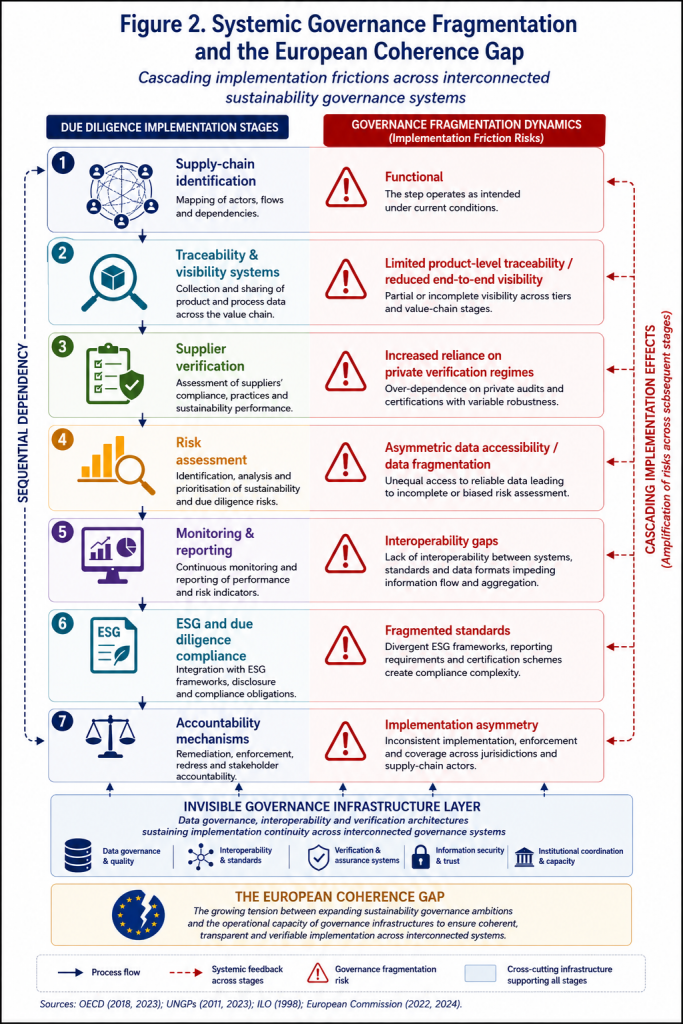
Source: Author’s elaboration based on OECD Due Diligence Guidance for Responsible Business Conduct (2018), OECD-FAO Guidance for Responsible Agricultural Supply Chains (2016), UN Guiding Principles on Business and Human Rights (2011), and the Governance Capacity Assessment Framework developed in this paper.
Figure 2 conceptualises the fragmentation dynamics that may emerge where sustainability governance systems become increasingly dependent upon interconnected verification infrastructures, interoperable reporting architectures and governance-data continuity across multiple implementation stages. The model illustrates how modifications affecting transparency continuity within one regulatory domain may generate indirect implementation effects across adjacent governance systems reliant upon shared informational and verification infrastructures. 79,80
The analytical focus therefore concerns the operational consequences of regulatory transition for governance coherence rather than questions of formal legal incompatibility alone. Particular attention is directed toward the capacity of implementation systems to preserve informational continuity, verification stability and coordination reliability under evolving transparency conditions associated with the proposed NGT framework.1,22,23,88
Methodologically, this approach enables the analysis to move beyond sector-specific or predominantly doctrinal examinations of biotechnology regulation toward a broader assessment of implementation resilience across interconnected sustainability governance environments. The principal contribution of the framework lies in the integration of governance-capacity analysis, process mapping, implementation-gap analysis and governance-fragmentation assessment within a unified operational model designed to evaluate institutional coherence under conditions of accelerating regulatory transition.37, 82,87
1. European Commission, Proposal for a Regulation of the European Parliament and of the Council on Plants Obtained by Certain New Genomic Techniques and Their Food and Feed COM(2023) 411 final, 5 July 2023.
22. OECD, OECD Due Diligence Guidance for Responsible Business Conduct (OECD Publishing 2018) 17–25; Robert B Mitchell, ‘Compliance Theory: Compliance, Effectiveness, and Behaviour Change in International Environmental Law’ in Daniel Bodansky, Jutta Brunnée and Ellen Hey (eds), The Oxford Handbook of International Environmental Law (OUP 2007).
23. OECD, OECD-FAO Guidance for Responsible Agricultural Supply Chains (OECD Publishing 2016) 27–39; John Braithwaite and Peter Drahos, Global Business Regulation (CUP 2000).
30. Giandomenico Majone, Regulating Europe (Routledge 1996).
33. Julia Black, ‘Decentring Regulation: Understanding the Role of Regulation and Self-Regulation in a “Post-Regulatory” World’ (2001) 54 Current Legal Problems 103.
34. Julia Black, ‘Constructing and Contesting Legitimacy and Accountability in Polycentric Regulatory Regimes’ (2008) 2 Regulation & Governance137.
37. See generally Christopher Ansell and Jacob Torfing (eds), Handbook on Theories of Governance (Edward Elgar Publishing 2016); Guy Peters, Institutional Theory in Political Science (4th edn, Edward Elgar Publishing 2019).
40. Jonathan Zeitlin, ‘The Rise of Experimentalist Governance in the European Union’ in Charles Sabel and Jonathan Zeitlin (eds), Experimentalist Governance in the European Union (OUP 2010).
41. Joanne Scott and David M Trubek, ‘Mind the Gap: Law and New Approaches to Governance in the European Union’ (2002) 8 European Law Journal 1.
43. Mark Bovens, Thomas Schillemans and Paul ’t Hart, The Oxford Handbook of Public Accountability (OUP 2014);
45. Colin Scott, Fabrizio Cafaggi and Linda Senden (eds), The Challenge of Transnational Private Regulation (Blackwell Publishing 2011);
46. David Levi-Faur, ‘The Global Diffusion of Regulatory Capitalism’ (2005) 598 The ANNALS of the American Academy of Political and Social Science 12;
47. Vivien A Schmidt, Europe’s Crisis of Legitimacy (OUP 2020).
52. Henry Farrell and Abraham Newman, Underground Empire (Henry Holt 2023).
54.Julie E Cohen, Between Truth and Power: The Legal Constructions of Informational Capitalism (OUP 2019).
56. Susan Leigh Star, ‘The Ethnography of Infrastructure’ (1999) 43 American Behavioral Scientist 377.
57. Susan Leigh Star and Karen Ruhleder, ‘Steps Toward an Ecology of Infrastructure: Design and Access for Large Information Spaces’ (1996) 7 Information Systems Research 111;
58. Geoffrey C Bowker and Susan Leigh Star, Sorting Things Out: Classification and Its Consequences (MIT Press 1999).
63. Michael Power, The Audit Society: Rituals of Verification (Oxford University Press 1997).
75. Kenneth Abbott and Duncan Snidal, ‘Strengthening International Regulation Through Transnational New Governance’ (2009) 42 Vanderbilt Journal of Transnational Law 501.
79. Oran R Young, Institutional Interplay: Biosafety and Trade (United Nations University Press 2008);
80. Frank Biermann and others, ‘The Fragmentation of Global Governance Architectures’ (2009) 9 Global Environmental Politics 14.
81. Claudio M Radaelli and Fabrizio De Francesco, ‘Regulatory Impact Assessment’ in Robert Baldwin, Martin Cave and Martin Lodge (eds), The Oxford Handbook of Regulation (OUP 2010);
82. Michael Howlett and M Ramesh, Studying Public Policy (4th edn, OUP 2022).
83. Jeffrey Pressman and Aaron Wildavsky, Implementation (3rd edn, University of California Press 1984).
84. Michael Hill and Peter Hupe, Implementing Public Policy (3rd edn, Sage 2014).
87. Fabrizio Cafaggi and Katharina Pistor (eds), Regulatory Capabilities and Transnational Governance (Edward Elgar 2013).
88. M. Eliantonio and A. Volpato, ‘The Regulation of New Genomic Techniques in the European Union: Innovation, Precaution and Governance Challenges’ (2023) 14 European Journal of Risk Regulation 221.
- Regulatory Credibility and the European Coherence Gap
The governance implications associated with the evolving framework on New Genomic Techniques (NGTs) may be situated within broader debates concerning regulatory credibility, adaptive governance and institutional resilience under conditions of accelerating regulatory transformation.30,31,47 Contemporary governance scholarship increasingly recognises that the legitimacy of modern regulatory systems depends not solely upon the adoption of legal norms, but upon the capacity of institutions to preserve stable and credible implementation conditions while continuously adapting to technological, geopolitical and socio-economic change.34,35,42
This tension between adaptability and stability has become a defining structural feature of contemporary European governance. Regulatory systems are increasingly expected to remain flexible enough to accommodate innovation, sustainability transition and market transformation, while simultaneously preserving predictability, implementation continuity and institutional trust across interconnected governance domains.37,38 Governance credibility therefore no longer derives exclusively from regulatory responsiveness or legislative ambition alone. It increasingly depends upon whether governance systems can adapt without generating operational instability, fragmentation or declining implementation reliability.
Within the broader architecture of European sustainability governance, this challenge becomes particularly significant because implementation increasingly operates through complex multi-level governance environments combining public regulation, private compliance systems, transnational reporting architectures and hybrid accountability arrangements.38,39,75 Under such conditions, institutional trust is closely connected to the capacity of governance systems to preserve continuity and predictability across evolving regulatory environments. Governance actors must remain capable of relying upon sufficiently stable implementation conditions even as regulatory frameworks themselves continue to evolve.
The concept of regulatory credibility is consequently approached in this paper as the capacity of governance systems to sustain coherent and operationally reliable implementation conditions over time despite ongoing regulatory adaptation.30,32 This understanding departs from more traditional conceptions of legitimacy focused primarily upon formal rule-making authority. Instead, credibility increasingly depends upon whether institutions are capable of maintaining coherence between evolving policy objectives and the operational conditions necessary for implementation across interconnected governance systems.39,41,47
Questions of governance resilience emerge directly from this dynamic. Regulatory adaptation may strengthen institutional responsiveness and innovation capacity, yet continuous modification of implementation conditions may simultaneously weaken predictability, coordination reliability and implementation continuity across governance ecosystems. Excessive flexibility may therefore generate unintended governance instability, particularly within systems increasingly dependent upon cumulative verification processes, interconnected reporting obligations and sequential accountability mechanisms distributed across multiple institutional environments.35,37,45
The evolving NGT framework illustrates this broader structural tension particularly clearly. The proposed regulatory differentiation between NGT1 and NGT2 categories is primarily justified through objectives relating to innovation, competitiveness, climate adaptation and agricultural resilience.1,2,17,88
At the same time, contemporary European sustainability governance increasingly depends upon stable operational conditions capable of sustaining due diligence implementation, supplier verification, ESG reporting and accountability processes across interconnected agri-food systems.12-15,22 The governance challenge therefore concerns whether regulatory flexibility can remain compatible with the degree of continuity and predictability required for credible implementation across adjacent governance domains.
Importantly, the European coherence gap conceptualised throughout this paper does not primarily reflect formal legal contradiction between innovation governance and sustainability governance. Rather, it reflects a growing imbalance between expanding adaptive ambitions and the operational capacity of governance systems to preserve coherent implementation environments during ongoing regulatory transition.30,33,41,47 Governance tensions consequently emerge less through doctrinal inconsistency than through gradual destabilisation of the conditions upon which implementation reliability and institutional trust depend.
These pressures become particularly visible within governance systems increasingly characterised by hybrid public-private implementation arrangements. As implementation environments become more complex and regulatory conditions evolve more rapidly, governance actors may rely increasingly upon fragmented compliance systems, proprietary verification architectures and differentiated reporting mechanisms in order to preserve operational continuity.33,44,75 Over time, such developments may contribute to asymmetric implementation capacity, uneven governance resilience and growing fragmentation across sustainability governance ecosystems.61,79,80
Institutional trust consequently acquires a more operational meaning within contemporary governance environments. Trust depends not solely upon transparency in normative terms, but upon the capacity of governance systems to maintain predictability, continuity and implementation reliability across evolving regulatory conditions.42,47 Governance systems lose credibility not only when regulation fails, but also when implementation environments become excessively unstable, fragmented or operationally unpredictable for governance actors required to comply with expanding accountability obligations.
The broader significance of the evolving NGT framework therefore extends beyond biotechnology governance alone. More fundamentally, it reveals a structural transformation affecting contemporary European governance systems under conditions of permanent adaptation. The central governance challenge increasingly concerns whether institutions can preserve operational coherence, implementation resilience and institutional trust while simultaneously pursuing innovation-oriented flexibility, sustainability transition and regulatory acceleration across interconnected governance domains.30,40,47
Ultimately, the long-term credibility of the European Union’s sustainability governance model will depend not solely upon the ambition of its regulatory objectives, but upon the institutional capacity to reconcile adaptability with stability across interconnected implementation environments. Governance resilience increasingly depends upon whether regulatory systems can evolve without undermining the operational continuity, predictability and implementation reliability necessary for credible sustainability governance over time.49-52
1. Proposal for a Regulation of the European Parliament and of the Council on plants obtained by certain new genomic techniques COM(2023) 411 final.
12. European Commission, Corporate Sustainability Due Diligence Directive Directive (EU) 2024/1760.
13. Directive (EU) 2022/2464 as regards Corporate Sustainability Reporting (CSRD).
22. OECD, OECD Due Diligence Guidance for Responsible Business Conduct (OECD Publishing 2018).
23. OECD-FAO, Guidance for Responsible Agricultural Supply Chains (OECD Publishing 2016).
26. OECD, Concentration in Seed Markets and Agricultural Governance (OECD Publishing 2022).
27. OECD, SMEs and Responsible Business Conduct (OECD Publishing 2022).
30. Giandomenico Majone, Regulating Europe (Routledge 1996).
31. Giandomenico Majone, Dilemmas of European Integration (Oxford University Press 2005).
32. Giandomenico Majone, ‘The Rise of the Regulatory State in Europe’ (1994) 17 West European Politics 77.
33. Julia Black, ‘Decentring Regulation: Understanding the Role of Regulation and Self-Regulation in a “Post-Regulatory” World’ (2001) 54 Current Legal Problems 103.
34. Julia Black, ‘Constructing and Contesting Legitimacy and Accountability in Polycentric Regulatory Regimes’ (2008) 2 Regulation & Governance137.
35. Robert Baldwin, Martin Cave and Martin Lodge, Understanding Regulation: Theory, Strategy and Practice (2nd edn, Oxford University Press 2012).
38. Christopher Ansell and Alison Gash, Collaborative Governance Regimes (Georgetown University Press 2018).
39. Jonathan Zeitlin, ‘The Rise of Experimentalist Governance in the European Union’ in Charles Sabel and Jonathan Zeitlin (eds), Experimentalist Governance in the European Union (Oxford University Press 2010).
40. Jonathan Zeitlin, ‘Extending Experimentalist Governance? The European Union and Transnational Regulation’ (2015) 14 Regulation & Governance 1.
41. Joanne Scott and David M Trubek, ‘Mind the Gap: Law and New Approaches to Governance in the European Union’ (2002) 8 European Law Journal 1.
42. Mark Bovens, Deirdre Curtin and Paul ‘t Hart (eds), The Real World of EU Accountability (Oxford University Press 2010).
44. Orly Lobel, ‘The Renew Deal: The Fall of Regulation and the Rise of Governance in Contemporary Legal Thought’ (2004) 89 Minnesota Law Review 342.
45. Colin Scott, ‘Regulation in the Age of Governance: The Rise of the Post-Regulatory State’ in Jacint Jordana and David Levi-Faur (eds), The Politics of Regulation (Edward Elgar 2004).
47. Vivien Schmidt, Europe’s Crisis of Legitimacy (Oxford University Press 2020).
49. Ian Manners, ‘Normative Power Europe: A Contradiction in Terms?’ (2002) 40 Journal of Common Market Studies 235.
50. Ian Manners, ‘The European Union as a Normative Power’ (2009) 2 European Foreign Affairs Review 67.
51. Chad Damro, ‘Market Power Europe’ (2012) 19 Journal of European Public Policy 682.
52. Henry Farrell and Abraham Newman, Underground Empire (Henry Holt 2023).
54. Julie E Cohen, Between Truth and Power: The Legal Constructions of Informational Capitalism (Oxford University Press 2019).
55. Frank Pasquale, The Black Box Society (Harvard University Press 2015).
56. Susan Leigh Star, ‘The Ethnography of Infrastructure’ (1999) 43 American Behavioral Scientist 377.
57. Susan Leigh Star and Karen Ruhleder, ‘Steps Toward an Ecology of Infrastructure: Design and Access for Large Information Spaces’ (1996) 7 Information Systems Research 111;
58. Geoffrey C Bowker and Susan Leigh Star, Sorting Things Out: Classification and Its Consequences (MIT Press 1999).
59. Bruno Latour, Reassembling the Social (Oxford University Press 2005).
61. Saskia Sassen, Territory, Authority, Rights (Princeton University Press 2006).
62. A. Edwards, ‘Datafied Governance and Regulatory Interoperability in the European Union’ (2022) 45 Journal of European Public Policy 1334.
63. Michael Power, The Audit Society: Rituals of Verification (Oxford University Press 1997).
68. Joanne Scott and Sangeeta Khorana, ‘The EU and Global Sustainable Development Governance’ (2015) 52 Common Market Law Review1145.
71. Dani Rodrik, The Globalization Paradox (Oxford University Press 2011).
75. Kenneth W Abbott and Duncan Snidal, ‘Strengthening International Regulation Through Transnational New Governance’ (2009) 42 Vanderbilt Journal of Transnational Law 501.
76. Kenneth W Abbott and others, ‘International Organizations as Orchestrators’ (2015) 31 Cambridge Journal of International Affairs 1.
80. Frank Biermann and others, ‘The Fragmentation of Global Governance Architectures’ (2009) 9 Global Environmental Politics 14.
86. Fabrizio Cafaggi and Katharina Pistor (eds), Regulatory Capabilities and Transnational Governance (Edward Elgar 2013).
87. M. Eliantonio and A. Volpato, ‘The Regulation of New Genomic Techniques in the European Union: Innovation, Precaution and Governance Challenges’ (2023) 14 European Journal of Risk Regulation 221.
88. David Vogel, The Politics of Precaution (Princeton University Press 2012).
- Trade Governance and Invisible Governance Infrastructures
The governance implications associated with the evolving framework on New Genomic Techniques (NGTs) become particularly significant when situated within the broader transformation of European Union trade governance and external sustainability policy.64,66,68 Over the past two decades, the European Union has progressively repositioned trade governance beyond the logic of market liberalisation alone toward a broader strategic model linking trade integration, sustainability governance, due diligence obligations and regulatory accountability across transnational governance environments.46,67,69
This transformation reflects a deeper structural evolution within the European regulatory project. Contemporary EU trade governance increasingly operates not merely through the export of regulatory standards, but through the projection of governance reliability itself. External governance credibility depends upon the capacity of the European Union to demonstrate that its regulatory systems remain coherent, predictable and operationally credible across interconnected internal and external governance domains.49,51,67 In this sense, the European Union increasingly exports not only substantive norms, but also expectations concerning implementation reliability, institutional continuity and governance stability across global supply chains.
Trade governance consequently functions as a strategic extension of internal governance credibility. Modern trade agreements increasingly operate as institutional frameworks through which the European Union projects sustainability expectations, accountability requirements and governance principles beyond its territorial boundaries.65,68,69 The effectiveness of such governance projection depends not solely upon the formal incorporation of sustainability clauses or regulatory commitments within trade agreements, but upon the capacity of the European governance model to preserve sufficiently stable and credible implementation conditions over time.
The EU–Mercosur Agreement represents a particularly significant example within this broader transformation.10,19 Institutional communications issued by the European Commission, DG Trade and Commissioner for Agriculture and Food Christophe Hansen repeatedly emphasise safeguards, implementation oversight, sanitary and phytosanitary protections, monitoring arrangements and Geographical Indication protections as central components of the agreement’s governance architecture.11,20 These elements illustrate that contemporary EU trade governance increasingly relies upon the projection of institutional reliability and operational governance credibility rather than solely upon regulatory alignment in formal legal terms.
Questions of strategic coherence emerge directly from this governance model. The credibility of European external governance increasingly depends upon the relationship between internal regulatory adaptation and the operational stability of the governance conditions projected externally. Internal reforms affecting implementation reliability, predictability or governance continuity may therefore generate indirect consequences for the credibility of the European Union’s broader external governance agenda. This issue becomes particularly significant under conditions of accelerating regulatory transition, where governance systems are simultaneously expected to remain adaptive, innovation-oriented and institutionally reliable across interconnected policy domains.30,31,47
The analytical significance of the evolving NGT framework must therefore be understood within this broader strategic context. The principal issue does not concern formal legal incompatibility between the proposed NGT regime and existing trade or sustainability obligations.1,12,17 Rather, the governance challenge concerns whether evolving internal regulatory flexibility remains compatible with the degree of continuity, predictability and implementation coherence required to sustain credible external governance projection across interconnected sustainability governance systems.
This tension reflects a broader structural characteristic of contemporary European governance. Regulatory adaptation may strengthen innovation capacity, technological competitiveness and strategic autonomy, yet continuous reconfiguration of implementation conditions may simultaneously create pressures affecting governance stability and institutional predictability across adjacent governance environments.35,37,45 The challenge facing contemporary EU governance therefore concerns not whether adaptation should occur, but whether governance systems remain capable of preserving coherent implementation conditions while adaptation itself becomes permanent.
These dynamics acquire particular importance within sustainability-oriented trade governance because contemporary implementation systems increasingly depend upon cumulative accountability processes distributed across multiple governance levels and institutional actors. Instruments such as the Corporate Sustainability Due Diligence Directive (CSDDD), the Corporate Sustainability Reporting Directive (CSRD), the EU Deforestation Regulation (EUDR) and OECD due diligence frameworks collectively reinforce a governance environment in which implementation credibility increasingly depends upon stable conditions of verification, monitoring and accountability across transnational supply chains.12-14,22
The strategic significance of the EU–Mercosur framework therefore extends beyond trade governance narrowly understood. The agreement functions as a broader credibility test for the European Union’s sustainability governance model under conditions of regulatory transition.10,68,73 More specifically, it reveals the extent to which EU external governance increasingly depends upon the preservation of coherent implementation conditions capable of sustaining trust, accountability and governance reliability across interconnected internal and external governance domains.66,67,72
Institutional credibility consequently becomes inseparable from strategic coherence. External governance projection cannot remain fully credible where internal governance systems generate increasing fragmentation, declining implementation predictability or unstable operational conditions across interconnected governance environments. Governance coherence therefore concerns not only compatibility between legal instruments, but also the capacity of institutions to preserve continuity and reliability while simultaneously pursuing innovation-oriented flexibility and regulatory adaptation.
The broader governance challenge confronting the European Union is therefore fundamentally strategic in nature. The issue is no longer confined to the production of regulatory standards or sustainability commitments alone. Increasingly, it concerns whether European governance systems can preserve institutional credibility while operating under conditions of continuous transformation, technological acceleration and expanding governance complexity across interconnected regulatory domains.49,51,52
1. Proposal for a Regulation on plants obtained by certain new genomic techniques COM(2023) 411 final.
10. European Commission, EU–Mercosur Trade Agreement (2024).
11. European Commission, Questions and Answers on the EU–Mercosur Agreement (2024).
12. European Commission, Corporate Sustainability Due Diligence Directive Directive (EU) 2024/1760.
13. Directive (EU) 2022/2464 as regards Corporate Sustainability Reporting (CSRD).
14. Regulation (EU) 2023/1115 on Deforestation-Free Products (EUDR).
17. European Parliament Research Service (EPRS), New Genomic Techniques and the Future of EU Agri-Food Governance (2024).
19. Council of the European Union, EU–Mercosur Agreement — Political and Sustainability Dimensions (2024).
20. DG AGRI, Geographical Indications and Sustainability in EU Trade Governance (2024).
22. OECD, OECD Due Diligence Guidance for Responsible Business Conduct (OECD Publishing 2018).
23. OECD-FAO, Guidance for Responsible Agricultural Supply Chains (OECD Publishing 2016).
31. Giandomenico Majone, Dilemmas of European Integration (Oxford University Press 2005).
34. Julia Black, ‘Constructing and Contesting Legitimacy and Accountability in Polycentric Regulatory Regimes’ (2008) 2 Regulation & Governance137.
38. Christopher Ansell and Alison Gash, Collaborative Governance Regimes (Georgetown University Press 2018).
41. Joanne Scott and David M Trubek, ‘Mind the Gap: Law and New Approaches to Governance in the European Union’ (2002) 8 European Law Journal 1.
42. Mark Bovens, Deirdre Curtin and Paul ‘t Hart (eds), The Real World of EU Accountability (Oxford University Press 2010).
44. Orly Lobel, ‘The Renew Deal: The Fall of Regulation and the Rise of Governance in Contemporary Legal Thought’ (2004) 89 Minnesota Law Review 342.
47. Vivien Schmidt, Europe’s Crisis of Legitimacy (Oxford University Press 2020).
46. David Levi-Faur, ‘The Global Diffusion of Regulatory Capitalism’ (2005) 598 The ANNALS of the American Academy of Political and Social Science 12;
49. Ian Manners, ‘Normative Power Europe: A Contradiction in Terms?’ (2002) 40 Journal of Common Market Studies 235.
51. Chad Damro, ‘Market Power Europe’ (2012) 19 Journal of European Public Policy 682.
52. Henry Farrell and Abraham Newman, Underground Empire (Henry Holt 2023).
54. Julie E Cohen, Between Truth and Power: The Legal Constructions of Informational Capitalism (Oxford University Press 2019).
61. Saskia Sassen, Territory, Authority, Rights (Princeton University Press 2006).
62. A. Edwards, ‘Datafied Governance and Regulatory Interoperability in the European Union’ (2022) 45 Journal of European Public Policy 1334.
63. Michael Power, The Audit Society: Rituals of Verification (Oxford University Press 1997).
64. Lorand Bartels, Human Rights and Sustainable Development Obligations in EU Free Trade Agreements (Cambridge University Press 2020).
65. Lorand Bartels, ‘The Trade and Sustainable Development Chapter in EU Free Trade Agreements’ (2013) International Centre for Trade and Sustainable Development.
66.Olivier De Schutter, Trade in the Service of Sustainable Development (Bloomsbury 2015).
67. Joanne Scott, ‘The Global Reach of EU Law’ (2014) 38 Fordham International Law Journal 1349.
68. Joanne Scott and Sangeeta Khorana, ‘The EU and Global Sustainable Development Governance’ (2015) 52 Common Market Law Review1145.
69. Gregory Shaffer, Emerging Powers and the World Trading System (Cambridge University Press 2021).
71. Dani Rodrik, The Globalization Paradox (Oxford University Press 2011).
73. Damien Geradin and Nicolas Petit, ‘Trade and Regulatory Governance in the European Union’ (2021) 46 European Law Review 311.
75. Kenneth W Abbott and Duncan Snidal, ‘Strengthening International Regulation Through Transnational New Governance’ (2009) 42 Vanderbilt Journal of Transnational Law 501.
79. Oran R Young, Institutional Interplay: Biosafety and Trade (United Nations University Press 2008);
80. Frank Biermann and others, ‘The Fragmentation of Global Governance Architectures’ (2009) 9 Global Environmental Politics 14.
86. Fabrizio Cafaggi and Katharina Pistor (eds), Regulatory Capabilities and Transnational Governance (Edward Elgar 2013).
87. M. Eliantonio and A. Volpato, ‘The Regulation of New Genomic Techniques in the European Union: Innovation, Precaution and Governance Challenges’ (2023) 14 European Journal of Risk Regulation 221.
- Innovation Governance and the European Coherence Gap
The evolving European Union framework on New Genomic Techniques (NGTs) may be understood not merely as a sectoral reform in biotechnology governance, but as an empirical governance case revealing broader structural tensions within contemporary European sustainability and accountability architectures.30,40,47 More specifically, the reform provides a significant case through which to examine how governance systems preserve implementation coherence and institutional reliability while adapting to accelerating technological and regulatory transformation.22,23,62
From this perspective, the analytical significance of the NGT reform extends beyond scientific classification or agricultural innovation alone. The framework functions as a governance stress test capable of revealing the extent to which contemporary European governance increasingly relies upon what may be described as invisible governance infrastructures — namely the operational systems of traceability, certification, reporting, auditability, verification and governance-data interoperability underpinning implementation coherence across interconnected governance environments.52,54,56
Within such governance systems, sustainability governance no longer operates solely through formal legal obligations or regulatory commitments. Rather, implementation increasingly depends upon the operational continuity of informational and verification infrastructures capable of sustaining monitoring, supplier verification, ESG reporting and accountability mechanisms across transnational governance ecosystems.63,75,87 The evolving NGT framework therefore becomes analytically significant because it directly affects some of the transparency infrastructure upon which these implementation architectures increasingly depend.1,17,88
Viewed through this analytical lens, the following sections examine the NGT reform not primarily as a technical debate concerning biotechnology regulation, but as a broader governance case concerning the capacity of European governance systems to preserve operational coherence, implementation credibility and institutional trust under conditions of accelerating regulatory and technological transition.42,38,41
1. Proposal for a Regulation on plants obtained by certain new genomic techniques COM(2023) 411 final.
17. European Parliament Research Service (EPRS), New Genomic Techniques and the Future of EU Agri-Food Governance (2024).
22. OECD, OECD Due Diligence Guidance for Responsible Business Conduct (OECD Publishing 2018).
23. OECD-FAO, Guidance for Responsible Agricultural Supply Chains (OECD Publishing 2016).
30. Giandomenico Majone, Regulating Europe (Routledge 1996).
38. Christopher Ansell and Alison Gash, Collaborative Governance Regimes (Georgetown University Press 2018).
40. Jonathan Zeitlin, ‘Extending Experimentalist Governance? The European Union and Transnational Regulation’ (2015) 14 Regulation & Governance 1.
41. Joanne Scott and David M Trubek, ‘Mind the Gap: Law and New Approaches to Governance in the European Union’ (2002) 8 European Law Journal 1.
42. Mark Bovens, Deirdre Curtin and Paul ‘t Hart (eds), The Real World of EU Accountability (Oxford University Press 2010).
47. Vivien Schmidt, Europe’s Crisis of Legitimacy (Oxford University Press 2020).
52. Henry Farrell and Abraham Newman, Underground Empire (Henry Holt 2023); Bruno Latour, Science in Action (Harvard University Press 1987).
54. Julie E Cohen, Between Truth and Power: The Legal Constructions of Informational Capitalism (Oxford University Press 2019).
56. Susan Leigh Star, ‘The Ethnography of Infrastructure’ (1999) 43 American Behavioral Scientist 377
62. A. Edwards, ‘Datafied Governance and Regulatory Interoperability in the European Union’ (2022) 45 Journal of European Public Policy 1334.
63. Michael Power, The Audit Society: Rituals of Verification (Oxford University Press 1997).
75. Kenneth W Abbott and Duncan Snidal, ‘Strengthening International Regulation Through Transnational New Governance’ (2009) 42 Vanderbilt Journal of Transnational Law 501.
87. Fabrizio Cafaggi and Katharina Pistor (eds), Regulatory Capabilities and Transnational Governance (Edward Elgar 2013).
88. M. Eliantonio and A. Volpato, ‘The Regulation of New Genomic Techniques in the European Union: Innovation, Precaution and Governance Challenges’ (2023) 14 European Journal of Risk Regulation 221.
- Strategic Drivers of the Reform
The reform of the European Union’s regulatory framework on New Genomic Techniques (NGTs) emerges within a broader context of accelerating environmental, geopolitical and economic transformation affecting contemporary agri-food governance systems.7,28,29 European agriculture increasingly faces multiple structural pressures associated with climate change, water scarcity, rising production costs, geopolitical instability, food-security concerns and growing international technological competition.25,28,29Under such conditions, the governance of agricultural innovation progressively becomes linked not solely to productivity objectives, but also to broader strategic questions concerning resilience, competitiveness and long-term governance capacity within critical food systems.
Within this evolving strategic environment, the European Union has increasingly framed NGT reform as part of a broader strategy intended to strengthen agricultural sustainability, climate adaptation and innovation capacity across the European agri-food sector.1,4,7 Institutional communications accompanying the proposed reform repeatedly emphasise the potential contribution of genomic technologies to the development of crop varieties more resistant to drought, pests, diseases and changing climatic conditions while also supporting reductions in pesticide use and improving agricultural resilience.2,3,18
At the same time, the reform also reflects broader concerns relating to strategic autonomy and technological sovereignty within increasingly technology-intensive agricultural systems.5-7 In recent years, European governance debates have progressively linked innovation capacity with broader questions concerning dependence upon external technological infrastructures, proprietary seed systems and global innovation asymmetries involving major agricultural and technological powers such as the United States and China.52,53,70 From this perspective, genomic innovation increasingly becomes associated not solely with agricultural modernisation, but also with the broader capacity of European governance systems to preserve strategic control over critical agri-food infrastructures and technological development pathways.5,61,89
This strategic dimension is particularly significant because agriculture increasingly functions not merely as an economic sector, but as a critical governance infrastructure linked to food security, environmental resilience and geopolitical stability.28,29,52 Under such conditions, the governance of agricultural technologies becomes progressively connected to broader European concerns relating to supply-chain resilience, technological dependency and long-term implementation autonomy across interconnected food systems.52,61,70
The reform seeks to establish a differentiated governance framework capable of increasing regulatory adaptability while preserving institutional oversight across rapidly evolving technological environments.1,2 Rather than maintaining a uniform regulatory model for all forms of genomic modification, the proposed framework introduces differentiated implementation regimes intended to accommodate varying degrees of perceived regulatory complexity and risk. From the perspective of adaptive governance, the reform reflects a broader institutional attempt to increase regulatory responsiveness under conditions of accelerating scientific innovation, geopolitical competition and environmental pressure affecting contemporary agri-food systems.4,7,29
At the same time, differentiated regulatory adaptation introduces broader governance questions concerning the stability of implementation conditions across interconnected sustainability governance environments. As governance systems become increasingly dependent upon continuity, predictability and institutional reliability across multiple regulatory domains, the expansion of regulatory flexibility may generate uneven implementation conditions affecting accountability structures operating across interconnected supply-chain systems. The central governance issue therefore concerns not whether institutional adaptation should occur, but whether adaptive regulatory frameworks can preserve sufficient coherence, implementation stability and governance credibility while regulatory environments themselves undergo continuous transformation.However, the governance significance of the reform extends beyond innovation policy alone. Contemporary European governance increasingly operates through interconnected sustainability, trade and accountability architectures dependent upon governance visibility, traceability continuity and verification capacity across transnational supply chains.22,67,68 Consequently, the strategic challenge confronting the European Union concerns not simply whether innovation should be accelerated, but whether governance systems can preserve institutional coherence and implementation reliability while simultaneously accelerating regulatory adaptation.22,23,75
From this perspective, the central issue raised by the evolving NGT framework does not concern innovation itself, nor the broader objective of strengthening European competitiveness and resilience.
Rather, the governance challenge concerns the conditions under which innovation remains sufficiently governed within broader accountability and implementation architectures capable of preserving institutional trust, operational coherence and long-term governance credibility across interconnected agri-food systems.38,42,47
1. European Commission, ‘Proposal for a Regulation on Plants Obtained by Certain New Genomic Techniques’ COM(2023) 411 final.
2. European Commission, Impact Assessment Report Accompanying the Proposal for a Regulation on Plants Obtained by Certain New Genomic Techniques SWD(2023) 412 final, 5 July 2023.
3. European Commission, Questions and Answers on New Genomic Techniques (2023).
4. European Commission, Building the Future with Nature: Boosting Biotechnology and Biomanufacturing in the EU COM(2024) 137 final.
5. European Commission, European Economic Security Strategy JOIN(2023) 20 final.
6. European Commission, Long-Term Competitiveness of the EU: Looking Beyond 2030 COM(2023) 168 final.
7. European Commission, Strategic Foresight Report 2023: Sustainability and People’s Wellbeing at the Heart of Europe’s Open Strategic Autonomy COM(2023) 376 final.
17. European Parliament Research Service (EPRS), New Genomic Techniques and the Future of EU Agri-Food Governance (2024).
18. European Food Safety Authority (EFSA), Applicability of Existing Guidelines for the Risk Assessment of New Genomic Techniques (2022).
22. OECD, OECD Due Diligence Guidance for Responsible Business Conduct (OECD Publishing 2018).
23. OECD-FAO, Guidance for Responsible Agricultural Supply Chains (OECD Publishing 2016).
25. OECD, Innovation, Agricultural Productivity and Sustainability in Europe (OECD Publishing 2023).
26. OECD, Innovation, Agricultural Productivity and Sustainability in Europe (OECD Publishing 2023).
28. Food and Agriculture Organization (FAO), The State of Food Security and Nutrition in the World 2023 (FAO 2023).
29. Intergovernmental Panel on Climate Change (IPCC), Climate Change 2023: Synthesis Report (IPCC 2023).
30. Intergovernmental Panel on Climate Change (IPCC), Climate Change 2023: Synthesis Report (IPCC 2023).
38. Christopher Ansell and Alison Gash, Collaborative Governance Regimes (Georgetown University Press 2018).
42. Mark Bovens, Deirdre Curtin and Paul ‘t Hart (eds), The Real World of EU Accountability (Oxford University Press 2010).
47. Vivien Schmidt, Europe’s Crisis of Legitimacy (Oxford University Press 2020).
52. Henry Farrell and Abraham Newman, Underground Empire (Henry Holt 2023); Bruno Latour, Science in Action (Harvard University Press 1987).
53. H. Farrell and A. Newman, ‘Weaponized Interdependence: How Global Economic Networks Shape State Coercion’ (2019) 44 International Security 42.
61. Saskia Sassen, Territory, Authority, Rights (Princeton University Press 2006).
67. Joanne Scott, ‘The Global Reach of EU Law’ (2014) 38 Fordham International Law Journal 1349.
68. Joanne Scott and Sangeeta Khorana, ‘The EU and Global Sustainable Development Governance’ (2015) 52 Common Market Law Review1145.
70. Dani Rodrik, The Globalization Paradox (Oxford University Press 2011).
75. Kenneth W Abbott and Duncan Snidal, ‘Strengthening International Regulation Through Transnational New Governance’ (2009) 42 Vanderbilt Journal of Transnational Law 501.
87. M. Eliantonio and A. Volpato, ‘The Regulation of New Genomic Techniques in the European Union: Innovation, Precaution and Governance Challenges’ (2023) 14 European Journal of Risk Regulation 221.
88. David Vogel, The Politics of Precaution (Princeton University Press 2012).
89. Mariana Mazzucato, The Entrepreneurial State (Penguin 2018).
- The NGT1/NGT2 Distinction and the Reconfiguration of Governance Conditions
The proposed European Union framework on New Genomic Techniques (NGTs) introduces a differentiated regulatory structure distinguishing between two principal categories of genomic modification.1,2 The proposed model, NGT1 plants considered comparable to products capable of occurring naturally or through conventional breeding techniques would benefit from simplified regulatory treatment, whereas NGT2 products would remain subject to stricter authorisation, traceability and risk-assessment requirements broadly comparable to those applicable to conventional genetically modified organisms.1,17,18
At the formal legal level, this distinction primarily concerns the calibration of regulatory obligations applicable to different categories of genomic intervention. Its broader governance significance, however, lies in the way differentiated regulatory adaptation restructures implementation conditions across interconnected sustainability-governance environments.30,35,41 The proposed framework does not merely modify procedural requirements within biotechnology regulation. More fundamentally, it alters some of the operational assumptions upon which contemporary accountability, monitoring and verification systems increasingly depend.
The governance implications of the differentiated NGT framework become particularly visible in implementation environments characterised by growing reliance upon stable and predictable informational conditions across interconnected regulatory domains. Sustainability governance increasingly depends upon governance systems capable of preserving continuity between regulatory classification, monitoring procedures, supplier verification practices and accountability mechanisms operating simultaneously across transnational supply chains.13,15,22 From this perspective, differentiated regulatory treatment may progressively generate uneven implementation environments in which governance actors operate under varying degrees of visibility, verification capacity and operational predictability.
The central governance issue therefore concerns not transparency as an abstract normative principle, but the preservation of sufficiently coherent implementation conditions capable of sustaining governance reliability over time. As regulatory systems become increasingly adaptive and differentiated, implementation environments may simultaneously become more complex, fragmented and operationally uneven across interconnected governance domains.22,38,40 The significance of the NGT1/NGT2 distinction consequently lies less in the existence of differentiated regulation itself than in the broader transformation of the governance conditions through which sustainability accountability becomes operationally achievable.
These pressures become particularly significant where economic actors are required to substantiate sustainability-related claims, maintain non-GMO sourcing arrangements or demonstrate compliance with ESG-related accountability obligations across complex supply-chain environments.16,22,23 Where harmonised visibility conditions become partially reduced, governance actors may increasingly rely upon contractual disclosure mechanisms, private certification systems and parallel verification arrangements designed to preserve implementation continuity across fragmented governance environments.33,75,87 Over time, such developments may contribute to differentiated implementation capacity between actors possessing unequal access to technological, administrative and verification-related resources.
The broader significance of the NGT1/NGT2 distinction therefore extends beyond regulatory differentiation narrowly understood. More fundamentally, the reform illustrates how adaptive regulatory governance may gradually reshape the operational conditions underpinning implementation coherence, institutional predictability and governance credibility across interconnected sustainability-governance architectures.41,47,52
1. European Commission, ‘Proposal for a Regulation on Plants Obtained by Certain New Genomic Techniques’ COM(2023) 411 final.
2. European Commission, Impact Assessment Report Accompanying the Proposal for a Regulation on Plants Obtained by Certain New Genomic Techniques SWD(2023) 412 final, 5 July 2023.
3. European Commission, ‘Questions and Answers on New Genomic Techniques’ (2023).
12. European Commission, Corporate Sustainability Due Diligence Directive Directive (EU) 2024/1760.
13. Directive (EU) 2022/2464 as regards Corporate Sustainability Reporting (CSRD).
15. European Commission, European Sustainability Reporting Standards (ESRS) (2023).
17. European Parliament Research Service, ‘New Genomic Techniques and the Future of EU Agri-Food Governance’ (2024).
18. European Food Safety Authority (EFSA), Applicability of Existing Guidelines for the Risk Assessment of New Genomic Techniques (2022).
22. OECD, OECD Due Diligence Guidance for Responsible Business Conduct (OECD Publishing 2018).
23. OECD, OECD-FAO Guidance for Responsible Agricultural Supply Chains (OECD Publishing 2016).
30. Giandomenico Majone, Regulating Europe (Routledge 1996).
33. Julia Black, ‘Decentring Regulation’ (2001) 54 Current Legal Problems 103.
35. Robert Baldwin, Martin Cave and Martin Lodge, Understanding Regulation: Theory, Strategy and Practice (2nd edn, Oxford University Press 2012).
38. Christopher Ansell and Alison Gash, Collaborative Governance Regimes (Georgetown University Press 2018).
40. Jonathan Zeitlin, ‘EU Experimentalist Governance in Times of Crisis’ (2016) 43 West European Politics 1073.
41. Joanne Scott and David M Trubek, ‘Mind the Gap: Law and New Approaches to Governance in the European Union’ (2002) 8 European Law Journal 1.
45. Colin Scott, ‘Regulation in the Age of Governance: The Rise of the Post-Regulatory State’ in Jacint Jordana and David Levi-Faur (eds), The Politics of Regulation (Edward Elgar 2004).
47. Vivien Schmidt, Europe’s Crisis of Legitimacy (Oxford University Press 2020).
52. Henry Farrell and Abraham Newman, Underground Empire (Henry Holt 2023).
54. Julie E Cohen, Between Truth and Power: The Legal Constructions of Informational Capitalism (Oxford University Press 2019).
61. Saskia Sassen, Territory, Authority, Rights (Princeton University Press 2006).
62. A. Edwards, ‘Datafied Governance and Regulatory Interoperability in the European Union’ (2022) 45 Journal of European Public Policy 1334.
63. Michael Power, The Audit Society: Rituals of Verification (Oxford University Press 1997).
75. Kenneth W Abbott and Duncan Snidal, ‘Strengthening International Regulation Through Transnational New Governance’ (2009) 42 Vanderbilt Journal of Transnational Law 501.
87. Fabrizio Cafaggi and Katharina Pistor (eds), Regulatory Capabilities and Transnational Governance (Edward Elgar 2013).
- NGT Reform and Invisible Governance Infrastructures
The governance implications of the evolving European Union framework on New Genomic Techniques (NGTs) become particularly significant when situated within the broader transformation of contemporary sustainability governance toward increasingly complex implementation environments characterised by continuous regulatory adaptation, data-intensive oversight and expanding accountability obligations across interconnected governance domains.13,15,22 Due to this conditions, governance effectiveness depends not solely upon the formal adoption of legal obligations, but upon the institutional capacity to preserve sufficiently stable and reliable implementation conditions while regulatory systems themselves undergo ongoing transformation.35,38,45 Contemporary sustainability governance increasingly relies upon operational architectures through which monitoring, accountability, reporting and verification become institutionally achievable across transnational governance environments.12,22,23 These architectures — conceptualised throughout the present paper as invisible governance infrastructures — include the informational, organisational and verification systems that sustain implementation continuity across interconnected public and private governance arrangements.56-58Their significance lies not merely in supporting administrative coordination, but in enabling governance systems to preserve operational reliability, comparability and institutional credibility across increasingly complex implementation ecosystems.
The governance relevance of the evolving NGT framework consequently extends beyond scientific classification or biotechnology regulation narrowly understood. More fundamentally, the reform illustrates how adaptive regulatory change may gradually reshape the implementation conditions upon which broader sustainability-accountability systems increasingly depend. As governance systems become progressively reliant upon continuity between reporting architectures, supplier-verification procedures, sustainability standards and monitoring mechanisms, modifications affecting one regulatory domain may generate indirect implementation pressures across adjacent governance environments dependent upon stable coordination and predictable implementation assumptions.33,41,52
These dynamics become particularly significant in governance systems where accountability increasingly depends upon cumulative verification processes distributed across multiple implementation stages. Sustainability-related claims, due diligence obligations and ESG-related reporting frameworks require governance actors to preserve sufficiently coherent informational conditions capable of supporting monitoring continuity, auditability and institutional reliability across interconnected supply-chain systems.12-16,22 Governance credibility therefore increasingly depends not solely upon regulatory ambition, but upon the capacity of governance systems to sustain operational continuity while implementation environments evolve under conditions of regulatory acceleration.
Potential fragmentation pressures emerge where differentiated regulatory adaptation generates uneven implementation conditions across interconnected governance systems. Reduced harmonisation of visibility conditions may progressively increase reliance upon contractual disclosure systems, private certification mechanisms, proprietary compliance technologies and parallel audit infrastructures designed to compensate for declining interoperability within broader public implementation frameworks. 33,54,61Over time, such developments may contribute to differentiated implementation capacity between governance actors possessing unequal access to technological infrastructures, administrative resources and verification expertise. 38,77,80
These pressures may become especially significant for SMEs, smaller agricultural operators and less vertically integrated actors whose implementation capacity remains more dependent upon stable and harmonised governance environments.23,27 In increasingly complex regulatory ecosystems, implementation resilience may progressively correlate with access to sophisticated reporting systems, digital verification infrastructures and compliance-related governance resources rather than with formal legal obligations alone.
The evolving NGT framework therefore reveals a broader structural transformation affecting contemporary European governance systems. Sustainability governance increasingly depends upon the resilience of the invisible infrastructures through which implementation coherence, institutional predictability and accountability continuity are maintained across interconnected governance domains. The central governance issue raised by the reform consequently concerns not biotechnology regulation in isolation, but the long-term capacity of governance systems to preserve sufficiently coherent implementation environments capable of sustaining institutional trust and governance credibility under conditions of accelerating regulatory and technological transition. 35,47,52
12. European Commission, ‘Corporate Sustainability Due Diligence Directive (CSDDD)’ (2024).
13. Directive (EU) 2022/2464 as regards Corporate Sustainability Reporting (CSRD).
15. European Commission, European Sustainability Reporting Standards (ESRS) (2023).
16. European Financial Reporting Advisory Group (EFRAG), ESRS Implementation Guidance (2024).
22. OECD, OECD Due Diligence Guidance for Responsible Business Conduct (OECD Publishing 2018).
23. OECD, OECD-FAO Guidance for Responsible Agricultural Supply Chains (OECD Publishing 2016).
27. OECD, SMEs and Responsible Business Conduct (OECD Publishing 2022).
30. Giandomenico Majone, Regulating Europe (Routledge 1996).
33. Julia Black, ‘Decentring Regulation’ (2001) 54 Current Legal Problems 103.
34. Julia Black, Constructing and Contesting Legitimacy and Accountability in Polycentric Regulatory Regimes (2013).
35. Robert Baldwin, Martin Cave and Martin Lodge, Understanding Regulation: Theory, Strategy and Practice (2nd edn, Oxford University Press 2012).
38. Christopher Ansell and Alison Gash, Collaborative Governance Regimes (Georgetown University Press 2018).
40. Jonathan Zeitlin, ‘EU Experimentalist Governance in Times of Crisis’ (2016) 43 West European Politics 1073.
41. Joanne Scott and David M Trubek, ‘Mind the Gap: Law and New Approaches to Governance in the European Union’ (2002) 8 European Law Journal 1.
44. Orly Lobel, ‘The Renew Deal: The Fall of Regulation and the Rise of Governance’ (2004) 89 Minnesota Law Review 342.
45. Colin Scott, ‘Regulation in the Age of Governance: The Rise of the Post-Regulatory State’ in Jacint Jordana and David Levi-Faur (eds), The Politics of Regulation (Edward Elgar 2004).
47. Vivien Schmidt, Europe’s Crisis of Legitimacy (Oxford University Press 2020).
52. Henry Farrell and Abraham Newman, Underground Empire (Henry Holt 2023).
54. Julie E Cohen, Between Truth and Power: The Legal Constructions of Informational Capitalism (Oxford University Press 2019).
61. Saskia Sassen, Territory, Authority, Rights (Princeton University Press 2006).
62. A. Edwards, ‘Datafied Governance and Regulatory Interoperability in the European Union’ (2022) 45 Journal of European Public Policy 1334.
63. Michael Power, The Audit Society: Rituals of Verification (Oxford University Press 1997).
66. Olivier De Schutter, Trade in the Service of Sustainable Development (Bloomsbury 2015).
75. Kenneth Abbott and Duncan Snidal, ‘Strengthening International Regulation Through Transnational New Governance’ (2009) 42 Vanderbilt Journal of Transnational Law 501.
77.Elinor Ostrom, Governing the Commons (Cambridge University Press 1990).
79. Oran R Young, Institutional Interplay: Biosafety and Trade (United Nations University Press 2008).
80. Frank Biermann and others, ‘The Fragmentation of Global Governance Architectures’ (2009) 9 Global Environmental Politics 14.
87. Fabrizio Cafaggi and Katharina Pistor (eds), Regulatory Capabilities and Transnational Governance (Edward Elgar 2013).
88. David Vogel, The Politics of Precaution (Princeton University Press 2012).
- Governed Innovation and the European Coherence Gap
The evolving European Union framework on New Genomic Techniques (NGTs) reveals a broader structural dilemma confronting contemporary governance systems under conditions of accelerating technological and regulatory transformation: how to preserve implementation stability and institutional credibility while simultaneously increasing regulatory adaptability in response to innovation pressures, geopolitical instability and environmental change.30,35,47 In this context, agricultural innovation is no longer framed exclusively through the logic of productivity enhancement or scientific modernisation. Increasingly, it forms part of wider European strategies concerning strategic autonomy, resilience of critical supply systems and the preservation of technological sovereignty within strategically sensitive economic sectors.5,7,70
The governance relevance of the NGT reform consequently extends beyond biotechnology regulation narrowly understood. The reform reflects a broader European attempt to maintain adaptive governance capacity within an increasingly competitive and technologically concentrated global environment.26,52,89 Questions concerning genomic innovation therefore intersect with broader institutional concerns relating to long-term governance autonomy, resilience of food systems and the capacity of European governance structures to preserve operational control over critical implementation environments under conditions of systemic transformation.
At the same time, these developments expose a deeper transformation affecting the nature of governance itself. Contemporary sustainability governance increasingly operates through interconnected accountability architectures linking due diligence obligations, ESG-related reporting systems, monitoring arrangements and transnational implementation frameworks across multiple governance domains.12-15 As a consequence, regulatory adaptation can no longer be evaluated solely according to criteria of flexibility, deregulation or economic competitiveness. Governance credibility increasingly depends upon the ability of institutions to preserve sufficiently stable implementation conditions capable of sustaining accountability, predictability and institutional reliability while regulatory systems continue to evolve.39-41
The central challenge raised by the evolving NGT framework therefore concerns the governance conditions under which innovation remains institutionally embedded within coherent accountability architectures.1,88,89 The issue is not whether differentiated regulatory treatment for certain genomic techniques may be scientifically or economically justified. Rather, the deeper governance question concerns whether adaptive regulatory frameworks can preserve sufficient implementation coherence and institutional stability to sustain long-term governance credibility across interconnected sustainability-governance environments.
Within this context, the concept of governed innovation acquires particular analytical significance. 33,38,44 Governed innovation refers not to the restriction of technological development, but to the institutional capacity to integrate technological adaptation within governance systems capable of preserving implementation stability, accountability continuity and regulatory credibility under conditions of ongoing transformation.30,35,75 The governance problem consequently shifts beyond the traditional dichotomy between innovation and regulation toward the more complex question of how governance systems can remain simultaneously adaptive and institutionally coherent under conditions of permanent regulatory transition.
This tension between adaptability and stability becomes especially significant where governance capacity increasingly depends upon hybrid implementation ecosystems combining public regulation, private certification systems, proprietary compliance technologies and concentrated verification infrastructures.52,61,87 As implementation environments become more technologically intensive and operationally fragmented, governance systems may gradually become more dependent upon actors possessing disproportionate access to informational infrastructures, compliance-related expertise and verification technologies. In such environments, excessive reliance upon fragmented implementation architectures may progressively affect governance autonomy itself by weakening institutional oversight over the operational conditions through which accountability and compliance become practically achievable.
Strategic autonomy, in this sense, cannot be reduced to technological competitiveness or the acceleration of innovation alone.5,52,54 Its broader governance dimension concerns the institutional capacity to preserve coherent implementation environments capable of sustaining accountability, predictability and operational continuity across interconnected governance systems. The resilience of European sustainability governance therefore depends not solely upon the ambition of regulatory objectives, but upon the capacity of governance systems to maintain credible implementation conditions while technological and regulatory environments undergo continuous transformation.
The evolving NGT framework consequently reveals a broader structural shift within the European governance model. Regulatory authority increasingly depends not merely upon the formal production of legal norms, but upon the institutional ability to preserve governance coherence under conditions of permanent adaptation.30,59,63
The European coherence gap should therefore be understood less as a formal contradiction between sustainability governance and innovation governance than as a structural tension between expanding adaptive regulatory ambitions and the institutional capacity to sustain sufficiently stable implementation conditions across interconnected governance environments.41,47,80
The central governance challenge confronting the European Union ultimately concerns whether adaptive regulatory governance can preserve sufficient institutional coherence, implementation reliability and operational stability to sustain long-term governance credibility under conditions of accelerating technological transformation.35,38,40
1. European Commission, ‘Proposal for a Regulation on Plants Obtained by Certain New Genomic Techniques’ COM(2023) 411 final.
5. European Commission, European Economic Security Strategy JOIN(2023) 20 final.
7. European Commission, Strategic Foresight Report 2023: Sustainability and People’s Wellbeing at the Heart of Europe’s Open Strategic Autonomy COM(2023) 376 final.
9. European Commission, ‘Long-term Vision for Rural Areas’ COM(2021) 345 final.
12. European Commission, ‘Corporate Sustainability Due Diligence Directive (CSDDD)’ (2024).
13. Directive (EU) 2022/2464 as regards Corporate Sustainability Reporting (CSRD).
15. European Commission, European Sustainability Reporting Standards (ESRS) (2023).
22. OECD, OECD Due Diligence Guidance for Responsible Business Conduct (OECD Publishing 2018).
23. OECD, OECD-FAO Guidance for Responsible Agricultural Supply Chains (OECD Publishing 2016).
26. OECD, Innovation, Agricultural Productivity and Sustainability in Europe (OECD Publishing 2023).
30. Giandomenico Majone, Regulating Europe (Routledge 1996).
33. Julia Black, ‘Decentring Regulation’ (2001) 54 Current Legal Problems 103.
35. Robert Baldwin, Martin Cave and Martin Lodge, Understanding Regulation: Theory, Strategy and Practice (2nd edn, Oxford University Press 2012).
38. Christopher Ansell and Alison Gash, Collaborative Governance Regimes (Georgetown University Press 2018).
39. Jonathan Zeitlin, ‘The Rise of Experimentalist Governance in the European Union’ in Charles Sabel and Jonathan Zeitlin (eds), Experimentalist Governance in the European Union (Oxford University Press 2010).
40. Jonathan Zeitlin, ‘EU Experimentalist Governance in Times of Crisis’ (2016) 43 West European Politics 1073.
41. Joanne Scott and David M Trubek, ‘Mind the Gap: Law and New Approaches to Governance in the European Union’ (2002) 8 European Law Journal 1.
44. Orly Lobel, ‘The Renew Deal: The Fall of Regulation and the Rise of Governance’ (2004) 89 Minnesota Law Review 342.
47. Vivien Schmidt, Europe’s Crisis of Legitimacy (Oxford University Press 2020).
51. Chad Damro, ‘Market Power Europe’ (2012) 19 Journal of European Public Policy 682.
52. Henry Farrell and Abraham Newman, Underground Empire (Henry Holt 2023).
54. Julie E Cohen, Between Truth and Power: The Legal Constructions of Informational Capitalism (Oxford University Press 2019).
59. Bruno Latour, Science in Action (Harvard University Press 1987).
60. Bruno Latour, Science in Action (Harvard University Press 1987).
61. Saskia Sassen, Territory, Authority, Rights (Princeton University Press 2006).
62. A. Edwards, ‘Datafied Governance and Regulatory Interoperability in the European Union’ (2022) 45 Journal of European Public Policy 1334.
63. Michael Power, The Audit Society: Rituals of Verification (Oxford University Press 1997).
66. Olivier De Schutter, Trade in the Service of Sustainable Development (Bloomsbury 2015).
70. Dani Rodrik, The Globalization Paradox (Oxford University Press 2011).
75. Kenneth Abbott and Duncan Snidal, ‘Strengthening International Regulation Through Transnational New Governance’ (2009) 42 Vanderbilt Journal of Transnational Law 501.
80. Frank Biermann and others, ‘The Fragmentation of Global Governance Architectures’ (2009) 9 Global Environmental Politics 14.
86. Fabrizio Cafaggi and Katharina Pistor (eds), Regulatory Capabilities and Transnational Governance (Edward Elgar 2013).
87. M. Eliantonio and A. Volpato, ‘The Regulation of New Genomic Techniques in the European Union: Innovation, Precaution and Governance Challenges’ (2023) 14 European Journal of Risk Regulation 221.
88. David Vogel, The Politics of Precaution (Princeton University Press 2012).
89. Mariana Mazzucato, The Entrepreneurial State (Penguin 2018).
- External Governance, Trade Credibility and the European Coherence Gap
The governance implications of the evolving European Union framework on New Genomic Techniques (NGTs) acquire broader strategic significance when situated within the external dimension of the European Union’s sustainability-governance architecture.1,30,88 The issue extends beyond the internal regulation of agricultural biotechnology and increasingly concerns the capacity of the European Union to preserve the external credibility of a governance model progressively organised around sustainability accountability, due diligence obligations and transnational implementation oversight across interconnected supply-chain environments.67,68,75
Over the past decade, European trade governance has undergone a substantial transformation. Trade agreements no longer function exclusively as instruments of market liberalisation and economic integration. Increasingly, they operate as mechanisms through which the European Union projects governance expectations relating to sustainability, accountability, regulatory reliability and implementation oversight across transnational governance environments.46,67,69 Contemporary EU trade governance therefore depends not solely upon the export of regulatory standards, but upon the external projection of governance credibility itself.
This transformation has significantly expanded the strategic importance of implementation coherence within European external governance. Sustainability-related trade commitments increasingly rely upon governance systems capable of preserving predictable implementation conditions, monitoring continuity and institutional reliability across interconnected regulatory environments.12-15,22The effectiveness of external governance consequently depends not merely upon the formal existence of legal commitments, but upon the institutional capacity to sustain sufficiently coherent operational conditions through which accountability and verification remain practically achievable across complex transnational supply chains.35,41,63
The broader governance significance of these developments becomes especially visible in the context of the EU–Mercosur framework.10,11,20,64 The agreement illustrates how contemporary EU trade governance increasingly operates through interconnected implementation architectures linking sustainability safeguards, SPS oversight systems, certification arrangements, accountability mechanisms and supply-chain monitoring infrastructures across highly complex agri-food sectors. The credibility of such governance arrangements depends not solely upon legal enforceability in formal terms, but upon the preservation of sufficiently stable governance conditions capable of sustaining implementation continuity across both internal and external governance domains simultaneously.22,30,63
The interaction between the evolving NGT framework and the European Union’s external governance architecture consequently reveals a broader strategic coherence challenge. The issue does not primarily concern formal doctrinal inconsistency between internal regulatory reform and external sustainability commitments. Rather, it concerns whether adaptive internal regulatory transformation remains compatible with the stable implementation conditions increasingly required to sustain governance credibility across transnational sustainability-governance environments.22,23,54 Internal regulatory adaptation may therefore generate indirect external governance consequences where evolving implementation conditions affect the predictability, reliability and coherence of broader accountability architectures upon which EU external governance increasingly depends.
This issue becomes particularly significant because contemporary European trade governance increasingly functions through the external projection of governance reliability rather than through market integration alone.67,68,75 The European Union increasingly seeks to position itself not merely as a producer of sustainability norms, but as a governance actor capable of sustaining credible implementation systems across interconnected global governance environments. External governance credibility therefore depends upon the institutional capacity to maintain coherence between internal regulatory transformation and the broader accountability structures through which sustainability governance is operationalised internationally.
Against this background, the EU–Mercosur framework may be understood as a revealing governance stress scenario illustrating the extent to which contemporary European sustainability governance increasingly depends upon the preservation of coherent implementation conditions across both internal and external governance architectures simultaneously.51,52,68 The broader governance challenge confronting the European Union consequently concerns whether adaptive regulatory governance can preserve sufficient institutional stability, implementation reliability and strategic coherence to sustain long-term external governance credibility under conditions of accelerating technological and regulatory transformation.
1. European Commission, ‘Proposal for a Regulation on Plants Obtained by Certain New Genomic Techniques’ COM(2023) 411 final.
10. European Commission, EU–Mercosur Trade Agreement (2024).
11. European Commission, Questions and Answers on the EU–Mercosur Agreement (2024).
12. European Commission, Corporate Sustainability Due Diligence Directive Directive (EU) 2024/1760.
13. Directive (EU) 2022/2464 as regards Corporate Sustainability Reporting (CSRD).
20. DG AGRI, Geographical Indications and Sustainability in EU Trade Governance (2024).
22.OECD, OECD Due Diligence Guidance for Responsible Business Conduct (OECD Publishing 2018).
23. OECD-FAO, Guidance for Responsible Agricultural Supply Chains (OECD Publishing 2016).
30. Giandomenico Majone, Regulating Europe (Routledge 1996).
33. Julia Black, ‘Decentring Regulation’ (2001) 54 Current Legal Problems 103.
35. Robert Baldwin, Martin Cave and Martin Lodge, Understanding Regulation: Theory, Strategy and Practice (2nd edn, Oxford University Press 2012).
38. Christopher Ansell and Alison Gash, Collaborative Governance Regimes (Georgetown University Press 2018).
41. Joanne Scott and David M Trubek, ‘Mind the Gap: Law and New Approaches to Governance in the European Union’ (2002) 8 European Law Journal 1.
51. Chad Damro, ‘Market Power Europe’ (2012) 19 Journal of European Public Policy 682.
52. Henry Farrell and Abraham Newman, Underground Empire (Henry Holt 2023).
54. Julie E Cohen, Between Truth and Power: The Legal Constructions of Informational Capitalism (Oxford University Press 2019).
63. Michael Power, The Audit Society: Rituals of Verification (Oxford University Press 1997).
64.Lorand Bartels, Human Rights and Sustainable Development Obligations in EU Free Trade Agreements (Cambridge University Press 2020).
65. Lorand Bartels, ‘The Trade and Sustainable Development Chapter in EU Free Trade Agreements’ (2013) International Centre for Trade and Sustainable Development.
66. Olivier De Schutter, Trade in the Service of Sustainable Development (Bloomsbury 2015).
67. Joanne Scott, ‘The Global Reach of EU Law’ (2014) 38 Fordham International Law Journal 1349.
68. Joanne Scott and Sangeeta Khorana, ‘The EU and Global Sustainable Development Governance’ (2015) 52 Common Market Law Review1145.
75. Kenneth Abbott and Duncan Snidal, ‘Strengthening International Regulation Through Transnational New Governance’ (2009) 42 Vanderbilt Journal of Transnational Law 501.
88. M. Eliantonio and A. Volpato, ‘The Regulation of New Genomic Techniques in the European Union: Innovation, Precaution and Governance Challenges’ (2023) 14 European Journal of Risk Regulation 221.
- EU–Mercosur and Sustainability Governance
The EU–Mercosur Agreement represents one of the clearest illustrations of the transformation of European trade governance into a broader system of sustainability-oriented external governance.51,67,68 Earlier generations of trade agreements were primarily structured around tariff reduction and market integration. Contemporary EU trade governance, by contrast, increasingly incorporates implementation-oriented governance mechanisms linking market access to sustainability oversight, monitoring capacity and accountability conditions across transnational supply-chain environments.64,65,75
This transformation is particularly significant within agri-food sectors characterised by high regulatory sensitivity, complex supply-chain structures and growing dependence upon credible implementation systems capable of sustaining SPS oversight, certification procedures and sustainability-related monitoring across interconnected production environments.10,19,72 Institutional communications issued by the European Commission and related EU bodies have repeatedly framed the EU–Mercosur framework as compatible with broader European sustainability objectives because of the inclusion of safeguard mechanisms, implementation-monitoring procedures and protections relating to Geographical Indications (GIs).10,11,20 These elements demonstrate that the European Union increasingly understands trade governance not merely in terms of legal market access, but in terms of preserving governance credibility across transnational implementation environments.
The strategic importance of these developments lies in the fact that contemporary EU external governance increasingly depends upon operational reliability rather than normative ambition alone. Sustainability-oriented trade governance requires governance systems capable of maintaining sufficiently stable implementation conditions through which monitoring, accountability and verification remain institutionally credible over time.22,30,63 Trade governance therefore increasingly operates through architectures of implementation reliability linking regulatory commitments to operational oversight mechanisms across interconnected governance domains.
Within this broader governance environment, traceability, monitoring and verification mechanisms acquire significance not merely as administrative instruments, but as operational conditions underpinning institutional trust and governance continuity across transnational supply chains.14,20,66 SPS oversight systems, certification arrangements, supplier-verification mechanisms and sustainability-related safeguards all depend upon governance systems capable of preserving sufficiently coherent informational and implementation conditions across multiple governance levels simultaneously.
This transformation becomes even more significant as European sustainability governance increasingly operates through interconnected governance-data systems and implementation architectures requiring comparability, interoperability and continuity across complex regulatory environments.52,54,62 External governance credibility progressively depends upon the institutional capacity to generate and maintain coherent operational conditions capable of sustaining implementation consistency across trade, sustainability and accountability frameworks operating simultaneously across interconnected governance systems.
The broader strategic significance of the EU–Mercosur framework consequently extends beyond trade governance narrowly understood.41,61,63 The agreement illustrates the extent to which contemporary European external governance increasingly functions through the projection of governance reliability itself. The credibility of the European Union’s sustainability-oriented external governance model therefore depends not solely upon the production of sustainability commitments, but upon the institutional capacity to preserve coherent implementation environments capable of sustaining accountability, predictability and operational trustworthiness across transnational governance systems.
10. European Commission, ‘EU-Mercosur Trade Agreement’ (2024).
11. European Commission, ‘Questions and Answers on the EU-Mercosur Agreement’ (2024).
14. Regulation (EU) 2023/1115 on Deforestation-Free Products (EUDR).
19. Council of the European Union, EU–Mercosur Agreement — Political and Sustainability Dimensions (2024).
20. DG AGRI, Geographical Indications and Sustainability in EU Trade Governance (2024).
22.OECD, OECD Due Diligence Guidance for Responsible Business Conduct (OECD Publishing 2018).
23. OECD, OECD-FAO Guidance for Responsible Agricultural Supply Chains (OECD Publishing 2016).
30. Giandomenico Majone, Regulating Europe (Routledge 1996).
33. Julia Black, ‘Decentring Regulation’ (2001) 54 Current Legal Problems 103.
38. Christopher Ansell and Alison Gash, Collaborative Governance Regimes (Georgetown University Press 2018).
41. Joanne Scott and David M Trubek, ‘Mind the Gap: Law and New Approaches to Governance in the European Union’ (2002) 8 European Law Journal 1.
47. Vivien A Schmidt, Europe’s Crisis of Legitimacy (Oxford University Press 2020).
51. Chad Damro, ‘Market Power Europe’ (2012) 19 Journal of European Public Policy 682.
52. Henry Farrell and Abraham Newman, Underground Empire (Henry Holt 2023).
54. Julie E Cohen, Between Truth and Power: The Legal Constructions of Informational Capitalism (Oxford University Press 2019).
55. Frank Pasquale, The Black Box Society (Harvard University Press 2015).
61. Saskia Sassen, Territory, Authority, Rights (Princeton University Press 2006).
62. A. Edwards, ‘Datafied Governance and Regulatory Interoperability in the European Union’ (2022) 45 Journal of European Public Policy 1334.
63. Michael Power, The Audit Society: Rituals of Verification (Oxford University Press 1997).
64. Lorand Bartels, Human Rights and Sustainable Development Obligations in EU Free Trade Agreements (Cambridge University Press 2020).
65. Lorand Bartels, ‘The Trade and Sustainable Development Chapter in EU Free Trade Agreements’ (2013) International Centre for Trade and Sustainable Development.
66. Olivier De Schutter, Trade in the Service of Sustainable Development (Bloomsbury 2015).
67. Joanne Scott, ‘The Global Reach of EU Law’ (2014) 38 Fordham International Law Journal 1349.
68. Joanne Scott and Sangeeta Khorana, ‘The EU and Global Sustainable Development Governance’ (2015) 52 Common Market Law Review1145.
72. Robert Falkner, Environmentalism and Global International Society (Cambridge University Press 2021).
75.Kenneth Abbott and Duncan Snidal, ‘Strengthening International Regulation Through Transnational New Governance’ (2009) 42 Vanderbilt Journal of Transnational Law 501.
- Trade Governance and Verification Infrastructures
The evolution of European trade governance reflects a broader structural transition toward governance systems increasingly dependent upon implementation reliability, informational continuity and operational verification across interconnected transnational supply chains.41,68,75 Sustainability governance consequently operates not solely through the formal articulation of legal obligations, but through the institutional capacity to sustain coherent implementation environments capable of preserving accountability, monitoring continuity and governance credibility across multiple regulatory domains simultaneously.54,56,63
These developments are particularly visible within due diligence regimes, ESG-related reporting frameworks and sustainability-oriented trade arrangements requiring economic actors to maintain credible systems of supplier oversight, risk assessment and compliance verification across highly complex production environments.12,13,22 The operational functioning of such systems depends upon interconnected implementation architectures integrating certification procedures, audit mechanisms, traceability arrangements, SPS-monitoring systems and governance-data reporting structures across sequential governance stages.14,23,75
Implementation reliability within these governance environments increasingly depends upon cumulative informational continuity. Governance-relevant information generated at one stage of implementation subsequently functions as an operational condition for downstream monitoring, reporting and accountability procedures operating across interconnected governance systems.23,62,63Supplier verification, sustainability certification and ESG-related disclosure systems therefore rely not merely upon isolated compliance mechanisms, but upon the broader interoperability and institutional coherence of the infrastructures through which implementation becomes operationally sustainable over time.22,83,84
This transformation acquires particular significance within agri-food governance systems characterised by transnational supply chains, hybrid public-private implementation arrangements and growing regulatory complexity.38,45,86 Oversight capacity increasingly depends upon governance systems capable of maintaining sufficiently coherent verification conditions across multiple institutional environments simultaneously. Interoperability therefore emerges not merely as a technical administrative objective, but as a structural condition underpinning implementation consistency, institutional predictability and governance legitimacy across interconnected sustainability-governance architectures.41,62,87
As governance environments become more dependent upon data-intensive verification systems and interconnected reporting architectures, pressures affecting informational continuity or operational coordination may generate broader implementation asymmetries across sustainability-governance systems.35,63,80 Under such conditions, governance actors may progressively rely upon fragmented private certification arrangements, proprietary compliance infrastructures and differentiated reporting systems designed to compensate for declining coordination capacity within public governance architectures.33,45,75 Although such mechanisms may partially preserve implementation functionality, they may simultaneously contribute to increasing compliance costs, uneven verification capacity and fragmented implementation conditions across interconnected governance environments.27,61,87
The broader governance significance of verification infrastructures therefore extends beyond technical compliance or administrative monitoring alone.47,52,68 Contemporary EU trade governance increasingly depends upon the institutional resilience of the operational architectures through which accountability, implementation continuity and governance credibility become practically sustainable across interconnected transnational governance systems.
12. European Commission, Corporate Sustainability Due Diligence Directive Directive (EU) 2024/1760.
13. Directive (EU) 2022/2464 as regards Corporate Sustainability Reporting (CSRD).
14. Regulation (EU) 2023/1115 on Deforestation-Free Products (EUDR).
21. OECD, Guidelines for Multinational Enterprises on Responsible Business Conduct (OECD Publishing 2023).
22. OECD, Due Diligence Guidance for Responsible Business Conduct (OECD Publishing 2018).
23. OECD, OECD-FAO Guidance for Responsible Agricultural Supply Chains (OECD Publishing 2016).
27. OECD, SMEs and Responsible Business Conduct (OECD Publishing 2022).
30. Giandomenico Majone, Regulating Europe (Routledge 1996).
33. Julia Black, ‘Decentring Regulation’ (2001) 54 Current Legal Problems 103.
35.Robert Baldwin, Martin Cave and Martin Lodge, Understanding Regulation: Theory, Strategy and Practice (2nd edn, Oxford University Press 2012).
38. Christopher Ansell and Alison Gash, Collaborative Governance Regimes (Georgetown University Press 2018).
40. Jonathan Zeitlin, ‘EU Experimentalist Governance in Times of Crisis’ (2016) 43 West European Politics 1073.
41. Joanne Scott and David M Trubek, ‘Mind the Gap: Law and New Approaches to Governance in the European Union’ (2002) 8 European Law Journal 1.
44. Orly Lobel, ‘The Renew Deal: The Fall of Regulation and the Rise of Governance’ (2004) 89 Minnesota Law Review 342.
45. Colin Scott, ‘Regulation in the Age of Governance: The Rise of the Post-Regulatory State’ in Jacint Jordana and David Levi-Faur (eds), The Politics of Regulation (Edward Elgar 2004).
47.Vivien A Schmidt, Europe’s Crisis of Legitimacy (Oxford University Press 2020).
52. Henry Farrell and Abraham Newman, Underground Empire (Henry Holt 2023).
54. Julie E Cohen, Between Truth and Power: The Legal Constructions of Informational Capitalism (Oxford University Press 2019).
55. Frank Pasquale, The Black Box Society (Harvard University Press 2015).
61. Saskia Sassen, Territory, Authority, Rights (Princeton University Press 2006).
62. A. Edwards, ‘Datafied Governance and Regulatory Interoperability in the European Union’ (2022) 45 Journal of European Public Policy 1334.
63. Michael Power, The Audit Society: Rituals of Verification (Oxford University Press 1997).
66. Olivier De Schutter, Trade in the Service of Sustainable Development (Bloomsbury 2015).
68. Joanne Scott and Sangeeta Khorana, ‘The EU and Global Sustainable Development Governance’ (2015) 52 Common Market Law Review1145.
75. Kenneth Abbott and Duncan Snidal, ‘Strengthening International Regulation Through Transnational New Governance’ (2009) 42 Vanderbilt Journal of Transnational Law 501.
80.Claudio M Radaelli and Fabrizio De Francesco, ‘Regulatory Impact Assessment’ in Robert Baldwin, Martin Cave and Martin Lodge (eds), The Oxford Handbook of Regulation (Oxford University Press 2010).
83.Michael Hill and Peter Hupe, Implementing Public Policy (3rd edn, Sage 2014).
84.Robert O Keohane, After Hegemony (Princeton University Press 1984).
86.Fabrizio Cafaggi and Katharina Pistor (eds), Regulatory Capabilities and Transnational Governance (Edward Elgar 2013).
87.Fabrizio Cafaggi and Katharina Pistor (eds), Regulatory Capabilities and Transnational Governance (Edward Elgar 2013).
88. David Vogel, The Politics of Precaution (Princeton University Press 2012).
- The External–Internal Coherence Gap
The interaction between the evolving NGT framework and the European Union’s external sustainability governance architecture reveals a broader structural tension concerning the coherence of governance systems operating simultaneously across internal regulatory reform and external accountability projection.30,40,41 The central issue is not one of direct doctrinal inconsistency between internal regulatory adaptation and external sustainability commitments. Rather, the challenge concerns whether the European Union can preserve sufficiently coherent implementation conditions while governance systems undergo continuous regulatory transformation internally.54,63,75
This tension becomes increasingly significant within governance environments dependent upon implementation reliability, verification continuity and operational accountability across transnational supply chains.13,22,68 External governance arrangements such as the EU–Mercosur framework rely upon governance systems capable of sustaining predictable monitoring conditions, certification credibility, SPS oversight and implementation continuity across interconnected regulatory environments.10,11,20 The effectiveness of such arrangements therefore depends not solely upon formal sustainability commitments, but upon the institutional capacity to preserve stable governance conditions through which accountability remains operationally credible over time.
At the same time, the differentiated NGT1 regime reflects a broader shift toward more flexible and adaptive forms of regulatory governance within the European Union’s internal agri-food governance architecture.1,2,17 Although these reforms are primarily justified through objectives relating to innovation, resilience and competitiveness, they also contribute to the reconfiguration of implementation conditions within governance environments increasingly dependent upon informational continuity and verification interoperability across multiple governance stages.62,63,88
The broader governance significance of this development lies in the possibility that internal regulatory adaptation may gradually generate asymmetrical implementation conditions across interconnected governance systems. As harmonised transparency and verification arrangements become increasingly differentiated, governance actors may progressively rely upon fragmented combinations of contractual disclosure mechanisms, proprietary compliance systems and private verification infrastructures designed to preserve implementation continuity where public governance coordination becomes less operationally integrated.33,45,75 Over time, such dynamics may intensify pressures affecting interoperability, implementation comparability and institutional consistency across interconnected sustainability-governance environments.79,80,87
The emerging coherence gap should therefore be understood less as a contradiction between individual legal instruments than as a structural tension between expanding governance ambitions and the uneven operational conditions available to implement them coherently across interconnected governance domains.35,41,80 As European governance increasingly operates through data-intensive implementation architectures and verification-dependent accountability systems, institutional credibility progressively depends upon the capacity to preserve sufficiently stable and interoperable governance conditions throughout sequential implementation processes.42,47,63
The evolving relationship between NGT reform and external sustainability governance consequently illustrates a broader transformation affecting the nature of European governance itself. The credibility of the European Union’s sustainability-oriented governance model increasingly depends not solely upon the production of regulatory norms or external standards, but upon the institutional resilience of the governance architectures through which implementation continuity, accountability reliability and operational trustworthiness become sustainable across interconnected internal and external governance environments.30,52,68
1. European Commission, ‘Proposal for a Regulation on Plants Obtained by Certain New Genomic Techniques’ COM(2023) 411 final.
2. European Commission, Impact Assessment Report Accompanying the Proposal for a Regulation on Plants Obtained by Certain New Genomic Techniques SWD(2023) 412 final, 5 July 2023.
10. European Commission, EU–Mercosur Trade Agreement (2024).
11. European Commission, ‘Questions and Answers on the EU-Mercosur Agreement’ (2024).
13.Directive (EU) 2022/2464 as regards Corporate Sustainability Reporting (CSRD).
17. European Parliament Research Service (EPRS), New Genomic Techniques and the Future of EU Agri-Food Governance (2024).
20. DG AGRI, Geographical Indications and Sustainability in EU Trade Governance (2024).
22. OECD, Due Diligence Guidance for Responsible Business Conduct (OECD Publishing 2018).
30. Giandomenico Majone, Regulating Europe (Routledge 1996).
33. Julia Black, ‘Decentring Regulation: Understanding the Role of Regulation and Self-Regulation in a “Post-Regulatory” World’ (2001) 54 Current Legal Problems 103.
34. Julia Black, ‘Constructing and Contesting Legitimacy and Accountability in Polycentric Regulatory Regimes’ (2013).
35. Robert Baldwin, Martin Cave and Martin Lodge, Understanding Regulation: Theory, Strategy and Practice (2nd edn, Oxford University Press 2012).
38. Christopher Ansell and Alison Gash, Collaborative Governance Regimes (Georgetown University Press 2018).
40. Jonathan Zeitlin, ‘EU Experimentalist Governance in Times of Crisis’ (2016) 43 West European Politics 1073.
41. Joanne Scott and David M Trubek, ‘Mind the Gap: Law and New Approaches to Governance in the European Union’ (2002) 8 European Law Journal 1.
42. Mark Bovens, Deirdre Curtin and Paul ’t Hart (eds), The Real World of EU Accountability (Oxford University Press 2010).
45. Colin Scott, ‘Regulation in the Age of Governance: The Rise of the Post-Regulatory State’ in Jacint Jordana and David Levi-Faur (eds), The Politics of Regulation (Edward Elgar 2004).
47. Vivien A Schmidt, Europe’s Crisis of Legitimacy (Oxford University Press 2020).
51. Chad Damro, ‘Market Power Europe’ (2012) 19 Journal of European Public Policy 682.
52. Henry Farrell and Abraham Newman, Underground Empire (Henry Holt 2023).
54. Julie E Cohen, Between Truth and Power: The Legal Constructions of Informational Capitalism (Oxford University Press 2019).
61. Saskia Sassen, Territory, Authority, Rights (Princeton University Press 2006).
62. A. Edwards, ‘Datafied Governance and Regulatory Interoperability in the European Union’ (2022) 45 Journal of European Public Policy 1334.
63. Michael Power, The Audit Society: Rituals of Verification (Oxford University Press 1997).
66. Olivier De Schutter, Trade in the Service of Sustainable Development (Bloomsbury 2015).
63. Michael Power, The Audit Society: Rituals of Verification (Oxford University Press 1997).
65. Lorand Bartels, ‘The Trade and Sustainable Development Chapter in EU Free Trade Agreements’ (2013).
68. Joanne Scott and Sangeeta Khorana, ‘The EU and Global Sustainable Development Governance’ (2015) 52 Common Market Law Review 1145.
75. Kenneth Abbott and Duncan Snidal, ‘Strengthening International Regulation Through Transnational New Governance’ (2009) 42 Vanderbilt Journal of Transnational Law 501.
79. Frank Biermann and others, ‘The Fragmentation of Global Governance Architectures’ (2009) 9 Global Environmental Politics 14.
80. Claudio M Radaelli and Fabrizio De Francesco, ‘Regulatory Impact Assessment’ in Robert Baldwin, Martin Cave and Martin Lodge (eds), The Oxford Handbook of Regulation (Oxford University Press 2010).
87.Fabrizio Cafaggi and Katharina Pistor (eds), Regulatory Capabilities and Transnational Governance (Edward Elgar 2013).
88. M. Eliantonio and A. Volpato, ‘The Regulation of New Genomic Techniques in the European Union: Innovation, Precaution and Governance Challenges’ (2023) 14 European Journal of Risk Regulation 221.
- Regulatory and Legal Tensions: Operational Coherence under Sustainability Governance
This chapter does not argue that the proposed NGT reform creates a direct legal contradiction with existing EU due diligence, ESG reporting or sustainable trade frameworks. The central issue is more subtle. The tension lies less in formal legal incompatibility than in the operational conditions required for these regulatory systems to function coherently together.30,40,43,44
The proposed NGT reform aims to simplify the regulatory treatment of certain categories of plants, especially NGT1 plants considered comparable to conventionally bred varieties. From an innovation perspective, this simplification may support agricultural competitiveness, climate adaptation, food security and technological sovereignty. However, from a governance perspective, regulatory simplification may also reconfigure the transparency and traceability conditions upon which other EU sustainability frameworks increasingly depend. This creates an operational regulatory tension. On the one hand, the EU is strengthening due diligence, ESG reporting and sustainability accountability through instruments such as the CSDDD, the CSRD and sustainable trade governance frameworks. These instruments rely on the capacity of companies, public authorities and certification systems to identify risks, trace supply chains, verify suppliers, document compliance and report credible information. On the other hand, if certain internal regulatory reforms reduce visibility, labelling or traceability requirements, they may weaken some of the informational conditions needed for effective due diligence implementation.12-15,21-23
The problem is therefore not that NGT reform legally cancels or contradicts due diligence obligations. Rather, the problem is that it may make their practical implementation more complex. Due diligence depends on stable, accessible and verifiable information.51-57 ESG reporting depends on comparable and reliable data.61,62 Trade sustainability commitments depend on the capacity to demonstrate that products, practices and supply chains comply with expected standards. If regulatory flexibility reduces the visibility of certain production or supply-chain characteristics, the burden of verification may shift increasingly toward private actors, contractual mechanisms, certification schemes and company-level compliance systems. This is where the European coherence gap becomes visible. The EU may remain coherent at the level of normative objectives: innovation, sustainability, competitiveness, due diligence and trade openness can all be justified as legitimate policy goals.12,13 However, these goals may become difficult to reconcile at the operational level if the infrastructures required to implement them are not sufficiently aligned. The coherence gap therefore emerges between the EU’s expanding regulatory ambition and the practical capacity of governance systems to preserve traceability, verification continuity and interoperability across interconnected policy domains.
The EU–Mercosur Agreement reinforces this tension.10,11,19 As an external governance credibility test, it requires the EU to demonstrate that trade liberalisation can coexist with sustainability safeguards, agricultural protection, sanitary and phytosanitary oversight, environmental commitments and supply-chain accountability. In this context, the credibility of EU trade governance depends not only on the existence of legal commitments, but on the robustness of the infrastructures capable of verifying them. If internal regulatory developments simultaneously reduce or reconfigure some transparency mechanisms, the EU may face increasing difficulty in proving that its sustainability governance model remains operationally credible. This tension is particularly important because contemporary EU governance increasingly relies on hybrid public – private.32,33,74-76,86 implementation ecosystems.86Public regulation establishes obligations, but much of the practical verification is carried out through companies, auditors, certifiers, ESG platforms, contractual clauses and supplier monitoring systems.15 When public traceability mechanisms are weakened or fragmented, private verification systems must compensate. This may increase costs, create asymmetries between large companies and smaller actors, and generate fragmented compliance architectures.33,37,44,79,86
The risk is therefore not only regulatory complexity. It is the gradual privatisation and fragmentation of proof. Large firms may be able to develop sophisticated compliance systems, while smaller firms, producers or suppliers may struggle to meet multiplying documentation and verification requirements.63,65,67 This creates a second-order coherence problem: the EU seeks to strengthen accountability, but the operational burden of accountability may become unevenly distributed across the supply chains. For this reason, the NGT reform should be understood as a regulatory stress scenario. It tests whether the EU can pursue innovation-oriented flexibility without weakening the transparency infrastructures required by its broader sustainability governance model. The key question is not whether NGTs should be authorised or rejected, but whether their regulatory integration can remain compatible with due diligence, ESG reporting, supplier verification and sustainable trade commitments.21-23
A possible way forward would be to introduce an operational coherence test for major EU reforms affecting sustainability-sensitive sectors. Such a test would not evaluate only legal compatibility. It would assess whether a reform preserves the informational, traceability and verification conditions required for other EU governance systems to remain credible.5,7 This could include an assessment of impacts on due diligence implementation, ESG reporting, supply-chain transparency, certification systems, SME compliance capacity and interoperability between regulatory frameworks.
In this sense, the legal and regulatory tension created by the NGT reform reveals a broader transformation of European governance. The EU no longer governs only through norms. It increasingly governs through infrastructures of proof.51 Its long-term credibility will depend not only on the ambition of its legislation, but on its ability to preserve the operational conditions that make this legislation verifiable, implementable and trusted across interconnected governance systems.51,89
5. European Commission, European Economic Security Strategy JOIN(2023) 20 final.
7. European Commission, Strategic Foresight Report 2023.
10. European Commission, EU–Mercosur Trade Agreement (2024).
11. European Commission, Questions and Answers on the EU–Mercosur Agreement (2024).
12. European Commission, Corporate Sustainability Due Diligence Directive Directive (EU) 2024/1760.
13. Directive (EU) 2022/2464 as regards Corporate Sustainability Reporting (CSRD).
15. European Commission, European Sustainability Reporting Standards (ESRS) (2023).
19. Council of the European Union, EU–Mercosur Agreement — Political and Sustainability Dimensions (2024).
21. OECD, OECD Guidelines for Multinational Enterprises on Responsible Business Conduct (OECD Publishing 2023).
22. OECD, OECD Due Diligence Guidance for Responsible Business Conduct (OECD Publishing 2018).
23. OECD-FAO, Guidance for Responsible Agricultural Supply Chains (OECD Publishing 2016).
27. OECD, SMEs and Responsible Business Conduct (OECD Publishing 2022).
30. Majone
32. Julia Black, ‘Decentring Regulation: Understanding the Role of Regulation and Self-Regulation in a “Post-Regulatory” World’ (2001) 54 Current Legal Problems 103.
33. Julia Black
40. Scott & Trubek
44. Colin Scott
44. Colin Scott, ‘Regulation in the Age of Governance: The Rise of the Post-Regulatory State’…
51. Henry Farrell and Abraham Newman, Underground Empire (Henry Holt 2023).
53. Julie E Cohen, Between Truth and Power: The Legal Constructions of Informational Capitalism (Oxford University Press 2019).
54. Frank Pasquale, The Black Box Society (Harvard University Press 2015).
55. Susan Leigh Star, ‘The Ethnography of Infrastructure’ (1999) 43 American Behavioral Scientist 377.
57. Geoffrey C Bowker and Susan Leigh Star, Sorting Things Out: Classification and Its Consequences (MIT Press 1999).
61. A. Edwards, ‘Datafied Governance and Regulatory Interoperability in the European Union’ (2022) 45 Journal of European Public Policy 1334.
62. Michael Power, The Audit Society: Rituals of Verification (Oxford University Press 1997).
63. Lorand Bartels, Human Rights and Sustainable Development Obligations in EU Free Trade Agreements (Cambridge University Press 2020).
65. Olivier De Schutter, Trade in the Service of Sustainable Development (Bloomsbury 2015).
67. Joanne Scott and Sangeeta Khorana, ‘The EU and Global Sustainable Development Governance’ (2015) 52 Common Market Law Review 1145.
79. Frank Biermann and others, ‘The Fragmentation of Global Governance Architectures’ (2009) 9 Global Environmental Politics 14.
86. Fabrizio Cafaggi and Katharina Pistor (eds), Regulatory Capabilities and Transnational Governance (Edward Elgar 2013).
89. Mariana Mazzucato, The Entrepreneurial State (Penguin 2018).
- Operational Consequences of the European Coherence Gap
The broader significance of the evolving European Union framework on New Genomic Techniques (NGTs) becomes most visible when examined through the operational dynamics of contemporary sustainability governance systems functioning across interconnected trade, accountability and implementation environments.41,68,86 The principal governance issue does not concern formal doctrinal incompatibility between the proposed reform and existing due diligence or sustainability obligations. Rather, it concerns the extent to which regulatory adaptation may alter the implementation conditions upon which interconnected governance systems increasingly depend.1,22,88
Contemporary European governance progressively operates through implementation architectures reliant upon informational continuity, verification reliability and interoperability across multiple institutional environments simultaneously.13,15,62 Governance effectiveness therefore depends not solely upon the formal existence of legal obligations, but upon the institutional capacity to preserve sufficiently coherent operational conditions capable of sustaining monitoring continuity, accountability procedures and implementation consistency across sequential governance stages.54,56,63
This transformation carries important implications for sustainability governance systems dependent upon the circulation of reliable governance-relevant information across transnational supply chains.12,22,23 Due diligence frameworks, sustainability-certification mechanisms and ESG-related reporting architectures increasingly function through cumulative implementation processes in which informational outputs generated at one governance stage subsequently become operational inputs for downstream monitoring, verification and accountability procedures. Governance coherence consequently depends upon maintaining interoperability between reporting systems, traceability arrangements, supplier-verification procedures and monitoring infrastructures operating simultaneously across interconnected governance domains.35,41,87
Against this institutional background, the operational implications of the evolving NGT framework extend well beyond biotechnology regulation narrowly understood. Regulatory modifications affecting transparency and visibility conditions within one governance domain may generate indirect implementation effects across adjacent systems reliant upon shared informational infrastructures and interoperable verification architectures.52,54,55 Regulatory transition within agri-food governance may therefore influence the operational functioning of sustainability certification systems, ESG-reporting environments, trade-accountability mechanisms and due diligence architectures extending across interconnected transnational supply chains.79,80,83
Several categories of governance pressure emerge from this broader transformation. One concerns the preservation of implementation continuity across increasingly complex supply-chain systems operating under differentiated transparency conditions. A second relates to the institutional reliability of verification infrastructures and the growing operational complexity associated with due diligence implementation under conditions of fragmented informational continuity. A third concerns the expanding dependence of governance systems upon technologically intensive private compliance architectures and uneven verification capacities distributed across economic actors. Finally, broader pressures affect institutional trust, governance legitimacy and the long-term resilience of sustainability-accountability systems increasingly dependent upon interoperable governance-data environments and verification-intensive implementation structures.35,75,87
Viewed through this analytical perspective, the evolving NGT framework functions as a broader governance stress scenario revealing how implementation pressures generated within one regulatory domain may progressively diffuse across interconnected governance ecosystems dependent upon operational coherence, verification continuity and institutional reliability under conditions of accelerating regulatory transition.30,46,52
1. European Commission, ‘Proposal for a Regulation on Plants Obtained by Certain New Genomic Techniques’ COM(2023) 411 final.
12. European Commission, Corporate Sustainability Due Diligence Directive Directive (EU) 2024/1760.
13. Directive (EU) 2022/2464 as regards Corporate Sustainability Reporting (CSRD).
15. European Commission, European Sustainability Reporting Standards (ESRS) (2023).
22. OECD, Due Diligence Guidance for Responsible Business Conduct (OECD Publishing 2018).
23 OECD, OECD-FAO Guidance for Responsible Agricultural Supply Chains (OECD Publishing 2016).
30. Giandomenico Majone, Regulating Europe (Routledge 1996).
33. Julia Black, ‘Decentring Regulation’ (2001) 54 Current Legal Problems 103.
35. Robert Baldwin, Martin Cave and Martin Lodge, Understanding Regulation: Theory, Strategy and Practice (2nd edn, Oxford University Press 2012).
38 Christopher Ansell and Alison Gash, Collaborative Governance Regimes (Georgetown University Press 2018).
40 Jonathan Zeitlin, ‘EU Experimentalist Governance in Times of Crisis’ (2016) 43 West European Politics 1073.
41. Joanne Scott and David M Trubek, ‘Mind the Gap: Law and New Approaches to Governance in the European Union’ (2002) 8 European Law Journal 1.
44. Orly Lobel, ‘The Renew Deal: The Fall of Regulation and the Rise of Governance’ (2004) 89 Minnesota Law Review 342.
47.Vivien A Schmidt, Europe’s Crisis of Legitimacy (Oxford University Press 2020).
52. Henry Farrell and Abraham Newman, Underground Empire (Henry Holt 2023).
54. Julie E Cohen, Between Truth and Power: The Legal Constructions of Informational Capitalism (Oxford University Press 2019).
55. Frank Pasquale, The Black Box Society (Harvard University Press 2015).
56. Susan Leigh Star, ‘The Ethnography of Infrastructure’ (1999) 43 American Behavioral Scientist 377.
61. Saskia Sassen, Territory, Authority, Rights (Princeton University Press 2006).
62. A. Edwards, ‘Datafied Governance and Regulatory Interoperability in the European Union’ (2022) 45 Journal of European Public Policy 1334.
63.Michael Power, The Audit Society: Rituals of Verification (Oxford University Press 1997).
68. Joanne Scott and Sangeeta Khorana, ‘The EU and Global Sustainable Development Governance’ (2015) 52 Common Market Law Review1145.
75. Kenneth Abbott and Duncan Snidal, ‘Strengthening International Regulation Through Transnational New Governance’ (2009) 42 Vanderbilt Journal of Transnational Law 501.
79. Oran R Young, Institutional Interplay: Biosafety and Trade (United Nations University Press 2008).
80. Frank Biermann and others, ‘The Fragmentation of Global Governance Architectures’ (2009) 9 Global Environmental Politics 14.
83. Jeffrey Pressman and Aaron Wildavsky, Implementation (3rd edn, University of California Press 1984).
84. Michael Hill and Peter Hupe, Implementing Public Policy (3rd edn, Sage 2014).
86. Sabino Cassese, The Global Polity (Global Law Press 2012).
87.Fabrizio Cafaggi and Katharina Pistor (eds), Regulatory Capabilities and Transnational Governance (Edward Elgar 2013).
88. M. Eliantonio and A. Volpato, ‘The Regulation of New Genomic Techniques in the European Union: Innovation, Precaution and Governance Challenges’ (2023) 14 European Journal of Risk Regulation 221.
- Transparency and Traceability Pressures
The operational consequences associated with the evolving NGT framework become particularly significant within governance environments increasingly dependent upon stable implementation conditions across interconnected agri-food supply chains.23,62,68In contemporary sustainability governance, transparency and traceability no longer function merely as technical disclosure mechanisms. Increasingly, they form part of the broader institutional conditions through which implementation coordination, monitoring reliability and accountability processes remain operationally stable across multiple governance stages.41,63,84
Within contemporary agri-food governance systems, traceability arrangements support a broad range of governance functions extending beyond product identification alone. They contribute to supplier verification, sustainability certification, ESG-related reporting, SPS monitoring, non-GMO sourcing systems and broader accountability procedures operating simultaneously across interconnected implementation environments.13,14,22 Their significance becomes particularly visible where governance systems depend upon stable informational conditions capable of supporting continuity between sequential implementation stages across highly complex transnational supply chains.22,62,83
Against this background, the differentiated NGT1 regime introduces implications extending beyond formal regulatory classification itself. Although obligations relating to seed registries and upstream identification remain in place, the partial reduction of harmonised downstream traceability and labelling arrangements may gradually reshape the implementation environments within which sustainability governance systems operate.1,2,17 The central issue therefore concerns not transparency in abstract normative terms, but the extent to which adaptive regulatory transition may generate uneven implementation conditions across interconnected governance systems.
As governance environments become increasingly dependent upon coordinated monitoring systems and verification-intensive accountability structures, even limited changes affecting informational visibility may generate broader operational pressures across adjacent implementation domains.1,3,18 Governance systems reliant upon stable reporting conditions, supplier verification procedures and sustainability-accountability processes may encounter growing difficulties in maintaining coordination consistency where implementation standards evolve unevenly across governance environments.
The practical significance of these developments lies in their capacity to generate implementation instability across interconnected governance systems.35,80,87 Sustainability-reporting frameworks, supplier-monitoring systems and accountability procedures increasingly depend upon predictable implementation conditions capable of sustaining coordination reliability across multiple institutional stages simultaneously. Where such conditions become fragmented or operationally uneven, governance actors may experience increasing uncertainty regarding verification procedures, reporting comparability and accountability expectations across interconnected implementation environments.13,15,62
Under such conditions, implementation systems may progressively shift toward more fragmented and asymmetrical governance arrangements. Economic actors may become increasingly dependent upon contractual disclosure systems, private compliance mechanisms and differentiated verification infrastructures designed to compensate for declining coordination consistency within broader governance architectures.33,45,75 Although such arrangements may preserve functionality in the short term, they may also intensify operational fragmentation, increase compliance complexity and generate uneven implementation resilience across governance environments.
These pressures are unlikely to affect all governance actors equally. Larger economic operators possessing greater technological, financial and administrative resources may be better positioned to adapt to increasingly fragmented implementation environments through the development of sophisticated internal compliance systems and proprietary verification mechanisms. Smaller operators, SMEs and less vertically integrated actors may face growing difficulties in maintaining comparable implementation capacity under conditions of increasing operational complexity and coordination instability.27,35,87
The broader governance significance of these developments extends beyond biotechnology governance narrowly understood. As European sustainability governance increasingly depends upon interconnected implementation systems operating across multiple regulatory domains, adaptive regulatory transition within one governance environment may generate indirect destabilising effects across adjacent accountability and monitoring architectures.41,52,79
The central governance issue raised by the evolving NGT framework therefore concerns the capacity of contemporary governance systems to preserve implementation stability, coordination reliability and institutional coherence while simultaneously adapting to accelerating technological and regulatory transformation.30,38,47
1. European Commission, ‘Proposal for a Regulation on Plants Obtained by Certain New Genomic Techniques’ COM(2023) 411 final.
2. European Commission, Impact Assessment Report Accompanying the Proposal for a Regulation on Plants Obtained by Certain New Genomic Techniques SWD(2023) 412 final, 5 July 2023.
3. European Commission, Questions and Answers on New Genomic Techniques (2023).
11. European Commission, ‘Questions and Answers on the EU–Mercosur Agreement’ (2024).
13. Directive (EU) 2022/2464 as regards Corporate Sustainability Reporting (CSRD).
14. Regulation (EU) 2023/1115 on Deforestation-Free Products (EUDR).
15. European Commission, European Sustainability Reporting Standards (ESRS) (2023).
17. European Parliament Research Service, ‘New Genomic Techniques and the Future of EU Agri-Food Governance’ (2024).
18. European Food Safety Authority (EFSA), Applicability of Existing Guidelines for the Risk Assessment of New Genomic Techniques (2022).
22. OECD, Due Diligence Guidance for Responsible Business Conduct (OECD Publishing 2018).
23. OECD, OECD-FAO Guidance for Responsible Agricultural Supply Chains (OECD Publishing 2016).
27. OECD, SMEs and Responsible Business Conduct (OECD Publishing 2022).
30. Giandomenico Majone, Regulating Europe (Routledge 1996).
33. Julia Black, ‘Decentring Regulation: Understanding the Role of Regulation and Self-Regulation in a “Post-Regulatory” World’ (2001) 54 Current Legal Problems 103.
34. Julia Black, ‘Constructing and Contesting Legitimacy and Accountability in Polycentric Regulatory Regimes’ (2013).
35. Robert Baldwin, Martin Cave and Martin Lodge, Understanding Regulation: Theory, Strategy and Practice (2nd edn, Oxford University Press 2012).
38. Christopher Ansell and Alison Gash, Collaborative Governance Regimes (Georgetown University Press 2018).
40. Jonathan Zeitlin, ‘EU Experimentalist Governance in Times of Crisis’ (2016) 43 West European Politics 1073.
41. Joanne Scott and David M Trubek, ‘Mind the Gap: Law and New Approaches to Governance in the European Union’ (2002) 8 European Law Journal 1.
44. Orly Lobel, ‘The Renew Deal: The Fall of Regulation and the Rise of Governance’ (2004) 89 Minnesota Law Review 342.
45. Colin Scott, ‘Regulation in the Age of Governance: The Rise of the Post-Regulatory State’ in Jacint Jordana and David Levi-Faur (eds), The Politics of Regulation (Edward Elgar 2004).
47. Vivien A Schmidt, Europe’s Crisis of Legitimacy (Oxford University Press 2020).
52. Henry Farrell and Abraham Newman, Underground Empire (Henry Holt 2023).
61. Saskia Sassen, Territory, Authority, Rights (Princeton University Press 2006).
62. A. Edwards, ‘Datafied Governance and Regulatory Interoperability in the European Union’ (2022) 45 Journal of European Public Policy 1334.
63. Michael Power, The Audit Society: Rituals of Verification (Oxford University Press 1997).
68. Joanne Scott and Sangeeta Khorana, ‘The EU and Global Sustainable Development Governance’ (2015) 52 Common Market Law Review1145.
75. Kenneth Abbott and Duncan Snidal, ‘Strengthening International Regulation Through Transnational New Governance’ (2009) 42 Vanderbilt Journal of Transnational Law 501.
79. Oran R Young, Institutional Interplay: Biosafety and Trade (United Nations University Press 2008).
80. Frank Biermann and others, ‘The Fragmentation of Global Governance Architectures’ (2009) 9 Global Environmental Politics 14.
83. Jeffrey Pressman and Aaron Wildavsky, Implementation (3rd edn, University of California Press 1984).
84. Michael Hill and Peter Hupe, Implementing Public Policy (3rd edn, Sage 2014).
87.Fabrizio Cafaggi and Katharina Pistor (eds), Regulatory Capabilities and Transnational Governance (Edward Elgar 2013).
- The European Coherence Gap and Trust Architecture
The governance pressures examined throughout the preceding sections reveal a broader structural tension affecting the contemporary evolution of European sustainability governance under conditions of accelerating regulatory transition.42,47,48 The principal challenge emerging from the interaction between evolving NGT governance, sustainability-related due diligence obligations and external trade governance does not primarily concern formal legal incompatibility between regulatory instruments. Rather, it concerns the capacity of governance systems to preserve coherent implementation conditions while simultaneously adapting to increasingly complex and rapidly evolving governance environments.41,62,87
Contemporary European governance increasingly operates through interconnected implementation architectures linking ESG-related reporting systems, due diligence mechanisms, sustainability certification arrangements, trade-governance frameworks and broader accountability structures functioning simultaneously across multiple governance levels.12,13,15,22 Under such conditions, governance coherence depends not solely upon consistency between legal norms, but upon the institutional capacity to sustain operational stability, implementation predictability and coordination reliability across interconnected governance ecosystems.30,35,63
The evolving NGT framework becomes particularly significant within this broader transformation because it illustrates how adaptive regulatory reform within one governance domain may generate indirect destabilising effects across adjacent implementation systems increasingly dependent upon coordinated governance conditions.1,17,88 As sustainability governance progressively evolves toward more data-intensive and verification-dependent implementation environments, governance reliability increasingly depends upon maintaining sufficiently stable operational conditions capable of sustaining continuity between monitoring systems, reporting procedures, accountability mechanisms and verification processes distributed across sequential governance stages.52,54,62
The European coherence gap may therefore be understood as the growing tension between expanding governance ambitions and the uneven institutional conditions available to implement them coherently in practice.41,47,80 The issue is not whether sustainability-related objectives formally exist within European governance frameworks, but whether governance systems remain operationally capable of sustaining implementation consistency, coordination continuity and institutional reliability while governance architectures themselves undergo continuous adaptation.
This challenge becomes especially significant within governance environments increasingly characterised by fragmented combinations of public regulation, private certification systems, contractual disclosure arrangements, ESG-related reporting mechanisms and differentiated verification procedures operating simultaneously across interconnected institutional environments.33,45,75 As governance complexity intensifies, implementation systems may progressively experience growing coordination pressures, uneven implementation resilience and increasing dependence upon technologically sophisticated compliance infrastructures distributed asymmetrically across governance actors.
Such dynamics may gradually produce differentiated implementation capacity across economic sectors, Member States and supply-chain actors possessing unequal access to technological resources, governance expertise and compliance-related infrastructures.27,36,87 Larger actors may become more capable of adapting to fragmented governance conditions through proprietary implementation systems and advanced compliance architectures, while smaller operators and SMEs may encounter increasing operational uncertainty and declining institutional resilience under conditions of expanding implementation complexity.
Over time, these developments may contribute to broader governance fragmentation characterised by uneven coordination capacity, differentiated implementation reliability, fragmented reporting conditions and increasing operational unpredictability across interconnected sustainability-governance systems.61,79,80 The broader governance significance of these dynamics extends beyond administrative efficiency or technical compliance alone. More fundamentally, they affect the institutional trust architecture underpinning the legitimacy and credibility of contemporary European sustainability governance.
Within interconnected governance environments, institutional trust increasingly depends upon the perceived capacity of governance systems to preserve predictable, coherent and operationally reliable implementation conditions across multiple governance domains simultaneously.47,49,50 Trust therefore emerges not merely as a normative or political attribute of governance systems, but as a structural consequence of implementation stability, coordination continuity and governance reliability under conditions of regulatory transformation.
The long-term credibility of the European Union’s sustainability governance model consequently depends not solely upon the ambition of its regulatory commitments, but upon the institutional resilience of the governance architectures through which accountability, implementation continuity and operational coherence become sustainable across interconnected governance systems.30,37,38 The central governance challenge raised by the evolving NGT framework therefore concerns whether adaptive regulatory flexibility can remain sufficiently embedded within stable implementation environments capable of preserving institutional trust, coordination reliability and long-term governance coherence under conditions of accelerating technological and regulatory change.35,88,89
Viewed from this analytical perspective, the broader significance of the evolving NGT framework extends far beyond biotechnology governance alone. More fundamentally, it reveals how contemporary European governance increasingly depends upon the capacity of institutions to sustain coherent implementation systems while simultaneously managing continuous processes of regulatory adaptation across interconnected governance environments. 40,47,51
1. European Commission, ‘Proposal for a Regulation on Plants Obtained by Certain New Genomic Techniques’ COM(2023) 411 final.
6. European Commission, ‘Long-Term Competitiveness of the EU: Looking Beyond 2030’ COM(2023) 168 final.
12. European Commission, Corporate Sustainability Due Diligence Directive Directive (EU) 2024/1760.
13. Directive (EU) 2022/2464 as regards Corporate Sustainability Reporting (CSRD).
14. Regulation (EU) 2023/1115 on Deforestation-Free Products (EUDR).
15. European Commission, European Sustainability Reporting Standards (ESRS) (2023).
16. European Financial Reporting Advisory Group (EFRAG), ESRS Implementation Guidance (2024).
17. European Parliament Research Service (EPRS), New Genomic Techniques and the Future of EU Agri-Food Governance (2024).
23. OECD, OECD-FAO Guidance for Responsible Agricultural Supply Chains (OECD Publishing 2016).
22. OECD, Due Diligence Guidance for Responsible Business Conduct (OECD Publishing 2018).
27. OECD, SMEs and Responsible Business Conduct (OECD Publishing 2022).
30. Giandomenico Majone, Regulating Europe (Routledge 1996).
32. Giandomenico Majone, The Rise of the Regulatory State in Europe (1994) 17 West European Politics 77.
33. Julia Black, ‘Decentring Regulation’ (2001) 54 Current Legal Problems 103.
34. Julia Black, ‘Constructing and Contesting Legitimacy and Accountability in Polycentric Regulatory Regimes’ (2008) 2 Regulation & Governance137.
35. Robert Baldwin, Martin Cave and Martin Lodge, Understanding Regulation: Theory, Strategy and Practice (2nd edn, Oxford University Press 2012).
36. Martin Lodge and Kai Wegrich, Managing Regulation: Regulatory Analysis, Politics and Policy (Palgrave Macmillan 2012).
37. Christopher Ansell and Jacob Torfing (eds), Handbook on Theories of Governance (Edward Elgar Publishing 2016).
38. Christopher Ansell and Alison Gash, Collaborative Governance Regimes (Georgetown University Press 2018).
40 Jonathan Zeitlin, ‘EU Experimentalist Governance in Times of Crisis’ (2016) 43 West European Politics 1073.
41. Joanne Scott and David M Trubek, ‘Mind the Gap: Law and New Approaches to Governance in the European Union’ (2002) 8 European Law Journal 1.
42. Mark Bovens, Deirdre Curtin and Paul ’t Hart (eds), The Real World of EU Accountability (Oxford University Press 2010).
43. Mark Bovens, Thomas Schillemans and Paul ’t Hart, The Oxford Handbook of Public Accountability (Oxford University Press 2014).
44. Orly Lobel, ‘The Renew Deal: The Fall of Regulation and the Rise of Governance’ (2004) 89 Minnesota Law Review 342.
45. Colin Scott, ‘Regulation in the Age of Governance: The Rise of the Post-Regulatory State’ in Jacint Jordana and David Levi-Faur (eds), The Politics of Regulation (Edward Elgar 2004).
47. Vivien A Schmidt, Europe’s Crisis of Legitimacy (Oxford University Press 2020).
48. Nicolas Jabko, Contesting the European Union (Harvard University Press 2019).
49. Ian Manners, ‘Normative Power Europe: A Contradiction in Terms?’ (2002) 40 Journal of Common Market Studies 235.
50. Ian Manners, ‘The European Union as a Normative Power’ (2009) 2 European Foreign Affairs Review 67.
51. Chad Damro, ‘Market Power Europe’ (2012) 19 Journal of European Public Policy 682.
52. Henry Farrell and Abraham Newman, Underground Empire (Henry Holt 2023).
54. Julie E Cohen, Between Truth and Power: The Legal Constructions of Informational Capitalism (Oxford University Press 2019).
56. Susan Leigh Star, ‘The Ethnography of Infrastructure’ (1999) 43 American Behavioral Scientist 377.
57. Susan Leigh Star and Karen Ruhleder, ‘Steps Toward an Ecology of Infrastructure’ (1996) 7 Information Systems Research 111.
58. GeoffreyC Bowker and Susan Leigh Star, Sorting Things Out: Classification and Its Consequences (MIT Press 1999).
61. Saskia Sassen, Territory, Authority, Rights (Princeton University Press 2006).
62. A. Edwards, ‘Datafied Governance and Regulatory Interoperability in the European Union’ (2022) 45 Journal of European Public Policy 1334.
63. Michael Power, The Audit Society: Rituals of Verification (Oxford University Press 1997).
75. Kenneth Abbott and Duncan Snidal, ‘Strengthening International Regulation Through Transnational New Governance’ (2009) 42 Vanderbilt Journal of Transnational Law 501.
79. Oran R Young, Institutional Interplay: Biosafety and Trade (United Nations University Press 2008).
80. Frank Biermann and others, ‘The Fragmentation of Global Governance Architectures’ (2009) 9 Global Environmental Politics 14.
84. Michael Hill and Peter Hupe, Implementing Public Policy (3rd edn, Sage 2014).
87.Fabrizio Cafaggi and Katharina Pistor (eds), Regulatory Capabilities and Transnational Governance (Edward Elgar 2013).
88. M. Eliantonio and A. Volpato, ‘The Regulation of New Genomic Techniques in the European Union: Innovation, Precaution and Governance Challenges’ (2023) 14 European Journal of Risk Regulation 221.
89. Mariana Mazzucato, The Entrepreneurial State (Penguin 2018).
- Strategic Implications for European Governance
The governance tensions examined throughout the present analysis extend well beyond the specific regulatory context of New Genomic Techniques (NGTs) and reveal broader structural transformations affecting the contemporary evolution of European governance under conditions of accelerating regulatory and technological transition.46-48 More specifically, the interaction between innovation-oriented regulatory adaptation, sustainability governance, trade governance and due diligence implementation illustrates the extent to which contemporary European governance increasingly depends upon the capacity to preserve coherent implementation conditions across interconnected governance environments.41,75,88
This transformation signals an important evolution in the nature of European governance itself. The European Union no longer functions solely as a producer of legal norms and regulatory standards. Increasingly, its governance effectiveness depends upon the institutional capacity to sustain reliable implementation environments capable of coordinating complex accountability systems across interconnected policy domains.49-52 Contemporary sustainability governance consequently relies not only upon formal legal obligations, but upon stable implementation architectures capable of supporting monitoring, verification, reporting and accountability across transnational governance ecosystems.12,13,15,22
Within this broader transformation, the European Union’s traditional role as a normative power progressively becomes intertwined with an emerging role as a governance reliability actor.49-51 Historically, the Union’s international influence derived largely from its capacity to establish high regulatory standards in areas such as food safety, environmental protection, sustainability governance, consumer protection and Responsible Business Conduct (RBC).21,49,51 Under contemporary governance conditions, however, the credibility of these ambitions increasingly depends upon whether institutions remain capable of preserving operational stability and implementation continuity while governance systems themselves undergo continuous adaptation.30,54,63
The growing strategic importance of governance reliability reflects a deeper transformation affecting contemporary regulatory systems. Institutional credibility increasingly derives not merely from the formal adoption of legal norms, but from the capacity of governance systems to maintain predictable, coherent and operationally stable implementation conditions across interconnected governance environments.22,62,63 In practice, the legitimacy of sustainability governance increasingly depends upon the institutional resilience of the systems through which accountability, monitoring and verification become practically sustainable over time.
Against this background, governance infrastructures acquire growing strategic significance within the European governance model. These infrastructures encompass the institutional architectures through which implementation coherence and accountability continuity become operationally achievable across interconnected governance systems.56-58 Their strategic relevance lies in the fact that contemporary sustainability governance increasingly depends upon their long-term resilience, coordination capacity and operational compatibility under conditions of continuous regulatory adaptation.
Where implementation environments become fragmented, unevenly coordinated or excessively dependent upon differentiated private governance systems, broader governance pressures may emerge affecting institutional trust, implementation consistency and long-term governance reliability across interconnected governance domains.33,80,87 Governance systems operating under conditions of accelerating adaptation may therefore experience increasing coordination pressures, uneven implementation resilience and growing asymmetries between actors possessing unequal institutional and technological capacity to navigate complex governance environments.
These dynamics become particularly significant as the European Union simultaneously pursues innovation-oriented reform, sustainability-related accountability, strategic autonomy, digital transformation and geopolitical resilience across multiple governance sectors.4,5,7 The principal governance challenge consequently concerns not merely the expansion of innovation governance or sustainability governance individually, but the institutional capacity to preserve coherence, predictability and implementation stability between these evolving governance objectives across increasingly interconnected regulatory environments.35,37,41
Viewed from this perspective, the evolving NGT framework illustrates a broader structural challenge affecting the future trajectory of European governance. The issue is not whether innovation-oriented reform should occur, nor whether sustainability governance should continue to expand. Rather, the central challenge concerns whether governance systems remain capable of sustaining coherent implementation conditions while continuously adapting to technological acceleration, geopolitical instability and expanding accountability expectations across interconnected governance domains.53-57
The broader analytical implication is therefore that the long-term credibility of the European regulatory model may increasingly depend upon the European Union’s capacity to function simultaneously as a normative actor capable of producing regulatory standards and as an institutional governance actor capable of sustaining reliable implementation environments across interconnected governance systems.49,51,52 Governance coherence, in this sense, increasingly becomes not merely a question of formal consistency between legal instruments, but a question of institutional resilience, adaptive coordination and operational stability under conditions of permanent regulatory transition.
4. European Commission, Building the Future with Nature: Boosting Biotechnology and Biomanufacturing in the EU COM(2024) 137 final.
5. European Commission, European Economic Security Strategy JOIN(2023) 20 final.
6. European Commission, ‘Long-Term Competitiveness of the EU: Looking Beyond 2030’ COM(2023) 168 final.
7. European Commission, Strategic Foresight Report 2023: Sustainability and People’s Wellbeing at the Heart of Europe’s Open Strategic Autonomy COM(2023) 376 final.
13. European Commission, Corporate Sustainability Due Diligence Directive Directive (EU) 2024/1760.
12. Directive (EU) 2022/2464 as regards Corporate Sustainability Reporting (CSRD).
15. European Commission, European Sustainability Reporting Standards (ESRS) (2023).
21. OECD, OECD Guidelines for Multinational Enterprises on Responsible Business Conduct (OECD Publishing 2023).
22. OECD, Due Diligence Guidance for Responsible Business Conduct (OECD Publishing 2018).
23. OECD, OECD-FAO Guidance for Responsible Agricultural Supply Chains (OECD Publishing 2016).
30. Giandomenico Majone, Regulating Europe (Routledge 1996).
33. Julia Black, ‘Decentring Regulation’ (2001) 54 Current Legal Problems 103.
35. Robert Baldwin, Martin Cave and Martin Lodge, Understanding Regulation: Theory, Strategy and Practice (2nd edn, Oxford University Press 2012).
37. Christopher Ansell and Jacob Torfing (eds), Handbook on Theories of Governance (Edward Elgar Publishing 2016).
38. Christopher Ansell and Alison Gash, Collaborative Governance Regimes (Georgetown University Press 2018).
40. Jonathan Zeitlin, ‘EU Experimentalist Governance in Times of Crisis’ (2016) 43 West European Politics 1073.
41. Joanne Scott and David M Trubek, ‘Mind the Gap: Law and New Approaches to Governance in the European Union’ (2002) 8 European Law Journal 1.
44. Orly Lobel, ‘The Renew Deal: The Fall of Regulation and the Rise of Governance’ (2004) 89 Minnesota Law Review 342.
46. David Levi-Faur, ‘The Global Diffusion of Regulatory Capitalism’ (2005) 598 The ANNALS of the American Academy of Political and Social Science 12.
47. Vivien A Schmidt, Europe’s Crisis of Legitimacy (Oxford University Press 2020).
48. Nicolas Jabko, Contesting the European Union (Harvard University Press 2019).
49. Ian Manners, ‘Normative Power Europe: A Contradiction in Terms?’ (2002) 40 Journal of Common Market Studies 235.
50. Ian Manners, ‘The European Union as a Normative Power’ (2009) 2 European Foreign Affairs Review 67.
51. Chad Damro, ‘Market Power Europe’ (2012) 19 Journal of European Public Policy 682.
52. Henry Farrell and Abraham Newman, Underground Empire (Henry Holt 2023).
54. Julie E Cohen, Between Truth and Power: The Legal Constructions of Informational Capitalism (Oxford University Press 2019).
56. Susan Leigh Star, ‘The Ethnography of Infrastructure’ (1999) 43 American Behavioral Scientist 377.
57. Susan Leigh Star and Karen Ruhleder, ‘Steps Toward an Ecology of Infrastructure’ (1996) 7 Information Systems Research 111.
58. GeoffreyC Bowker and Susan Leigh Star, Sorting Things Out: Classification and Its Consequences (MIT Press 1999).
61. Saskia Sassen, Territory, Authority, Rights (Princeton University Press 2006).
62. A. Edwards, ‘Datafied Governance and Regulatory Interoperability in the European Union’ (2022) 45 Journal of European Public Policy 1334.
63.Michael Power, The Audit Society: Rituals of Verification (Oxford University Press 1997).
75. Kenneth Abbott and Duncan Snidal, ‘Strengthening International Regulation Through Transnational New Governance’ (2009) 42 Vanderbilt Journal of Transnational Law 501.
80. Frank Biermann and others, ‘The Fragmentation of Global Governance Architectures’ (2009) 9 Global Environmental Politics 14.
87.Fabrizio Cafaggi and Katharina Pistor (eds), Regulatory Capabilities and Transnational Governance (Edward Elgar 2013).
88. M. Eliantonio and A. Volpato, ‘The Regulation of New Genomic Techniques in the European Union: Innovation, Precaution and Governance Challenges’ (2023) 14 European Journal of Risk Regulation 221.
- Preserve Operational Transparency
The European Union should preserve sufficiently stable operational transparency conditions across interconnected agri-food governance systems in order to maintain implementation reliability, institutional coordination and accountability within increasingly complex sustainability-governance environments.22,23,30 In contemporary governance systems, transparency no longer functions merely as a procedural disclosure principle associated with regulatory openness. Increasingly, it constitutes an operational condition underpinning monitoring reliability, supplier verification, ESG-related reporting, sustainability certification and due diligence implementation across interconnected governance environments.12,13,15,22
The strategic significance of transparency derives less from visibility in abstract terms than from its role in sustaining predictable implementation conditions across sequential governance stages. Contemporary sustainability governance increasingly depends upon the institutional capacity to generate, circulate and verify sufficiently reliable governance-relevant information across complex regulatory and supply-chain environments. Transparency therefore contributes directly to implementation stability, coordination reliability and governance predictability across interconnected regulatory domains.
Future regulatory reforms affecting New Genomic Techniques (NGTs) should consequently ensure that reductions in harmonised visibility mechanisms do not generate broader implementation instability or governance fragmentation across adjacent accountability systems.1,18,88 The principal governance issue does not concern the preservation of transparency as a symbolic objective. Rather, it concerns the capacity of governance systems to preserve sufficiently coherent informational conditions capable of sustaining implementation continuity and institutional reliability under conditions of accelerating regulatory adaptation.
Particular attention should therefore be devoted to maintaining coordination continuity between monitoring systems, verification arrangements, reporting architectures and accountability mechanisms operating across interconnected governance environments.52,62,63 As contemporary governance systems increasingly rely upon cumulative informational processes distributed across multiple implementation stages, disruptions affecting upstream visibility conditions may generate cascading pressures affecting downstream implementation stability, monitoring consistency and governance coordination.
The long-term effectiveness of sustainability governance consequently depends not solely upon the existence of formal legal obligations, but upon the institutional capacity to preserve sufficiently stable implementation environments while governance systems themselves undergo continuous adaptation. Governance resilience increasingly requires the ability to balance regulatory flexibility with implementation predictability, thereby preventing excessive fragmentation or operational asymmetry across interconnected governance ecosystems.35,37,41
Accordingly, the objective of European governance should not be to preserve transparency for its own sake, nor to reproduce conventional GMO governance structures without differentiation. Rather, the central objective should be to maintain sufficiently coherent implementation conditions capable of preserving institutional trust, governance reliability and accountability continuity across sustainability-governance environments undergoing accelerating technological and regulatory transformation.30,35,41
1. European Commission, ‘Proposal for a Regulation on Plants Obtained by Certain New Genomic Techniques’ COM(2023) 411 final.
12. European Commission, Corporate Sustainability Due Diligence Directive Directive (EU) 2024/1760.
13. Directive (EU) 2022/2464 as regards Corporate Sustainability Reporting (CSRD).
15. European Commission, European Sustainability Reporting Standards (ESRS) (2023).
18. European Food Safety Authority (EFSA), Applicability of Existing Guidelines for the Risk Assessment of New Genomic Techniques (2022).
22. OECD, Due Diligence Guidance for Responsible Business Conduct (OECD Publishing 2018).
23. OECD, OECD-FAO Guidance for Responsible Agricultural Supply Chains (OECD Publishing 2016).
30. Giandomenico Majone, Regulating Europe (Routledge 1996).
35. Robert Baldwin, Martin Cave and Martin Lodge, Understanding Regulation: Theory, Strategy and Practice (2nd edn, Oxford University Press 2012).
41. Joanne Scott and David M Trubek, ‘Mind the Gap: Law and New Approaches to Governance in the European Union’ (2002) 8 European Law Journal 1.
52. Henry Farrell and Abraham Newman, Underground Empire (Henry Holt 2023).
62. A. Edwards, ‘Datafied Governance and Regulatory Interoperability in the European Union’ (2022) 45 Journal of European Public Policy 1334.
63. Michael Power, The Audit Society: Rituals of Verification (Oxford University Press 1997).
88. M. Eliantonio and A. Volpato, ‘The Regulation of New Genomic Techniques in the European Union: Innovation, Precaution and Governance Challenges’ (2023) 14 European Journal of Risk Regulation 221.
- Strengthen Governance Interoperability
The European Union should strengthen interoperability between traceability systems, ESG-related reporting architectures, supplier-verification mechanisms and broader sustainability-governance infrastructures operating across interconnected regulatory environments.41,62,87 Within contemporary governance systems, sustainability governance increasingly depends upon interoperable implementation architectures capable of supporting due diligence implementation, ESG-related disclosure, sustainability certification, SPS oversight and accountability-oriented monitoring across transnational supply chains.12-14,22
As implementation environments become progressively more data-intensive and institutionally interconnected, governance effectiveness increasingly relies upon the capacity of diverse governance systems to exchange, operationalise and verify governance-relevant information across multiple regulatory and organisational levels. Interoperability therefore emerges not merely as a technical administrative objective, but as a foundational operational condition for implementation coherence, verification reliability and accountability continuity within contemporary sustainability governance architectures.
In this context, fragmented or insufficiently compatible reporting and verification systems may progressively weaken implementation consistency, comparability and monitoring continuity across interconnected governance ecosystems .33,45,80 Divergent reporting standards, incompatible traceability systems and uneven governance-data architectures may generate informational discontinuities capable of undermining supplier verification, sustainability reporting and cross-sectoral accountability processes. Over time, such fragmentation risks producing increasingly uneven implementation conditions across
Member States, economic sectors and transnational supply-chain environments. Future governance reforms should therefore prioritise the development of sufficiently interoperable governance-data architectures capable of preserving informational continuity between public regulatory systems, private certification mechanisms, ESG-reporting infrastructures, digital traceability systems and broader supply-chain accountability frameworks.62,76,75The operational resilience of contemporary sustainability governance increasingly depends upon the existence of implementation systems capable of sustaining comparability, auditability and governance-data continuity across interconnected implementation stages.
Particular attention should be devoted to reducing interoperability asymmetries between Member States, economic sectors and supply-chain actors possessing differentiated access to technological and compliance-related resources.27,36,87 Without sufficiently coherent interoperability frameworks, implementation capacity may progressively become unevenly distributed, thereby increasing governance fragmentation, compliance asymmetries and operational dependency upon proprietary private infrastructures. Strengthening interoperability across governance systems may therefore contribute not only to improving verification consistency and monitoring reliability, but also to sustaining more coherent accountability conditions and institutional trust across interconnected European sustainability governance environments.37,38,80
6. European Commission, ‘Long-Term Competitiveness of the EU: Looking Beyond 2030’ COM(2023) 168 final.
12. European Commission, Corporate Sustainability Due Diligence Directive Directive (EU) 2024/1760.
13. Directive (EU) 2022/2464 as regards Corporate Sustainability Reporting (CSRD).
14. Regulation (EU) 2023/1115 on Deforestation-Free Products (EUDR).
16. European Financial Reporting Advisory Group (EFRAG), ESRS Implementation Guidance (2024).
22. OECD, Due Diligence Guidance for Responsible Business Conduct (OECD Publishing 2018).
27. OECD, SMEs and Responsible Business Conduct (OECD Publishing 2022).
33. Julia Black, ‘Decentring Regulation: Understanding the Role of Regulation and Self-Regulation in a “Post-Regulatory” World’ (2001) 54 Current Legal Problems 103.
36. Martin Lodge and Kai Wegrich, Managing Regulation: Regulatory Analysis, Politics and Policy (Palgrave Macmillan 2012).
37. Christopher Ansell and Jacob Torfing (eds), Handbook on Theories of Governance (Edward Elgar Publishing 2016).
38. Christopher Ansell and Alison Gash, Collaborative Governance Regimes (Georgetown University Press 2018).
41. Joanne Scott and David M Trubek, ‘Mind the Gap: Law and New Approaches to Governance in the European Union’ (2002) 8 European Law Journal 1.
45. Colin Scott, ‘Regulation in the Age of Governance: The Rise of the Post-Regulatory State’ in Jacint Jordana and David Levi-Faur (eds), The Politics of Regulation (Edward Elgar 2004).
52. Henry Farrell and Abraham Newman, Underground Empire (Henry Holt 2023).
62. A. Edwards, ‘Datafied Governance and Regulatory Interoperability in the European Union’ (2022) 45 Journal of European Public Policy 1334.
75. Kenneth Abbott and Duncan Snidal, ‘Strengthening International Regulation Through Transnational New Governance’ (2009) 42 Vanderbilt Journal of Transnational Law 501.
76. Kenneth Abbott and others, ‘International Organizations as Orchestrators’ (2015) 31 Cambridge Journal of International Affairs 1.
80. Frank Biermann and others, ‘The Fragmentation of Global Governance Architectures’ (2009) 9 Global Environmental Politics 14.
87.Fabrizio Cafaggi and Katharina Pistor (eds), Regulatory Capabilities and Transnational Governance (Edward Elgar 2013).
- Prevent Governance Fragmentation
The European Union should seek to prevent the progressive fragmentation of sustainability governance systems arising from the uneven proliferation of parallel verification architectures, proprietary traceability infrastructures and differentiated compliance mechanisms across interconnected governance environments.45,79,80 The long-term effectiveness of contemporary sustainability governance increasingly depends upon the capacity of implementation systems to preserve operational coherence, interoperability and accountability across regulatory ecosystems characterised by growing institutional complexity and hybrid governance arrangements.
Contemporary implementation systems no longer operate exclusively through traditional public regulatory structures. Instead, sustainability governance increasingly functions through hybrid governance ecosystems combining public regulation, private certification systems, ESG-related reporting architectures, supplier-monitoring infrastructures, contractual compliance mechanisms and digital governance-data systems distributed across multiple governance levels.33,75,76 This transformation has significantly expanded the operational density of sustainability governance while simultaneously increasing dependence upon coordination between diverse public and private implementation infrastructures.
As these governance ecosystems evolve, fragmentation risks emerge where implementation systems develop unevenly across sectors, economic operators and Member States. Such asymmetries may generate differentiated access to verification capacity, governance-data infrastructures, reporting systems and accountability-related resources, thereby producing increasingly unequal implementation conditions across interconnected sustainability governance environments.27,6,87 Over time, governance actors possessing greater technological, financial or administrative resources may become better positioned to construct sophisticated proprietary verification systems capable of compensating for fragmented public interoperability conditions, while smaller operators may encounter increasing implementation burdens and reduced access to reliable governance infrastructures.
Maintaining sufficiently coherent implementation conditions across interconnected sustainability governance architectures should therefore constitute a central strategic priority for European governance. Particular attention should be devoted to limiting excessive dependence upon fragmented private verification infrastructures operating outside harmonised governance arrangements, especially where such systems risk undermining interoperability, comparability and accountability continuity across regulatory environments.33,45,86 The growing reliance upon parallel compliance architectures may gradually weaken the consistency of implementation conditions and contribute to the emergence of uneven governance capacities throughout transnational supply-chain systems.
Reducing governance fragmentation may consequently strengthen implementation consistency, improve interoperability between governance systems, reduce verification asymmetries, preserve monitoring continuity and sustain institutional trust across interconnected implementation environments.37,38,84 More fundamentally, preventing fragmentation represents not merely an administrative or technical objective, but a broader strategic governance condition necessary for preserving operational coherence and long-term implementation reliability within contemporary European sustainability governance systems.30,47,80
30. Giandomenico Majone, Regulating Europe (Routledge 1996).
37. Christopher Ansell and Jacob Torfing (eds), Handbook on Theories of Governance (Edward Elgar Publishing 2016).
38. Christopher Ansell and Alison Gash, Collaborative Governance Regimes (Georgetown University Press 2018).
47. Vivien A Schmidt, Europe’s Crisis of Legitimacy (Oxford University Press 2020).
80. Frank Biermann and others, ‘The Fragmentation of Global Governance Architectures’ (2009) 9 Global Environmental Politics 14.
84. Michael Hill and Peter Hupe, Implementing Public Policy (3rd edn, Sage 2014).
- Ensure Governed Innovation
The European Union should ensure that innovation-oriented regulatory reform remains operationally integrated within the broader governance infrastructures underpinning sustainability, accountability and implementation credibility across interconnected agri-food governance system.35,41,88 The governance significance of contemporary innovation policy can no longer be assessed solely through the traditional metrics of technological acceleration, market efficiency or scientific competitiveness. Increasingly, innovation governance must be evaluated in relation to its capacity to remain institutionally coherent with the operational infrastructures sustaining traceability, verification, interoperability and accountability across complex sustainability governance environments.
The strategic importance of this issue becomes particularly evident within increasingly technology-intensive governance systems characterised by accelerating regulatory transformation, geopolitical instability and growing dependence upon data-intensive implementation architectures. In such contexts, European governance requires forms of governed innovation capable of reconciling technological adaptation with strategic autonomy, sustainability governance, operational transparency and accountability-oriented implementation systems.5,7,89 Innovation governance therefore cannot be detached from the broader implementation ecosystems through which sustainability obligations, due diligence commitments and ESG-related accountability mechanisms become operationally achievable across transnational supply chains.
The governance challenge raised by the evolving NGT framework consequently does not concern innovation itself, nor the scientific legitimacy of differentiated regulatory approaches applicable to specific categories of genomic technologies. Rather, the central issue concerns whether innovation-oriented regulatory flexibility can remain sufficiently operationally coherent to preserve traceability continuity, verification capacity, interoperability between governance systems and institutional trust across interconnected implementation environments.30,62,63
As sustainability governance becomes progressively dependent upon interoperable governance-data systems and cumulative informational continuity across sequential implementation stages, regulatory reforms affecting visibility conditions may generate broader operational implications extending far beyond biotechnology governance in isolation.
Particular attention should therefore be devoted to ensuring that future innovation governance reforms do not contribute to excessive technological dependency, implementation asymmetries or concentration dynamics capable of weakening balanced access to governance infrastructures and verification systems across agri-food supply chains .26,52,87Where governance capacity becomes increasingly concentrated within actors possessing superior technological, financial or informational resources, broader structural vulnerabilities may emerge affecting implementation reliability, interoperability and long-term governance resilience throughout interconnected sustainability governance ecosystems.
The strategic objective of European governance should consequently not be to oppose innovation and sustainability governance as competing policy agendas, but rather to preserve governance conditions capable of sustaining innovation without weakening the data-dependent implementation architectures upon which accountability reliability increasingly depends.22,54,62 This implies the development of governance frameworks capable of integrating technological transformation within sufficiently coherent operational systems preserving informational continuity, verification reliability and implementation consistency across interconnected governance environments.
In this broader strategic context, governed innovation increasingly constitutes a central condition for preserving the European Union’s long-term capacity to function simultaneously as a normative power capable of producing regulatory standards and as a verification power capable of operationalising, monitoring and sustaining those standards across interconnected cross-sectoral governance arrangements.49,51,52 The future credibility of the European governance model may therefore depend not merely upon its capacity to promote innovation, but upon its ability to ensure that innovation remains institutionally embedded within operational governance infrastructures capable of preserving accountability, interoperability and trust under conditions of accelerating technological and regulatory transformation.
5. European Commission, European Economic Security Strategy JOIN(2023) 20 final.
7. European Commission, Strategic Foresight Report 2023: Sustainability and People’s Wellbeing at the Heart of Europe’s Open Strategic Autonomy COM(2023) 376 final.
22.OECD, OECD Due Diligence Guidance for Responsible Business Conduct (OECD Publishing 2018).
26. OECD, Concentration in Seed Markets and Agricultural Governance (OECD Publishing 2022).
30. Giandomenico Majone, Regulating Europe (Routledge 1996).
35. Robert Baldwin, Martin Cave and Martin Lodge, Understanding Regulation: Theory, Strategy and Practice (2nd edn, Oxford University Press 2012).
41. Joanne Scott and David M Trubek, ‘Mind the Gap: Law and New Approaches to Governance in the European Union’ (2002) 8 European Law Journal 1.
49. Ian Manners, ‘Normative Power Europe: A Contradiction in Terms?’ (2002) 40 Journal of Common Market Studies 235.
50. Ian Manners, ‘The European Union as a Normative Power’ (2009) 2 European Foreign Affairs Review 67.
51. Chad Damro, ‘Market Power Europe’ (2012) 19 Journal of European Public Policy 682.
52. Henry Farrell and Abraham Newman, Underground Empire (Henry Holt 2023).
54. Julie E Cohen, Between Truth and Power: The Legal Constructions of Informational Capitalism (Oxford University Press 2019).
62. A. Edwards, ‘Datafied Governance and Regulatory Interoperability in the European Union’ (2022) 45 Journal of European Public Policy 1334.
63. Michael Power, The Audit Society: Rituals of Verification (Oxford University Press 1997).
87.Fabrizio Cafaggi and Katharina Pistor (eds), Regulatory Capabilities and Transnational Governance (Edward Elgar 2013).
88. M. Eliantonio and A. Volpato, ‘The Regulation of New Genomic Techniques in the European Union: Innovation, Precaution and Governance Challenges’ (2023) 14 European Journal of Risk Regulation 221.
89. Mariana Mazzucato, The Entrepreneurial State (Penguin 2018).
- Conclusion
The evolving European Union framework on New Genomic Techniques (NGTs) should not be understood merely as a sectoral reform in biotechnology governance. More fundamentally, it reflects a broader transformation affecting the nature of contemporary European governance under conditions of accelerating regulatory, technological and geopolitical transition. The governance significance of the reform therefore extends beyond questions of scientific classification or agricultural innovation alone and instead concerns the capacity of European governance systems to preserve institutional coherence while simultaneously adapting to continuously evolving governance pressures.
The present analysis has argued that the principal tensions associated with the evolving NGT framework do not primarily emerge through formal legal incompatibility between innovation governance and sustainability-related obligations. Rather, they emerge through the growing difficulty of maintaining stable and coherent implementation conditions across governance systems undergoing permanent adaptation. Contemporary European governance increasingly operates within environments characterised by continuous regulatory acceleration, expanding accountability expectations and growing implementation complexity across interconnected policy domains.
Under such conditions, governance effectiveness can no longer be understood solely through the production of legal norms or the formal expansion of regulatory ambition. Increasingly, governance credibility depends upon the institutional capacity to preserve operational stability, implementation reliability and coordination continuity while governance systems themselves remain in constant transformation. The central governance challenge confronting the European Union therefore concerns not adaptation itself, but the conditions under which adaptation remains institutionally sustainable and operationally coherent over time.
The analysis has further demonstrated that contemporary sustainability governance increasingly functions through interconnected implementation ecosystems linking due diligence systems, ESG-related accountability frameworks, trade governance arrangements, supplier-verification mechanisms and hybrid public–private implementation structures operating simultaneously across multiple governance levels. The effectiveness of these systems depends not solely upon regulatory ambition, but upon the institutional resilience of the governance environments through which implementation becomes practically achievable across interconnected governance domains.
From this perspective, the evolving NGT framework functions as a broader governance stress test revealing structural tensions affecting contemporary European governance systems. More specifically, it illustrates the growing tension between regulatory flexibility and implementation stability within governance systems increasingly required to reconcile innovation, sustainability, strategic autonomy, competitiveness and accountability simultaneously across interconnected governance architectures.
The broader analytical implication therefore extends considerably beyond biotechnology governance itself. More fundamentally, the analysis demonstrates that contemporary European governance increasingly depends upon the capacity to maintain coherence under conditions of permanent regulatory transition. Institutional legitimacy, governance credibility and long-term implementation reliability increasingly derive not merely from the ability to adapt regulatory frameworks, but from the capacity to preserve predictable and coherent implementation conditions while adaptation occurs continuously across interconnected governance systems.
Seen within this broader transformation, the future credibility of the European governance model may increasingly depend upon the European Union’s capacity to function not only as a normative power capable of producing regulatory standards, but also as an institutional governance actor capable of sustaining coordination, implementation resilience and operational coherence across increasingly complex governance environments. Governance coherence, in this sense, emerges not as static regulatory consistency, but as the institutional capacity to govern effectively under conditions of permanent adaptation.
- REFERENCES
- European Commission, Proposal for a Regulation of the European Parliament and of the Council on Plants Obtained by Certain New Genomic Techniques and Their Food and Feed COM(2023) 411 final, 5 July 2023.
- European Commission, Impact Assessment Report Accompanying the Proposal for a Regulation on Plants Obtained by Certain New Genomic Techniques SWD(2023) 412 final, 5 July 2023.
- European Commission, Questions and Answers on New Genomic Techniques (2023).
- European Commission, Building the Future with Nature: Boosting Biotechnology and Biomanufacturing in the EU COM(2024) 137 final.
- European Commission, European Economic Security Strategy JOIN(2023) 20 final.
- European Commission, Long-Term Competitiveness of the EU: Looking Beyond 2030 COM(2023) 168 final.
- European Commission, Strategic Foresight Report 2023: Sustainability and People’s Wellbeing at the Heart of Europe’s Open Strategic Autonomy COM(2023) 376 final.
- European Commission, Farm to Fork Strategy COM(2020) 381 final.
- European Commission, Long-Term Vision for the EU’s Rural Areas COM(2021) 345 final.
- European Commission, EU–Mercosur Trade Agreement (2024).
- European Commission, Questions and Answers on the EU–Mercosur Agreement (2024).
- European Commission, Corporate Sustainability Due Diligence Directive Directive (EU) 2024/1760.
- Directive (EU) 2022/2464 as regards Corporate Sustainability Reporting (CSRD).
- Regulation (EU) 2023/1115 on Deforestation-Free Products (EUDR).
- European Commission, European Sustainability Reporting Standards (ESRS) (2023).
- European Financial Reporting Advisory Group (EFRAG), ESRS Implementation Guidance (2024).
- European Parliament Research Service (EPRS), New Genomic Techniques and the Future of EU Agri-Food Governance (2024).
- European Food Safety Authority (EFSA), Applicability of Existing Guidelines for the Risk Assessment of New Genomic Techniques (2022).
- Council of the European Union, EU–Mercosur Agreement — Political and Sustainability Dimensions (2024).
- DG AGRI, Geographical Indications and Sustainability in EU Trade Governance (2024).
- OECD, OECD Guidelines for Multinational Enterprises on Responsible Business Conduct (OECD Publishing 2023).
- OECD, OECD Due Diligence Guidance for Responsible Business Conduct (OECD Publishing 2018).
- OECD-FAO, Guidance for Responsible Agricultural Supply Chains (OECD Publishing 2016).
- OECD, Innovation, Agricultural Productivity and Sustainability in Europe (OECD Publishing 2023).
- OECD, Concentration in Seed Markets and Agricultural Governance (OECD Publishing 2022).
- OECD, SMEs and Responsible Business Conduct (OECD Publishing 2022).
- Food and Agriculture Organization (FAO), The State of Food Security and Nutrition in the World 2023 (FAO 2023).
- Intergovernmental Panel on Climate Change (IPCC), Climate Change 2023: Synthesis Report (IPCC 2023).
- Giandomenico Majone, Regulating Europe (Routledge 1996).
- Giandomenico Majone, Dilemmas of European Integration (Oxford University Press 2005).
- Giandomenico Majone, ‘The Rise of the Regulatory State in Europe’ (1994) 17 West European Politics 77.
- Julia Black, ‘Decentring Regulation: Understanding the Role of Regulation and Self-Regulation in a “Post-Regulatory” World’ (2001) 54 Current Legal Problems 103.
- Julia Black, ‘Constructing and Contesting Legitimacy and Accountability in Polycentric Regulatory Regimes’ (2008) 2 Regulation & Governance 137.
- Robert Baldwin, Martin Cave and Martin Lodge, Understanding Regulation: Theory, Strategy and Practice (2nd edn, Oxford University Press 2012).
- Martin Lodge and Kai Wegrich, Managing Regulation: Regulatory Analysis, Politics and Policy (Palgrave Macmillan 2012).
- Christopher Ansell and Jacob Torfing (eds), Handbook on Theories of Governance (Edward Elgar Publishing 2016).
- Christopher Ansell and Alison Gash, Collaborative Governance Regimes (Georgetown University Press 2018).
- Jonathan Zeitlin, ‘The Rise of Experimentalist Governance in the European Union’ in Charles Sabel and Jonathan Zeitlin (eds), Experimentalist Governance in the European Union (Oxford University Press 2010).
- Jonathan Zeitlin, ‘EU Experimentalist Governance in Times of Crisis’ (2016) 43 West European Politics 1073.
- Joanne Scott and David M Trubek, ‘Mind the Gap: Law and New Approaches to Governance in the European Union’ (2002) 8 European Law Journal 1.
- Mark Bovens, Deirdre Curtin and Paul ’t Hart (eds), The Real World of EU Accountability (Oxford University Press 2010).
- Mark Bovens, Thomas Schillemans and Paul ’t Hart, The Oxford Handbook of Public Accountability (Oxford University Press 2014).
- Orly Lobel, ‘The Renew Deal: The Fall of Regulation and the Rise of Governance in Contemporary Legal Thought’ (2004) 89 Minnesota Law Review 342.
- Colin Scott, ‘Regulation in the Age of Governance: The Rise of the Post-Regulatory State’ in Jacint Jordana and David Levi-Faur (eds), The Politics of Regulation (Edward Elgar 2004).
- David Levi-Faur, ‘The Global Diffusion of Regulatory Capitalism’ (2005) 598 The ANNALS of the American Academy of Political and Social Science 12.
- Vivien A Schmidt, Europe’s Crisis of Legitimacy (Oxford University Press 2020).
- Nicolas Jabko, Contesting the European Union (Harvard University Press 2019).
- Ian Manners, ‘Normative Power Europe: A Contradiction in Terms?’ (2002) 40 Journal of Common Market Studies 235.
- Ian Manners, ‘The European Union as a Normative Power’ (2009) 2 European Foreign Affairs Review 67.
- Chad Damro, ‘Market Power Europe’ (2012) 19 Journal of European Public Policy 682.
- Henry Farrell and Abraham Newman, Underground Empire (Henry Holt 2023).
- H. Farrell and A. Newman, ‘Weaponized Interdependence: How Global Economic Networks Shape State Coercion’ (2019) 44 International Security 42.
- Julie E Cohen, Between Truth and Power: The Legal Constructions of Informational Capitalism (Oxford University Press 2019).
- Frank Pasquale, The Black Box Society (Harvard University Press 2015).
- Susan Leigh Star, ‘The Ethnography of Infrastructure’ (1999) 43 American Behavioral Scientist 377.
- Susan Leigh Star and Karen Ruhleder, ‘Steps Toward an Ecology of Infrastructure’ (1996) 7 Information Systems Research 111.
- Geoffrey C Bowker and Susan Leigh Star, Sorting Things Out: Classification and Its Consequences (MIT Press 1999).
- Bruno Latour, Reassembling the Social (Oxford University Press 2005).
- Bruno Latour, Science in Action (Harvard University Press 1987).
- Saskia Sassen, Territory, Authority, Rights (Princeton University Press 2006).
- A. Edwards, ‘Datafied Governance and Regulatory Interoperability in the European Union’ (2022) 45 Journal of European Public Policy 1334.
- Michael Power, The Audit Society: Rituals of Verification (Oxford University Press 1997).
- Lorand Bartels, Human Rights and Sustainable Development Obligations in EU Free Trade Agreements (Cambridge University Press 2020).
- Lorand Bartels, ‘The Trade and Sustainable Development Chapter in EU Free Trade Agreements’ (2013) International Centre for Trade and Sustainable Development.
- Olivier De Schutter, Trade in the Service of Sustainable Development (Bloomsbury 2015).
- Joanne Scott, ‘The Global Reach of EU Law’ (2014) 38 Fordham International Law Journal 1349.
- Joanne Scott and Sangeeta Khorana, ‘The EU and Global Sustainable Development Governance’ (2015) 52 Common Market Law Review 1145.
- Gregory Shaffer, Emerging Powers and the World Trading System (Cambridge University Press 2021).
- Dani Rodrik, The Globalization Paradox (Oxford University Press 2011).
- Dani Rodrik, Straight Talk on Trade (Princeton University Press 2017).
- Robert Falkner, Environmentalism and Global International Society (Cambridge University Press 2021).
- Damien Geradin and Nicolas Petit, ‘Trade and Regulatory Governance in the European Union’ (2021) 46 European Law Review 311.
- Andrew D Mitchell and Neha Mishra, ‘Regulating Digital Trade’ (2020) 32 Journal of International Economic Law 1.
- Kenneth Abbott and Duncan Snidal, ‘Strengthening International Regulation Through Transnational New Governance’ (2009) 42 Vanderbilt Journal of Transnational Law 501.
- Kenneth Abbott and others, ‘International Organizations as Orchestrators’ (2015) 31 Cambridge Journal of International Affairs 1.
- Elinor Ostrom, Governing the Commons (Cambridge University Press 1990).
- Vincent Ostrom, Charles Tiebout and Robert Warren, ‘The Organization of Government in Metropolitan Areas’ (1961) 55 American Political Science Review 831.
- Oran R Young, Institutional Interplay: Biosafety and Trade (United Nations University Press 2008).
- Frank Biermann and others, ‘The Fragmentation of Global Governance Architectures’ (2009) 9 Global Environmental Politics 14.
- Claudio M Radaelli and Fabrizio De Francesco, ‘Regulatory Impact Assessment’ in Robert Baldwin, Martin Cave and Martin Lodge (eds), The Oxford Handbook of Regulation (Oxford University Press 2010).
- Michael Howlett and M Ramesh, Studying Public Policy (4th edn, Oxford University Press 2022).
- Jeffrey Pressman and Aaron Wildavsky, Implementation (3rd edn, University of California Press 1984).
- Michael Hill and Peter Hupe, Implementing Public Policy (3rd edn, Sage 2014).
- Robert O Keohane, After Hegemony (Princeton University Press 1984).
- Sabino Cassese, The Global Polity (Global Law Press 2012).
- Fabrizio Cafaggi and Katharina Pistor (eds), Regulatory Capabilities and Transnational Governance (Edward Elgar 2013).
- M. Eliantonio and A. Volpato, ‘The Regulation of New Genomic Techniques in the European Union: Innovation, Precaution and Governance Challenges’ (2023) 14 European Journal of Risk Regulation 221.
- David Vogel, The Politics of Precaution (Princeton University Press 2012).
- Mariana Mazzucato, The Entrepreneurial State (Penguin 2018).