
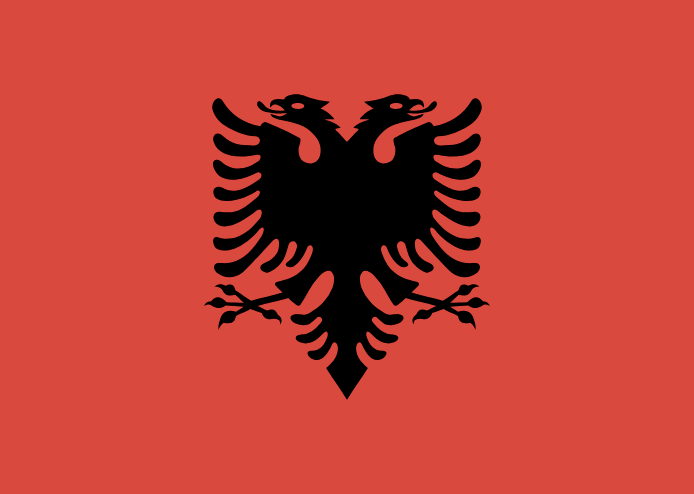
Albania
Author: Inès OGER
Published Date: June 10, 2026
Key data
Name: Republic of Albania
Status: candidate country for accession to the European Union
Captale: Tirana
Population: 2.4 million
Currency: Albanian lek (L)
Official language: Albanian
GDP: ~$33 billion (2026)
GDP per capita: ~$5,726 (2024)
Strategic historical landmarks
1939-1944 – Occupation by fascist Italy and then by Germany during the Second World War. Albania became a strategic space in the Balkans, used by the Axis powers to control the region. This period also strengthened the internal resistance movements (notably the communist partisans led by Enver Hoxha), laying the foundations for the communist seizure of power in 1944.
1946 – Establishment of the People’s Republic of Albania under Enver Hoxha. The new regime imposed itself as an authoritarian, centralized communist power, and aimed to profoundly transform society (collectivization, total political control). The main challenge is the consolidation of power in a very fragile state.
1961-1978 – Gradual isolation of the country: Albania breaks with the USSR in 1961 after the de-Stalinization initiated by Khrushchev, considered too ‘revisionist’ by Hoxha. It then turned to Maoist China, which provided it with economic and military support in exchange for its ideological alignment. However, relations deteriorated from 1972 onwards (criticism of the Sino-American rapprochement and Deng Xiaoping’s economic reformism). In 1978, the rupture was consummated, plunging Albania into total isolation.
1985 – Death of Enver Hoxha. The regime survives but loses its central figure. This disappearance opened a phase of political stagnation, where the communist system gradually began to weaken in the face of internal pressures (popular discontent, economic crisis) and external pressures (collapse of the Soviet bloc, fall of the Berlin Wall).
1991 – Fall of the communist regime and the first multiparty elections, won by Sali Berisha’s Democratic Party. The transition to democracy and a market economy is brutal and ill-prepared (savage economic liberalisation, political instability and social crisis).
1997 – Financial pyramid crisis: massive economic collapse after fraudulent savings schemes. The state lost much of its legitimacy and had to deal with quasi-insurrectionary unrest, revealing the fragility of the post-communist transition.
2009 – NATO joins. Albania is anchoring itself in Euro-Atlantic structures in order to stabilise its geopolitical position in the Balkans and strengthen its security, in a still fragile regional context.
2014 – Obtaining the status of candidate country for the European Union. This step marks a recognition of the reforms undertaken, but also a still long process, conditioned by issues of governance, corruption and the consolidation of the rule of law.
CURRENT POLITICAL STRUCTURE
Albania has been a consolidated parliamentary republic since 1998, based on a multi-party democratic system. The executive power is largely dominated by the Prime Minister, currently Edi Rama (since 2013), who concentrates most of the country’s political leadership. The President of the Republic, Bajram Begaj, plays a mainly representative and institutional role.
Political life is structured around a strong bipolarisation between the Socialist Party (PS) in power and the Democratic Party (PD) in opposition. This dynamic organizes alternations but also generates regular political tensions.
The institutional system formally operates on a democratic model, but remains marked by governance issues, including corruption and the consolidation of judicial independence.
Albanian policy is strongly oriented towards the outside world, with a central objective: integration into the European Union, complemented by anchoring in NATO since 2009.
Albania should also be understood as a pivotal state in the Euro-Atlantic strategy in the Western Balkans. Its stability is perceived as a factor in the ‘containment’ of regional fragilities (Bosnia-Herzegovina, Kosovo, North Macedonia). NATO and the EU see it as an actor of regional consolidation, particularly in the face of competing influences (Russia, China, Turkey) that seek to maintain or strengthen their presence in the area.
ECONOMIC STRUCTURE
Albania is an economy in transition, still marked by the post-communist legacy, but engaged in a process of convergence towards European standards. Growth is relatively stable, driven by consumption, tourism and investment, but it remains fragile and dependent on external factors. The economy is mainly based on services and agriculture, while industry remains limited. Remittances from the diaspora play a key role in supporting household incomes.
Despite macroeconomic improvements, Albania faces persistent structural challenges: high informality, unemployment and low productivity, in a context of reforms linked to European integration. FDI amounts to about $1.62 billion per year in 2023, mainly from the EU and Turkey.
INTERNATIONAL POSITIONING
Albania is now part of a Euro-Atlantic anchoring logic. A member of NATO since 2009, it has also been a candidate for membership of the European Union since 2014, which largely structures its foreign policy and internal reforms. The country has special relations with the United States and the EU states, which are considered its main strategic partners. This orientation can be explained by the search for stabilization of a historically unstable and fragmented Balkan space.
In the Western Balkans, Albania seeks to emerge as a factor of stability and regional cooperation, while pursuing its central objective of European integration. It also plays an indirect role in regional balances via the issue of Kosovo, which it strongly supports, which structures its relations with Serbia.
Strategic issues and vulnerabilities
- EU integration: Structuring political reforms (governance, rule of law, fight against corruption) to meet the accession criteria, but hampered by slow change, persistent corruption and political polarisation.
- Economic stability and diversification: Reducing dependence on tourism and diaspora remittances, while addressing informality and unemployment, in a context of a poorly diversified economy and low productivity.
- Stabilizing role in the Western Balkans: Strengthening regional cooperation and security, but limited by internal political instability, external influences (Russia, China, Turkey) and residual tensions.
- Human and demographic capital: Retaining young people and training a skilled workforce, in the face of mass emigration, an ageing population and an inadequate education system.
Prospective reading (2026-2030)
Albania’s development between now and 2030 depends mainly on its pace of internal reforms and its ability to make progress in the EU accession process.
Scenario 1 – Acceleration of European enlargement: Albania continues its institutional reforms (justice, fight against corruption, administration) and consolidates its political stability. The accession process is progressing more quickly, under the effect of a European geopolitical context that is more favourable to enlargement. This dynamic could be accompanied, in the long term, by increased economic convergence towards euro area standards, or even by preparations for monetary integration. Albania then strengthened its European anchorage and its internal stability.
Scenario 2 – Lasting blockage of enlargement: Internal political blockages (corruption, polarisation, institutional fragility) are added to the opposition of some EU Member States, which is slowing down or conditioning the progress of the negotiations. Bilateral tensions within the EU (notably between Bulgaria and some Balkan countries over identity and historical issues) are slowing down the process for a long time. Albania remains a candidate but is making slow progress, which maintains a form of institutional stagnation.
Scenario 3 – Rise of Russian, Turkish and Chinese influences: The slowdown in the European process favours a diversification of external partnerships. Turkey is strengthening its economic and cultural influence, China is reactivating certain strategic investments (infrastructure, energy), while Russia is acting mainly indirectly in the Balkans to maintain zones of influence and slow down the Euro-Atlantic anchoring of the region. This competition accentuates the geopolitical fragmentation of the Western Balkans and reduces the coherence of the European project.
Scenario 4 – Regional crisis in the Balkans: A deterioration in regional tensions (particularly around Kosovo and Serbia), combined with internal economic and political fragilities, leads to an increase in the risks of destabilization. Albania, because of its proximity to Kosovo and its regional role, could be indirectly drawn into these tensions. This scenario greatly slows down the European accession process and weakens regional stability.
Sources
- World Perspective, « Albania », Historical Review of Countries, Université de Sherbrooke: https://perspective.usherbrooke.ca/bilan/servlet/BMHistoriquePays/ALB
- Encyclopædia Universalis, « Albania », Geography – Encyclopédie Universalis: https://www.universalis.fr/encyclopedie/albanie/
- Clio, « Chronology of Albania », Historical Chronologies: https://www.clio.fr/CHRONOLOGIE/pdf/pdf_chronologie_lalbanie.pdf
- All of Europe, « Albania », Country profiles: https://www.touteleurope.eu/pays/albanie/
- Ministry for Europe and Foreign Affairs, « Presentation of Albania », Country Brief – Albania: https://www.diplomatie.gouv.fr/fr/information-par-pays/albanie/presentation-de-l-albanie
- Robert Schuman Foundation, « Albania today », Entretiens d’Europe: https://www.robert-schuman.eu/entretiens-d-europe/170-l-albanie-aujourd-hui
- Ministry of the Economy, Finance and Industrial and Digital Sovereignty,
- Directorate-General of the Treasury, « Indicators and economic conditions – Albania »: https://www.tresor.economie.gouv.fr/Pays/AL/indicateurs-et-conjoncture