
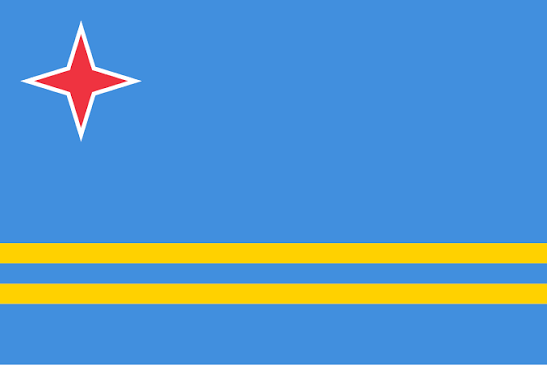

ARUBA
Authors: La Ligne Fine – Institut
Published Date: October 13, 2026
Key data
Official name: Aruba.
Capital : Oranjestad.
Political status : The constituent country of the Kingdom of the Netherlands, alongside the Netherlands, Curaçao, and Sint Maarten. Aruba has its own government, but defense, nationality, and some aspects of foreign affairs are the responsibility of the Kingdom[1].
Area : 180 km²
Population : Approximately 108,000 to 109,000 in 2025; the Central Bureau of Statistics of Aruba reports 109,435 at the end of the second quarter of 2025[2].
Languages : Papiamento and Dutch; English and Spanish are widely used in economic, tourist and regional exchanges.
Currency : Aruban guilder.
Head of state : King Willem-Alexander, represented in Aruba by a governor. The governor represents the interests of the Kingdom and is formally at the head of the local government, without participating in the day-to-day management of the cabinet[3].
Governor : Alfonso Boekhoudt[4].
Prime Minister : Mike Eman, at the head of an AVP/Futuro government that took office on 28 March 2025[5].
Current GDP : about $4.17 billion in 2024 according to World Bank data taken from the Federal Reserve Bank of St. Louis; the IMF indicates a nominal GDP of about $4.285 billion in 2024[6][7].
Growth: 7.6% in 2024 according to the IMF, after 8.9% in 2023; growth projected for 2026 is 2.3%.[8]
Public debt : 68.6% of GDP at the end of 2024, projected at 64.4% in 2025 and 50.4% in 2030 according to the IMF[9].
Driving sector : tourism, hospitality, related services, visitor spending, tourism real estate, port and airport activities. The IMF clearly identifies tourism as the main driver of the post-pandemic recovery[10].
European status: Aruba is not a territory of the European Union, but an overseas country and territory associated with the European Union by virtue of the constitutional link with the Netherlands[11].
- Executive Summary
Aruba is an autonomous Caribbean microterritory within the Kingdom of the Netherlands. Its small size should not lead to underestimating its strategic interest. The island is located in the southern Caribbean, in the immediate vicinity of Venezuela, at the crossroads of several dynamics: international tourism, maritime security, regional migration, energy transition, climate vulnerability, Dutch cooperation, association with the European Union and dependence on North American flows.
Aruba’s recent trajectory is based on a rapid economic recovery from the shock of the pandemic. The IMF points out that growth from 2021 to 2024 was driven by the rebound in tourism, private hotel investment, and the gradual improvement in the fiscal position. Real GDP grew by 8.9% in 2023 and 7.6% in 2024, while public debt rose from 116.3% of GDP in 2020 to 68.6% at the end of 2024. This macroeconomic improvement is real, but it is based on a narrow foundation: dependence on tourism[12].
The island has a successful economic model in the short term, but structurally vulnerable. Aruba benefits from a strong tourist attractiveness, a stable image, relative security, proximity to the North American, South American and European markets, as well as an institutional framework backed by the Kingdom of the Netherlands. In May 2026, Aruba welcomed 133,680 visitors, while cumulative visitor nights reached 1,515,102 in the first five months of the year[13].
However, this tourism specialisation creates a concentration effect. A shock to energy prices, air transport, US demand, regional security or the island’s environmental image can have immediate effects on activity, government revenues, employment and external accounts. The IMF insists on the need to continue to reduce debt, improve the tax system, regulate short-term tourist rentals and create fiscal space to finance public priorities[14].
Climate vulnerability is a second strategic axis. Aruba is a dry island, dependent on desalination infrastructure, exposed to rising sea levels, pressures on water resources, heat risks, coastal erosion and the weakening of its tourism model. An IMF study on climate adaptation in Aruba highlights that tourism is particularly vulnerable to climate change and that even modest negative impacts can have significant consequences on the balance of payments[15].
The proximity to Venezuela adds a security and migratory dimension. Aruba is not a territory in conflict, but its regional environment is unstable. The Aruban and Dutch authorities have maintained negative travel advisories for Venezuela, due to a situation described as tense and unpredictable near the Venezuelan coast[16].
The relationship with the Netherlands is therefore ambivalent: it guarantees a solid institutional and security framework, but it also recalls the limits of Aruban autonomy. The governor represents the Kingdom; the Dutch armed forces maintain a permanent presence in the Caribbean; maritime security mobilizes the Dutch Caribbean Coast Guard; and strategic decisions that go beyond the local level are partly the responsibility of The Hague[17].
Strategic reading : Aruba is a stable, prosperous and institutionally protected microterritory, but whose power is based on a fragile tourism specialization. Its main challenge is to convert its attractiveness into resilience: fiscal, climate, energy, social, security and productive resilience.
- Strategic historical landmarks
Aruba belongs to the Dutch Caribbean group. Its contemporary political history is part of the gradual transformation of the former Dutch colonial space into a differentiated institutional whole, composed of autonomous territories, special municipalities and variable links with the Netherlands and the European Union.
The island was part of the Netherlands Antilles for a long time before obtaining a separate status in 1986. This status allowed Aruba to become an autonomous country within the Kingdom of the Netherlands, with its own government, its Parliament, its internal public policies and a broad decision-making capacity on economic, social and administrative affairs. This autonomy did not mean complete independence: Aruba remained integrated into the Kingdom, particularly in terms of defence, nationality, certain external affairs and institutional guarantees.
This trajectory explains Aruba’s uniqueness. The island is neither a classic sovereign state, nor a territory administered directly from Europe, nor an outermost region of the European Union. It is a constituent country of the Kingdom of the Netherlands, associated with the European Union as an overseas country and territory. This status gives it its own political capacity, while placing it within a broader legal, diplomatic and security framework[18][19].
Recent economic history has been dominated by the rise of tourism. Aruba has gradually built an international image as a stable, safe, sunny destination that is strongly connected to North American markets. This specialization has allowed for a high level of per capita income and strong integration into international service flows. It has also reduced the margins for diversification, by concentrating employment, investment and tax revenues on a limited number of sectors.
The Covid-19 crisis was a major shock, because it abruptly interrupted the main engine of the economy. The rapid recovery of tourism after the pandemic confirmed the strength of Arub’s attractiveness, but it also highlighted the dependence of the economic model on international mobility, air capacity, visitor spending, energy costs and the perception of safety[20].
Strategic reading : Aruba’s contemporary history can be read as the transition from successful institutional autonomy to a question of economic resilience. The island has built a successful model, but this model remains exposed to shocks that its small size makes difficult to absorb alone.
- Current political structure
Aruba is a constituent country of the Kingdom of the Netherlands. The Kingdom consists of four countries: the Netherlands, Aruba, Curaçao and Sint Maarten. Each has its own government, while some competences remain exercised at the level of the Kingdom[21].
The governor of Aruba represents the King of the Netherlands. He has a dual role: to represent the interests of the Kingdom and to be formally at the head of the Aruban government. However, he does not participate in the day-to-day management of the cabinet and has no ministerial responsibility[22].
Since 28 March 2025, Aruba has been led by an AVP/Futuro government led by Mike Eman. The new cabinet was installed after the end of the Wever-Croes II government. Mike Eman serves as Prime Minister and Minister for General Affairs, Culture, Environment and Nature; Gerlien Croes holds the position of Vice-President of the Government and the portfolio of Kingdom Relations, Education, Youth, Innovation and Sport; Geoffrey Wever is in charge of Finance, Economic Affairs and the Primary Sector[23].
The Aruban political system is based on significant internal autonomy. The local government formulates public policies, prepares laws and determines their financial implications[24]. However, this autonomy is exercised under constraint: the small size of the territory, the dependence on tourism, the need to maintain budgetary discipline, the agreements with the Netherlands and the imperatives of regional security limit the government’s room for manoeuvre.
Aruba’s institutional stability is a strategic asset. Unlike many Caribbean states or territories facing recurrent political crises, Aruba benefits from a relatively predictable institutional framework, backed by the Kingdom of the Netherlands. This stability reinforces its attractiveness for visitors, investors, airlines, hotel operators and European partners.
The central political issue is therefore not one of immediate institutional instability, but that of the quality of economic governance. Aruba must continue to reduce its debt, modernize its tax revenues, regulate tourist rentals, invest in the energy transition, and preserve the balance between tourism growth, residents’ quality of life, and territorial sustainability. The IMF recommends strengthening revenues, improving tax compliance, and evaluating a transition to a broader VAT[25].
Strategic reading : Aruba has real political autonomy, but its functional sovereignty depends on its ability to finance its public policies, to control its vulnerabilities and to use the Dutch framework as a lever rather than a simple protection.
- Economic structure
Aruba’s economy is a service economy, with a strong focus on tourism. The post-pandemic recovery has been particularly fast: the IMF estimates that real GDP grew by 8.9% in 2023 and 7.6% in 2024, driven by the rebound in tourism and private hotel investment[26].
This performance has led to a significant fiscal improvement. Public debt, which had reached 116.3% of GDP in 2020, fell to 68.6% at the end of 2024. The IMF projects a decline to 64.4% in 2025 and 50.4% in 2030, provided that fiscal consolidation continues[27].
Tourism is at the heart of the business model. Data from the Aruba Tourism Authority shows sustained footfall in 2026. In May 2026, Aruba welcomed 133,680 overnight visitors; in August 2026, the island welcomed 145,750 overnight visitors, generating 967,001 visitor nights, with an average length of stay of 6.6 nights[28].
Spending data confirms the central role of tourism consumption. In 2025, Aruba recorded 1,028,071 Visa cardholders from 152 countries, for $696 million in spending. In the first half of 2026, 304,308 Visa cardholders spent $184.9 million on the island[29].
This specialization provides high incomes, but it creates three major vulnerabilities.
The first is cyclical. Aruba depends on the ability of foreign, mainly North American, households to travel and spend. An economic slowdown in the United States, an increase in the cost of air travel, a health crisis, or a deterioration in regional security perceptions can quickly be transmitted to the local economy.
The second is budgetary. Tourism feeds public revenues, but the small size of the territory limits fiscal diversification. The rise of short-term tourist rentals is forcing the authorities to improve registration, fiscal control and regulation. The IMF explicitly identifies the regulation of short-term vacation rentals as a lever for revenue and efficiency[30].
The third is social and territorial. Tourism exerts pressure on housing, infrastructure, prices, water, energy, waste, the coastline and the workforce. Tourism success can therefore have a saturation effect if it is not accompanied by urban, environmental and social planning.
Strategic reading: Aruba has succeeded in its economic recovery, but its prosperity remains concentrated in a single sector. The question is not only to attract more visitors, but to transform tourism into a driver of diversification, stable government revenues and resilient investment.
- Tourism, energy and structural dependencies
Tourism is Aruba’s main comparative advantage. The island enjoys an image of stability, an attractive climate, developed hotel infrastructure, a loyal international clientele and a high-end positioning in the Caribbean space. This specialization has made it possible to generate significant income and a high standard of living compared to many neighboring territories.
But tourism is also a dependency. The local economy is particularly exposed to energy costs, supply chains, food imports, air transport, and critical infrastructure. The IMF points out that Caribbean economies that depend on tourism and import energy are particularly vulnerable to oil shocks and fuel price increases[31].
Energy is therefore a strategic issue. Aruba still depends on an insular energy system, which is expensive, exposed to imports and grid constraints. The Dutch government and the Aruba authorities have engaged in discussions and support for the energy transition, particularly in the context of the transformation of the former refinery site into an innovation, renewable energy and circular economy zone. The government of Aruba has announced that the Netherlands will provide 110 million guilders in financial assistance to support this transition and the rehabilitation of the former refinery area[32].
The island is also working to strengthen its energy security. The expansion of electricity production capacities, in particular through the RECIP-3 project, aims to guarantee supply while preparing for the integration of a larger share of solar and wind energy into the mix[33].
The energy transition must be analysed as a question of functional sovereignty. For an island micro-territory, reducing dependence on energy imports, stabilising the cost of electricity, securing water desalination, supplying tourism infrastructure and protecting essential services is a challenge for economic continuity. Aruba’s national strategic plan for 2030 explicitly aims to substantially reduce carbon emissions and stabilise the cost of energy at an acceptable and affordable level[34].
Strategic reading: tourism has created prosperity in Arubais; energy will determine its sustainability. Without a credible energy transition, tourism dependence will remain exposed to external shocks, import costs and climate constraints.
- Regional and international positioning
Aruba occupies a singular position in the Caribbean. It is Caribbean by its geography, Dutch by its belonging to the Kingdom of the Netherlands, European by the OCT association with the European Union, and South American by its immediate proximity to Venezuela.
Its relationship with the European Union is indirect but important. Aruba is not a territory of the Union and is not directly subject to European law. It does, however, enjoy association status as an overseas country and territory linked to the Netherlands. The OCTs are not part of the territory of the Union, but the association aims to support their economic and social development and to establish close economic relations with the Union[35].
This position provides Aruba with access to European cooperation mechanisms, funding and programmes, without fully integrating it into the internal market. The inhabitants of the Caribbean territory of the Kingdom of the Netherlands have Dutch nationality and European citizenship, but the islands themselves are not territories of the European Union[36].
The relationship with the Netherlands is central. It provides a legal, diplomatic and security framework. The Dutch armed forces maintain a permanent presence in the Caribbean to carry out military and certain police missions, including support to the coast guard. A company of the Dutch Marine Corps is present in Aruba[37].
Proximity to Venezuela is the other geopolitical determinant. Aruba is located near a state in political, economic and security crisis. The Arubai and Dutch authorities have maintained negative travel advisories to Venezuela, citing a tense and unpredictable situation in the Caribbean Sea near the Venezuelan coast[38].
This proximity creates historical, commercial, migratory and security interdependencies. Along with Curaçao, Aruba is one of the Kingdom of the Netherlands’ forward lines in the face of the regional effects of the Venezuelan crisis. Specialized analyses have highlighted that tens of thousands of Venezuelans have sought refuge in Aruba and Curaçao, and that irregular sea crossings carry significant humanitarian risks[39].
Strategic reading : Aruba is an interface territory. Its stability depends on its internal autonomy, the protection of the Kingdom, its association with the European Union and its ability to manage the neighbourhood effects linked to Venezuela.
- Security, migration and regional vulnerabilities
Aruba does not face a direct military threat comparable to that of some states exposed to territorial disputes. The security risk is mainly maritime, migratory, criminal and regional.
External security and defence are the responsibility of the Kingdom of the Netherlands. Dutch forces in the Caribbean contribute to land and maritime security, support the Coast Guard, monitor the waters around the islands, and participate in the fight against violent crime, drug trafficking, and criminal migration in Curaçao, Sint Maarten, and Aruba[40].
The Dutch Caribbean Coast Guard plays a structuring role. It has its origins in the mechanisms put in place to combat drug and human trafficking from Venezuela and Colombia to neighbouring islands. The Government of Aruba recalls that the Netherlands Antilles and Aruba Coast Guard was established in 1996 to respond to the scale of this trafficking in the 1980s and 1990s[41].
The Venezuelan crisis amplifies this monitoring function. Aruba must manage human flows, the risks of detention or incidents at sea, trafficking, potential diplomatic tensions and the need for coordination with The Hague. The territory is too small to absorb a massive migratory or security shock on its own; the Kingdom’s support therefore remains decisive.
Aruba’s security challenge is also infrastructural. The island depends on a few critical points: airport, port, water and electricity networks, hotel infrastructure, desalination facilities, digital networks and coastal routes. The security of a tourist microterritory is not limited to police or defense; it includes the protection of critical infrastructure and the continuity of services.
Strategic reading : Aruba is secured by its belonging to the Kingdom of the Netherlands, but its vulnerability lies in its proximity to an unstable regional environment and the concentration of its critical infrastructure on a small island space.
- Risks and vulnerabilities
The first risk is economic: dependence on tourism. The post-pandemic recovery has confirmed the strength of the Aruban model, but it has also shown its concentration. A decline in tourism demand or visitor spending would directly affect government revenues, employment, hotel investment and external accounts.
The second risk is fiscal. Debt has declined since the peak in 2020, but remains high for a small island territory. The IMF insists on the need to continue debt reduction and create fiscal space to finance long-term priorities[42].
The third risk is energy. Aruba imports a significant portion of its energy and remains exposed to international price fluctuations. A sustained increase in oil or transportation costs can be passed on to prices, households, tourism businesses, and public finances.
The fourth risk is climatic. Projections of more erratic rainfall increase pressure on water resources, while rising sea levels, coastal erosion, rising temperatures and the risk of damage to infrastructure threaten the tourism model[43].
The fifth risk is environmental. The concentration of activity on the coast, real estate pressure, waste, water consumption, artificialization and the fragility of ecosystems can degrade the natural capital that supports tourist attractiveness.
The sixth risk is social. The cost of housing, dependence on service jobs, pressure on household incomes, inequalities linked to tourism and the coexistence between the resident population and the tourist economy can become subjects of tension.
The seventh risk is migratory and regional. Venezuela’s proximity exposes Aruba to migratory flows, maritime tensions, humanitarian issues and the risk of transnational crime[44].
The eighth risk is institutional. Aruba has significant autonomy, but this autonomy remains enshrined in the Kingdom. The trade-offs between local autonomy, budgetary requirements, Dutch support and guarantees from the Kingdom can become sensitive, especially in times of crisis.
Strategic reading : the Aruban risk does not come from immediate instability, but from an accumulation of dependencies: tourism, energy, imports, climate, Venezuelan neighbourhood and Dutch institutional support.
- Opportunities and dynamics to follow
The first opportunity is to move upmarket in tourism. Aruba has a strong brand and robust attendance. The challenge is to move from a quantitative to a qualitative logic: visitors with higher added value, better taxation of tourist rentals, sustainable tourism, limitation of coastal saturation, integration of residents into economic benefits.
The second opportunity is the energy transition. The development of solar, wind, storage and more resilient grids can reduce dependence on imports, stabilise costs and improve economic security. The transformation projects of the former refinery site, Dutch financial support and investments in energy resilience are important signals[45].
The third opportunity is the circular economy. For an island of 180 km², the management of waste, water, energy and space is not a sectoral policy: it is a condition for the viability of the economic model. The transition to a sustainable and inclusive model is already identified by the authorities as a public policy objective[46].
The fourth opportunity is European cooperation. The status of overseas country and territory can allow Aruba to mobilize programs, technical partnerships and cooperation on climate, energy, education, mobility and economic development, without being subject to all the obligations of the European territory of the Union[47].
The fifth opportunity is maritime security. In a Caribbean environment marked by traffic, the Venezuelan crisis and the importance of port infrastructure, Aruba can strengthen its function as a safe and stable platform, under the Dutch umbrella.
The sixth opportunity is digital and educational. The island can develop higher value-added services, including training, digital services, the creative economy, business services and tourism innovation. This diversification will remain limited by the size of the market, but it can reduce dependence on strictly hotel employment.
Strategic reading : Aruba cannot become a diversified economy in the continental sense of the term. Its realistic objective is functional diversification: to produce more value, better capture tourism rents, reduce energy bills, secure infrastructure and strengthen climate resilience.
- Points of vigilance
The first point to watch is the trajectory of tourism: staycation arrivals, average duration, spending per visitor, North American share, reliance on airlines, growth in short-term rentals, and housing pressure.
The second point is public debt. The decline in debt since 2020 is positive, but it must be maintained. Any tourism slowdown, energy shock or increase in public spending can weaken the fiscal trajectory.
The third point is tax reform. The regulation of short-term tourist rentals, tax compliance, the efficiency of revenue administration and the possible reform of indirect taxation will be decisive in creating fiscal space[48].
The fourth point is energy. Aruba’s ability to accelerate renewables, modernize its grid, secure desalination, and limit exposure to international prices will determine its economic resilience.
The fifth point is water. Aruba has already adapted its model to a dry climate through desalination, but climate change can increase pressure on water resources and the cost of water management[49].
The sixth point is the coastline. Hotels, accommodation, infrastructure and tourism activities are concentrated in coastal areas. Sea level rise, erosion, storms and floods can directly affect economic assets.
The seventh point is Venezuela. Regional tensions, migration flows, maritime security and travel advisories must be closely monitored. Aruba cannot dissociate its stability from the evolution of the Venezuelan neighbourhood.
The eighth point is the relationship with the Netherlands. Dutch support is an asset, but it can also become a point of tension if budgetary, climatic or institutional requirements are perceived as a limitation of local autonomy.
The ninth point is social capital. The tourism model will only be sustainable if it remains socially acceptable for residents: housing, wages, employment, access to services, cost of living and preservation of public space.
- Final strategic reading
Aruba is a stable micro-territory, rich on a Caribbean scale and institutionally protected by its belonging to the Kingdom of the Netherlands. Its political autonomy allows it to conduct its internal policies, while the Dutch framework provides it with a security, legal and diplomatic guarantee.
But this stability is based on a highly concentrated economic base. Tourism is both the country’s strength and vulnerability. It generates income, employment, investment and international visibility, but it also exposes the island to external shocks, energy prices, climate, real estate pressure, health crises and variations in international demand.
Aruba’s strategic challenge is therefore not to abruptly change its model. It is to make its model less fragile. This means better taxing tourism rents, investing in the energy transition, strengthening climate resilience, protecting critical infrastructure, managing real estate pressure and mobilising the link with the Netherlands and the European Union as a lever for transformation.
Aruba will not become a regional power in the classic sense. On the other hand, it can become a case of island micro-resilience: a territory capable of converting a high-performance tourism specialization into a sustainable model, more energy autonomous, fiscally more robust, socially more balanced and better prepared for the climate.
Final strategic reading : Aruba is an autonomous but interdependent territory, prosperous but vulnerable, stable but exposed. Its trajectory will depend on its ability to transform tourism rent into sustainable resilience.
[1] Rijksoverheid, n.d., https://www.rijksoverheid.nl/vraag-en-antwoord/caribische-deel-van-het-koninkrijk/waaruit-bestaat-het-koninkrijk-der-nederlanden
[2] Central Bureau of Statistics Aruba, 2025, https://cbs.aw/wp/index.php/2025/12/15/test-births/
[3] Government of the Netherlands, n.d., https://www.government.nl/themes/government-and-democracy/caribbean-parts-of-the-kingdom/governance-of-aruba-curacao-and-st-maarten
[4] Kabinet van de Gouverneur van Aruba, 2025, https://www.kabinetaruba.nl/nieuws/01/04/2025/aruba-heeft-een-nieuwe-regering
[5] Kabinet van de Gouverneur van Aruba, 2025, https://www.kabinetaruba.nl/nieuws/01/04/2025/aruba-heeft-een-nieuwe-regering
[6] Federal Reserve Bank of St. Louis, 2024, https://fred.stlouisfed.org/series/MKTGDPAWA646NWDB
[7] International Monetary Fund, 2025, https://www.imf.org/en/news/articles/2025/12/01/pr25401-the-kingdom-of-the-netherlands-aruba-imf-concludes-article-iv-consultation-discussions
[8] International Monetary Fund, 2025, https://www.imf.org/en/news/articles/2025/12/01/pr25401-the-kingdom-of-the-netherlands-aruba-imf-concludes-article-iv-consultation-discussions
[9] International Monetary Fund, 2025, https://www.imf.org/en/news/articles/2025/10/07/cs-kingdom-of-the-netherlands-aruba-concluding-statement-of-the-2025-article-iv-mission
[10] International Monetary Fund, 2025, https://www.imf.org/en/news/articles/2025/10/07/cs-kingdom-of-the-netherlands-aruba-concluding-statement-of-the-2025-article-iv-mission
[11] European Commission, n.d., https://taxation-customs.ec.europa.eu/customs/rules-origin-goods/preferential-rules-origin/overseas-countries-and-territories-octs_en
[12] International Monetary Fund, 2025, https://www.imf.org/en/news/articles/2025/10/07/cs-kingdom-of-the-netherlands-aruba-concluding-statement-of-the-2025-article-iv-mission
[13] Government of Aruba, 2026, https://www.gobierno.aw/en/ata-releases-may-2026-results
[14] International Monetary Fund, 2025, https://www.imf.org/en/news/articles/2025/10/07/cs-kingdom-of-the-netherlands-aruba-concluding-statement-of-the-2025-article-iv-mission
[15] International Monetary Fund, 2025, https://www.elibrary.imf.org/view/journals/002/2025/316/article-A002-en.xml
[16] Government of Aruba, 2026, https://www.gobierno.aw/en/update-negative-travel-advisory-for-venezuela-situation-remains-tense-and-unpredictable
[17] Government of the Netherlands, n.d., https://www.government.nl/themes/government-and-democracy/caribbean-parts-of-the-kingdom/governance-of-aruba-curacao-and-st-maarten
[18] Rijksoverheid, n.d., https://www.rijksoverheid.nl/vraag-en-antwoord/caribische-deel-van-het-koninkrijk/waaruit-bestaat-het-koninkrijk-der-nederlanden
[19] European Commission, n.d., https://taxation-customs.ec.europa.eu/customs/rules-origin-goods/preferential-rules-origin/overseas-countries-and-territories-octs_en
[20] International Monetary Fund, 2025, https://www.imf.org/en/news/articles/2025/10/07/cs-kingdom-of-the-netherlands-aruba-concluding-statement-of-the-2025-article-iv-mission
[21] Rijksoverheid, n.d., https://www.rijksoverheid.nl/vraag-en-antwoord/caribische-deel-van-het-koninkrijk/waaruit-bestaat-het-koninkrijk-der-nederlanden
[22] Government of the Netherlands, n.d., https://www.government.nl/themes/government-and-democracy/caribbean-parts-of-the-kingdom/governance-of-aruba-curacao-and-st-maarten
[23] Kabinet van de Gouverneur van Aruba, 2025, https://www.kabinetaruba.nl/nieuws/01/04/2025/aruba-heeft-een-nieuwe-regering
[24] Government of Aruba, n.d., https://www.gobierno.aw/en/governance-administration
[25] International Monetary Fund, 2025, https://www.imf.org/en/news/articles/2025/10/07/cs-kingdom-of-the-netherlands-aruba-concluding-statement-of-the-2025-article-iv-mission
[26] International Monetary Fund, 2025, https://www.imf.org/en/news/articles/2025/12/01/pr25401-the-kingdom-of-the-netherlands-aruba-imf-concludes-article-iv-consultation-discussions
[27] International Monetary Fund, 2025, https://www.imf.org/en/news/articles/2025/10/07/cs-kingdom-of-the-netherlands-aruba-concluding-statement-of-the-2025-article-iv-mission
[28] Government of Aruba, 2026, https://www.gobierno.aw/en/ata-releases-may-2026-results
[29] Government of Aruba, 2026, https://www.gobierno.aw/en/ata-shares-the-january-2026-result
[30] International Monetary Fund, 2025, https://www.imf.org/en/news/articles/2025/10/07/cs-kingdom-of-the-netherlands-aruba-concluding-statement-of-the-2025-article-iv-mission
[31] Reuters, 2026, https://www.reuters.com/world/americas/imf-says-middle-east-war-deepen-economic-divide-latin-america-caribbean-2026-04-17/
[32] Government of Aruba, 2026, https://www.gobierno.aw/en/aruba-opens-a-new-chapter-for-a-sustainable-future
[33] Government of Aruba, 2026, https://www.gobierno.aw/en/expansion-of-recip-3-is-a-major-step-for-arubas-energy-security
[34] Government of Aruba, 2020, https://www.deaci.aw/wp-content/uploads/2020/11/FINAL-NSP-REPORT-STRATEGY-10202020.pdf
[35] European Commission, n.d., https://taxation-customs.ec.europa.eu/customs/rules-origin-goods/preferential-rules-origin/overseas-countries-and-territories-octs_en
[36] European Commission Representation in the Netherlands, n.d., https://netherlands.representation.ec.europa.eu/over-ons/status-caribisch-gebied_nl
[37] Ministry of Defence of the Netherlands, n.d., https://english.defensie.nl/topics/n/national-security/in-the-caribbean
[38] Government of Aruba, 2026, https://www.gobierno.aw/en/update-negative-travel-advisory-for-venezuela-situation-remains-tense-and-unpredictable
[39] Center for Strategic and International Studies, 2024, https://www.csis.org/analysis/forgotten-frontlines-aruba-curacao-and-venezuelan-displacement-crisis
[40] Ministry of Defence of the Netherlands, n.d., https://english.defensie.nl/topics/c/caribbean/tasks-in-the-caribbean
[41] Government of Aruba, 2026, https://www.gobierno.aw/en/dutch-caribbean-coast-guard-celebrates-30th-anniversary
[42] International Monetary Fund, 2025, https://www.imf.org/en/news/articles/2025/10/07/cs-kingdom-of-the-netherlands-aruba-concluding-statement-of-the-2025-article-iv-mission
[43] International Monetary Fund, 2025, https://www.elibrary.imf.org/view/journals/002/2025/316/article-A002-en.xml
[44] Government of Aruba, 2026, https://www.gobierno.aw/en/update-negative-travel-advisory-for-venezuela-situation-remains-tense-and-unpredictable
[45] Government of Aruba, 2026, https://www.gobierno.aw/en/aruba-opens-a-new-chapter-for-a-sustainable-future
[46] Government of Aruba, 2026, https://www.gobierno.aw/en/arubas-transition-to-a-sustainable-inclusive-economic-model
[47] European Commission, n.d., https://international-partnerships.ec.europa.eu/countries/overseas-countries-and-territories_en
[48] International Monetary Fund, 2025, https://www.imf.org/en/news/articles/2025/10/07/cs-kingdom-of-the-netherlands-aruba-concluding-statement-of-the-2025-article-iv-mission
[49] International Monetary Fund, 2025, https://www.elibrary.imf.org/view/journals/002/2025/316/article-A002-en.xml