
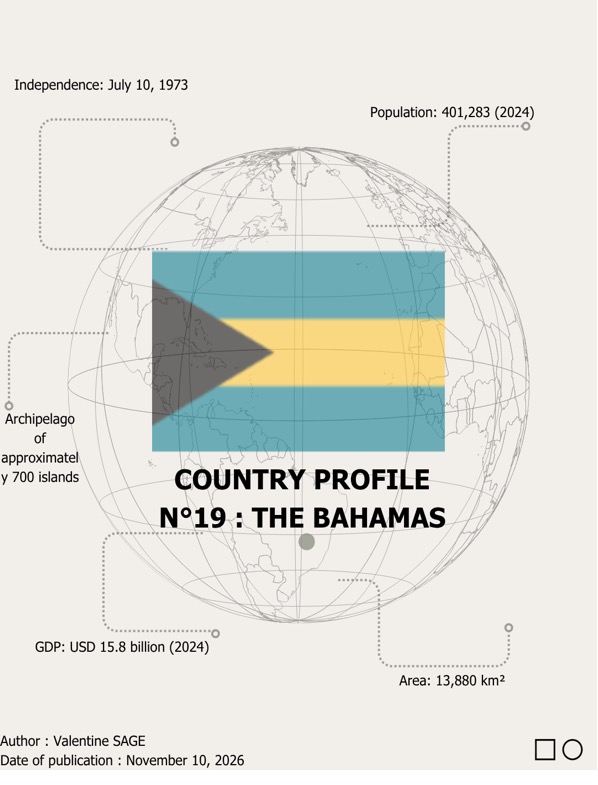
- KEY DATA
[1]Official name : Commonwealth of the Bahamas.
Capital : Nassau.
Population : 401,283 inhabitants (World Bank, 2024)
Area : 13,880 km².
Territorial organization: The territory is divided between 700 islands, of which only fifteen are inhabited.
Official language : English.
Currency : Bahamian dollar (BSD), pegged to the US dollar at a fixed parity.
Nature of the regime : Parliamentary constitutional monarchy of the British type.
Head of state: King Charles III, represented locally by a Governor-General Dame Cynthia A. Pratt (since September 1, 2022).
Head of Government : Mr. Philip E. Davis, Prime Minister (elected on 17 September 2021).
Parliament : Bicameral: The House of Assembly has 41 elected members and the Senate has 16 appointed members.
GDP: $15.8 billion (USD) (World Bank, 2024).
Inflation : 1.1% (World Bank 2024).
Employment : Unemployment rate 8.5% (World Bank 2025).
Structuring sectors of the economy : Services (86% of GDP), Industry (13%) and Agriculture (1%) (World Bank 2016).
Key issues : Economic dependence on tourism, imports of goods and foreign capital; vulnerability to climate change and natural disasters; a stable political system that needs to be more transparent.
- EXECUTIVE SUMMARY
The Bahamas is an island state in the Caribbean, benefiting from a strategic geographical position in the immediate vicinity of the United States, Cuba and the main Atlantic shipping routes. Its institutional stability, relatively high level of wealth and tourist and financial attractiveness make it an important regional player, but its room for manoeuvre is limited by its dependence on tourism and its exposure to climate risks.
The economy of the Bahamas is largely dependent on tourism, which accounts for 40% of GDP and 50% of employment[2]. This sector has developed significantly since its independence in 1973, thanks to its paradisiacal beaches, its diverse marine life and its direct proximity to the United States. This specialization supports growth, but exposes the archipelago to fluctuations in tourism demand and external shocks. The country also benefits from a lot of foreign capital, attracted by a liberal tax regime (no income taxes, no inheritance tax, etc.), which has encouraged the establishment of financial and banking companies.
On the political front, the re-election of Philip Davis as leader of the Progressive Liberal Party in May 2026 reinforces the continuity of government, which until now had been subject to an almost perfect alternation with the opposition party, the Free National Movement. However, issues relating to the transparency of public life, the independence of institutions and the fight against corruption remain issues of institutional consolidation.
Finally, Bahamian foreign policy is based on a balance between close cooperation with Washington and the desire to diversify its partnerships. Its strong presence in regional institutions allows it to maintain an essential role in the balance of the area, and in particular in the fight against international trafficking and the management of migratory flows. The preservation of national sovereignty, the security of maritime space and adaptation to climate change represent the main strategic challenges of the archipelago today.
- HISTORICAL LANDMARKS
It was the explorer Christopher Columbus who discovered the Bahamas archipelago in 1492, discovering at the same time the Arawaks, an Amerindian people of the West Indies. The latter were deported by the Spanish between 1492 and 1508 to the mines of Hispaniola (now Santo Domingo). The islands remained very sparsely populated until the arrival of the colonists[3].
The country was disputed between Spanish and British colonists and pirates. It was after the accession to the throne of Charles I that he invested a royal governor for the Bahamas, making it possible to wage war against pirates and establish commercial activities. In 1782, the archipelago was attacked by a union between the Americans and the Spanish, who seized Nassau for only a few months before it was recovered by the British.
The British colonists did not settle until 1649, and the Parliament of London established its direct control there in 1729, control confirmed by the Treaty of Versailles of 1783.
The islands developed on the cultivation of plantations by slaves, but prosperity was regularly undermined by the raids of French and Spanish pirates during the seventeenth and eighteenth centuries.
As the economy was essentially based on the exploitation of slaves, the abolition of slavery in 1838 represented a real threat. The reception of blockade ships during the American Civil War allowed for a new prosperity.
In 1950, the Liberal Progressive Party was created and represented the majority of the population of African descent. In 1964, internal autonomy was granted to the archipelago, and thanks to a new Constitution of 1969, the competence of the local government extended to foreign affairs, defence and internal security.
The Progressive Liberal Party government elected in September 1972 immediately demanded full independence, which was decided on 10 July 1973 during the conference bringing together representatives of the British government and the two main political leaders of the archipelago (Messrs. Pindling for the PLP and Kendal Isaacs for the FNM), specifying however that the Bahamas would remain a member of the Commonwealth[4].
The country is now developing on a service economy based on tourism and offshore financial services. It is regularly the scene of natural disasters, including hurricanes, making it fragile and vulnerable. The archipelago is still a Commonwealth realm today, i.e. a constitutional monarchy that recognises the British monarch as its own official head of state.
- ECONOMIC SITUATION
The Bahamas is the third richest country in the Americas, behind the United States and Canada, with a GDP per capita of $39,455[5]. The economy is mainly based on tourism, the financial sector and foreign private investment.
The economy of the Bahamas depends largely on tourism, mainly from the United States, and therefore more broadly from the service sector. Tourism accounts for about 85% of exports, 40% of GDP and 50% of employment[6]. The tourism sector supports employment, foreign exchange earnings, tax revenues, trade and construction. According to the government, about 12.5 million visitors were recorded in 2025[7]. However, the import of capital and consumer goods needed by the tourism sector is thus widening the trade deficit. In addition, the dependence on foreign visitors, imports and international investment exposes the country to external shocks[8].
After the sharp contraction in 2020 due to the Covid-19 crisis, the IMF observes an increase of 3.4% in 2024 and estimates growth of 2.2% for 2026. However, growth is expected to slow further to 1.5% in the medium term, due to the limited capacity of the tourism sector and the expected slowdown in cruise growth[9].
Another pillar of the economy is supported by the financial sector, which accounts for between 15% and 20% of the Bahamas’ GDP[10], including private banks, wealth management and trust services. The country is indeed extremely attractive as an international financial centre as there are no personal or corporate income taxes.
This therefore requires greater compliance with tax transparency and anti-money laundering standards. The requirement for physical representation in the Bahamas introduced by the Central Bank in 2001 through the Banks and Trust Companies Regulations Act has reduced the number of offshore banks. The Bahamas is no longer on the European Union’s list of non-cooperative countries and territories for tax purposes. The country is also placed under enhanced surveillance by the FATF, with which they cooperate [11]closely. However, the country’s reputation is now tarnished and needs to be rebuilt.
The Bahamian economy is also driven by foreign private investment concentrated in construction. Indeed, there is external investment in tourism infrastructure projects and in energy, where an ambitious modernization program aims to reduce high costs. Among the flagship projects is the renovation of the New Providence electricity grid (estimated at $130 million) which is due to be completed by 2027/2028[12].
Despite a relatively wealthy economy, imported inflation via fuel, transport and food prices is weighing on household purchasing power, but should be partly offset by tourism spillovers. The adoption of the Sand Dollar, the digital currency introduced by the Central Bank of the Bahamas in 2020, is also expected to support private consumption[13].
The Bahamas also remains highly dependent on imports of goods, due to its specialization in services and a weak productive base. According to UN-Comtrade data, merchandise imports reached $4.94 billion in 2024, compared to about $670 million in exports, resulting in a goods trade deficit of about $4.27 billion[14]. Imports include petroleum and other fuel products, vehicles, machinery, and food products on which not only households but also tourism depend.
The country’s top supplier is the United States, which accounted for 85.6% of the Bahamas’ merchandise imports in 2024. The European Union (2.8%) is the second largest supplier, and China (2.5%) is the third[15].
The Bahamian economy also suffers from numerous natural disasters, including hurricanes that occur regularly (Dorian in 2019, Maria and Irma in 2017, Matthew in 2016, Joaquin in 2015 and Irene in 2011), resulting in significant reconstruction and social aid costs. These natural disasters are one of the reasons for the uneven economic growth of the archipelago since 2010[16].
The Bahamas is thus benefiting from an economic recovery driven by tourism and foreign investment. However, although fluctuations are expected to stabilize, medium-term growth potential remains limited by dependence on tourism, the external deficit and vulnerability to natural disasters. For long-term development, the archipelago must focus on economic diversification, energy reform and climate resilience.
- DOMESTIC POLICY
The Bahamas regime is a parliamentary constitutional monarchy of the British type. In this sense, the head of state is King Charles III, represented locally by a governor general appointed after deliberation by the cabinet. The head of government is the Prime Minister, leader of the party that wins the legislative elections.
The Senate is composed of 16 members appointed by the Governor General, 9 of whom are nominated by the Prime Minister, 4 by the Leader of the Opposition and 3 by mutual agreement.
The House of Representatives is made up of 41 members elected by direct universal suffrage for 5 years.
Since 2021, the Prime Minister has been Philip Davis, head of the Progressive Liberal Party (PLP). He was re-elected in the legislative elections of 12 May 2026 and his party won 33 of the 41 seats in the House of Representatives, compared to 8 for his political opponent[17]. This allows him to serve a second consecutive term, a first in nearly thirty years. Indeed, the Bahamian system is bipartisan, and there is an almost perfect alternation between the two competing parties: the Progressive Liberal Party (PLP, centre-left tendency) and the Free National Movement (FNM, centre-right tendency).
The main objectives for this new mandate are the fight against crime, improving access to healthcare and education, reducing the cost of living, immigration and the economic development of the outer islands[18].
However, there are questions about the independence of electoral institutions. Indeed, the department in charge of voter registration and several electoral functions is under the executive, which calls into question its autonomy. After the elections of May 12, 2026, the Commonwealth and the Organization of American States (OAS) recommended the creation of an independent authority as well as specific legislation on campaign financing in order to strengthen transparency, while still noting the competitive and credible nature of the election[19].
In addition, corruption in the administration and law enforcement remains another main concern and is considered a serious problem. Drug trafficking cases involving public officials have revealed the weaknesses of control mechanisms, although this does not involve the entire government[20].
Ultimately, despite political stability, the Bahamas still needs to strengthen the transparency of public life, the independence of oversight mechanisms and the fight against corruption in order to strengthen citizens’ trust in its institutions.
- REGIONAL GEOPOLITICAL ISSUES
The Bahamas has a strategic geographical position in the Atlantic Ocean, in the immediate vicinity of Florida, Cuba and the maritime routes linking North America to the Caribbean. This situation allows it to have an important role in terms of trade, maritime surveillance and the management of migratory flows. However, this position exposes it to drug trafficking routes.
The archipelago is a member of the Caribbean Community (CARICOM), which promotes regional political, economic and security coordination. Although participating in the region’s cooperation initiatives, the Bahamas is not part of the single market, the single economy, or the CARICOM customs union. However, it is associated with other Caribbean states in order to advocate for better consideration of their exposure to climate risks in international institutions[21].
One of the major regional challenges is the Haitian crisis. The Bahamas is facing political and security instability on the island, leading to an increase in maritime migration and humanitarian needs. The archipelago is a destination for illegal migrants from Haiti who wish to go to the United States but remain in the Bahamas because they are unable to do so. It is estimated that 70,000 illegal immigrants are periodically repatriated by the security forces[22].
The Bahamas is participating in CARICOM efforts to restore stability in Haiti and the region in general[23].
Transnational crime is also an issue due to the geography of the archipelago, its high number of islands and the extent of its territorial waters, making it difficult to monitor the routes used for drug trafficking, smuggling and irregular migration. In this sense, the Bahamas represents a strategic partner for the United States, due to the shared maritime border. Their collaboration includes the fight against drug trafficking, arms trafficking and irregular migration, particularly within the framework of the regional operation OPBAT, which allows the Bahamian authorities to benefit from the support of the United States Coast Guard[24].
However, this cooperation is accompanied by the challenge of maintaining sovereignty for the Bahamas. Indeed, in September 2026, their ambassador to the United States denounced alleged unauthorized operations by American agents of the Drug Enforcement Administration (DEA) on Bahamian territory. This privileged relationship thus remains asymmetrical and exposes the archipelago to American decisions concerning trade, migration and the regional policy on which it depends.
Its geographical proximity to Cuba allows it to maintain diplomatic relations, particularly on migration issues, education and disaster management. However, the Bahamas is in a delicate position between Washington and Havana. The Bahamian government has notably spoken out in favour of lifting the US economic embargo, thus demonstrating its desire to preserve balanced regional relations despite its privileged relations with the United States[25].
Its geographical location places the Bahamas at the heart of regional issues, while forcing it to strengthen its sovereignty and its role in the region.
- FOREIGN POLICY AND DEFENCE
In terms of foreign policy, the Bahamas prioritizes multilateralism, regional cooperation, and the defense of its sovereignty as a small island state. It is a member of the UN, the Commonwealth, CARICOM, and the Organization of American States (OAS). It also participates in the Non-Aligned Movement.
Their main defence force is the Royal Bahamas Defense Force (RBDF), whose main missions are the defence of territorial integrity, the surveillance of national waters, the fight against trafficking, assistance during disasters and humanitarian operations. The Royal Police provides internal security[26].
The Bahamas has very good relations with the United States, despite the archipelago’s refusal to take in migrants deported from the United States in 2024. Washington remains the first trading partner, the first source of tourists and the main investor for the Bahamas[27]. About 32,000 Bahamians live on American territory as legal residents, allowing a total interweaving of the two territories.
The archipelago benefits from significant support from Washington from a security point of view: since 1982, the country has benefited from a coordination mechanism between the Pentagon, the Drug Enforcement Administration (DEA) and the Coast Guard in the fight against trafficking for OPBAT (Operation Bahamas, Turks & Caicos). Since May 2010, the Caribbean Basin Security Initiative (CBSI) has completed this system, providing the Bahamian forces with equipment and training[28].
The Bahamas is a member of CARICOM and the Association of Caribbean States, and participates in the missions without seeking to deepen its integration into the regional market, the Caribbean Single Market & Economy.
However, although the Bahamas does not participate in the CARICOM common market project, it is still a signatory to the Economic Partnership Agreement between the European Union and CARICOM, signed in Barbados on 15 October 2008) [29].
The Bahamas maintains good relations with France, which are based on regular political dialogue, mainly in a regional and multilateral framework. Geographical proximity to French communities and common interests in terms of maritime security, the fight against illicit trafficking and the management of natural risks and the protection of the environment also strengthen trade[30].
The Bahamian government also continues to seek to diversify its partnerships, as evidenced by the agreement signed with the United Arab Emirates in 2022 to promote tourism between the two countries and the partnership with Botswana in 2023, to strengthen tourism and financial services cooperation[31]. The archipelago is also developing its economic and diplomatic relations with China, particularly in infrastructure, health, solar energy and food security. The two countries strengthened their economic dialogue and cooperation in 2026, and Nassau reaffirmed its adherence to the one-China principle[32]. However, these initiatives do not reverse the weight of the archipelago’s economic dependence on the United States.
The strategic position of the Bahamas gives it an essential role in the Atlantic Ocean. However, the limited means of defence and the size of the archipelago make international cooperation essential. The challenge then lies in preserving national sovereignty, while taking advantage of security partnerships.
- ENVIRONMENTAL ISSUES
The Bahamas is highly vulnerable to climate change. As an archipelago in the Caribbean, there are several risks to consider:
- The first is the rise in sea level, since the very low altitude of many islands in the archipelago exposes coastal areas to flooding, erosion and salinization of freshwater aquifers. Freshwater reserves as well as coastal activities are thus directly threatened.
- The intensification of cyclone risks is the other major challenge. The passage of tropical hurricanes is becoming more and more regular (Dorian in 2019, Maria and Irma in 2017, Matthew in 2016, Joaquin in 2015 and Irene in 2011), causing major human, economic and environmental destruction. Hurricane Dorian in 2019, for example, devastated several islands, including Abaco and Grand Bahama. The World Bank stresses the importance of strengthening the resilience of infrastructure and coastlines[33].
- Another issue concerns the protection of marine ecosystems, whose reefs and the biodiversity within them are severely degraded by ocean warming and storms. Reefs are essential for marine biodiversity, fisheries and coastal protection. Indeed, it has been proven that mangroves that resisted Hurricane Dorian contributed to the protection of certain coastal communities. Their conservation is therefore now part of the adaptation solutions promoted in the country[34].
- Finally, pollution linked to human activities contributes greatly to the degradation of ecosystems and coastal areas. Waste from tourism activities and hotel and real estate developments on the coast represents a factor of environmental fragility in the Caribbean identified by the World Bank[35]. Waste management is also an important issue for the archipelago, whose economy depends heavily on the quality of its marine environment.
The current challenge for the Bahamas is therefore to strengthen the resilience of its territories by adapting infrastructure, inhabited areas and economic activities to environmental risks. As a small island state, the challenge lies in mobilizing financing for costly adaptation measures. It is indeed essential for the archipelago to conserve its natural capital since this represents not only an environmental but also an economic objective.
- POINTS OF VIGILANCE
The Bahamas must be careful about its structural economic dependence, due to the concentration of activity on tourism and financial services that exposes it to fluctuations in international demand. The trade deficit in goods, estimated at around $4.3 billion in 2024, further underlines the weakness of the national productive base and dependence on exports. The country must seek to diversify its economy in order to mitigate future constraints.
The country’s climate vulnerability is also a key issue that has a direct impact on the Bahamian economy. Natural disasters directly threaten infrastructure, coastal populations and tourism activities, and cause significant economic losses.
Washington is the Bahamas’ largest trading partner, its main source of tourists and a key security partner. This asymmetrical relationship exposes the archipelago to American decisions while raising questions of national sovereignty. The diversification of partners put in place must be developed for the years to come.
Finally, migratory pressures, transnational crime and the lack of institutional transparency greatly weaken the country. Border control and the fight against drug trafficking are complicated by the geographical location of the archipelago, while at the same time, the credibility and trust of the country can be undermined because of corruption and lack of transparency.
- PERSPECTIVE FOR EVOLUTION
In terms of economic growth, future progress will depend on the ability of the tourism sector to maintain its dynamism and on the planned investments in infrastructure to improve the country’s competitiveness. With growth estimated to slow according to the IMF, economic diversification must be achieved.
In addition, climate resilience must be strengthened to enable the country to maintain relative prosperity. Mobilizing international financing will be key to implementing measures to adapt infrastructure, protect coastlines, and improve waste management.
Philip Davis’ second term in office made it possible to establish political continuity favourable to the conduct of reforms and to continue the economic and social policies undertaken. The achievement of the objectives will nevertheless depend on the government’s ability to respond to the cost of living, crime and the requirements of institutional transparency.
Finally, the Bahamas should continue to focus on its partnership with the United States while developing its relations with China, the European Union and other Western partners. This diversification will allow it to increase its financing and cooperation opportunities.
- FINAL STRATEGY READING
The Bahamas occupies a strategic position in the Caribbean and Atlantic space because of its proximity to the United States, its position at the heart of important maritime routes and its role in monitoring migratory flows and combating transnational trafficking. Its tourist and financial attractiveness also gives it a significant economic position on a regional scale.
However, their power of influence remains limited by the constraints specific to a small island state: dependence on capital and external markets, low national production, limited means of defence and high exposure to climate risks. The partnership with the United States is therefore both a major economic and security asset and a source of strategic dependence.
The Bahamian strategy is therefore based on a logic of balance: preserving the privileged relationship with Washington, developing complementary partnerships and relying on multilateral organizations to defend the interests of small island states. Regional cooperation remains particularly important to deal with the Haitian crisis, maritime traffic and the consequences of climate change.
In the medium term, the country’s ability to strengthen its economic, institutional, and environmental resilience will determine its strategic autonomy. Diversifying the economy, improving public transparency, and protecting its biodiversity are therefore interrelated priorities. Without progress on these fronts, the Bahamas risks maintaining an attractive but fragile economic model, whose stability depends largely on external factors. Conversely, sustainable investment and gradual diversification could strengthen its ability to defend its interests, maintain its attractiveness, and better absorb crises.
[1] Card, Cartograf – carte_les_bahamas.jpg (1000×1050)

[2] Bahamas: Country Profile and Economic Analysis, Coface. Bahamas: Country Profile, Economic Risk Analysis | Coface
[3] History – Bahamas, Universalis. BAHAMAS : History | Geography – Encyclopedia Universalis
[4] The Bahamas gain independence, Le Monde (11 July 1973). The Bahamas gain independence
[5] Bahamas Country Data, The World Bank. Bahamas | Data
[6] Bahamas: Country Profile and Economic Analysis, Coface. Bahamas: Country Profile, Economic Risk Analysis | Coface
[7] A budget that build on progress, Ministry of Finance. Budget
[8] Bahamas, France Diplomacy, Ministry for Europe and Foreign Affairs (11 May 2026). Bahamas – Presentation of the Bahamas | France Diplomacy
[9] IMF Executive Board Concludes 2025 Article IV Consultation with The Bahamas, International Monetary Fund (5 February 2026). IMF Executive Board Concludes 2025 Article IV Consultation with The Bahamas
[10] Bahamas: Country Profile and Economic Analysis, Coface. Bahamas: Country Profile, Economic Risk Analysis | Coface
[11] Bahamas, France Diplomacy, Ministry for Europe and Foreign Affairs (11 May 2026). Bahamas – Presentation of the Bahamas | France Diplomacy
[12] Bahamas: Country Profile and Economic Analysis, Coface. Bahamas: Country Profile, Economic Risk Analysis | Coface
[13] Bahamas: Country Profile and Economic Analysis, Coface. Bahamas: Country Profile, Economic Risk Analysis | Coface
[14] General profile: Bahamas, Data Hub, UN Trade and Development. General profile | Data Hub
[15] Bahamas, World Trade Organization. WTO Tariff & Trade Data | Bahamas – Member profile
[16] Bahamas, France Diplomacy, Ministry for Europe and Foreign Affairs (11 May 2026). Bahamas – Presentation of the Bahamas | France Diplomacy
[17] House of Assembly Bahamas, IPU Parline. Bahamas House of Assembly May 2026 Election | Election results | Bahamas | IPU Parline: global data on national parliaments
[18] Our Priorities, Office of the Prime Minister. Priorities – Office of the Prime Minister
[19] The Bahamas General Election: 12 May 2026, The Commonwealth (07 September 2026). The Bahamas General Election | Commonwealth
[20] Freedom House. The Bahamas: Freedom in the World 2026 Country Report | Freedom House
[21] Statement by Prime Minister Philip Davis at the conclusion of the 51st Ordinary Meeting of CARICOM Heads of Government, Office of the Prime Minister, Commonwealth of the Bahamas (July 7, 2026). Statement by Prime Minister Philip Davis at the conclusion of the 51st Ordinary Meeting of CARICOM Heads of Government – Office of the Prime Minister
[22] Bahamas, France Diplomacy, Ministry for Europe and Foreign Affairs (11 May 2026). Bahamas – Presentation of the Bahamas | France Diplomacy
[23] Statement by Prime Minister Philip Davis at the conclusion of the 51st Ordinary Meeting of CARICOM Heads of Government, Office of the Prime Minister, Commonwealth of the Bahamas (July 7, 2026). Statement by Prime Minister Philip Davis at the conclusion of the 51st Ordinary Meeting of CARICOM Heads of Government – Office of the Prime Minister
[24] U.S. Relations with the Bahamas, Bureau of Western Hemisphere Affairs, U.S. Department of State (July 10, 2023). U.S. Relations with the Bahamas – U.S. Department of State
[25] Statement by Prime Minister Philip Davis at the conclusion of the 51st Ordinary Meeting of CARICOM Heads of Government, Office of the Prime Minister, Commonwealth of the Bahamas (July 7, 2026). Statement by Prime Minister Philip Davis at the conclusion of the 51st Ordinary Meeting of CARICOM Heads of Government – Office of the Prime Minister
[26] Who we are, Royal Bahamas Defense Force. About – Royal Bahamas Defence Force
[27] Bahamas: Country Profile and Economic Analysis, Coface. Bahamas: Country Profile, Economic Risk Analysis | Coface
[28] Bahamas, France Diplomacy, Ministry for Europe and Foreign Affairs (11 May 2026). Bahamas – Presentation of the Bahamas | France Diplomacy
[29] Bahamas, France Diplomacy, Ministry for Europe and Foreign Affairs (11 May 2026). Bahamas – Presentation of the Bahamas | France Diplomacy
[30] Bahamas, France Diplomacy, Ministry for Europe and Foreign Affairs (11 May 2026). Bahamas – Presentation of the Bahamas | France Diplomacy
[31] Bahamas: Country Profile and Economic Analysis, Coface. Bahamas: Country Profile, Economic Risk Analysis | Coface
[32] Speech by Chinese Ambassador to the Bahamas Yan Jiaronf at the reception celebrating the 77th anniversary of the founding of the People’s Republic of China, Ministry of Foreign Affairs of the People’s Republic of China (October 4, 2026). Remarks by Chinese Ambassador to the Bahamas Yan Jiarong at the reception celebrating the 77th anniversary of the founding of the People’s Republic of China_Ministry Foreign Affairs of the People’s Republic of China
[33] Can we help nature bounce back? Realizing the benefits of nature-based solutions for climate resilience, World Bank (November 11, 2021). Can we help nature bounce back? Realizing the benefits of nature-based solutions for climate resilience
[34] Can we help nature bounce back? Realizing the benefits of nature-based solutions for climate resilience, World Bank (November 11, 2021). Can we help nature bounce back? Realizing the benefits of nature-based solutions for climate resilience
[35] 360° Resilience, A Guide to Prepare the Caribbean for a New Generation of Shocks, World Bank. World Bank Document