
Author: Margo LUYSSEN
Published Date: February 18, 2026
General data:
| Capital | Bissau | Head of State | Horta Inta-A Na Man: Transitional President from the Military High Command for the Restoration of Security and Public Order (since the coup d’état of Nov 2025) |
| Surface area | 36,125 km² | Nature of the plan | Semi-Presidential |
| Population (2024) | ~ 2 million inhabitants | Currency | BCEAO CFA Franc (XOF) |
| Official language | Portuguese (official), Creoles, local languages | GDP (US$ billion in 2024) | 2.2 billion |
| Religion(s) | Islam (46%), Animism (30%), Christianity (19%), others. | Human Development Index (2024) | 174th |
Political and security situation:
Guinea-Bissau is a country marked by persistent political instability, with a history of coups, institutional crises, and civil-military rivalries. In November 2025, Guinea-Bissau’s military overthrew President Umaro Sissoco Embaló, who was established in a tense political climate after disputed elections. General Horta N’Tam was installed as transitional president for a one-year term with the official objective of putting the country back on a constitutional path. ECOWAS and the African Union suspended Guinea-Bissau from their bodies and condemned the seizure of power by force of arms.
In January 2026, the military authorities released opposition figures arrested after the coup, and announced a plan for a transitional government deemed « inclusive » by ECOWAS, with representation from several key parties. The Organization welcomed these measures as a step towards a return to constitutional order, while calling for credible elections.
The climate remains fragile: political tensions, pressure on civic space and institutional fragilities are permanent risk factors. The presence of regional support forces (ECOWAS mission) aims to stabilize and support the transition.
| Economic context | Growth | Inflation | Strategic sectors |
| ~5.1% in 2025 (IMF) increase from 2024 (~4.8%) | ̴ 2% in 2025 (IMF) sharp decline since 2022 (7.9%) | Agriculture (35% GDP), industry (15% of GDP), tertiary sector | |
| Issues and challenges | Public debt | Informal sector | Diversification |
| 78.5% (2025) constant stable around 80% since 2022 | Remains dominant in employment (85% of the population), including illicit trafficking (drugs and wood) | Very important fishing potential still remains largely unexploited. Mining potential (bauxite and phosphate) |
Economic indicators : source S&P and Moody’s (2025)
Guinea-Bissau’s economy is highly dependent on agriculture, particularly cashew nuts, which account for a significant share of exports and earnings. The secondary sector is weak (~20% of GDP) and the tertiary sector (~48%) dominated by trade and services. The country is one of the poorest in the world with a low GDP per capita, a very low HDI, and a large share of the population living below the poverty line.
The IMF is supporting Guinea-Bissau through an Extended Credit Facility (ECF) that aims to support debt sustainability, fiscal consolidation, and inclusive growth. The country has met several of the programme’s criteria, but underperformance remains, particularly due to limited tax revenues and a difficult socio-political environment.
Social situation:
More than half of the population lives below the poverty line. Life expectancy is about 64 years, with a high infant mortality rate. Agriculture employs a significant part of the population, but suffers from low yields and climatic vulnerabilities. Access to essential services (health, education, social protection) remains limited, especially outside Bissau.
Recent news:
November 2025 – January 2026: coup d’état followed by the release of political figures and progress towards an « inclusive » transition, according to ECOWAS. The IMF forecasts growth of 5.5% in 2025, despite internal challenges and pressure on tax revenues.
Guinea-Bissau is involved in ECOWAS’ regional security dynamics, particularly because of its repeated political crises. The country was suspended from ECOWAS and AU institutions after the November 2025 putsch. The neighbours (Senegal, Guinea, Cape Verde) are closely following political developments with a view to stabilising the West African region.
Main points of attention:
Strengths:
- relatively sustained economic growth despite a difficult context;
- international support (IMF);
- exportable agricultural potential if increased processing;
- geostrategic position on the coast of the Gulf of Guinea.
Vulnerabilities:
- political instability and uncertain transition;
- international financial rating of B+ (Sept 2025) limiting market access;
- high socio-economic vulnerability;
- dependence on exports.
Guinea-Bissau’s economic trajectory is broadly resilient in a deeply volatile political and institutional context. Growth remains strong and inflation has fallen sharply in recent years, but these positive signals remain fragile, largely dependent on exogenous factors (international aid, cashew nut prices) and hampered by high debt, a dominant informal sector and low economic diversification. Fiscal space for manoeuvre remains limited and the structural transformation of the economy remains embryonic.
In the medium term, the central challenge for Bissau will be to articulate political stabilization and credible economic reforms: without an effective return to constitutional order and without improved governance, macroeconomic gains will remain precarious. On the other hand, a controlled transition to allow for greater mobilization of regional and international partners and to initiate, finally, the economic diversification essential to the stability of the country.
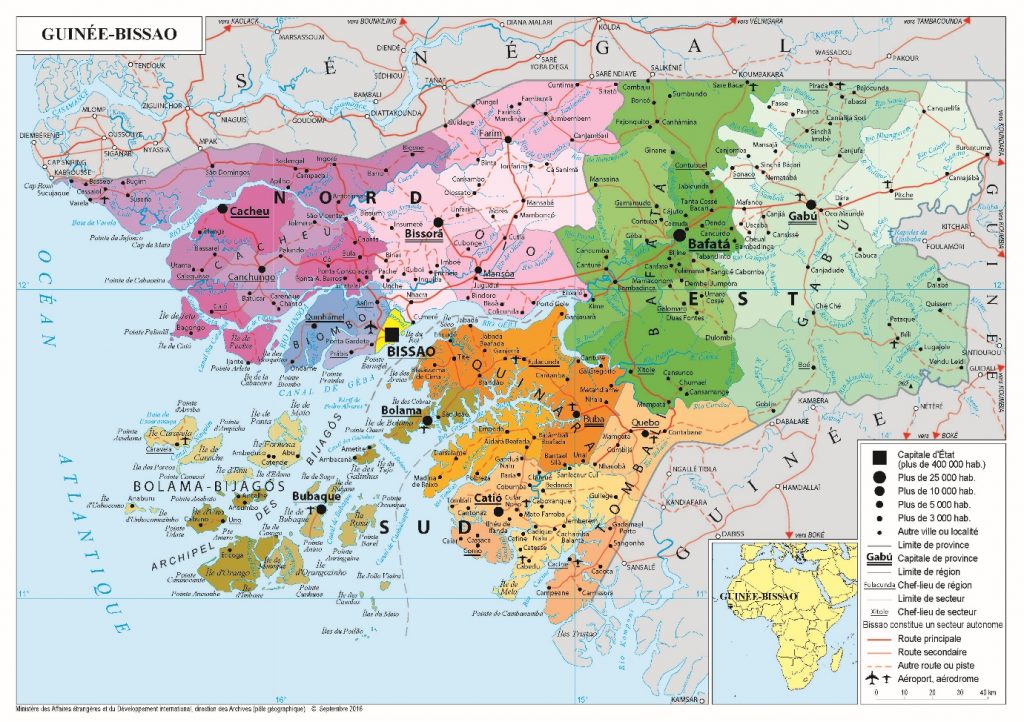
Ministry for Europe and Foreign Affairs – Sept 2016