Official name : Republic of Austria
Capital : Vienna
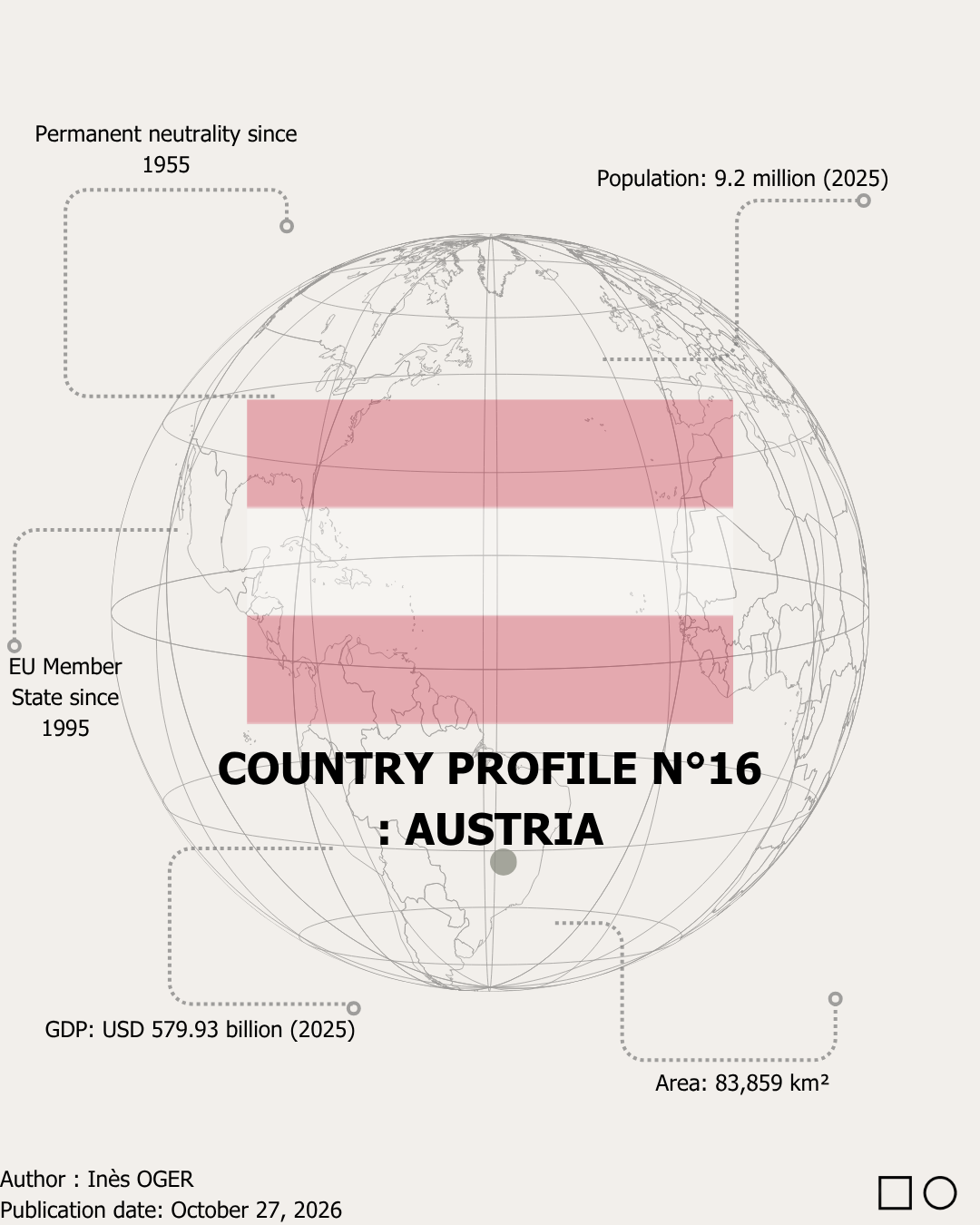
National holiday : 26 October. The day commemorated refers to the adoption of the Neutrality Law of 26 October 1955, which formalised the withdrawal of Soviet troops from Austria at the end of the Second World War[1].
Area : 83,859 km2.
Population : 9,197,213 inhabitants in 2025[2].
Official language : German.
EU Member State : since 1 January 1995.
Border countries : Switzerland, Liechtenstein, Italy, Slovenia, Hungary, Slovakia, Germany, Czech Republic.
Currency : euro (member of the euro area since 1 January 1999).
Political system : Federal republic of a parliamentary type made up of 9 federated provinces[3].
Head of State : Alexander VAN DER BELLEN, since 26 January 2017, re-elected for 6 years on 22 May 2022[4].
Chancellor : Christian STOCKER, since 3 March 2025
Ruling party: The ÖVP (Austrian People’s Party) is the party that leads the government, of which Chancellor Christian STOCKER is a member. However, it governs in coalition with the SPÖ (Social Democrats) and NEOS (liberals).[5]
GDP : $579.93 billion in 2025[6].
GDP growth : 0.62% in 2025.
GDP per capita : $63,161 in 2025.
Inflation : +3.6% in 2025[7].
Public debt: first half of 2025 at 83%, first half of 2026 at 83.3%.[8]
Unemployment : 5.2% in 2023[9].
Driving sector: The tertiary sector is the main economic driver, accounting for about 72% of the country’s value added in 2025. Industry and construction account for about 27%.[10]
Strategic historical landmarks:
1278 : Beginning of the reign of the Habsburg family in Austria, after their victory at the Battle of Marchfeld[11].
1809 : During the Austrian campaign, Austrian troops repulsed Napoleon at Aspern-Essling, but were later defeated at Wagram[12][13].
1815 : The Congress of Vienna reorganizes Europe following the Napoleonic Wars[14].
1866 : Austria is defeated by Prussia at the Battle of Sadowa, and loses its influence over the German states[15].
1867 : The Austro-Hungarian Compromise creates the Dual Monarchy of Austria-Hungary[16].
1908 : Austria-Hungary annexed Bosnia and Herzegovina, which it had administered since 1878[17].
1914 : After the assassination of Archduke Franz Ferdinand in Sarajevo, Austria-Hungary declares war on Serbia on 28 July. This event triggers the First World War.
1918 : End of the First World War, defeat of Austria-Hungary, dissolution of the Empire and proclamation of the German Republic of Austria[18].
1919 : The Treaty of Saint-Germain confirms Austria’s independence and prohibits it from uniting with Germany without an international agreement[19].
1920 : Vote on the first Austrian Constitution.
1933-1934 : Chancellor Engelbert Dolfuss puts an end to the functioning of Parliament and establishes an authoritarian regime, often referred to as Austrofascism. In February 1934, his government violently represses the Social Democratic opposition. Dollfuss is assassinated in July 1934 during an attempted putsch led by the Nazis.[20]
1938 : Nazi Germany annexes Austria in the Anschluss; the country loses its independence.
1945 : The Republic of Austria is re-established after the defeat of Nazi Germany. The country is occupied and administered by the United States, the United Kingdom, France and the USSR.
1955 : The State Treaty restores Austria’s sovereignty. On 26 October, Parliament separately adopts the Constitutional Law of Neutrality. Austria becomes a member of the UN in December.
1956 : Joined the Council of Europe.
1995 : Accession to the European Union.
Current political structure
Austria is a parliamentary federal republic. Its organisation is based on the Constitution and the separation of powers: the government exercises executive power, Parliament votes laws and controls the government, while justice is administered by independent courts.
The country is made up of nine Länder, comparable to federated states. Each has its own parliament and government. The capital, Vienna, is also one of these Länder.
The head of state is the Federal President, who is elected by direct universal suffrage for a term of six years: this position is currently held by Alexander VAN DER BELLEN. The President represents the State and appoints the Chancellor and the members of the Federal Government.
The federal government exercises executive power. It consists of the chancellor, the vice-chancellor and the ministers. The chancellor leads the government. The government must retain the support of the National Council, which can force him to resign by a vote of no confidence. In 2026, the chancellor is Christian STOCKER, a member of the ÖVP.
The Austrian Parliament comprises two chambers. The National Council (Nationalrat), composed of 183 deputies elected for five years, represents the population. It examines and votes on laws, and controls the government’s action. The Federal Council (Bundesrat) represents the nine Länder; its members are appointed by the regional parliaments and participate in the examination of federal laws.
In the 2024 parliamentary elections, the FPÖ came out on top, but it did not join the government. After the failure of the negotiations led by its leader Herbert Kickl, a coalition bringing together the ÖVP, the SPÖ and NEOS was formed. Christian Stocker’s government took office on 3 March 2025.
Political life is marked by tensions between this coalition and the FPÖ, which criticises the government’s action and calls for new elections. On 15 October 2026, the National Council rejected a motion of no confidence tabled by the FPÖ. The coalition must therefore maintain its unity and find compromises between its three parties to govern.
Economic structure
Austria’s economy is largely based on small and medium-sized enterprises. Its industry is diversified, including the food industry, mechanical and metal engineering, chemicals, automotive, electronics, and the wood and paper industries.
The service sector is the most important part of the economy. Tourism is an important contributor: in 2025, Austria recorded 48.2 million arrivals to its accommodation, including 33.5 million foreign visitors, and 157.3 million overnight stays. Tourism generated around 33.1 billion euros in direct and indirect added value.
Austria has a high GDP per capita, which is a sign of a wealthy economy. However, this indicator alone does not measure living standards: it does not provide direct information on income distribution or inequality.
Austria’s economy is strongly oriented towards foreign trade. Germany is its main trading partner: in 2025, it received 29.5% of Austrian exports and supplied 32.2% of its imports. This trade proximity is an asset, but it also makes Austria sensitive to the German economic situation. Austrian banks are also present in Central, Eastern and South-Eastern Europe, which exposes them to developments in these markets.
Economic challenges include the high cost of labour and dependence on energy imports. In 2025, the hourly cost in the manufacturing industry was estimated at €51.30 in Austria, compared to €35 on average in the European Union. Since January 2025, Austria has no longer received Russian gas; it must therefore diversify its energy supplies[21][22].
Regional and international positioning
Located in the heart of Central Europe, Austria maintains close economic and political ties with its neighbours, particularly with the countries of Central Europe and the Balkans. A member of the European Union since 1995, it participates in the EU’s decisions and common foreign policy. It is also part of the Eurozone and the Schengen Area.
Since 1955, Austria has enshrined its permanent neutrality in its constitution. It is not a member of NATO, but its neutrality does not prevent it from participating in the EU or in its cooperation in foreign and security policy.
Austria also plays an important diplomatic role. Vienna hosts one of the headquarters of the United Nations as well as several international organizations, including the International Atomic Energy Agency (IAEA), the Organization for Security and Cooperation in Europe (OSCE) and the Organization of the Petroleum Exporting Countries (OPEC). This presence makes the capital a center of international negotiations and cooperation[23][24].
Security, defence and conflicts:
Austria has been militarily neutral since 1955 and is not a member of NATO. However, it participates in European security and defence cooperation, as well as in international missions. Its national defence is carried out by the Austrian federal army, the Bundesheer.
Austria does not have an armed conflict on its territory, but Russia’s war against Ukraine has changed its security environment. Austria’s national security strategy identifies hybrid threats, cyber-attacks, espionage, terrorism and risks to critical infrastructure, such as energy and communication networks. It also highlights the risks associated with crises in neighbouring regions and dependencies on energy, raw materials and technology.
Military neutrality allows Austria not to belong to a military alliance such as NATO, while remaining engaged in the EU and international organisations. Its location in the heart of Europe and its strong regional integration expose it to crises and threats affecting the continent. Its security therefore depends on its ability to protect its infrastructure, strengthen its defence and cybersecurity, and cooperate with its European and international partners[25][26].
Opportunities and dynamics to follow:
Austria’s position at the heart of Europe and its membership of the EU make it an interesting partner for French companies wishing to develop their trade in Central Europe. The sectors concerned include pharmaceuticals, machinery, chemicals, transport and industrial equipment. The ecological transition and energy cooperation are also areas to follow.
It will also be necessary to monitor the evolution of its economy and its trade with its main partners, in particular Germany, as well as the consequences of the diversification of its energy supplies[27].
Relations with France and French interests: France and Austria maintain close political, economic and cultural relations, including within the framework of the EU. They cooperate on topics such as internal security, migration management, the Schengen area, the rule of law, EU enlargement and the ecological transition[28].
Trade is of great interest to France. In 2025, France exported around €4.9 billion worth of goods to Austria and imported around €5.7 billion. Pharmaceutical products are among France’s main exports to Austria; metallurgical products and machinery are among France’s main imports from Austria. The development of trade and partnerships in these sectors is therefore an economic challenge for both countries[29].
Final strategic reading
Austria derives much of its importance from its position at the heart of Europe. Its military neutrality coexists with strong integration into the European Union, while Vienna strengthens its diplomatic role by hosting several international organizations.
Its diversified economy, industry and tourism sector offer it solid assets. However, its openness makes it sensitive to developments in its main partners, in particular Germany, as well as to energy supply issues. The coalition government’s ability to find compromises and the country’s ability to protect its infrastructure from cyber threats will also be decisive for its stability.
For France, Austria is a European partner that is both economic and diplomatic. Exchanges in the pharmaceutical, industrial, transport and energy sectors offer opportunities for cooperation, in a context where economic resilience and energy security are becoming increasingly important.
[1] Ouest-France. (2016, 26 October). National Day. What is celebrated in Austria on 26 October? https://www.ouest-france.fr/europe/autriche/fete-nationale-que-celebre-t-en-autriche-le-26-octobre-4585347
[2] European Union. (n.d.). Austria – Countries of the European Union. Official website of the European Union. https://european-union.europa.eu/principles-countries-history/eu-countries/austria_fr
[3] All of Europe. (2025, March 3). Austria. https://www.touteleurope.eu/pays/autriche/
[4] Ministry for Europe and Foreign Affairs. (2026, 22 October). Presentation of Austria. France Diplomacy. https://www.diplomatie.gouv.fr/fr/information-par-pays/autriche/presentation-de-l-autriche
[5] Chaaban, F. (2025, March 3). Austria: The coalition government officially takes over the reins of the country. All of Europe. https://www.touteleurope.eu/vie-politique-des-etats-membres/autriche-le-gouvernement-de-coalition-prend-officiellement-les-renes-du-pays/
[6] Chaaban, F. (2025, March 3). Austria: The coalition government officially takes over the reins of the country. All of Europe. https://www.touteleurope.eu/vie-politique-des-etats-membres/autriche-le-gouvernement-de-coalition-prend-officiellement-les-renes-du-pays/
[7] Directorate-General of the Treasury. (2026, May 6). Austria, barely out of recession and already affected by geopolitical uncertainties. Ministry of Economy and Finance. https://www.tresor.economie.gouv.fr/Pays/AT/l-autriche-petit-pays-certes-mais-au-carrefour-de-l-europe
[8] The Editor. (2026, 22 October). Public debt: where does France stand compared to other European countries? All of Europe. https://www.touteleurope.eu/economie-et-social/dette-publique-ou-se-situe-la-france-par-rapport-aux-autres-pays-europeens/
[9] The Editor. (2026, 22 October). Public debt: where does France stand compared to other European countries? All of Europe. https://www.touteleurope.eu/economie-et-social/dette-publique-ou-se-situe-la-france-par-rapport-aux-autres-pays-europeens/
[10] Statistik Austria. (n.d.). Gross domestic product and main aggregates. https://www.statistik.at/en/statistics/national-economy-and-public-finance/national-accounts/gross-domestic-product-and-main-aggregates
[11] Austrian National Tourist Board. (n.d.). The Habsburgs in Austria: A Dynasty that Shaped History. Austria.info. https://www.austria.info/fr/portraits/habsbourg/
[12] Information Centre on the European Institutions (CIIE). (n.d.). Austria. Strasbourg Europe. https://www.strasbourg-europe.eu/autriche/
[13] Brun, J.-F. (n.d.). Essling’s Chaos. Fondation Napoléon. https://www.napoleon.org/histoire-des-2-empires/articles/le-chaos-dessling/
[14] Ministry of the Armed Forces and Veterans Affairs. (2025, October 6). The Battle of Wagram. Army. https://www.defense.gouv.fr/terre/mieux-nous-connaitre/histoire-larmee-terre/larmee-terre-travers-ses-batailles/bataille-wagram
[15] Larousse. (n.d.). Battle of Sadowa (3 July 1866). Larousse Encyclopedia. https://www.larousse.fr/encyclopedie/divers/bataille_de_Sadowa/141990
[16] Digital library of legal and political materials. (n.d.). Hungary: Law XII of 1867 relating to the Austro-Hungarian compromise. University of Perpignan Via Domitia.https://mjp.univ-perp.fr/constit/hu1867.htm
[17] Digital library of legal and political materials. (n.d.). Bosnia-Herzegovina: annexation by the Austro-Hungarian Empire (1908). University of Perpignan Via Domitia.https://mjp.univ-perp.fr/constit/ba1908.htm
[18] Digital library of legal and political materials. (n.d.). Austria: formation of the state of German Austria (1918). University of Perpignan Via Domitia. https://mjp.univ-perp.fr/constit/at1918.htm
[19] Allied and Associated Powers and Austria. (1919, 10 September). Peace Treaty between the Allied and Associated Powers and Austria (Treaty of Saint-Germain-en-Laye). Digital Library of Legal and Political Materials, University of Perpignan Via Domitia. https://mjp.univ-perp.fr/traites/1919saintgermain.htm
[20] Stolz, J. (2021, December 11). The ghost of Dollfuss still haunts Austria. The Mediapart Club. https://blogs.mediapart.fr/joelle-stolz/blog/111221/le-fantome-de-dollfuss-hante-encore-lautriche
[21] ADVANTAGE AUSTRIA. (n.d.). The main sectors. Austrian Federal Economic Chamber. https://www.advantageaustria.org/ca/zentral/business-guide/zahlen-und-fakten/wirtschaft/wichtige-sektoren/wichtige-sektoren.fr.html
[22] Coface. (n.d.). Austria: country profile, economic risk analysis. https://www.coface.com/fr/actualites-economie-conseils-d-experts/tableau-de-bord-des-risques-economiques/fiches-risques-pays/autriche
[23] Federal Ministry for European and International Affairs. (n.d.). Foreign policy. Republic of Austria. https://www.bmeia.gv.at/en/european-foreign-policy/foreign-policy
[24] City of Vienna. (n.d.). Vienna as a centre of international diplomacy. https://www.wien.gv.at/en/politics/centre-international-organisations
[25] Bundesministerium für europäische und internationale Angelegenheiten. (n.d.). Sicherheitspolitik [Security Policy]. Republic of Austria. https://www.bmeia.gv.at/themen/sicherheitspolitik/
[26] City of Vienna. (n.d.). Vienna as a centre of international diplomacy. https://www.wien.gv.at/en/politics/centre-international-organisations
[27] Federal Ministry of Economy, Energy and Tourism. (n.d.). National data. Republic of Austria. https://www.bmwet.gv.at/en/Topics/tourism/tourism-statistics/national-data.html
[28] Ministry for Europe and Foreign Affairs. (2026, 28 May). Austria – Bilateral relations. France Diplomacy. https://www.diplomatie.gouv.fr/fr/information-par-pays/autriche/relations-bilaterales
[29] Directorate-General of the Treasury. (2026, 12 March). Bilateral trade relations in 2025 – Austria. Ministry of Economy and Finance. https://www.tresor.economie.gouv.fr/Pays/AT/relations-commerciales-bilaterales