
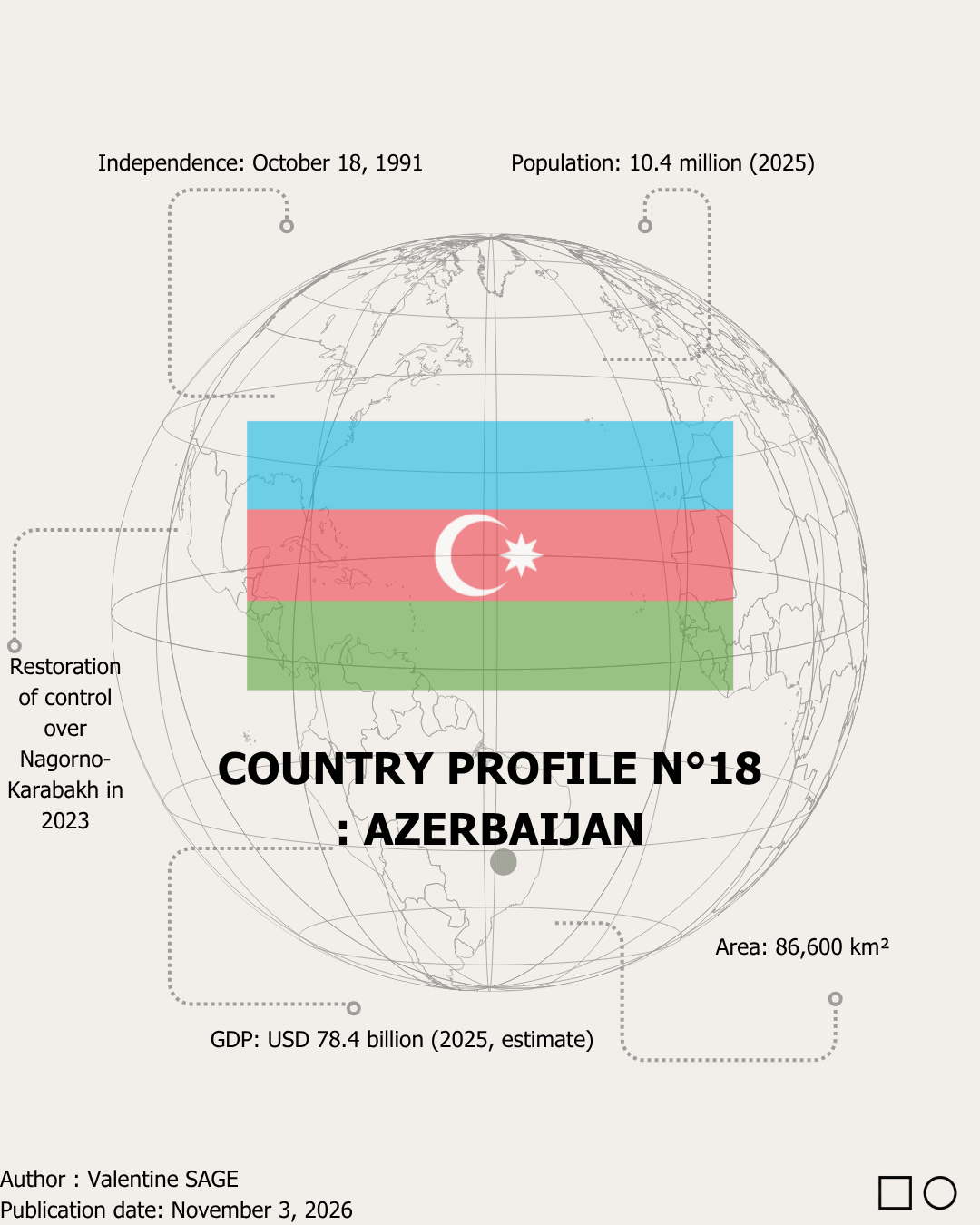
- Key data
Official name : Republic of Azerbaijan
Capital : Baku
Population (2025): 10.4 million
Area : 86,600 km²
Territorial organization : Azerbaijan is an independent state whose territory is organized into several administrative divisions: Baku, the capital and main political, economic and energy center of the country; administrative districts, territorial subdivisions of the country; economic regions (14 in all), groupings of territories used for economic development planning; Nakhchivan, an autonomous republic belonging to Azerbaijan but geographically separated from the rest of the country by Armenian territory; Karabakh, a historical economic region that includes the Nagorno-Karabakh conflict zone.
Official language : Azerbaijani or Azerbaijani
Currency : Azerbaijani Manat (AZN)
Nature of the regime : Presidential Republic
Head of State : President of the Republic: Ilham Aliyev (since 2003)
First Vice-President of the Republic : Mehriban Aliyeva (since 2017)
Parliament : Unicameral Parliament, with 125 MPs
GDP (2025): The IMF forecasts Azerbaijan’s nominal GDP at around USD 78.4 billion, with real growth in 2025 of 1.4%. Growth slowed sharply in 2024 (4.2% in 2024), but with a moderate recovery estimated at 2.2% in 2026[1].
Inflation (2025): The IMF forecasts inflation to average 6% in 2026.
Employment: The employment rate measured by the World Bank was about 60% in 2025 (category 15 years and above), with a participation rate of 63% (category 15 years and over). [2]The unemployment rate in 2025 was about 5.5%. [3]Agriculture accounts for a significant share of jobs despite its limited contribution to GDP.
Structuring sectors of the economy : In 2024, the extractive industry represents 23% of GDP[4]. In 2025, the share of trade, particularly automotive, represents 11% of GDP; transport 7%, construction 6.5% and agriculture about 6% of GDP[5].
Main issues : Relations with Armenia since the end of the conflict over the Nagorno-Karabakh region in 2023, with a desire to normalize relations; maintaining its strategic autonomy in the regional geopolitical balance and in its relations with Turkey, Iran, Russia and Western powers; its dependence on hydrocarbons and the business environment not conducive to economic diversification; domestic stability, including issues of civil liberties, the fight against corruption, and institutional transparency.
Essential geographical landmarks
Due to the complex regional geostrategic situation, an update on the different regions and territories presented in this fact sheet is essential to a good understanding of the analysis.
First of all, it is important to know that Azerbaijan has a territorial organization in several administrative divisions. In particular, there are[6]:
- Baku: capital and main political, economic and energy centre of the country
- Administrative districts: these are territorial subdivisions of the country.
- Economic regions: these are groupings of territories used for economic development planning. The country has 14 in total.
- Nakhchivan: it is an autonomous republic, exclave of Azerbaijan because it is geographically separated from the rest of the country by Armenian territory. It is located between Armenia, Iran and Turkey and has its own constitution, parliament and government, although its autonomy is strongly supervised and centralized by Baku.
- Karabakh: historical economic region that includes the Nagorno-Karabakh conflict zone.
We will also mention the Caucasus, a geographical region located between the Black Sea and the Caspian Sea, at the junction of Europe and Asia.[7]
It consists of:
- South Caucasus, including Azerbaijan, Armenia and Georgia.
- North Caucasus, mainly comprising territories belonging to Russia.
- Greater Caucasus, which is the mountain range that runs through the region and serves as a geographical landmark between the North and the South.
The Caucasus region is a strategic space due to its position between Russia, Turkey and Iran, its energy resources and its transport corridors connecting Europe to Asia.
Finally, it is a question of locating the territory of Nagorno-Karabakh, disputed between Armenia and Azerbaijan between 1991 and 2023[8].
The territory lies within Azerbaijan’s internationally recognized borders, while historically being populated by a majority of Armenians. It will become a self-proclaimed republic administered by Armenian separatist authorities, but not recognized by the international community since its declaration of independence from Azerbaijan in 1991.
The First Nagorno-Karabakh War (1991-1994) led to the takeover of the territory and surrounding territories by Armenian forces.
In 2020, the six-week war took place, which allowed Azerbaijan to retake several territories, and finally the entire territory in September 2023. Almost the entire local Armenian population fled to Armenia.
Since 2023, the territory has been under Azerbaijani control and is no longer administered by the Armenian separatist authorities.
- Executive Summary
Azerbaijan is a state in the South Caucasus occupying a strategic position between Russia, Iran, Turkey, Central Asia and Europe. Bordered by the Caspian Sea, it has significant oil and gas resources, which form the bedrock of its economy and a major instrument of its international influence. Its geographical position also gives it a role as an energy and logistics crossroads between Europe and Asia. Its location also gives it strategic importance for the country, which has always been an object of envy for neighboring empires.
Thanks to its geographical diversity (mountains of the Greater and Lesser Caucasus in the north and west, fertile plains and plateaus in the centre and south), the country ensures a rich climatic diversity and culture (cotton, citrus fruits, grapes).[9]
Its majority population is the Azeris, a Turkic-speaking people with a Shiite Muslim majority. Politically, the country has been led by Ilham Aliyev since 2003, within the framework of a highly centralised presidential regime. This concentration of power favours the continuity of state policy, but raises issues of governance, transparency and public freedoms.
Economically, Azerbaijan remains highly dependent on hydrocarbons, despite efforts to develop the non-oil sectors and renewable energies and the growing importance of diversification. The State Petroleum Fund (SOFAZ) is an essential instrument for managing rents, but it cannot replace the development of a diversified private sector.
Geopolitically, the resumption of control of Nagorno-Karabakh in 2023 has changed relations with Armenia. The Washington Declaration of 8 August 2025 opened a new stage towards the normalisation of relations. The TRIPP regional link project could also strengthen connectivity between Azerbaijan, Nakhchivan, Turkey and European markets, while raising questions of sovereignty and control of infrastructure.
Finally, Baku is pursuing a multi-vector foreign policy, based on maintaining relations with partners with sometimes competing interests: Turkey, Russia, Iran, Israel, the European Union and the United States. This strategy is nevertheless accompanied by persistent regional tensions, particularly around Armenia and the legal status and resources of the Caspian Sea.
In the medium term, the main challenges for Azerbaijan will be to consolidate peace in the South Caucasus, reduce its dependence on hydrocarbons, strengthen its role as a transport and energy hub, and respond to the challenges of governance and climate vulnerability.
- Historical landmarks[10]
Azerbaijan is a West Asian state located in the Caucasus region, surrounded by the Caspian Sea to the east, Russia to the north, Georgia to the northwest, Armenia to the west, and Iran to the south.
Before obtaining its independence, the country was widely disputed. The territory was first a province of Achaemenid Persia, and with the Arab conquest, Islam gradually established itself there in the seventh century. It was subjected in turn to Turko-Mongol (11th century) and Ottoman Turkish (16th to 18th century) invasions, before being returned to Persia in 1735. The Russian Empire annexed part of the territory a century later.
In the middle of the nineteenth century, the industrial extraction of oil from the Caspian began, which was to play a central role in the country’s economic transformation. Baku was the world’s leading oil centre in 1900, and attracted more than 200,000 inhabitants between 1870 and 1913. The majority of the inhabitants were thus represented by the multinational proletariat, leading to tensions with the Armenian bourgeoisie.
The country’s independence process then took place in several stages: Azerbaijan’s first independence took place on 28 May 1918. It was indeed following the collapse of the Russian Empire that the Azerbaijan Democratic Republic was proclaimed. The country was then successively occupied by British intervention forces (August-September 1918), then by the Turks wanting to seize the oil reserves (September-October 1918).
The Republic of Azerbaijan was finally sovietized by the Red Army in April 1920. Between 1920 and 1991, the country was integrated into the USSR, which made it the Azerbaijan Soviet Republic. The national elites were decimated, religious persecution was severe and culture was damaged. Only Nagorno-Karabakh has remained independent since 1923.
With the collapse of the USSR in 1991, independence was proclaimed again on 30 August 1991, confirmed by the Constitutional Act of 18 October 1991. However, Baku was unable to regain control of Nagorno-Karabakh, populated by Armenians.
The Armenian population within the territory of Nagorno-Karabakh claimed to be part of Armenia, which led to the armed conflict and the first Nagorno-Karabakh war of 1988-1994, which pitted Armenia against Azerbaijan. Armenian forces took control of the territory and several neighboring Azerbaijani districts. A ceasefire came into force in 1994. Azerbaijan lost 13% of its territory and suffered massive population displacements.
Intermittent tensions and clashes took place for several decades, until the military offensive led by Azerbaijan in 2020. The « Six-Week War » allowed it to regain control of the region. More than 100,000 Armenians returned to Armenia. A ceasefire agreement brokered by Russia ended the fighting after 44 days. A blockade was then put in place on the Lachin corridor, the main link between Nagorno-Karabakh and Armenia, causing shortages of food and fuel. In September 2023, Azerbaijan launched a final offensive, leading to the capitulation of the Armenian authorities and the resumption of control of the entire territory[11].
The Nagorno-Karabakh conflict resulted in many casualties on both sides: a series of massacres, thousands of deaths, tens of thousands of wounded, and more than a million displacements of Armenians fleeing Nagorno-Karabakh to Armenia[12].
Today, the main challenge for Azerbaijan is this conflict with Armenia and the normalization of their relations to affirm the stability of the region and Baku’s role within it.
- Economic situation
Azerbaijan’s economy is mainly based on hydrocarbons, and in particular on oil and gas, which are the mainstay of the country’s exports.
Historically, the country developed from the discovery of deposits in the 1870s. Baku became the world’s leading oil centre at the beginning of the twentieth century and the main centre of production and refining in the former USSR until the Second World War, before experiencing a period of continuous decline[13]. When Heydar Aliyev came to power, he staked everything on oil, and benefited from the support of British Petroleum, which remains to this day one of the country’s main foreign private investors[14]. In 1994, production was also multiplied thanks to the opening of the Azeri-Chirag-Gunashli offshore oil complex and the integration of the Shah Deniz gas field in 1998 into the European Commission’s energy corridor strategy.
In 2005, an oil pipeline linking Baku to Ceyhan via Tbilisi came into operation, and the TANAP gas pipeline has been linking Azerbaijan to Europe via Turkey since 2008[15].
Thanks to this infrastructure, the country is massively developing its economy on the basis of hydrocarbon exports.
Azerbaijan is the only state from the Soviet Union that produces energy and has direct access to the Western European market, thanks to the Baku-Tbilisi-Ceyhan oil pipeline. Most of the oil production is exported to the Mediterranean.
Today, the share of the industry sector (including oil and non-oil activities) accounts for about 33% of Azerbaijan’s GDP, making it the dominant sector of its economy. The trade sector, especially the automotive sector, accounts for about 11.3% of GDP (thanks to domestic consumption and distribution). Secondly, the economy is structured around the transport sector (7.1% of GDP), construction (6.5% of GDP) and agriculture (6% of GDP).[16]
In 2025, Azerbaijan’s foreign trade reached $48.9 billion, for $24.5 billion in exports and $24.4 billion in imports (limiting the trade surplus to about $146 million).[17]
Azerbaijan, although historically relying on its hydrocarbon revenues, is now transitioning to a greener economy, with plans to reduce greenhouse gas emissions and expand renewable energy[18]. The country hosted COP29, demonstrating its commitment to the global energy transition. However, governance failures are an obstacle to the development of the non-oil private sector.
In Azerbaijan, the State Oil Fund of the Republic of Azerbaijan (SOFAZ) plays an important role. Created by presidential decree on December 29, 1999, it aims to transform hydrocarbon revenues into sustainable financial assets, stabilize the economy and finance strategic projects. As of December 31, 2025, SOFAZ had $73.5 billion in assets, and transferred about $8.5 billion to the state budget[19].
Its main functions are as follows:
- the management and savings of oil and gas revenues: SOFAZ collects revenues related to the exploitation of hydrocarbons and invests them on international markets.
- Financing of the State budget: each year, part of SOFAZ’s resources are transferred to the public budget, thus contributing to the financing of State expenditure.
- financing of strategic projects: SOFAZ contributes to transport and energy infrastructure, water supply, educational programmes and rehousing of people displaced by the Nagorno-Karabakh conflict.
- diversification of national wealth: SOFAZ invests abroad in bonds, shares, gold and real estate in order to reduce the concentration of national wealth in energy resources alone[20].
However, it is important to note that the state’s finances are thus exposed to variations in oil and gas revenues, since energy revenues partly finance public expenditure. In addition, SOFAZ’s financial assets alone are not sufficient to develop the non-hydrocarbon sectors, although they diversify the country’s revenues. The sovereign wealth fund is thus a central instrument for the management of Azerbaijan’s energy rent, although it faces certain limitations.
Azerbaijan, having developed a significant weight in the region thanks to its role as a crossroads and exporter of hydrocarbons, has forged solid economic ties with its neighbours. It has access to the Black Sea thanks to the railway linking it to Batumi, and the port of Baku connects it with Asian territories. The Volga Delta also allows it to trade easily with central Russia[21].
Its main trading partners (according to the share in foreign trade in 2025) are the following:
- Italy is Azerbaijan’s largest trading partner and its main destination for exports, accounting for more than a quarter of the country’s total trade. Italy absorbs nearly 58% of Azerbaijan’s total crude oil exports, and Azerbaijan supplies about 16% of Italy’s gas imports via the Trans-Adriatic Pipeline[22].
- Turkey, which represents a strategic partner for oil and gas pipelines as well as for investments. Indeed, 13.5% of Azerbaijani exports are directed to Turkey in 2025, making it the country’s second largest partner in the world after Italy[23].
- Russia is also a major trading partner, especially for non-oil agricultural imports and exports. By the end of 2025, the volume of trade between the two countries had exceeded $4.9 billion[24].
- Georgia and the countries of Central Asia play a strategic role in the transit of hydrocarbons and goods between the Caspian Sea, the Caucasus and European markets.
- Israel, a historical partner since the country’s independence, whose partnership ensures that the Jewish state has 30% of its oil needs and ensures that Azerbaijan benefits from advanced Israeli technologies[25].
- The European Union is also Azerbaijan’s largest trading partner. The European Union imports around €13.9 billion from Azerbaijan, and exports €2.8 billion in 2025[26]. The EU imports oil, natural gas and related products, through a strategic partnership, the strategic memorandum signed in July 2022. This partnership aims to strengthen gas supplies through the Southern Gas Corridor, while developing cooperation on renewable energy and the reduction of methane emissions[27]. These relations are based on the Partnership and Cooperation Agreement that entered into force in 1999 and whose negotiations for a new agreement have been suspended since February 2022[28].
The main challenge to guarantee the country’s economic stability is to cope with the decline in oil production and the volatility of world prices. The IMF and the World Bank underline the slowdown in growth in 2025 and the need to accelerate the diversification of the economy[29]. In 2025, the production of added value in the hydrocarbon sector decreased by 1.6% while the non-hydrocarbon sector grew by 2.7%.[30] The risk is therefore that it is too dependent on hydrocarbons, weakened by the global decline in oil production and the global energy transition. Azerbaijan must succeed in diversifying its economy by strengthening the non-oil sectors, develop its infrastructure in order to strengthen its role as an energy and logistics crossroads between Europe and Asia, while developing renewable energies and improving competition and transparency within governance. There is also a need to take advantage of the normalization of relations in the South Caucasus region to develop cross-border trade and connections.
- Domestic policy
Azerbaijan is a unitary presidential republic, whose president has been Ilham Aliyev since 2003, who succeeded his father Heydar Aliyev. The latter, a former KGB general, came to power during the Nagorno-Karabakh conflict in 1993. He thus established a dynasty and will put the country under control[31].
The elections of 7 February 2024 re-elected Ilham Aliyev for a fifth consecutive term. With the early parliamentary elections on 1 September 2024, the presidential party « New Azerbaijan » won an absolute majority of seats[32].
However, although elections are held regularly, international organisations, including the OSCE Office for Democratic Institutions and Human Rights (ODIHR), believe that the restrictive legislation and the political environment have not allowed for effective competition[33]. The observation missions have noted the absence of real political competition, the limitation of critical voices and irregularities in the counting of votes. Opposition parties have limited space for action in an environment marked by restrictions on freedom of association and assembly.
The country is thus the subject of international concerns in terms of electoral transparency, the independence of electoral commissions and the participation of the opposition.
International organisations also believe that the political situation is worrying in terms of human rights: repression against political opponents and journalists continues to intensify in the country but also outside its borders[34].
One of the main concerns of recent years has been the Nagorno-Karabakh conflict, and the challenge today lies in the organization of the reconstruction of the retaken territories and the return of displaced populations. Political legitimacy must also be strengthened, by consolidating trust in institutions, responding to international concerns and improving the transparency of the administration.
- Regional geopolitical issues
Within the region, Azerbaijan faces a variety of security challenges in connection with some of its partners.
First of all, the stability of the border and relations with Armenia with the end of the war remains the main issue, despite the diplomatic advances of 2025.
Indeed, relations may be weakened depending on the actions of Azerbaijan, which is particularly interested in the Zangezur corridor, within the Armenian territory separating Azerbaijan from Turkey. By getting its hands on this territory, the country could not only link its enclave of Nakhchivan to the rest of its territory, but also link Turkey to the rest of the Turkic-speaking territories[35]. Turkey and Azerbaijan are indeed willing to develop an economic and strategic link between the various Turkic-speaking states in the region (Kazakhstan, Uzbekistan, Kyrgyzstan, Turkmenistan).
Then, another subject of tension is located at the level of the Caspian Sea, the largest enclosed inland body of water in the world.
It is bordered by Azerbaijan, Russia, Kazakhstan, Turkmenistan and Iran. Its legal status has long been contested because it determines the sharing of natural resources, the control of water and the possibilities of building energy infrastructure.
The difficulty comes from its geographical nature. Indeed, the question that remains is whether it should be considered as a sea, even though it does not communicate with any ocean, or as a lake? This distinction has concrete consequences: by being considered as a sea, the rules relating to territorial waters and maritime economic rights would be the reference, while by being considered as a lake, the sharing of waters and subsoil would depend on agreements between the riparian states[36].
The question is important because it raises the economic issue of controlling the oil and gas deposits present under the bottom of the Caspian, as well as the maritime routes allowing them to be exported.
After the dissolution of the USSR in 1991, the agreements concluded previously were no longer sufficient to settle the claims of the riparian states. The latter sometimes concluded bilateral agreements, but the adoption of a common framework was complicated by the many differences.
On 12 August 2018, the five States signed the Convention on the Legal Status of the Caspian Sea, which establishes a special regime providing for the delimitation of territorial zones, fishing zones, the seabed and the subsoil and the supervision of military and security activities. This convention represents a real step forward, but not a complete settlement of the dispute because several issues remain dependent on agreements between States[37].
For Baku, the status of the Caspian Sea is a question of sovereignty and energy security, since it wants to develop its offshore deposits there, secure its rights to the subsoil and thus facilitate the export of hydrocarbons to the West. The delimitation of the subsoil leads to disagreements with Turkmenistan and Iran, as do the various submarine pipeline projects, which remain subjects of discussion and negotiation.
Finally, Azerbaijan shares about 600 km of borders with Iran, within which many nationalist tendencies of certain Azeri groups have developed in some Iranian provinces. The latter hope for integration into the Republic of Azerbaijan. Iran also expresses concerns about relations between Azerbaijan and Israel, but despite these tensions, relations between the two countries remain good and are the subject of transport infrastructure projects in order to develop trade between Russia and Asia[38].
- Defence and foreign policy
Azerbaijan’s foreign policy is essentially based on the conflict with Armenia over the territory of Nagorno-Karabakh. With the end of the conflict in 2023 following the Azerbaijani offensive and the resumption of control of the territory, the goal is now to achieve a normalization of relations with Armenia. Armenia is also determined to normalize their relations. Armenian Prime Minister Nikol Pashinyan has taken note of his country’s defeat in 2020 and the fall of the separatist enclave in September 2023, and now intends to save what remains of Armenia and avoid a new conflict[39].
The summit of August 8, 2025 in Washington, mediated by the President of the United States, made it possible to put in place documents that are decisive for their relations, making it possible to overcome the aftermath of thirty years of war.
First, a peace agreement between the two countries was pre-signed by their leader, but was not initialled or ratified. This text buries any claim by Armenians to Nagorno-Karabakh, while no mention was made of the former leaders of this self-proclaimed former republic, captured by Azerbaijan in 2023 and sentenced in February 2025 to prison terms of up to life.
In a second phase, the American president also proposed to them to build relations around a commercial project: the « Trump Route for International Peace and Prosperity » (TRIPP). This project is for the moment only an agreement in principle, but its objective is to link Azerbaijan to its exclave of Nakhchivan and to Turkey, via Armenia. This will also make it possible to connect Central Asia to Europe, bypassing Russia and Iran. The United States will be the majority beneficiary of the project (74% of the shares, compared to 26% for Armenia for 49 years, then 51% compared to 49%).[40]
The Azerbaijani president said: « [The TRIPP] will be a new contribution to peace, development and regional cooperation. »
However, Azerbaijan’s discourse on this project is ambivalent, as it continues to refer to the TRIPP as a « corridor », thus implying a loss of sovereignty for Armenia.
The Armenian population thus remains distrustful of Azerbaijan’s position, and has the impression of being forced to peace with an unequal trade project, while the authorities consider that it is not possible to remain « enemies forever ».
The normalization of relations also requires tangible evidence, in particular the fact that Armenia sells Azerbaijani gasoline for the first time since the independence of the two countries in 1991. However, although the price is more attractive, a large part of the population refuses to buy it.
Although in a transitional phase of bilateral relations, a reversal of the situation could easily bring the conflict back to the table. Azerbaijan still occupies some 200 km² of Armenian territory since 2021 and continues to arm itself massively (increase in military spending: $2.2 billion in 2020 to $3.8 billion in 2024).[41]
Regarding its foreign policy and diplomatic strategy, Azerbaijan practices a so-called « multivectorial » foreign policy, i.e. it seeks to develop relations with partners with sometimes competing interests, without aligning itself with a single bloc. This strategy is facilitated by its position between Russia, Iran, Turkey and Central Asia.
During the Nagorno-Karabakh conflict with Armenia, Azerbaijan had the support of several countries, including Turkey, which supplied troops and armaments. The two countries have close political, cultural, economic and military ties, whose historic partnership facilitates energy and trade links between the Caspian, the Caucasus and European markets[42].
Relations with Russia can sometimes be tricky, although the latter depends in part on Azerbaijan to circumvent sanctions put in place following the full-scale invasion of Ukraine. The two states signed a declaration on their relations in February 2022, including political and security cooperation[43]. However, Baku seeks to preserve its diplomatic autonomy without overly dependent on Russia.
Azerbaijan also has a historic partnership with Israel, allowing it to benefit from advanced Israeli technologies. This is partly what allowed Ilham Aliyev to modernize his army and carry out military offensives against Armenia in Nagorno-Karabakh[44].
Although it has relations with Israel, Baku also has a neighbourly relationship with Iran, marked by rivalries. The two countries have interests related to the Caspian Sea and transport corridors, but differences are emerging, particularly over maritime delimitations, energy projects and regional strategic balances. The partnership with Israel is also a matter of concern for Tehran.
Azerbaijan has also forged more discreet ties with Western powers, including the United Kingdom, which is the country’s largest foreign private investor, with 25% of foreign investment directed to Azerbaijan.
Hungary and Cyprus are also hot on Turkey’s heels in terms of investment. Hungary accounts for 15% of Azerbaijani foreign investment, and Cyprus for 11%.[45]
Relations with the United States are more limited and have historically focused on energy security and stability in the South Caucasus. However, they have deepened in 2025 around regional connectivity and security cooperation, thanks in particular to the fact that the President of the United States acted as a mediator during the discussions between Azerbaijan and Armenia. A Strategic Partnership Charter was signed by the two countries in February 2026 and provides for enhanced cooperation in the diplomatic, economic, energy, technological and security fields[46].
However, bilateral relations with France have deteriorated sharply following Azerbaijan’s military operations in 2020. The French authorities have taken a clear position against the use of force. In addition, French nationals have been arbitrarily detained, the French diplomatic apparatus has been pressured and initiatives have been directed against France’s territorial integrity.
Diplomatic dialogue was reinitiated by France in January 2025, allowing for an affirmation of a common desire to normalize relations, allowing a revival of economic exchanges, although they have largely decreased in 2023 due to the conflict[47].
Azerbaijan is indeed engaging in ambivalent acts regarding its relations. First, it was a non-permanent member of the UN Security Council between 2012 and 2013. In 2019, the country took the lead in the non-aligned movement at the United Nations.
Baku also engages in what is called « caviar diplomacy ». When it joined the Council of Europe in 2001, the country made payments to European parliamentarians, resulting in the lifetime exclusion of 14 of them.
The country will also engage in intimidation actions, in particular to eliminate or threaten some of its political opponents who have taken refuge abroad. In 2022, France in turn becomes the target of destabilization operations by Baku, which reproaches it for its financial and military support for Armenia. In this sense, Baku will set up a network of logistical and financial support for separatists in the French overseas territories, in the name of a fight against « colonialism and neocolonialism ». Disinformation campaigns are thus carried out on a massive scale in 2024[48].
Ultimately, Azerbaijan’s foreign policy is organized around three priorities: preserving its territorial sovereignty, taking advantage of its energy and geographical position, and maintaining its relations with the major powers and its various neighbors. Hydrocarbons represent both a major source of revenue and a tool of international influence. However, some actions on the part of Azerbaijan tend to reduce trust in its partners.
- Environmental issues
Due to its dependence on hydrocarbons and its geographical location between the Caucasus and the Caspian Sea, Azerbaijan is subject to environmental challenges and is a country vulnerable to climate change.
- As oil and gas occupy a central place in the Azerbaijani economy, the reduction of CO2 and methane emissions linked to their extraction and the country’s energy diversification represent major challenges. In 2024, 3.8 tons of CO2 were emitted by Azerbaijan[49]. The country must manage to follow the energy transition in order to reduce its share of polluting gas emissions, as announced during the COP 29 which took place in Baku. Oil activities also lead to significant industrial pollution and soil degradation, which today represent a major health and environmental issue.
- The falling level of the Caspian Sea threatens coastal areas, port infrastructure and natural habitats. Fishing activities are affected, as are coastal ecosystems and infrastructure[50].
- The country is also facing drought and water stress from the transboundary rivers on which it depends. This affects the country’s drinking water supply, agriculture and ecosystems.
- Urban pollution is also a major issue. Indeed, urbanisation, industrial activities and the concentration of the population around Baku require better waste treatment as well as the improvement of the wastewater treatment system.
As a result of these major challenges, the government has identified the goal of a clean environment and a « green growth » country as one of the five key national priorities for Azerbaijan’s socio-economic development until 2030. In this sense, targeted efforts are being made to improve green spaces and forest areas, ensure the efficient use of water resources and sustainable energy sources, and develop modern infrastructure for waste management. Following the liberation of its territories, the country has also launched reconstruction and rehabilitation projects in accordance with « smart city » concepts, including green energy projects and modern technologies[51].
- Points of vigilance
The first point of vigilance concerns Azerbaijan’s dependence on hydrocarbons. The economy remains highly exposed to fluctuations in world oil and gas prices, as well as to the decline in oil production, which have led to a slowdown in growth. SOFAZ offers significant financial reserves, but the sustainability of the economic model will depend on the country’s ability to develop non-hydrocarbon productive activities.
The second point concerns the achievement of peace with Armenia. Indeed, despite the diplomatic progress made in 2025, normalization remains to be consolidated, with in particular the issues related to the final implementation of the peace agreement, the delimitation of the border, sovereignty issues related to communication routes and the fate of displaced persons. In addition, with the end of the conflict, the reconstruction of Karabakh and the surrounding territories requires significant investment. In addition, the return of displaced populations and the protection of the rights of the people concerned remain sensitive issues.
The third point is based on Baku’s desire to strengthen its role as a regional crossroads. The resulting tensions over the TRIPP corridor and the legal status of the Caspian Sea are undermining the balance of the region and the sovereignty of neighbouring states.
The fourth point concerns its multi-vector policy strategy. Based on diversified partnerships, it offers wide possibilities for cooperation, but also requires the management of sometimes contradictory interests. If regional tensions develop, Baku would find itself with reduced diplomatic room for manoeuvre.
The fifth point brings together the country’s institutional fragilities and tensions with Western partners. The concentration of power, restrictions on independent media and civil society, as well as concerns about electoral transparency, weaken the confidence of international partners and the business environment, making economic diversification difficult.
Finally, the last point concerns the climate and environmental risks that Azerbaijan is facing and which are pushing it to accelerate its energy transition. Falling water levels, drought and pollution linked to industrial activities are risks for infrastructure and agriculture. Despite the fact that the energy transition represents a constraint for a country that produces and exports hydrocarbons, it is also an opportunity for economic diversification.
- Prospects for development
The continuation of the dialogue and the peace process with Armenia could make it possible to consolidate the ceasefire and stabilise regional trade. However, this development remains conditional on the ability of the two countries to settle their political and territorial disputes.
The normalization of relations with Armenia would also allow Azerbaijan to take advantage of its geographical position and strengthen its role as a crossroads between Europe and Asia by developing trade links and infrastructure. The realization of these prospects depends on regional stability, investment and agreements between the States concerned.
For the economic sector, the IMF identifies diversification led by the private sector as a structural priority due to the downward trend in hydrocarbon production. Indeed, the resources on SOFAZ can support the development of the non-oil sectors (transport, logistics, agriculture, services), provided that the investments promote productivity, employment and private sector development in a sustainable manner.
It will also allow Azerbaijan to embark on its energy transition, with solar and wind energy projects that would allow the country to gradually diversify its energy system and cope with the growing pressure to adapt the country to climate risks.
Finally, cooperation with Western powers could be strengthened around energy and investment, but disagreements over fundamental rights and civil liberties could limit the deepening of relations.
- Final strategic reading
Azerbaijan occupies a strategic position based on the combination of three assets: its energy resources, its geographical location between Europe and Asia, and its ability to maintain relations with powers with competing interests. The resumption of control of Nagorno-Karabakh in 2023 has strengthened its regional position, while negotiations with Armenia since 2025 open up the possibility of a new phase of cooperation in the South Caucasus.
However, territorial and diplomatic achievements are not enough to guarantee lasting stability. Normalization with Armenia remains to be consolidated, and at the same time, relations with Iran, Russia and Western partners require Baku to maintain a delicate balance between its economic interests, its security needs and its diplomatic autonomy.
Economically, the country’s main vulnerability lies in its continued dependence on hydrocarbons. The financial reserves accumulated by SOFAZ provide a capacity to absorb shocks, but the decline in oil production makes it necessary to diversify the economy further, which could allow Azerbaijan to evolve its role from an exporter of hydrocarbons to that of a regional trade, transit and energy hub.
However, economic transition is inseparable from governance issues. The concentration of power, restrictions on civil liberties and concerns about institutional transparency can weigh on the quality of the business climate and on relations with Western partners.
Ultimately, Azerbaijan’s major strategic challenge is to convert its geopolitical position and energy resources into a more diversified and sustainable development model. Its ability to consolidate regional peace, develop Eurasian corridors, reduce its dependence on hydrocarbons and meet governance challenges will make it possible to meet its major challenges and develop its influence in the medium and long term.
[1] The Republic of Azerbaijan: Staff Report for the 2026 Article IV Consultation (27 May 2027). The Republic of Azerbaijan: Staff Report for the 2026 Article IV Consultation
[2] Labor force participation rate, total (% of total population ages 15+) (modeled ILO estimate) – Azerbaijan (17 January 2026). Labor force participation rate, total (% of total population ages 15+) (modeled ILO estimate) – Azerbaijan | Data
[3] Unemployment, total (% of total labor force) (17 January 2026). Unemployment, total (% of total labor force) (modeled ILO estimate) | Data
[4] Azerbaijan: country profile – July 2025, Evaluation, Studies and Forecasting Department, BPI France. Bpifrance
[5] Production of Gross Domestic Product in 2025, National Statistical Committee of Azerbaijan. Production of Gross Domestic Product in 2025 | The State Statistical Committee of the Republic of Azerbaijan
[6] Map – File:Azerbaijan regions (en).png – Wikivoyage, the free collaborative travel and tourism guide

[7] Map – Map of the Caucasus with countries and cities
[8] Map – NK-Map – Nagorno-Karabakh conflict – Wikipedia

[9] Azerbaijan: hydrocarbons and dictatorship, Le dessous des cartes, Arte. Le dessous des cartes – Azerbaijan: hydrocarbons and dictatorship – Watch the full documentary | ARTE
[10] History, Azerbaijan, Larousse. Azerbaijan in Azerbaijani Azärbaycan Republic of Azerbaijan – LAROUSSE
[11] Nagorno-Karabakh: understanding this century-old conflict that is setting Azerbaijan-Armenia relations ablaze, Le Monde (21 September 2023). Nagorno-Karabakh: understanding this century-old conflict that is setting Azerbaijan-Armenia relations ablaze
[12] Refugee Magazine Issue 98 – Conflict in the Caucasus, UNHCR, United Nations (1 December 1994). Refugees Magazine Issue 98 (After the Soviet Union) – Conflict in the Caucasus | UNHCR
[13] Azerbaijan, Larousse. Azerbaijan in Azerbaijani Azärbaycan Republic of Azerbaijan – LAROUSSE
[14] Azerbaijan: hydrocarbons and dictatorship, Le dessous des cartes, Arte. Le dessous des cartes – Azerbaijan: hydrocarbons and dictatorship – Watch the full documentary | ARTE
[15] Azerbaijan: hydrocarbons and dictatorship, Le dessous des cartes, Arte. Le dessous des cartes – Azerbaijan: hydrocarbons and dictatorship – Watch the full documentary | ARTE
[16] Production of Gross Domestic Product in 2025, National Statistical Committee of Azerbaijan. Production of Gross Domestic Product in 2025 | The State Statistical Committee of the Republic of Azerbaijan
[17] Foreign trade relations, National Statistical Committee of Azerbaijan (February 12, 2026). Foreign trade relations | Azərbaycan respublikasının dövlət statistika komitəsi
[18] Azerbaijan, World Bank. Azerbaijan | World Bank Group
[19] https://oilfund.az/en/fund/press-room/news-archive/1759
[20] The State Petroleum Fund of the Republic of Azerbaijan (SOFAZ), Directorate General of the Treasury, Ministry of Economy, Finance and Industrial, Energy and Digital Sovereignty (April 15, 2019). The State Petroleum Fund of the Republic of Azerbaijan (SOFAZ) | Directorate General of the Treasury
[21] Azerbaijan, Larousse. Azerbaijan in Azerbaijani Azärbaycan Republic of Azerbaijan – LAROUSSE
[22] Italy’s share in Azerbaijan’s total oil export nears 58%, Report AZ (21 September 2026). Italy’s share in Azerbaijan’s total oil exports nears 58%
[23] Azerbaijan imports from Turkey, Trading Economics. Azerbaijan Imports from Turkey – 2026 Data 2027 Forecast 1996-2025 Historical
[24] The volume of trade between Azerbaijan and Russia made public for the current year, Azerbaijan National News Agency (April 16, 2026). The volume of trade between Azerbaijan and Russia for the current year made public – AZERTAC
[25] Azerbaijan: hydrocarbons and dictatorship, Le dessous des cartes, Arte. Le dessous des cartes – Azerbaijan: hydrocarbons and dictatorship – Watch the full documentary | ARTE
[26] EU trade relations with Azerbaijan, European Commission. EU trade relations with Azerbaijan
[27] Neighbourhood-East, European Commission. EU-Neighbourhood-East energy cooperation
[28] EU trade relations with Azerbaijan, European Commission. EU trade relations with Azerbaijan
[29] Overview: Azerbaijan, World Bank. Azerbaijan | World Bank Group
[30] IMF Executive Board Concludes 2026 Art IV Consultation with the Republic of Azerbaijan (30 April 2026). IMF Executive Board Concludes 2026 Article IV Consultation with the Republic of Azerbaijan
[31] Azerbaijan: hydrocarbons and dicature, Le dessous des cartes, Arte (17 October 2025). Le dessous des cartes – Azerbaijan: hydrocarbons and dictatorship – Watch the full documentary | ARTE
[32] Azerbaijan, France Diplomacy, Ministry for Europe and Foreign Affairs (June 25, 2026). Azerbaijan – Presentation of Azerbaijan | France Diplomacy
[33] Azerbaijan, France Diplomacy, Ministry for Europe and Foreign Affairs (June 25, 2026). Azerbaijan – Presentation of Azerbaijan | France Diplomacy
[34] Lack of genuine political alternatives in a restricted environment characterized Azerbaijan’s presidential election, international observers say, Office for Democratic Institutions and Human Rights, OSCE. Lack of genuine political alternatives in a restricted environment characterized Azerbaijan’s presidential election, international observers say | OSCE Office for Democratic Institutions and Human Rights
[35] Azerbaijan: hydrocarbons and dictatorship, Le dessous des cartes, Arte. Le dessous des cartes – Azerbaijan: hydrocarbons and dictatorship – Watch the full documentary | ARTE
[36] Economic Issues and Prospects for the Settlement of Territorial Disputes in the Caspian Sea, Directorate General of the Treasury, Ministry of the Economy, Finance and Industrial, Energy and Digital Sovereignty (17 May 2018). Economic Issues and Prospects for the Settlement of Territorial Disputes in the Caspian Sea | Directorate General of the Treasury
[37] Legal status of the Caspian Sea, ministry of Foreign Affairs of the Republic of Kazakhstan (16 October 2019). Legal status of the Caspian Sea
[38] Azerbaijan: hydrocarbons and dictatorship, Le dessous des cartes, Arte. Le dessous des cartes – Azerbaijan: hydrocarbons and dictatorship – Watch the full documentary | ARTE
[39] In Armenia, peace with Azerbaijan on a forced march: « we cannot remain enemies forever », Le Monde (18 March 2026). In Armenia, peace with Azerbaijan on a forced march: « We cannot remain enemies forever »
[40] In Armenia, peace with Azerbaijan on a forced march: « we cannot remain enemies forever », Le Monde (18 March 2026). In Armenia, peace with Azerbaijan on a forced march: « We cannot remain enemies forever »
[41] In Armenia, peace with Azerbaijan on a forced march: « we cannot remain enemies forever », Le Monde (18 March 2026). In Armenia, peace with Azerbaijan on a forced march: « We cannot remain enemies forever »
[42] Azerbaijan relations in the framework of the revised European Neighbourhood Policy, European Commission (11 March 2019). 2019_report_on_eu-azerbaijan_relations_in_the_framework_of_the_revised_european_neighbourhood_policy_0.pdf
[43] Declaration on allied interaction between the Republic of Azerbaijan and the Russian Federation (22 February 2022). Declaration on allied interaction between the Republic of Azerbaijan and the Russian Federation » Official web-site of President of Azerbaijan Republic
[44] Azerbaijan: hydrocarbons and dictatorship, Le dessous des cartes, Arte. Le dessous des cartes – Azerbaijan: hydrocarbons and dictatorship – Watch the full documentary | ARTE
[45] Azerbaijan: hydrocarbons and dictatorship, Le dessous des cartes, Arte. Le dessous des cartes – Azerbaijan: hydrocarbons and dictatorship – Watch the full documentary | ARTE
[46] U.S-Azerbaijan relations, US department of State. Azerbaijan – United States Department of State
[47] Azerbaijan, France Diplomacy, Ministry for Europe and Foreign Affairs (June 25, 2026). Azerbaijan – Presentation of Azerbaijan | France Diplomacy
[48] Azerbaijan: hydrocarbons and dictatorship, Le dessous des cartes, Arte. Le dessous des cartes – Azerbaijan: hydrocarbons and dictatorship – Watch the full documentary | ARTE
[49] Azerbaijan, World Bank Group. Azerbaijan | Data
[50] The race to save the vanishing Caspian Sea, UN environment program. The race to save the vanishing Caspian Sea | UNEP – UN Environment Programme
[51] Remarks by President Ilham Aliyev on the occasion of World Environment Day 2026 (05 June 2026). Speech on the occasion of World Environment Day 2026 » Official website of the President of the Republic of Azerbaijan