
- Key data
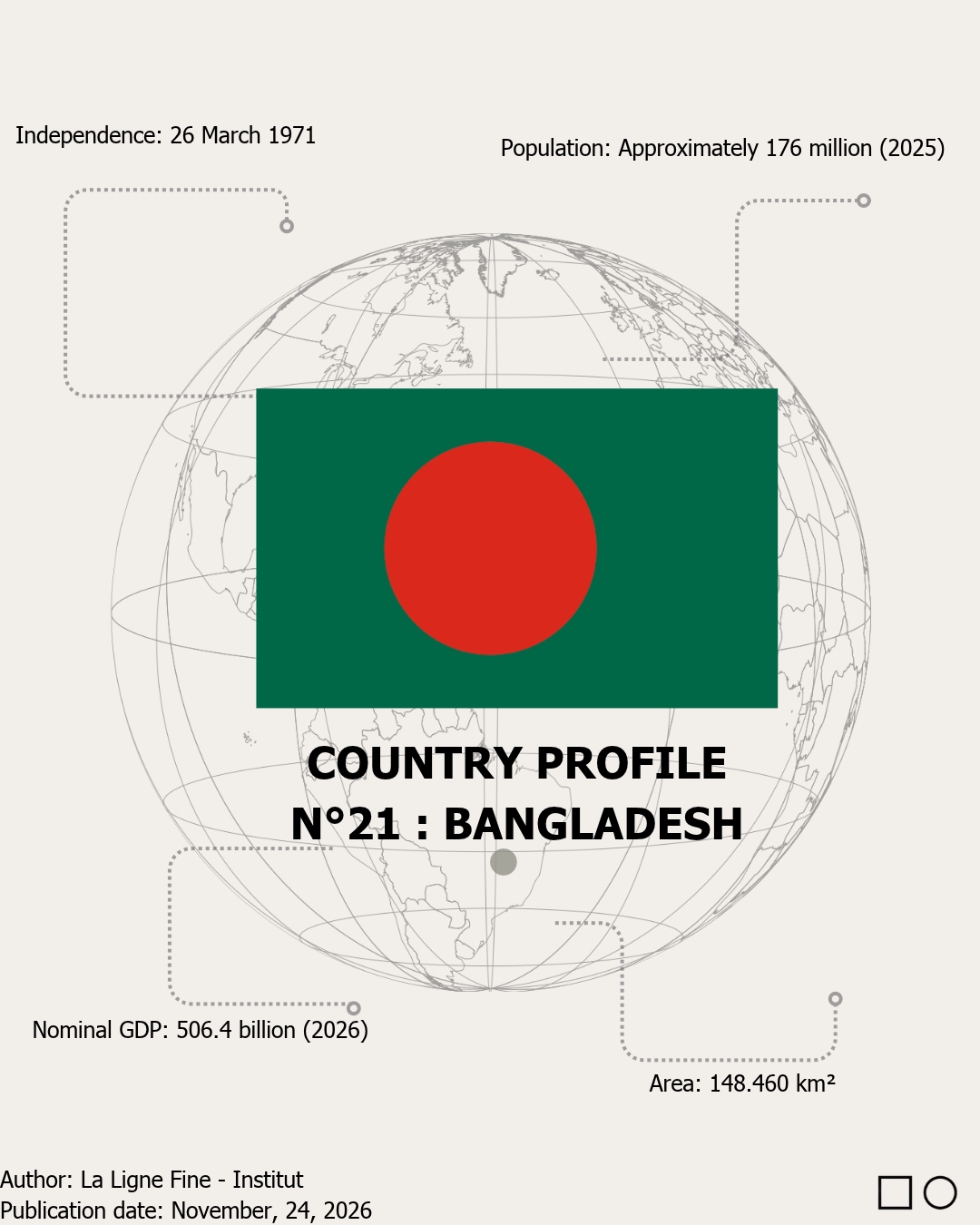
Official name : People’s Republic of Bangladesh (Gana Prajatantri Bangladesh).
Capital : Dhaka, the country’s main political, administrative, economic, and demographic center.
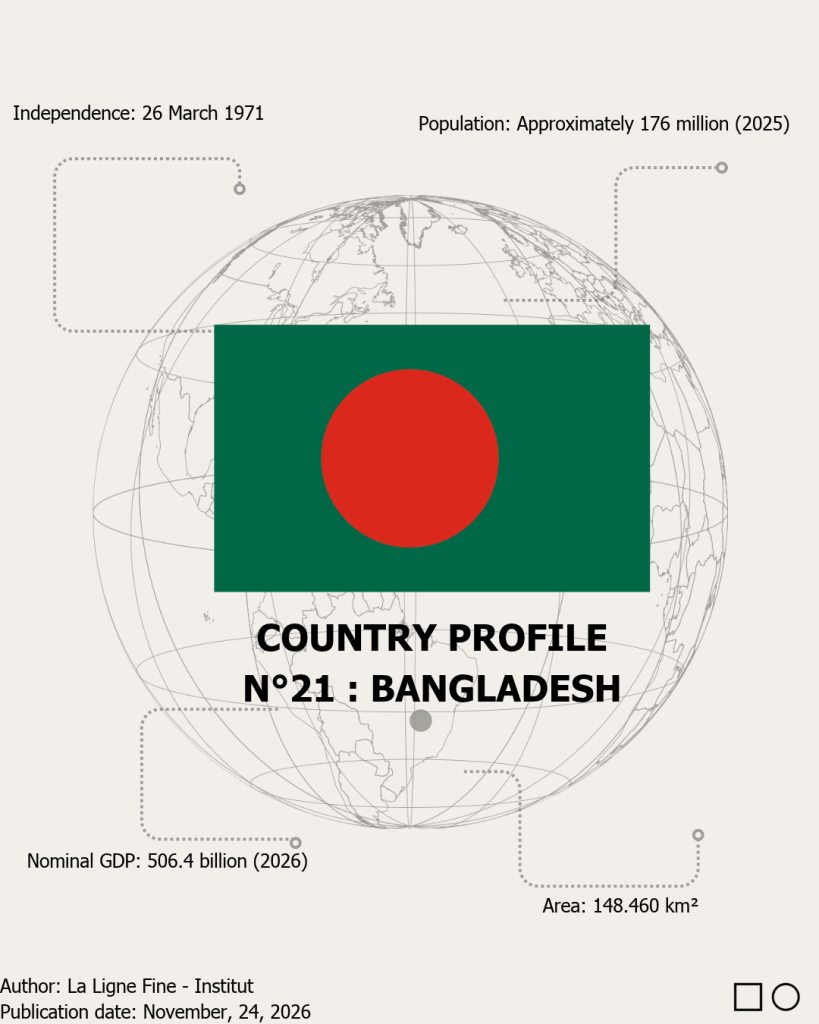
National holiday : March 26, commemorating the declaration of independence of 1971. December 16 also marks Victory Day, corresponding to the end of the liberation war.
GDP: ≈,506.4 billion USD (2026, IMF estimate)
Area : approximately 148,460 km².
Population : approximately 176 million inhabitants in 2025, according to international demographic estimates. This figure is rounded and may vary depending on the statistical series used[1][2].
Official language : Bengali (Bangla). English remains widely used in trade, higher education, and certain administrative activities.
Currency : Bangladeshi taka (BDT).
Political regime : unitary parliamentary republic, founded on the 1972 Constitution.
Head of State : Mohammed Shahabuddin, President of the Republic since April 2023.
Head of Government : Tarique Rahman, Prime Minister since February 17, 2026, following the legislative elections of February 12, 2026[3].
Parliament : Jatiya Sangsad, unicameral National Assembly comprising 350 seats, of which 300 are filled by direct election and 50 reserved for women through an indirect representation mechanism.
Territorial organization : A unitary state administratively organized into eight divisions, subdivided into districts (zilas) and sub-districts (upazilas).
Main economic sectors : textile and clothing industry, services, agriculture, trade, transport, construction, and activities related to the transfer of expatriate workers.
Main economic partners : European Union, United States, China, India, as well as several Asian and Gulf economies.
Main strategic challenges : consolidation of the political transition, industrial diversification, macroeconomic stability, energy security, relations with India and China, reception of Rohingya refugees, and adaptation to climate change.
- Executive summary
Bangladesh holds a unique place in the economic and geopolitical balances of South Asia. Located between India, Myanmar, and the Bay of Bengal, it combines a very large population, a manufacturing industry strongly integrated into international trade, and high exposure to environmental risks. This combination simultaneously makes it a strategic emerging economy and a territory subject to strong structural constraints.
Since its independence in 1971, the country has undergone a considerable economic and social transformation. Despite periods of political instability and food vulnerability, it has developed export industrial capacities and improved several social indicators. The World Bank notably highlights that progress made between 2010 and 2022 enabled some 34 million people to escape poverty, while noting a slowdown in this momentum starting in 2016[4].
However, this transformation is based on a relatively concentrated economic model. The ready-to-wear industry is one of the main drivers of manufacturing exports and employment. The development of services, the advancement of electrification, and income transfers from expatriates have also contributed to growth. But low tax revenues, the vulnerability of the banking sector, insufficient productive investment, and dependence on certain foreign markets limit the prospects for industrial upmarketing.
The political context constitutes a second essential dimension of this trajectory. After fifteen years of political dominance by the Awami League led by Sheikh Hasina, the 2024 protests led to the fall of the government and opened a transition period under the authority of Muhammad Yunus. The legislative elections of February 12, 2026, then allowed the installation of a government led by Tarique Rahman, president of the Bangladesh Nationalist Party (BNP), whose party won a large parliamentary majority[5].
This new political sequence represents an opportunity for institutional reconstruction, but it does not mechanically resolve the accumulated difficulties. Restoring judicial independence, preventing political violence, administrative transparency, and respect for pluralism remain essential to democratic consolidation.
On the international level, Bangladesh must maintain a delicate balance between its relations with India, its economic integration with China, and its trade partnerships with Europe and the United States. Its location in the Bay of Bengal also strengthens its importance for regional connectivity, port infrastructure, and maritime security.
Finally, the country remains directly confronted with two major vulnerabilities: the reception of a very large population of Rohingya refugees who fled Myanmar and the effects of climate change on a densely populated territory, largely structured around large river systems. These challenges highlight the limits of development that would only be envisaged through GDP growth.
Bangladesh’s central strategic challenge is now to convert its demographic, industrial, and social gains into more diversified, institutionally consolidated, and resilient development in the face of external shocks.
- Strategic historical landmarks
Bengal: a territory at the heart of regional trade
The history of Bangladesh is part of that of Bengal, a region historically located at the crossroads of several political and commercial entities in South Asia. The fertile lands of the Ganges and Brahmaputra delta, the waterways, and the opening onto the Bay of Bengal have fostered the development of agricultural, artisanal, and commercial activities.
Bengal was successively integrated into various political entities, notably regional sultanates and then the Mughal Empire. The region held an important place in textile and agricultural trade during the precolonial era.
The Battle of Plassey, in 1757, marked a fundamental step in the expansion of the British East India Company. British rule gradually transformed the political, economic, and administrative structures of the region, whose economy was integrated into imperial commercial circuits.
The 1947 partition and the birth of East Pakistan
In 1947, the partition of British India led to the creation of India and Pakistan. Bengal was divided: its western part remained integrated into India, while its eastern part became East Pakistan.
This configuration is geographically and politically distinctive. The two Pakistani territories are separated by a large portion of Indian territory and have significant linguistic, cultural, and economic differences.
Tensions quickly crystallized around the recognition of the Bengali language. In 1952, the language movement became a founding moment of Bangladeshi national affirmation. Mobilizations for the recognition of Bengali helped structure a political identity distinct from that promoted by the authorities of West Pakistan.
Economic imbalances, controversies over political representation, and tensions between the elites of the two territories gradually fueled autonomist demands.
The 1971 War of Independence
The year 1971 marks the main turning point in contemporary Bangladeshi history. After the 1970 Pakistani elections, won by Sheikh Mujibur Rahman’s Awami League, the central authorities refused to transfer power according to the election results. The political crisis escalated into military repression and a war of liberation.
The conflict caused massive violence, population displacement, and Indian military intervention. Estimates of the number of casualties remain debated and vary considerably depending on historical sources.
The war ended on December 16, 1971, with the surrender of Pakistani forces in Dhaka.
Bangladesh then gained independence as a sovereign state, with Sheikh Mujibur Rahman as the central figure of the new regime. This independence was the culmination of a national mobilization largely based on the defense of the language, Bengali identity, and the right to self-determination.
Institutional instability and return to parliamentarism
The early years of independence were marked by the country’s reconstruction, economic difficulties, and political tensions. In August 1975, Sheikh Mujibur Rahman was assassinated during a coup d’état.
A period of instability, military regimes, and power reshuffling then began. Ziaur Rahman, then Hussain Muhammad Ershad, successively held an important place in national political life.
In 1991, the return to parliamentary rule marked a new stage. Political competition was mainly organized around two major forces: the Awami League and the Bangladesh Nationalist Party.
Sheikh Hasina and Khaleda Zia became the main figures of this rivalry. Their confrontation shaped political life durably, but also contributed to significant institutional polarization.
The concentration of power between 2009 and 2024
From 2009, Sheikh Hasina held power for a long period. His government supported economic expansion, modernization of certain infrastructure, and internationalization of the textile industry.
At the same time, criticism regarding restrictions imposed on the opposition, electoral conditions, enforced disappearances, and institutional independence is multiplying.
In July 2024, the protests initially launched against the quota system in public jobs gradually turned into general protest against the government. Repression and violence worsened the political crisis.
Sheikh Hasina leaves power in August 2024. An interim government is installed under the leadership of Muhammad Yunus, with the mission to stabilize the country and prepare a new institutional sequence[6].
The 2026 elections: a new institutional stage
On February 12, 2026, Bangladesh is holding new legislative elections. The BNP wins a large majority, with 210 of the 300 directly elected seats, according to results published by the Inter-Parliamentary Union.
On February 17, 2026, Tarique Rahman became Prime Minister. This development marks a return to a government resulting from national elections after the transition that began in 2024. The new majority has significant political means to carry out reforms, but its actions must be assessed in light of the protection of pluralism, the functioning of checks and balances, and the results actually achieved in economic and social matters[7].
- Current political structure
A parliamentary republic marked by the historical concentration of power
Bangladesh is a parliamentary republic whose institutional organization is based on the Constitution adopted in 1972. The President of the Republic serves as head of state, while the Prime Minister heads the government and holds most executive prerogatives.
Legislative power belongs to the Jatiya Sangsad, a unicameral assembly. The political system is formally based on the separation of powers, parliamentary control, and the independence of the judiciary. In practice, Bangladesh’s institutional history has been marked by strong concentrations of power around the executive and by lasting confrontation between the main political parties.
Since the February 2026 elections, the governing majority belongs to the Bangladesh Nationalist Party, led by Tarique Rahman. The election marked a break with the period of Awami League dominance. It also led to a reshaping of the opposition and the parliamentary landscape, in which Islamist parties and movements arising from the 2024 protest movement now occupy a different place[8].
This reshuffle represents a major political change. However, it raises a fundamental question: can leadership renewal result in a lasting transformation of institutional practices?
The challenges of institutional reconstruction
The consolidation of the political system first requires strengthening the independence of institutions responsible for organizing elections, ensuring justice, and overseeing administrative action.
The tensions that preceded the fall of Sheikh Hasina’s government showed the possible consequences of lasting distrust towards institutions. Preventing new crises therefore implies that the various political actors have credible legal channels to express their disagreements and participate in public life.
Reform of judicial and police institutions is another task. Accusations of political violence, arbitrary arrests, and violations of fundamental freedoms have sustainably affected citizens’ trust. The response to these concerns requires mechanisms of public accountability, but also respect for the rights of the defense and procedural guarantees.
At the same time, the government must carry out economic and social reforms in an environment where public expectations are high. Youth unemployment, the cost of living, access to public services, and territorial disparities are factors likely to fuel new disputes.
The protection of public freedoms
The state of public freedoms remains a central indicator of Bangladesh’s democratic trajectory.
The historically imposed restrictions on the opposition, political violence, and difficulties faced by certain journalists, activists, and human rights defenders are matters of vigilance.
The political transition opens the possibility of strengthening pluralism, but this must be appreciated over the long term, through the functioning of institutions, freedom of the press, and citizens’ ability to participate in political life without intimidation.
Analyses published in October 2026 by the British government highlight the evolution of the political landscape after the elections, while examining the situation of political groups and the conditions of participation in public life[9].
The main institutional question is therefore no longer just the return to an elected government, but the construction of accountability and control mechanisms strong enough to limit the risks of excessive concentration of power.
- Economic structure
An economic transformation based on manufacturing industry
Bangladesh’s economy has undergone a profound transformation since the 1990s. Initially dominated by agriculture and low-productivity activities, it has gradually structured around manufacturing, services, and increasing integration into international trade chains.
The textile and clothing industry is the main symbol of this evolution. Bangladesh has become one of the major international garment manufacturing centers, supplying notably European and North American markets.
This integration into value chains relies on the availability of a significant workforce, the development of specialized industrial capacities, and relatively competitive production costs.
According to International Monetary Fund studies published in January 2026, manufactured clothing accounts for about 85% of the country’s exports. This concentration is a vulnerability factor to changes in international demand, changes in production costs, and changes in the trade policies of importing countries[10].
The development of the textile industry has also had significant social consequences. It has contributed to manufacturing employment, especially among women, and to the urbanization of several regions. However, working conditions, building safety, wages, and social relations remain structuring issues.
Improving competitiveness cannot therefore be considered solely from the cost perspective. It also requires investments in productivity, training, industrial safety, and compliance with social standards.
An economy vulnerable to the concentration of its exports
Dependence on textiles exposes Bangladesh to several categories of risks. A decrease in consumption in major import markets can cause a contraction in industrial orders. An increase in energy costs can reduce business margins, while logistical disruptions can compromise delivery deadlines.
Added to these risks are regulatory changes in Western markets. Requirements for traceability, supply chain transparency, and social responsibility may require additional investments from exporting companies.
The development of sectors such as pharmaceuticals, agri-food, information technologies, industrial components, or certain engineering activities represents a path to diversification. However, these prospects depend on the quality of infrastructure, access to financing, and training capacities.
The goal is not only to develop new activities but also to increase the share of locally produced value added.
The economic slowdown of 2025–2026
After several decades of sustained growth, Bangladesh is experiencing a period of slowdown.
The International Monetary Fund notably identifies low tax revenues, banking sector difficulties, persistent inflation, and delays in certain exchange rate regime reforms as major obstacles to macroeconomic stability.
In January 2026, the IMF forecast a growth recovery of around 4.7% for the 2025-2026 and 2026-2027 fiscal years. However, during its July 2026 mission, its services revised their assessment, estimating that growth could slow to 3.5% during the 2026-2027 fiscal year and fall below 3% in the medium term without decisive reforms. These figures correspond to successive projections, not to final results[11][12].
The World Bank confirmed, in its update of October 6, 2026, that weaknesses in the financial sector, energy constraints, and insufficient mobilization of domestic revenues continued to hinder investment and economic activity[13].
This deterioration occurs in a context where financing needs are significant, particularly for infrastructure, public services, social protection, and climate adaptation.
The fragility of the banking system and public finances
Banking stability is a crucial issue for Bangladesh’s economic prospects. Governance difficulties in certain financial institutions, non-performing loans, and insufficient control mechanisms affect investor confidence and banks’ ability to finance businesses.
These vulnerabilities can slow industrial investments, especially for small and medium-sized enterprises with limited external financing opportunities.
At the same time, Bangladesh mobilizes a relatively small share of its national wealth in the form of tax revenues. This situation constrains public spending and reduces budgetary room for maneuver. Increasing tax revenues, modernizing administration, and combating financial irregularities are therefore priorities. The challenge, however, is to improve resource mobilization without imposing excessive constraints on low-income households or productive enterprises.
Relocations of expatriate workers
Financial transfers from Bangladeshis working abroad play an important role in the national economy. Many Bangladeshi nationals work in Gulf countries, Southeast Asia, or other foreign economies.
The transferred amounts support household consumption, contribute to reducing certain forms of poverty, and constitute a source of foreign currency. However, this resource remains exposed to changes in international labor markets, host countries’ migration policies, and regional economic tensions.
Public authorities must therefore seek to strengthen professional qualifications, the protection of migrant workers, and the transparency of transfer channels.
Energy security as a condition for competitiveness
Industrial growth has greatly increased Bangladesh’s energy needs. The country has national natural gas resources, but these are not sufficient to guarantee sustainable coverage of all demand. Energy imports, electricity production infrastructure, and investments in networks are therefore becoming essential.
Exposure to international fuel prices can increase industrial costs, degrade external balances, and impose additional public spending. Supply difficulties particularly affect manufacturing companies, whose competitiveness depends on stable electricity availability. The energy strategy must therefore combine supply diversification, network strengthening, development of national capacities, and improvement of energy efficiency.
The World Bank identifies energy sector reforms among the necessary conditions for restoring sustained growth[14].
The scheduled exit from the least developed countries category
Bangladesh’s development trajectory also raises the question of its removal from the category of least developed countries, or LDCs. This development is a recognition of the country’s economic and social progress but may also lead to a gradual reduction of certain benefits granted to the most vulnerable economies.
Initially scheduled for November 2026, this release was extended from the preparatory period until November 24, 2029. This deadline is now indicated by the official United Nations portal dedicated to LDCs[15].
This extension gives Bangladesh more time to prepare its companies to adapt to new international trade conditions. For the textile industry, the issue is particularly high. European tariff preferences constitute a competitive advantage, but their future evolution may increase the costs of accessing the European market.
Bangladesh’s ability to boost the productivity of its companies, improve compliance with standards, and diversify its exports will therefore be decisive. The central economic objective is to shift from a model based mainly on production costs and trade preferences to a more diversified, productive economy capable of maintaining its competitiveness without overly relying on external mechanisms.
- Regional and international positioning
A crossroads position in the Bay of Bengal
Bangladesh occupies a strategic position at the junction of South Asia and Southeast Asia. This situation gives it significant potential for trade, energy infrastructure, and regional transport corridors. The Bay of Bengal constitutes an essential maritime area for exchanges between the Indian Ocean, Asian markets, and major international trade routes.
Bangladesh’s maritime frontage gives it strategic interest that goes beyond its domestic market. The development of ports, railway networks, roads, and logistics infrastructure can strengthen its position in regional value chains. However, this potential depends on the country’s ability to improve its port facilities, reduce transport costs, and ensure the security of trade flows.
Relations with India
India represents Bangladesh’s most structuring neighbor. The two countries share a long land border as well as numerous economic, social, and environmental challenges. Their cooperation notably concerns transport, trade, electricity, cross-border waterways, and border security.
India played a decisive role in Bangladesh’s independence in 1971. This historical proximity fostered the development of important bilateral relations, but it did not eliminate political disagreements.
Water resource management is one of the main challenges. Several major rivers cross both territories, which involves negotiations on water sharing, flood prevention, and management of agricultural uses.
The bilateral relationship is also influenced by internal political developments. Bangladesh’s institutional transformations since 2024 have opened a period of diplomatic readjustment. For Dhaka, the goal is to maintain functional economic and security relations with New Delhi while asserting its ability to conduct an autonomous foreign policy.
China: an industrial and infrastructure partner
China holds a major place in Bangladesh’s trade and infrastructure exchanges. Chinese companies supply industrial equipment, raw materials, and manufactured goods necessary for the Bangladeshi economy. Beijing is also involved in several infrastructure and energy development projects.
Chinese cooperation can facilitate the country’s logistical and industrial modernization, but it also raises questions related to financing conditions, technological dependencies, and investment sustainability. Bangladesh must therefore weigh the immediate benefits of these partnerships with the potential consequences of excessive concentration of its suppliers or investors.
This relationship is part of the broader competition for influence between China and India in the Indian Ocean. Dhaka seeks to benefit from its economic partnerships with Beijing without turning this cooperation into exclusive strategic alignment.
The European Union and the United States
The European Union and the United States are two key outlets for Bangladesh’s industrial exports. Trade relations with these partners are based on Bangladesh’s integration into international textile production chains and on preferences for access to certain markets.
However, discussions now go beyond tariff issues alone. They also cover workers’ rights, environmental standards, supply chain traceability, and economic governance. In the context of the future exit from the LDC category, Bangladesh must anticipate changes in its conditions of access to the European market.
European trade policy is part of the Generalized System of Preferences, whose mechanisms aim to support the trade integration of developing economies under certain conditions[16].
For Bangladesh, maintaining stable trade relations with Europe and the United States is an important condition for industrial employment, export revenues, and investor confidence.
Regional organizations and multilateralism
Bangladesh participates in several regional and international organizations, including the United Nations, the South Asian Association for Regional Cooperation (SAARC), the Bay of Bengal Initiative for Multisectoral Technical and Economic Cooperation (BIMSTEC), and the Association of Indian Ocean Coastal States (IORA).
These frameworks allow Dhaka to participate in discussions on connectivity, trade, energy, natural disasters, and regional security. BIMSTEC is of particular interest because it brings together several South Asian and Southeast Asian states around functional cooperation, potentially going beyond certain limits of South Asian cooperation.
Bangladeshi diplomacy thus favors a pragmatic approach: multiplying cooperation forums to avoid excessive dependence on a single regional power. This policy is consistent with the country’s diplomatic tradition, historically attached to preserving its independence and multilateralism[17].
- Security, defense, and conflict
National security structured around multiple vulnerabilities
Bangladesh’s defense policy takes place in a relatively complex environment. The country does not experience any major interstate armed conflict on its territory, but it faces risks related to domestic political stability, the situation in Myanmar, maritime surveillance, and the protection of strategic infrastructure.
The Bangladeshi armed forces include a land army, a navy, and an air force. They ensure the defense of the territory, the protection of national sovereignty, and various missions supporting civil authorities. The country’s geographical situation makes cooperation between land, naval, and air forces essential, especially for the protection of borders and maritime approaches.
Myanmar and the Rohingya crisis
The border with Myanmar is one of the main sources of security and humanitarian concern. For several decades, persecutions suffered by the Rohingya populations in Myanmar have caused significant displacement to Bangladesh, particularly during the 2017 violence.
Bangladesh currently hosts more than one million Rohingya refugees, mainly in the Cox’s Bazar region. A United Nations report published in September 2026 reports more than 1.2 million Rohingya in Cox’s Bazar, in addition to people hosted on Bhasan Char Island[18].
This situation represents a considerable burden on local infrastructure, public services, ecosystems, and humanitarian organizations. The stakes are not only financial. They also concern camp security, trafficking prevention, access to education, protection of women and children, and coexistence between refugees and local communities.
The Bangladeshi government supports the prospect of refugees returning to Myanmar. However, such a process can only be considered sustainable if it is based on verifiable conditions of security, dignity, and voluntarism. The ongoing clashes in Myanmar currently limit these prospects.
The protection of the Bay of Bengal
Bangladesh’s maritime space is an increasing challenge. The development of trade, port projects, and offshore energy infrastructure require appropriate securing of maritime approaches.
The main risks concern maritime crime, smuggling, trafficking, industrial accidents, and the consequences of natural disasters on port infrastructure.
The Bangladeshi navy participates in maritime surveillance and the protection of national economic interests. Improving maritime situational awareness, surveillance, and interministerial coordination capabilities could strengthen the country’s resilience to these risks.
United Nations peacekeeping operations
Participation in peacekeeping operations is an important component of Bangladesh’s defense diplomacy. Since 1988, Bangladesh has contributed to United Nations international missions by sending military, police, and observers.
In 2026, it remains among the main contributors to peacekeeping operations. This commitment provides the armed forces with international operational experience and allows the country to strengthen its diplomatic visibility[19][20].
This participation can also promote the professionalization of the armed forces and cooperative relations with other contributing countries. It thus constitutes a particularly important instrument of international influence for a state that does not have the economic and military capacities of the major regional powers.
Internal security risks
Internal security remains linked to political tensions, crime, and the prevention of violent extremism.
Periods of institutional transition can increase the risks of collective violence, partisan clashes, or weakening of certain security systems.
Authorities must also respond to minority protection needs and community tensions.
The government’s ability to maintain public order while respecting fundamental freedoms will be decisive for the confidence of citizens and investors. In this context, the quality of cooperation between security services and judicial authorities represents both a governance and national security issue.
- Environmental and climate issues
A territory highly exposed to natural risks
Bangladesh is among the countries particularly vulnerable to the consequences of climate change. Its geographical location, at the end of the Ganges, Brahmaputra, and Meghna delta, explains much of this exposure.
The territory is crossed by numerous watercourses and includes vast alluvial plains. This configuration favors agriculture and river exchanges, but also increases the risks of flooding, erosion, and population displacement.
Population concentration increases the human and economic consequences of disasters. A major flood can simultaneously affect homes, roads, energy infrastructure, agricultural operations, and industrial activities.
Risks are not evenly distributed: coastal regions are particularly exposed to cyclones and marine flooding, while territories along major rivers suffer more from floods and bank erosion.
According to the World Bank, climate disasters represent a significant obstacle to poverty reduction and can lead to job losses, loss of activity, and increased public financing needs[21].
Rising water levels and soil salinization
Sea level rise poses a major risk to Bangladesh’s coastal areas. The gradual salinization of certain agricultural lands and freshwater resources can degrade yields, affect living conditions, and reduce food production opportunities.
These phenomena are particularly concerning in areas where populations depend directly on agriculture, fishing, and local water resources. The decrease in freshwater availability can also increase health difficulties and tensions on supply infrastructure.
In the long term, these changes can contribute to internal mobility, especially towards large urban areas, with significant consequences for housing, employment, and public services.
Cyclones and the protection of populations
Bangladesh has developed disaster preparedness mechanisms that represent one of the important advances in its resilience policy. Early warning systems, cyclone shelters, community mobilization mechanisms, and evacuation operations have helped improve response capacity to extreme weather events.
However, these advances do not eliminate economic losses. Infrastructure destruction, business interruptions, and reconstruction needs remain considerable.
Resilience also depends on the quality of buildings, the continuity of electricity networks, the protection of health infrastructure, and the availability of transportation means. The World Bank believes that investments in climate resilience must be linked to economic and social development policies in order to preserve progress made against poverty[22].
The Sundarbans: a strategic ecological heritage
The Sundarbans form a vast network of mangroves shared between Bangladesh and India. This ecosystem plays an important role in regional biodiversity, coastal protection, and the livelihoods of several communities.
Mangroves notably help mitigate certain effects of storms and limit coastal erosion. Their preservation therefore simultaneously falls under environmental policy, a territorial security strategy, and an economic issue. However, urbanization, pollution, industrial activities, and changes in the hydrological regime threaten the balance of these areas. The protection of the Sundarbans requires sustainable cross-border cooperation, particularly in water management, biodiversity, and pollution prevention.
Climate adaptation as a national priority
Bangladesh cannot limit its climate strategy to reducing greenhouse gas emissions. Given its vulnerability, adaptation is an immediate necessity for protecting populations, ensuring food security, and economic continuity.
Priorities notably concern coastal zone development, modernization of drainage infrastructure, building resistance, water resource management, agricultural diversification, and population displacement planning. These policies require sustainable funding and coordination between national administrations, local authorities, international partners, and local communities.
The mobilization of international climate finance thus represents as much a foreign policy issue as a development need. For Bangladesh, climate resilience is not a sectoral policy: it is a fundamental condition for territorial stability, human security, and economic sustainability.
- Relations with France and French interests
A bilateral relationship historically based on cooperation
France and Bangladesh have maintained diplomatic relations since the country’s independence. The bilateral relationship is part of a tradition of political, economic, cultural, and development cooperation. France has notably contributed to several initiatives in water resource management, flood prevention, and development support.
President François Mitterrand’s visit in 1990 is one of the main historical milestones of this relationship. It was accompanied by a river management program aimed at flood prevention. In 1991, France also proceeded with a debt cancellation in favor of Bangladesh, whose current equivalent value is estimated at about 140 million euros by the French Ministry of Foreign Affairs[23].
The two countries also share several positions in multilateral forums, notably on climate, development issues, and international cooperation.
French economic interests
Bangladesh represents an important market due to its demographic weight, infrastructure needs, and the development of its industrial sector. French interests concern several areas.
In industry, the needs for equipment modernization, automation, productivity improvement, and energy transition offer opportunities for cooperation.
In transport, investments related to urban networks, rail infrastructure, and logistics platforms can encourage the involvement of companies specialized in engineering and equipment.
In energy, diversifying supplies and improving energy efficiency are important areas for technical and financial partners.
The aeronautics sector is also an area of economic cooperation. Air transport needs and capacity renewal can offer commercial prospects, subject to investment decisions and financing conditions.
However, the size of the market does not guarantee easy access. Foreign companies must take into account exchange rate risks, banking sector difficulties, administrative constraints, infrastructure issues, and compliance requirements.
Strategic and maritime interests
Bangladesh’s situation in the Bay of Bengal gives it particular importance in the Indo-Pacific space. France, as a power with territories and maritime interests in the Indian Ocean, can find in Bangladesh a partner for dialogue on maritime security, connectivity, and environmental protection issues.
This cooperation may concern knowledge of the maritime situation, combating certain illicit activities, disaster preparedness, and humanitarian operations. However, the development of security partnerships must be appreciated taking into account regional balances and Dhaka’s desire to preserve its diplomatic autonomy.
Cooperation based on common interests, rather than alignment logic, would be more consistent with the country’s international posture.
Climate and resilient infrastructure
Climate change is probably one of the most structuring areas for deepening Franco-Bangladeshi cooperation. The needs concern coastal protection, urban planning, water management, sanitation, and infrastructure reconstruction after natural disasters. French actors in development financing, engineering, and infrastructure can contribute to these projects while respecting Bangladesh’s national priorities.
This cooperation also offers the possibility of bringing environmental issues closer to social and economic development objectives. The Franco-Bangladeshi relationship is thus based on complementary interests: for France, strengthening its partnerships in South Asia; for Bangladesh, diversifying its economic partners and mobilizing skills and funding for its development.
Governance and economic responsibility issues
Economic cooperation cannot be completely separated from institutional and social issues. The importance of the textile sector notably requires particular attention to working conditions and the safety of industrial facilities.
French companies involved in Bangladeshi supply chains must integrate the requirements of vigilance, traceability, and management of social and environmental risks. Bilateral dialogue may also cover professional training, skills development, and improvement of production conditions.
For France, Bangladesh is an industrial, maritime, and climate partner. The deepening of the relationship will depend on the ability of both countries to build sustainable cooperations compatible with Bangladesh’s development goals.
- Points of Vigilance
The consolidation of the democratic transition
The first point of vigilance concerns the political trajectory opened by the February 2026 elections. The return to an elected government represents a major change after the institutional crisis of 2024. However, the presence of a large parliamentary majority must be accompanied by control mechanisms, an independent judiciary, and guarantees for the opposition.
Previous political experiences show that strong electoral dominance can favor the concentration of power if counter-powers do not have sufficient protections. The challenge will therefore be to assess not only the announced reforms but also their implementation and their ability to build trust in institutions.
Financial and banking stability
The second point concerns macroeconomic vulnerabilities. Low tax revenues, weaknesses in the banking sector, and inflationary pressures limit the state’s ability to finance its priorities. Difficulties in accessing credit can also slow productive investment, particularly in sectors that lack the commercial and financial networks of the textile industry.
The IMF and the World Bank emphasize the need for financial, fiscal, and energy reforms to restore sustainable growth[24][25].
Industrial concentration
The third point concerns dependence on the textile sector. This specialization constitutes a historic economic advantage, but it exposes the country to fluctuations in international demand, changes in customs tariffs, and the growing demands of importing markets.
Changes affecting trade preferences granted to least developed countries make industrial modernization particularly important. Bangladesh will need to strengthen its production capacities in complementary sectors and improve its competitiveness beyond cost advantages alone.
The humanitarian situation of the Rohingya
The fourth point concerns the consequences of the crisis in Myanmar. The reception of more than one million Rohingya refugees represents a considerable humanitarian responsibility. The situation remains particularly sensitive due to the fragility of living conditions in the camps and difficulties in financing international assistance.
Security tensions in Myanmar and the lack of sufficient guarantees for a sustainable return limit the prospects for resolution. Bangladesh must therefore continue seeking international support while preserving the security and living conditions of the local host communities.
Climate risks
The fifth point concerns environmental vulnerability. Floods, cyclones, salinization, and erosion can produce simultaneous shocks on agriculture, infrastructure, transport, and public finances. These phenomena can also exacerbate territorial disparities and contribute to internal migration. Climate resilience must therefore be integrated into industrial, social, agricultural, and planning policies.
Regional geopolitical balances
Finally, Bangladesh must maintain stable relations with its main partners without relying excessively on a single actor. Relations with India are essential for border stability and regional trade. China is a major industrial and infrastructure partner, while the European Union and the United States remain essential for exports.
This multiple interdependence offers opportunities for diplomatic diversification but also involves complex trade-offs. Dhaka’s ability to maintain a pragmatic foreign policy will be decisive for its economic security and strategic autonomy.
- Prospects for development
An opportunity for political stabilization
The new majority resulting from the 2026 elections has significant initiative. If it manages to strengthen institutions, restore trust in the administration, and guarantee pluralism, this political sequence could represent a step toward democratic consolidation.
Conversely, a new concentration of power, an increase in partisan violence, or the lack of institutional progress could prolong the political difficulties accumulated over several decades.
Political stability will therefore have to be assessed through concrete indicators: quality of electoral procedures, judicial functioning, freedom of the press, and the opposition’s ability to participate in public life.
Towards a new business model
Bangladesh has significant assets to develop a more diversified economy. Its workforce, manufacturing capabilities, and commercial integration offer prospects in industrial activities, services, technologies, and infrastructure.
However, this transformation will require sustained investments in training, innovation, energy, and logistics. The modernization of the banking sector and the improvement of the business climate will be essential conditions to attract investment. In the medium term, the economic trajectory will therefore depend less on the growth of textile exports alone than on the country’s ability to develop new productive sectors.
The connectivity potential of the Bay of Bengal
Bangladesh’s geographical position could strengthen its role as a regional logistics platform. The development of its port infrastructure, transport networks, and energy connections can facilitate exchanges between South Asia, Southeast Asia, and international markets.
Cooperation with neighboring countries nevertheless represents a condition for realizing this potential. A sustainable improvement in connectivity also requires reducing administrative obstacles, modernizing customs procedures, and improving infrastructure reliability.
A climate diplomacy likely to strengthen its influence
Bangladesh’s vulnerability to climate change is a major constraint, but it can also encourage its participation in international discussions on adaptation and climate justice. The country has significant experience in disaster preparedness and community mobilization. This experience can be leveraged in multilateral forums and development partnerships. Access to international financing and the ability to translate climate commitments into concrete investments will, however, be decisive.
An international influence based on multilateralism
Bangladesh can also strengthen its influence by continuing its participation in regional organizations and peacekeeping operations. The combination of its demographic weight, its participation in international trade, and its commitment to United Nations operations gives it significant diplomatic visibility. However, this influence will remain conditioned by its institutional stability, economic performance, and ability to maintain an independent foreign policy.
- Final strategic reading
Bangladesh is one of the most significant examples of economic and social transformation in South Asia over recent decades. Its evolution reflects the possibility for a state initially characterized by strong economic, food, and environmental vulnerabilities to develop a competitive export industry, improve several social indicators, and strengthen its international integration.
However, these achievements do not eliminate structural weaknesses. The economic model remains strongly focused on the textile industry, while financial and energy tensions reduce investment and diversification prospects. Politically, the fall of Sheikh Hasina’s government in 2024 and the February 2026 elections have opened a new institutional phase. The return to an elected government represents a major step, but democratic consolidation will depend on the ability of the new authorities to ensure pluralism, strengthen counterpowers, and improve public accountability.
Bangladesh’s geographical situation is both an opportunity and a constraint. Located near India, China, and the main routes of the Bay of Bengal, the country can play an increasing role in regional exchanges. However, this position requires careful management of diplomatic relations and economic dependencies.
Finally, climate vulnerability and the Rohingya refugee crisis remind us that Bangladesh’s security cannot be reduced to territorial defense alone. It also involves protecting populations, resource stability, infrastructure resilience, and the capacity of institutions to respond to prolonged crises.
Three imperatives therefore appear decisive for the country’s future. First, consolidate democratic institutions and trust in the administration in order to sustainably stabilize the political system.
Next, diversify the productive apparatus to reduce dependence on textile exports and strengthen economic resilience.
Finally, securing the conditions for national development through regional cooperation, climate adaptation, energy security, and the management of humanitarian crises.
Bangladesh’s major strategic challenge is to transform its demographic and industrial power into economically diversified, politically stable development capable of withstanding geopolitical and environmental shocks. For France and the European Union, Bangladesh thus represents a partner whose importance goes beyond textile supply chains alone. Its stability, development, and ability to preserve its strategic autonomy are issues for South Asia’s balance, Indo-Pacific connectivity, and international cooperation in the face of climate change.
[1] United Nations, 2025, https://population.un.org/wpp/
[2] World Bank, 2026, https://data.worldbank.org/country/bangladesh
[3] Inter-Parliamentary Union, 2026, https://data.ipu.org/parliament/BD/BD-LC01/election/BD-LC01-E20260212/
[4] World Bank, 2025, https://www.worldbank.org/en/news/press-release/2025/11/25/job-creation-key-to-equality-and-faster-poverty-reduction-in-bangladesh-says-world-bank
[5] Inter-Parliamentary Union, 2026, https://data.ipu.org/parliament/BD/BD-LC01/election/BD-LC01-E20260212/
[6] British Government, 2026, https://www.gov.uk/government/publications/bangladesh-country-policy-and-information-notes/country-policy-and-information-note-political-situation-bangladesh-october-2026-accessible
[7] Inter-Parliamentary Union, 2026, https://data.ipu.org/parliament/BD/BD-LC01/election/BD-LC01-E20260212/
[8] British Government, 2026, https://www.gov.uk/government/publications/bangladesh-country-policy-and-information-notes/country-policy-and-information-note-political-situation-bangladesh-october-2026-accessible
[9] British Government, 2026, https://www.gov.uk/government/publications/bangladesh-country-policy-and-information-notes/country-policy-and-information-note-political-situation-bangladesh-october-2026-accessible
[10] International Monetary Fund, 2026, https://www.imf.org/en/publications/cr/issues/2026/01/30/bangladesh-2025-article-iv-consultation-press-release-staff-report-and-statement-by-the-573579
[11] International Monetary Fund, 2026a, https://www.imf.org/en/news/articles/2026/01/30/pr-26029-bangladesh-imf-executive-board-concludes-2025-article-iv-consultation
[12] International Monetary Fund, 2026b, https://www.imf.org/en/news/articles/2026/07/16/pr26248-bangladesh-imf-staff-concludes-visit-to-bangladesh
[13] World Bank, 2026, https://www.worldbank.org/en/news/press-release/2026/10/06/bangladesh-needs-urgent-financial-energy-and-revenue-reforms-to-restore-growth-cre
[14] World Bank, 2026, https://www.worldbank.org/en/news/press-release/2026/10/06/bangladesh-needs-urgent-financial-energy-and-revenue-reforms-to-restore-growth-cre
[15] United Nations, 2026, https://www.un.org/ldcportal/en/content/bangladesh-graduation-status
[16] European Commission, 2026, https://policy.trade.ec.europa.eu/development-and-sustainability/generalised-scheme-preferences/questions-answers-new-eu-generalised-scheme-preferences_en
[17] Ministry for Europe and Foreign Affairs, 2026, https://www.diplomatie.gouv.fr/fr/information-par-pays/bangladesh/presentation-du-bangladesh
[18] United Nations, 2026, https://iimm.un.org/sites/default/files/2026/09/SG%20report%202026%20Situation%20of%20human%20rights%20of%20Rohingya%20Muslims%20and%20other%20minorities%20in%20Myanmar%20English.pdf
[19] United Nations, 2026, https://peacekeeping.un.org/en/bangladesh
[20] Armed Forces Division of Bangladesh, 2026, https://www.afd.gov.bd/un-peacekeeping/position-of-bangladesh-in-un-peace-operation
[21] World Bank, 2026, https://www.worldbank.org/en/country/bangladesh/overview
[22] World Bank, 2026, https://www.worldbank.org/en/country/bangladesh
[23] Ministry for Europe and Foreign Affairs, 2026, https://www.diplomatie.gouv.fr/fr/information-par-pays/bangladesh/relations-bilaterales
[24] International Monetary Fund, 2026, https://www.imf.org/en/news/articles/2026/07/16/pr26248-bangladesh-imf-staff-concludes-visit-to-bangladesh
[25] World Bank, 2026, https://www.worldbank.org/en/news/press-release/2026/10/06/bangladesh-needs-urgent-financial-energy-and-revenue-reforms-to-restore-growth-cre