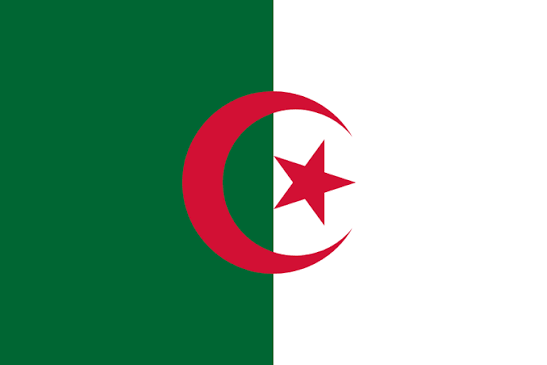
Algeria
People’s Democratic Republic of Algeria
Authors: La Ligne Fine – Institut
Published Date: August 4, 2026
Maps of World. (n.d.). Map of Algeria.
Key data
Official name: People’s Democratic Republic of Algeria.
Capital: Algiers.
Population: about 47.85 million inhabitants in 2026 according to the IMF[1].
Area: 2.38 million km². Algeria is the largest country in Africa, the Arab world and the Mediterranean basin. This territorial depth is a strategic asset, but also a challenge in terms of administration, border security, development and territorial cohesion[2].
Official languages: Arabic and Tamazight. French retains an important place in the economy, higher education, the media, business relations, scientific exchanges and part of the administration, without official status.
Currency: Algerian dinar.
Political system: presidential republic with strong executive centralization.
President of the Republic: Abdelmadjid Tebboune, re-elected in September 2024 for a second term. The Constitutional Court confirmed his victory with 84.30% of the vote and a final turnout of 46.10%, after an electoral sequence marked by controversies over the initial figures and by the contestation of certain irregularities by the candidates themselves[3].
Head of government: Sifi Ghrieb, appointed interim prime minister in August 2025 after the end of Nadir Larbaoui’s duties[4].
Current GDP: about $269.3 billion in 2024 according to the World Bank[5].
Recent growth: The Algerian economy grew by 4.1% in the first half of 2025 according to the World Bank, with growth expected at 3.8% for the whole of 2025[6].
Projected growth: 3.8% in 2026 according to the IMF[7].
Projected inflation: 2.9% in 2026 according to the IMF[8].
Strategic resources: natural gas, oil, condensates, mineral resources, significant solar potential, Saharan depth, energy infrastructure to Europe.
Central energy player: Sonatrach, a public company at the heart of Algeria’s economy, public finances and external energy projection.
Military spending: $25.4 billion in 2025 according to SIPRI, up 11%, making Algeria the largest military spender in Africa and North Africa[9].
Geopolitical status: Maghreb power, energy rentier state, major military player on the African continent, Euro-Mediterranean pivot, Saharan and Sahelian power, historical support for the Polisario Front, Morocco’s strategic rival.
International organizations and frameworks: African Union, Arab League, OPEC, Gas Exporting Countries Forum, UN, Non-Aligned Movement, partnership with the European Union, long-standing strategic relations with Russia, enhanced energy cooperation with Italy, Spain and several international majors.
- Executive Summary
Algeria is a locking power. It locks off part of the Maghreb through its rivalry with Morocco. It locks in part of the Mediterranean gas through its exports to southern Europe. It locks off part of the Sahelian access by its territorial depth and its borders with Mali, Niger, Libya and Mauritania. Finally, it locks in part of the Franco-Mediterranean memory, because relations between Algiers and Paris remain marked by the war of independence, human mobility, archives, visas, diasporas, language, security, energy and historical wounds.
This position gives Algeria a strategic importance greater than its real economic performance. The country has considerable resources, a powerful military, experienced diplomacy and exceptional geographical depth. But this power remains constrained by an economic model that is still very dependent on hydrocarbons, by a closed political system, by a young and underemployed society, by a cumbersome administration, by weak regional integration and by a difficult relationship with several European partners, first and foremost France.
Algeria is thus a state with real power, but with an incomplete conversion. Its hydrocarbons give it budgetary space, energy sovereignty and leverage over Europe. Its army gives it a regional deterrent capability. Its diplomacy gives it an African, Arab and non-aligned presence. But these resources are not yet sufficiently transformed into a productive economy, massive jobs, innovation, regional integration or sustainable positive influence.
Since the war in Ukraine and the energy disruption between the European Union and Russia, Algeria’s gas role has been strengthened. The European Union cites Algeria as one of its main gas suppliers, alongside Norway, the United States, the United Kingdom, Azerbaijan and residual Russia[10].
Algeria has strategic infrastructure to Europe, including gas pipelines to Italy and Spain. A presentation by Sonatrach indicates that two operational international gas pipelines connect Algeria to Europe, with a total capacity of 43 billion cubic meters per year[11].
This capability makes Algeria a close, politically autonomous and geographically crucial supplier for Mediterranean Europe. But Algerian gas is not an unlimited solution. Domestic consumption is increasing. Some deposits are mature. The infrastructure must be maintained. LNG exports may be affected by maintenance. Columbia University reported in January 2026 that Algerian LNG exports to the European Union had decreased by about 13% in 2025, due in particular to prolonged maintenance at the Skikda complex, while stressing that Algerian gas remained structurally important for Europe[12].
Algeria must therefore invest to maintain its position, as illustrated by the launch of the 2026 round of oil and gas tenders and the new contracts with players such as Eni and Sinopec[13].
Politically, Algeria is stable, but locked. Abdelmadjid Tebboune was re-elected in 2024, but this re-election does not resolve the question of deep political legitimacy. The turnout, the electoral controversies and the weakness of the opposition space are a reminder that the system is based less on open democratic competition than on the continuity of the centres of power. The Hirak of 2019 brought down Abdelaziz Bouteflika, but it did not transform the structure of the regime. Since then, the civic space has closed. Amnesty International reported in 2025 an intensification of the crackdown on dissenting voices, particularly in the run-up to the sixth anniversary of the Hirak[14]. The regime has regained control, but it has not necessarily rebuilt membership.
The Algerian economy is resilient but dependent. The World Bank points out that growth has been robust since the pandemic, driven by a more than 60% increase in public spending between 2021 and 2023, but that lower hydrocarbon prices, OPEC cuts, investment-related imports, and increased spending have put pressure on fiscal and external [15]balances. The IMF believes that the near-term outlook is broadly positive, but clouded by growing fiscal vulnerabilities, a wider deficit, and erosion of fiscal margins[16].
The problem is not the lack of growth; That’s the quality of that growth. It remains too dependent on rents, public spending and a private sector that is still insufficiently productive.
Social risk is long-lasting. Youth unemployment reached 29.4% in 2025 according to the World Bank[17]. This is politically central. It means that a large proportion of young people, even educated ones, do not find sufficient integration. Rent makes it possible to finance social measures, housing, public salaries and subsidies, but it is not enough to produce an economy of opportunities. Algeria is thus confronted with a classic paradox of rentier states: the state has resources, but society lacks prospects.
Strategic reading: Algeria is a real power, but its 2026-2030 trajectory will depend on its ability to convert its rents into capacities. Energy rent in productive diversification. Military income in regional stabilization. Memory rent in mature diplomacy. Budget rent in infrastructure, jobs and human capital. If this conversion succeeds, Algeria can strengthen its status as a Mediterranean and African power. If it fails, it will remain a central but defensive state, exposed to hydrocarbon cycles, social frustrations, regional blockages and crises of legitimacy.
- Strategic historical landmarks
The contemporary history of Algeria is structured by French colonization, the war of independence, the construction of a highly centralized postcolonial state, the Black Decade, the Bouteflika cycle and the Hirak. These sequences are not only historical. They also organize the way in which Algiers thinks about sovereignty, security, memory, diplomacy, the army and internal order.
The French conquest of 1830 opened a long, violent and specific colonial period. Algeria is not only administered as a colony of exploitation. It became a colony, legally and symbolically integrated into the French space, while maintaining a profound inequality between European and Muslim populations. This configuration produces a singular Franco-Algerian relationship, much more intimate, conflictual and memorial than other postcolonial relations. Colonization shaped the country’s land, urban, administrative and social structures. It also produces a memory of dispossession that continues to feed the centrality of the Algerian sovereignist discourse.
The war of independence, launched on 1 November 1954 by the FLN, was the founding matrix of the Algerian state. It is at once a war of national liberation, a counter-insurgency war, a partial civil war, a war of memory and a major crisis of the French state. It anchored several structuring principles in Algerian political culture: the primacy of national independence, the rejection of interference, the centrality of sacrifice, revolutionary legitimacy, the decisive role of the army and distrust of compromises perceived as imposed from the outside.
The independence of 1962 gave birth to a state whose legitimacy rested first and foremost on the anti-colonial victory. The FLN became the central party, then the party-state. The army, heir to the National Liberation Army, gradually became one of the centres of gravity of power. This architecture still explains the difficulty of thinking about Algerian politics without the army. The military institution is not only a defense force; It is a founding actor, a guarantor of order, an arbiter and a symbol of sovereignty.
The Boumediene era consolidated an authoritarian, planning and nationalist state. The nationalization of hydrocarbons in 1971 gave Algeria a decisive instrument of economic sovereignty. Sonatrach became one of the country’s central institutions. The Algerian model was built around the state, heavy industry, national socialism, mass education, Arabization and third-world diplomacy. Algeria presents itself as a capital of liberation movements, non-alignment and anti-imperialism.
The 1980s revealed the limits of the model. The fall in oil prices is weakening public finances. Population growth, the housing crisis, bureaucracy, unemployment and social tensions are piling up. The riots of October 1988 opened a major political crisis. The 1989 Constitution introduced pluralism, but this openness quickly led to polarisation around the Islamic Salvation Front. The interruption of the electoral process in 1992 plunged the country into a decade of civil war.
The black decade left a lasting mark on Algeria. Violence between the state and armed Islamist groups has killed tens of thousands of people and traumatized society. This period explains part of the contemporary preference for stability, even authoritarian stability. It also explains the regime’s distrust of mass mobilizations, rapid political ruptures, organized religious influences, and scenarios of state collapse. In the Algerian security imagination, disorder is never abstract: it refers to an immediate memory of violence.
The arrival of Abdelaziz Bouteflika in 1999 opened a sequence of stabilization. Civil harmony, the rise in hydrocarbon prices, the reconstruction of infrastructure and public spending allow the regime to restore relative social peace. But this stability comes at the cost of political immobility, corruption, the concentration of economic networks and the ageing of power. Bouteflika’s fourth term, then the project of a fifth term when the president was very weakened, caused the rupture of 2019.
The Hirak is the largest Algerian political movement since independence. It is massive, peaceful, national and transversal. He refused the fifth term, then called for a profound change in the system. He brought down Bouteflika, but failed to transform the deep structures of power. Tebboune’s election in December 2019 opened a sequence of controlled recomposition. The pandemic suspends mobilizations. The government gradually regained the initiative. Activists, journalists and independent organisations are under increasing pressure.
The 2022-2026 period gives Algeria a geopolitical rent again. The war in Ukraine, the European energy crisis, the demand for non-Russian gas, the recomposition of the Sahel and the tensions around Western Sahara are putting Algiers back at the centre of several issues. This external centrality strengthens the regime. But it can also delay internal reforms: when a rentier state becomes strategic again, there is a strong temptation to preserve the model rather than transform it.
- Current political structure
Algeria is formally a pluralist republic, but its real functioning remains that of a highly centralized presidential system, supported by the army, the administration, the security services, parties close to the government and a controlled management of the public space. Institutions exist, elections are organized, parties are authorized, but political competition does not produce an open alternation in the classic sense.
The president concentrates most of the power. He appoints the Prime Minister, directs national policy, controls major economic arbitrations, directs diplomacy and occupies a central place in defence issues. The government is applying more than it is defining. Parliament legislates, but it is not the heart of power. This architecture gives the system a great deal of continuity, but it limits the mechanisms of political accountability.
Abdelmadjid Tebboune is the civilian face of this post-Bouteflika sequence. His re-election in 2024 consolidated his mandate, but it did not dispel questions about participation, popular support and the sincerity of the process. Reuters reported that the Constitutional Court had confirmed his victory with 84.30% of the vote, after a recalculation that sharply lowered the score initially announced, and that Tebboune’s two opponents had denounced irregularities in the election[18].
The difficulty is there: power can produce an institutional result, but it struggles to produce an undeniable legitimacy. The party system remains weak. The FLN and the RND retain a historical and institutional function, but they no longer structure popular support as in the first decades of independence. Opposition parties exist, but their space for action is limited. The Hirak showed that society could mobilise massively outside the parties, but this mobilisation did not find a lasting institutional expression. Algeria is therefore crossed by a dissociation between official policy and social policy: the former operates through controlled institutions; the other manifests itself intermittently, in the street, in the networks, in exile, in electoral disaffection or in silence.
The locking of civic space is one of the major elements of the current sequence. Amnesty International denounced in 2025 arbitrary arrests, prosecutions and convictions of activists, journalists and citizens expressing critical opinions[19]. Le Monde also described in 2026 the weakening of activists seeking to preserve the legacy of the Hirak in a context of increased repression and political isolation[20].
This political closure is not simply a cyclical drift. It is based on a doctrine of stability. For the regime, uncontrolled mobilizations can produce disorder, then violence, then interference. This interpretation is reinforced by three experiences: the Algerian black decade, the Libyan and Syrian civil wars, and the Sahelian instability. Society is therefore kept within a narrow framework, in the name of national security and the preservation of the state.
But this strategy comes at a cost. It reduces the ability to express, alert and correct. It pushes frustrations out of institutional channels. It encourages exile, disengagement or political irony. It limits civic innovation. It can also create an increasing dependence of the regime on redistribution and coercion, rather than on deliberation and participation.
Political interpretation: the Algerian system is robust in control, but fragile in adherence. It may contain the dispute; it cannot indefinitely replace trust with stability alone.
- Economic structure
The Algerian economy is based on a rentier compromise: hydrocarbons finance the state, the state finances social peace, and social peace protects the political system. This compromise has made it possible to avoid major ruptures, but it limits the country’s productive transformation. Algeria is not a poor economy. It is an insufficiently diversified economy, whose power still depends too much on rent.
Hydrocarbons remain at the centre of the model. They provide the bulk of export earnings and a large part of budgetary resources. Sonatrach occupies a position comparable to an economic backbone. It is not just a company: it is an instrument of sovereignty, a fiscal lever, a diplomatic actor, an international partner and a symbol of economic independence.
The recent economic situation is rather favourable. The World Bank indicates that the Algerian economy grew by 4.1% in the first half of 2025, with growth expected to be 3.8% for the year as a whole, driven by non-hydrocarbon activity and public spending[21].
The IMF projects growth of 3.8% in 2026 and average inflation of 2.9%.[22] These figures indicate a resilient economy, capable of maintaining a higher growth rate than that of several Mediterranean economies.
However, this growth should be read with caution. The World Bank points out that post-pandemic growth has been supported by a sharp increase in public spending, above 60% between 2021 and 2023, while lower hydrocarbon prices, OPEC cuts, investment-related imports and increased spending have put pressure on fiscal and external balances[23]. The IMF adds that the outlook is clouded by growing fiscal vulnerabilities and eroding fiscal margins.[24]
The 2026 budget illustrates this tension. Reuters reported that Algiers plans to reduce its budget deficit by 35.5% in 2026, while maintaining a record spending plan of more than $135 billion, with public salaries accounting for about a third of the budget[25].
This trajectory reveals the Algerian dilemma: reduce imbalances without breaking social spending; supporting growth without increasing fiscal dependence too sharply; reform without provoking a social shock.
Diversification is progressing, but it remains insufficient. The World Bank notes that non-hydrocarbon exports have tripled since 2017 to reach $5.1 billion in 2023, reflecting a real effort to diversify[26].
However, this amount remains limited in view of the weight of hydrocarbons. The challenge is therefore not to note the existence of diversification, but to assess its depth: does it create qualified jobs? Does it reduce dependence on imports? Is it developing an export-oriented private sector? Does it improve productivity? For the moment, the answer remains partial.
The obstacles are known. The administration is cumbersome. Access to land is complex. Banks remain cautious. The rules can change quickly. The private sector is developing, but it often remains dependent on public procurement, imports or administrative protection. The business environment is improving by segments, but it is not yet producing a dynamic comparable to that of the most competitive emerging economies.
Youth is the critical point. Youth unemployment, estimated at 29.4% in 2025 by the World Bank, signals a persistent inability to absorb the young labor force into productive jobs[27]. This situation feeds emigration, discouragement, informal work and social frustration. It weakens the rentier contract: a state can finance subsidies, but it cannot replace economic integration in the long term.
The Algerian economy must therefore answer a central question: how to move from a distribution economy to a production economy? As long as the rent finances redistribution, the system holds. But as long as non-hydrocarbon production does not become strong enough, the country remains exposed to world prices, OPEC decisions, energy cycles and the growing needs of a large population.
Economic reading: Algeria is not condemned to rent, but it remains organized by it. Its main vulnerability is not the lack of resources; It is the difficulty of transforming these resources into productive capital, jobs, innovation and sustainable diversification.
- Energy and strategic rent
Energy is the heart of Algerian power. It finances the state, structures diplomacy, organizes relations with Europe and gives Algiers a margin of sovereignty greater than that of many states in the region. But this energy rent is also a possible trap: it gives time, but it can delay the transformation.
Algeria is a key supplier to Mediterranean Europe. Italy has become one of the most important partners. Reuters reported in March 2026 that Italy wanted to receive more Algerian gas and that Algeria had supplied about 20 billion cubic meters to Italy the previous year, nearly 30% of Italian gas consumption[28].
This energy relationship is part of Italy’s post-Russian diversification strategy and Giorgia Meloni’s « Mattei Plan », which aims to strengthen ties with North Africa and Africa.
Spain also remains an important partner, despite the political tensions related to Western Sahara and Madrid’s rapprochement with the Moroccan position. In March 2026, Reuters reported that Algeria and Spain were discussing strengthening their energy partnership, with a possible increase in deliveries via Medgaz of up to 10%.[29] Gas therefore makes it possible to maintain economic ties even when diplomatic relations are strained.
Algeria is also seeking to maintain and renew its exploration and production capacities. In April 2026, Algiers launched a new oil and gas tender offering seven exploration blocks, with the aim of strengthening production and attracting international investment[30]. The contracts with Eni and Sinopec confirm this strategy. Sonatrach and Eni signed a $1.35 billion production-sharing contract in July 2025 in the Berkine basin, with an expected production of 415 million barrels of oil equivalent, including 9.3 billion cubic meters of gas[31]. Sonatrach and Sinopec also signed an $850 million contract in February 2025 for the development and exploration of hydrocarbons[32].
But the Algerian energy issue is not limited to exports. Domestic consumption is a growing challenge. Energy subsidies, population growth, air conditioning, urbanization, and industrial needs are increasing domestic demand. Each cubic meter consumed locally is one cubic meter that cannot be exported, unless there is an increase in production. Algeria must therefore arbitrate between social energy peace, low prices for the population, industrial competitiveness and export revenues.
The solar potential is considerable, but still under-exploited. In a Saharan country, the energy transition could be thought of not only as a climate constraint, but as a strategy for releasing exportable gas. Developing solar energy would reduce domestic consumption of hydrocarbons for electricity, while retaining more gas for export or petrochemicals. But this requires investment, networks, industrial capacity, project governance and a stronger openness to technological partnerships.
Energy reading: Algeria has a strategic window. Europe needs gas that is close to and reliable. Algeria needs investment and revenue. But this window will not last forever. It must be used to finance the transition, modernise infrastructure and prepare for the post-rent economy.
- International positioning
Algerian diplomacy is structured by sovereignty. Algeria defends non-alignment, respect for the integrity of States, rejection of interference, solidarity with anti-colonial causes and a very political interpretation of the right of peoples to self-determination. This doctrine gives it coherence, but it can also lock its diplomacy into a defensive posture.
The first strategic issue is the rivalry with Morocco. The land border has been closed since 1994. Diplomatic relations were severed in 2021. Western Sahara remains the heart of the confrontation. Algeria supports the Polisario Front and defends self-determination. Morocco defends its autonomy plan under Moroccan sovereignty. However, the international diplomatic relationship tends to evolve in Rabat’s favour. In October 2025, Le Monde reported that the UN Security Council had adopted a resolution giving more weight to the Moroccan autonomy plan as a basis for negotiations, even if references to self-determination were maintained[33]. For Algiers, this development is an unfavourable signal.
The Maghreb is therefore one of the great regional strategic failures. Two major Maghreb powers, Algeria and Morocco, neutralize each other. The Arab Maghreb Union is paralyzed. Regional trade is weak. The closed border deprives the region of considerable economic potential. This fragmentation weakens the entire Maghreb in its relations with Europe, sub-Saharan Africa and the Middle East.
The second circle is Sahelian. Algeria shares long borders with fragile or unstable states: Mali, Niger, Libya. It considers itself a stabilizing power, but its influence is in competition with it. The Russian presence in Mali, the military coups in the Sahel, the French withdrawal, the rise of new players such as Turkey or the Emirates, and the weakening of multilateral frameworks complicate its position. Algeria wants to avoid external interventionism, but it cannot ignore the instability on its borders.
The third circle is European. Algeria has strong relations with Italy, Spain, France, Germany and the European Union. Energy, migration, security, diasporas and investments structure these relations. The relationship with France remains the densest and most sensitive. It is crossed by colonial memory, archives, visas, language, mobility, judicial files, security cooperation and diplomatic crises. It can heat up quickly, then deteriorate just as quickly. The case of Boualem Sansal, who was imprisoned and then pardoned after a German request, has shown how some Algerian cases could become European and no longer just bilateral[34].
The fourth circle is that of the non-Western powers. Russia remains a long-standing military partner. China is present in infrastructure, trade, energy, public works and strategic projects. Turkey is developing its economic and cultural presence. The Gulf countries are at the same time partners, potential investors and competitors of influence. Algeria practices a diplomacy of diversification, but it remains attached to its decision-making autonomy.
Diplomatic reading: Algeria is not isolated. She has several circles of relations. But it suffers from a lack of regional integration and a diplomacy that is often more defensive than projective. Its challenge is to move from a diplomacy of sovereignty to a diplomacy of cumulative influence.
- Security, defence and conflict
Algeria is one of Africa’s leading military powers. According to SIPRI, its military spending reached $25.4 billion in 2025, up 11%, making it the continent’s largest military spender[35]. This expenditure reflects a demanding security perception: rivalry with Morocco, Sahelian instability, border protection, security of energy infrastructure, residual terrorist threat, Mediterranean surveillance and modernization of capabilities.
The rivalry with Morocco is the first factor in military structuring. The risk of open war remains limited, as it would be costly, uncertain and dangerous for both states. But the risk of indirect escalation, an arms race, incidents, informational warfare or a crisis around Western Sahara is real. This rivalry absorbs some of Algeria’s strategic energy and prevents the Maghreb region from becoming an integrated space.
The Sahel is the second front. Algeria has a cautious doctrine: rejection of uncontrolled external interventions, preference for political solutions, defence of the sovereignty of states, mistrust of foreign bases. But this doctrine is being put to the test by reality: the collapse of the Malian order, the Russian presence, the French withdrawal, tensions between Bamako and Algiers, the movement of armed groups and the porosity of the borders.
Algeria cannot ignore the Sahel, but it cannot control it either. Energy security is another vital issue. Gas fields, pipelines, LNG terminals, ports, liquefaction complexes and transportation infrastructure are strategic targets. The In Amenas attack in 2013 remains in the security memory. It has shown that the rentier economy can be directly targeted. Protecting energy means protecting the state.
Maritime safety is also becoming more important. The Western Mediterranean concentrates energy flows, migration, submarine cables, trade routes, European naval presence, Libyan tensions and competition for influence. Algeria must therefore think of its maritime coastline not only as a commercial space, but as a security zone.
Finally, Algerian defence is faced with the challenge of technological diversification. Historically, Algeria has bought a lot from Russia. But the war in Ukraine, sanctions, Russian production constraints and operational lessons from the conflict are pushing many states to reassess their dependencies. Algeria will likely have to maintain its existing systems while gradually diversifying its suppliers, doctrines and capabilities, particularly in drones, air defence, electronic warfare, cyber and surveillance.
Security reading: Algeria is strong, but its environment is harsh. Its military power is an asset of sovereignty, but it cannot compensate for economic, social and regional vulnerabilities on its own.
- Risks and vulnerabilities
The first risk is dependence on hydrocarbons. As long as oil and gas finance the state, subsidies, imports, public wages and investments, Algeria remains exposed to world prices, OPEC decisions, production capacities and the global energy transition. The IMF is already highlighting fiscal vulnerabilities related to public spending and the erosion of tax margins[36].
The second risk is social. Youth unemployment, difficulty in accessing housing, consumer expectations, emigration and the feeling of political deadlock create lasting tension. The state can contain this tension through redistribution, but redistribution does not replace social mobility.
The third risk is political. The closure of civic space makes it possible to control the short term, but it reduces the capacity for mediation. The Hirak showed that Algerian society could mobilize peacefully on a large scale. The fact that this mobilization has been contained does not mean that its causes have disappeared.
The fourth risk is North African. The rivalry with Morocco is costly. It prevents regional integration, fuels military spending, internationalizes the Western Sahara issue and forces Algeria to devote permanent strategic attention to its western neighbor.
The fifth risk is Sahelian. Southern Algeria is exposed to trafficking, armed groups, the Malian, Nigerien and Libyan crises, migration and the recomposition of influence. Algeria is a stable state surrounded by fragile areas.
The sixth risk is climatic and water. Algeria is largely a Saharan country, with tensions over water, agriculture, cities, food security and ecosystems. Water stress and dependence on food imports can become political risks.
The seventh risk is that of administrative inertia. Diversification requires speed, trust, regulatory clarity, a more active banking sector, a better business climate and an administration that can support rather than block. Without this, diversification announcements will remain below needs.
- Opportunities and dynamics to follow
The first opportunity is energy. Europe is looking for suppliers that are close, reliable and politically diversified. Algeria has a geographical advantage and existing infrastructure. It can consolidate its position with Italy, Spain and the European Union if it invests in production, maintenance, LNG, renewables and energy efficiency.
The second opportunity is solar. The Saharan potential is immense. If Algeria develops solar energy on a large scale, it will be able to reduce its domestic gas consumption, free up more exportable volumes, develop industrial sectors and prepare part of the after-sales service.
The third opportunity is industrial. Algeria can develop petrochemicals, fertilizers, pharmaceuticals, agri-food, building materials, the mechanical industry, digital technology and certain services. But this diversification must be competitive, not just administered.
The fourth opportunity is African. Algeria can project itself towards the Sahel and sub-Saharan Africa through infrastructure, energy, trans-Saharan roads, training, academic exchanges, diplomacy and investments. It has a Saharan depth that few Mediterranean states have.
The fifth opportunity is human. Algerian youth is numerous, connected and educated. The diaspora is important. If the country can create opportunities, retain skills and mobilise talent, it can scale up.
The sixth opportunity is diplomatic. Algeria can once again become a mediating power, particularly in the Sahel, Africa, the Middle East and in the forums of the Global South. But this presupposes a diplomacy that is less defensive, more productive, capable of building compromises.
- Scenarios at 3-5 years old
Scenario 1 — Stabilized rentier continuity.
This is the most likely scenario. The regime retains political control. Growth remains positive, driven by hydrocarbons, public spending and moderate non-hydrocarbon activity. Europe continues to look for Algerian gas. Youth unemployment remains high, but social tensions are contained by redistribution. The rivalry with Morocco persists without tipping over into open war.
Scenario 2 — Fiscal pressure and deferred adjustment.
A drop in hydrocarbon prices, an increase in domestic consumption or too high public spending weakens finances. The State seeks to control imports, limit certain investments and preserve the most sensitive subsidies. Social tensions increased, but the regime favoured gradual adjustment.
Scenario 3 — Partial economic modernization.
Algeria is improving its investment climate, attracting more energy partnerships, developing certain industrial sectors and increasing non-hydrocarbon exports. The political system remains closed, but the economy becomes slightly more productive. It is a scenario of modernization without liberalization.
Scenario 4 — Localized social crisis.
Unemployment, prices, housing or a political issue trigger local mobilizations. The government responds with social concessions and security firmness. The risk is not necessarily a new immediate national Hirak, but a succession of occasional tensions.
Scenario 5 — Regional hardening.
An escalation around Western Sahara, an incident with Morocco, a Malian crisis or a deterioration in Libya is forcing Algiers to strengthen its military posture. Defence spending remains high. Economic diversification takes a back seat.
- Points of vigilance
Monitor oil and gas prices, as they directly condition the fiscal margin. Monitor Sonatrach’s real capacity to increase or maintain production. Track domestic gas consumption, which can reduce exportable volumes. Monitor foreign exchange reserves, budget deficit and public spending. Monitor youth unemployment and graduate emigration. Monitor the repression of civic space and the trials of journalists, activists or Hirak figures. Monitor relations with France, including visas, memory, security cooperation, consular cases and judicial affairs. To follow the Western Sahara issue and the evolution of international support for the Moroccan autonomy plan. Monitor instability in Mali, Niger and Libya. Monitor military spending and the diversification of arms suppliers. Monitor water stress, food imports and agricultural policy. Finally, to follow the investments in solar energy and the energy transition, because they will tell if Algeria is really preparing for the after-sales.
- Final strategic reading
Algeria is a central state, but a state in tension. It has real power: energy, military, diplomatic, memorial and geographical. It is essential for Southern Europe, for the Maghreb, for the Sahel and for part of the Mediterranean balance. It can weigh, block, negotiate, provide, secure and arbitrate.
But this power remains defensive. Algeria protects its sovereignty more than it projects an integrative regional vision. It controls its political system more than it organizes broad participation. It distributes its income more than it fully transforms its economy. It competes with Morocco more than it builds the Maghreb. It has a large number of young people, but does not yet offer them enough productive jobs.
The challenge for 2026-2030 is therefore conversion. Algeria must convert its energy rent into diversification. Convert its military weight into regional security. Converting his revolutionary memory into mature diplomacy. Convert public spending into productivity. Convert your human capital into innovation. To convert its Saharan depth into African projection. Convert its sovereignty into a positive influence.
If this conversion succeeds, Algeria can become a much more structuring Mediterranean and African power. If it fails, it will remain a lock: solid, central, but defensive; rich in resources, but vulnerable to cycles; sovereign, but not very integrated; stable, but under latent social tension.
Strategic conclusion: Algeria is a real power whose main adversary is not only external. It is not only Morocco, nor the volatility of gas prices, nor the instability of the Sahel. Its main challenge is internal: to transform a sovereignty of protection into a sovereignty of production. The country has the resources, the history, the depth, the military and the geographical position. It still lacks the institutional, economic and social conversion that would make this power a sustainable model.
[1] International Monetary Fund. (n.d.). Algeria and the IMF. https://www.imf.org/en/countries/dza
[2] Ministry of Foreign Affairs, National Community Abroad and African Affairs. (n.d.). About Algeria. https://www.mfa.gov.dz/discover-algeria/about-algeria
[3] Reuters. (2024, September 14). Algeria court confirms Tebboune re-elected president with 84.30% of vote. https://www.reuters.com/world/africa/algeria-court-confirms-tebboune-re-elected-president-with-8430-vote-2024-09-14/
[4] Naili, L. F. (2025, August 28). President Tebboune terminates duties of Nadir Larbaoui, appoints Sifi Ghrieb as acting prime minister. AL24 News.https://al24news.dz/en/president-tebboune-terminates-duties-of-nadir-larbaoui-appoints-sifi-ghrieb-as-acting-prime-minister/
[5] World Bank. (n.d.). Algeria | Data. World Bank Open Data. https://data.worldbank.org/country/algeria
[6] World Bank. (n.d.). Algeria. World Bank. https://www.worldbank.org/ext/en/country/algeria
[7] International Monetary Fund. (n.d.). Algeria and the IMF. https://www.imf.org/en/countries/dza
[8] International Monetary Fund. (n.d.). Algeria and the IMF. International Monetary Fund. https://www.imf.org/en/Countries/DZA
[9] Liang, X., Tian, N., Lopes da Silva, D., Scarazzato, L., Karim, Z., & Guiberteau Ricard, J. (2026, April). Trends in world military expenditure, 2025 (SIPRI Fact Sheet). Stockholm International Peace Research Institute. https://www.sipri.org/sites/default/files/2026-04/2604_milex_2025.pdf
[10] Council of the European Union. (2026, March 2). Where does the EU’s gas come from? https://www.consilium.europa.eu/en/infographics/where-does-the-eu-s-gas-come-from/
[11] Sonatrach. (2025, June). Sonatrach: An integrated oil & gas company [Brochure]. https://sonatrach.com/wp-content/uploads/2025/06/Presentation-SH-EN.pdf
[12] Center on Global Energy Policy at Columbia University SIPA. (n.d.). Algeria gas to stay « structurally key » for EU despite export dip. https://www.energypolicy.columbia.edu/algeria-gas-to-stay-structurally-key-for-eu-despite-export-dip/
[13] Amara, T. (2026, April 19). Algeria launches oil and gas licensing round to boost output. Reuters. https://www.reuters.com/business/energy/algeria-launches-oil-gas-licensing-round-boost-output-2026-04-19/
[14] Amnesty International. (2025, April 24). Algeria: Authorities step up crackdown on peaceful dissent in the face of new expressions of discontent. https://www.amnesty.org/en/latest/news/2025/04/algeria-authorities-step-up-crackdown-on-peaceful-dissent-in-the-face-of-new-expressions-of-discontent/
[15] World Bank. (n.d.). Algeria. https://www.worldbank.org/ext/en/country/algeria
[16] International Monetary Fund, Middle East and Central Asia Department. (2025). Algeria: 2025 Article IV consultation—Press release; and staff report (IMF Country Report No. 2025/270). https://doi.org/10.5089/9798229026000.002
[17] World Bank. (n.d.). Unemployment, youth total (% of total labor force ages 15–24) (modeled ILO estimate) – Algeria (SL. UEM.1524.ZS). World Bank Open Data. Retrieved July 21, 2026, from https://data.worldbank.org/indicator/SL.UEM.1524.ZS?locations=DZ
[18] Reuters. (2024, September 14). Algeria court confirms Tebboune re-elected president with 84.30% vote. https://www.reuters.com/world/africa/algeria-court-confirms-tebboune-re-elected-president-with-8430-vote-2024-09-14/
[19] Amnesty International. (2025, April 24). Algeria: Authorities step up crackdown on peaceful dissent in the face of new expressions of discontent. https://www.amnesty.org/en/latest/news/2025/04/algeria-authorities-step-up-crackdown-on-peaceful-dissent-in-the-face-of-new-expressions-of-discontent/
[20] Rekbi, A. (2026, June 8). Alone in Algiers: The activists fighting to preserve the Hirak movement’s legacy. Le Monde. https://www.lemonde.fr/en/international/article/2026/06/08/alone-in-algiers-the-activists-fighting-to-preserve-the-hirak-movement-s-legacy_6754259_4.html
[21] World Bank. (n.d.). Algeria. World Bank. Retrieved July 21, 2026, from https://www.worldbank.org/ext/en/country/algeria
[22] International Monetary Fund. (n.d.). Algeria and the IMF. Retrieved July 21, 2026, from https://www.imf.org/en/countries/dza
[23] World Bank. (n.d.). Algeria. World Bank. Retrieved July 21, 2026, from https://www.worldbank.org/ext/en/country/algeria
[24] International Monetary Fund, Middle East and Central Asia Department. (2025). Algeria: 2025 Article IV consultation—Press release; and staff report (IMF Country Report No. 2025/270). https://doi.org/10.5089/9798229026000.002
[25] Amara, T. (2025, October 8). Algeria eyes 35% cut to budget deficit in 2026 despite record spending plan. Reuters. https://www.reuters.com/world/africa/algeria-eyes-35-cut-budget-deficit-2026-despite-record-spending-plan-2025-10-08/
[26] World Bank. (2025, April 18). How Algeria is crafting a dynamic economy for tomorrow. https://www.worldbank.org/en/news/feature/2025/04/18/how-algeria-is-crafting-a-dynamic-economy-for-tomorro
[27] World Bank. (n.d.). Unemployment, youth total (% of total labor force ages 15–24) (modeled ILO estimate) – Algeria (SL. UEM.1524.ZS). World Bank Open Data. Retrieved July 21, 2026, from https://data.worldbank.org/indicator/SL.UEM.1524.ZS?locations=DZ
[28] Landini, F., & Amante, A. (2026, March 25). Italy hopes to receive more gas from Algeria, Meloni says. Reuters. https://www.reuters.com/business/energy/italy-hopes-receive-more-gas-algeria-meloni-says-2026-03-25
[29] Lombardi, P., & Rashad, M. (2026, March 26). Algeria and Spain in talks to increase gas supply. Reuters. https://www.reuters.com/sustainability/climate-energy/algeria-spain-agree-strengthen-energy-partnership-2026-03-26/
[30] Lewis, J., & Rashad, M. (2026, April 19). Algeria launches oil and gas licensing round to boost output. Reuters. https://www.reuters.com/business/energy/algeria-launches-oil-gas-licensing-round-boost-output-2026-04-19/
[31] Reuters. (2025, July 7). Sonatrach, Eni sign $1.35 billion production sharing deal. https://www.reuters.com/business/energy/sonatrach-eni-sign-135-billion-production-sharing-deal-2025-07-07/
[32] Taha, J., & Al Gebaly, M. (2025, February 25). Algeria’s Sonatrach, China’s Sinopec sign $850 million contract for hydrocarbon development, exploration. Reuters. https://www.reuters.com/business/energy/algerias-sonatrach-chinas-sinopec-sign-850-million-contract-hydrocarbon-2025-02-25/
[33] Aublanc, A., & Bobin, F. (2025, October 31). Western Sahara: Morocco secures diplomatic victory at the UN. Le Monde. https://www.lemonde.fr/en/le-monde-africa/article/2025/10/31/western-sahara-morocco-secures-diplomatic-victory-at-the-un_6746977_124.html
[34] Associated Press. (2025, November 12). Algeria pardons French-Algerian author Sansal after yearlong imprisonment. AP News. https://apnews.com/article/07681fada5fadd15840eeaa40a485f9e
[35] Liang, X., Tian, N., Lopes da Silva, D., Scarazzato, L., Karim, Z. A., & Guiberteau Ricard, J. (2026, April). Trends in world military expenditure, 2025. Stockholm International Peace Research Institute (SIPRI). https://doi.org/10.55163/ZLHQ1057
[36] International Monetary Fund, Middle East and Central Asia Department. (2025). Algeria: 2025 Article IV consultation—Press release; and staff report (IMF Country Report No. 2025/270). International Monetary Fund. https://doi.org/10.5089/9798229026000.002