
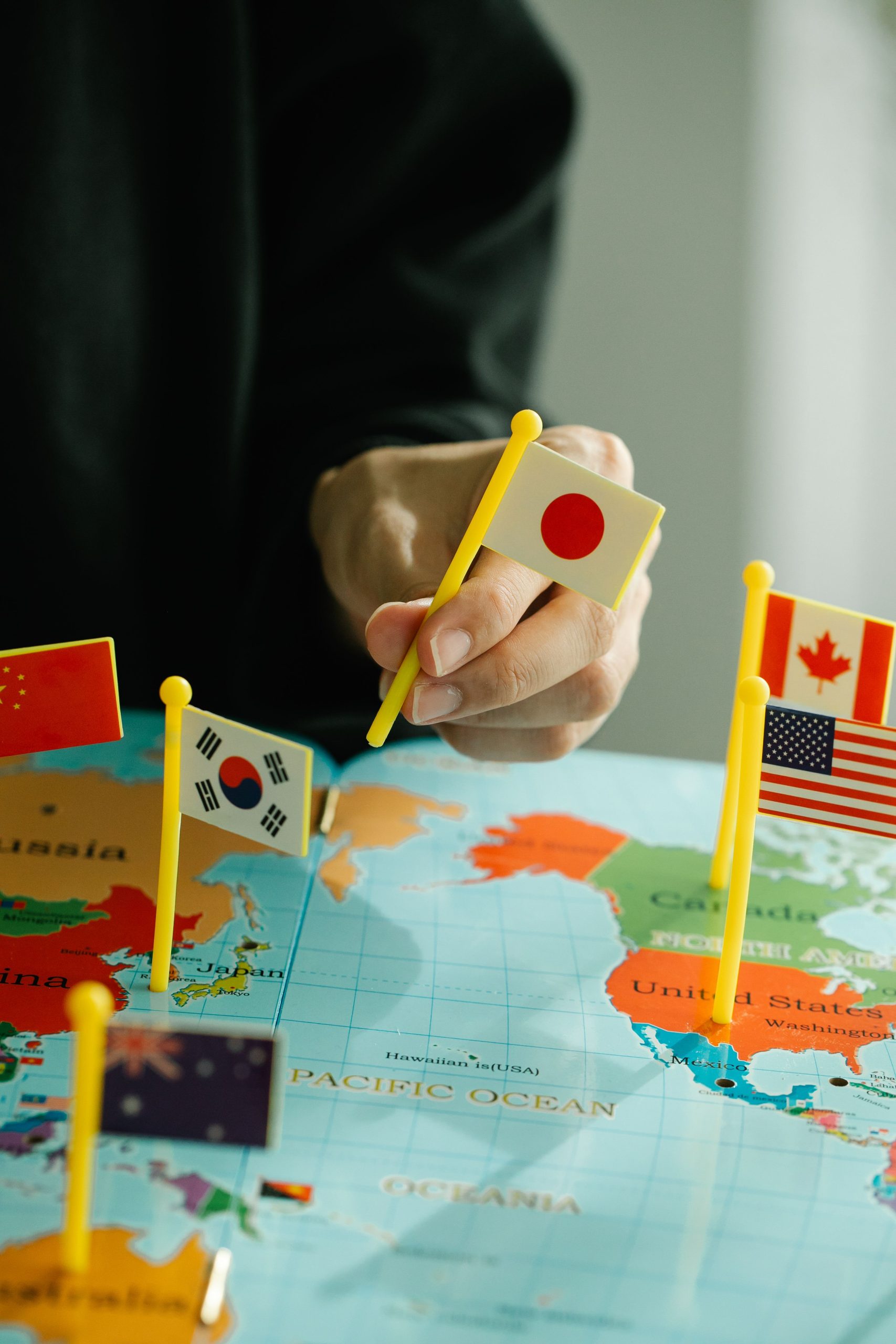
Recomposition of geopolitical blocs
Series: Strategic Foundations
Authors: La Ligne Fine – institute
Published Date: March 5, 2026
Executive Summary
The return of the vocabulary of « blocs » reflects a reality: international relations are once again structured by considerations of security, technological dependence, control of supply chains and political rivalry that lead states to privilege certain partners and reduce their exposure to others. The enlargement of NATO, the rapprochement between Russia and China, Moscow’s military cooperation with North Korea and Iran, the enlargement of the BRICS, the multiplication of trade restrictions linked to national security and the European search for greater strategic autonomy confirm this movement. However, it would be wrong to infer that the international system is simply reorganizing itself around two sets comparable to the Western and Soviet blocs of the Cold War. Polarization is increasing without producing two closed, homogeneous and disciplined coalitions.
The difference lies first of all in the level of integration of the groups concerned. NATO is an institutionalised military alliance with collective defence commitments, permanent structures, planning procedures and a long history of interoperability. It now has 32 members. Its functioning cannot be compared to that of the BRICS, which bring together powers with often different interests and do not include a mutual defence clause or an integrated military structure. The Brazilian government, which held the presidency of the BRICS in 2025, explicitly presented the organisation as a platform for coalition-building and not as a bloc for confrontation. The expanded meeting of foreign ministers in April 2025 brought together eleven members and nine invited or partner countries, which illustrates both the broadening of the format and its much more flexible nature than that of an alliance[1].
This institutional distinction does not mean that non-Western groupings are politically insignificant. Their importance lies precisely in a different function. The BRICS provide a framework for states that do not necessarily share a common military strategy to coordinate certain positions on international governance, the representation of emerging economies, financing for development, and, more broadly, the challenge to an international order perceived as too strongly structured by Western institutions. The interest of the format does not therefore presuppose the existence of a common foreign policy. On the contrary, it is based on its ability to bring together states that wish to increase their room for maneuver without accepting the much stronger disciplines of a traditional alliance.
The relationship between Russia, China, Iran and North Korea also needs to be analysed in detail. Cooperation between these four states has been strengthened, especially in the context of Russia’s war against Ukraine. NATO describes the deepening of the Russian-Chinese strategic partnership and the increase in Russia’s defence industrial cooperation with Iran and North Korea as a major concern in 2026. At the same time, the Alliance underlines that North Korea has provided direct support to Russia and that Iran has contributed to its war effort[2].
This cooperation is important, but it does not form the institutional equivalent of an integrated military bloc. Bilateral relations remain asymmetrical, regional priorities diverge, and no common organization coordinates their defense in the same way that NATO coordinates part of that of its members. China also has considerable economic relations with Europe and the United States, while Russian, Chinese, Iranian, and North Korean interests are not identical on all international issues. Talking about a coherent authoritarian bloc may therefore be politically convenient, but this formulation tends to attribute to this cooperation a level of unity that it does not necessarily have.
Rather, the international system is characterized by several levels of alignment that do not completely overlap. Military security tends to produce the most restrictive groupings. The economy remains much more intertwined. Strategic technologies are subject to stronger restrictive and securitization policies than ordinary trade. Energy, raw materials, infrastructure, payments, diplomacy, and international governance give rise to other coalitions. A state can be closely linked to a power in the security field while diversifying its economic partnerships, or belong to a political grouping without aligning itself with its members during a military crisis.
The work of the International Monetary Fund confirms this partial nature of fragmentation. A study on the evolution of global ties observes a reorientation of trade and investment along geopolitical lines since the Russian invasion of Ukraine. However, it concludes that the current fragmentation does not mechanically reproduce the economic separation of the early years of the Cold War. Global relations remain deeply interconnected and countries located between the main poles can even play an intermediary role in trade[3].
This nuance is fundamental. The current recomposition should not be confused with a general deglobalization. The IMF already noted that, despite signs of increasing fragmentation of trade and investment flows along geopolitical lines, the global ratio of trade in goods to GDP did not yet indicate a disappearance of economic integration at the aggregate level. First, it is the directions of flows, the sectors deemed sensitive and investment decisions that are evolving[4].
The recomposition of blocs is therefore manifested less in a clear separation of economies than in a political hierarchy of interdependencies. Governments are gradually distinguishing ordinary trade from dependencies that they consider likely to be used for coercive purposes. Advanced semiconductors, telecommunications equipment, digital infrastructure, energy, critical minerals, defence production chains or certain dual technologies are the subject of particular attention because a disruption of supply could directly affect national security. In these areas, the logic of minimum cost is increasingly complemented by considerations of security, diversification and political control.
The European Union is a clear example of this development. The European Council conclusions of 18 and 19 June 2026 explicitly link competitiveness, strategic autonomy, resilience, economic security and the reduction of strategic dependencies. At the same time, European leaders call for preserving economic openness and improving the single market. The objective is therefore not to close the European economy, but to reduce certain vulnerabilities deemed incompatible with sufficient political autonomy[5].
This European approach reveals another aspect of the current recomposition: political groups are not content to choose between alignment and non-alignment. They are seeking to change the conditions of their own dependencies. The Union remains deeply integrated into the transatlantic economy, closely linked to the United States in the military field through NATO, and simultaneously engaged in a policy of diversification designed to limit the risk that a single external relationship will become essential to its functioning. This policy is therefore neither an exit from the Western alliance nor a simple protectionist policy. It corresponds to the search for a greater capacity to absorb ruptures and to decide in a less predictable international environment.
States outside the main alliances play a central role in this configuration. India, Brazil, Saudi Arabia, the United Arab Emirates, Indonesia, South Africa or Turkey, depending on the area considered, rarely seek to subordinate their entire foreign policy to a single relationship. Several of them simultaneously maintain economic relations with China, defence cooperation with the United States or European powers, energy links with Russia or the Gulf, and participation in organisations such as the BRICS or the G20. Their behaviour is not a temporary anomaly while waiting for a choice between two camps. It corresponds to a strategy aimed at taking advantage of the multiplicity of partnerships while avoiding the costs of exclusive alignment.
However, this room for manoeuvre is not unlimited. The more competition between great powers intensifies, the more certain technical or economic choices acquire a political dimension. Using a specific digital infrastructure, buying a weapons system, joining a sanctions regime, choosing a semiconductor supplier or granting access to a port can gradually lock a state into a network of dependencies that is difficult to reverse. The pressure to align therefore varies from sector to sector. It can remain low in agricultural trade while becoming strong in the military or technological field.
The thesis of this paper is that the recomposition of geopolitical blocs is real, but that it produces a system of differentiated alignments rather than a return to two universal and watertight blocs. Military security is increasingly polarized and pushes the alliances formed to strengthen. Economic relations are fragmenting more selectively. The coalitions of the Global South remain flexible and focused on the search for room for maneuver. States capable of maintaining several external relations retain significant autonomy, but the cost of this position increases as technological and security rivalries strengthen.
The strategic challenge is therefore not simply to know which countries belong to which camp. It is to identify, area by area, the levels of commitment, the dependencies that really limit freedom of action and the situations in which a flexible partnership can turn into binding alignment. A map of the world divided into two colours provides a simple representation; it does not explain how the current system works.
Problem
The idea of a return of the blocs has taken hold with the deterioration of relations between great powers, the war in Ukraine, the Sino-American rivalry and the appearance of economic policies explicitly linked to national security. The comparison with the Cold War is understandable because it offers a familiar framework: on the one hand, a Western entity organized around the United States; on the other, a group of powers challenging the international order dominated by the West. However, this comparison becomes misleading when it ceases to be a partial analogy and claims to accurately describe the structure of the contemporary system.
The Cold War was based on elements that are not found today with the same intensity. The two main poles had structured military alliances, a global ideological confrontation and economies that were much less integrated with each other than the current major powers. The states in each group were subject to varying levels of discipline, but strategic polarization largely determined their external relations. The contemporary environment retains alliances and experiences strong strategic rivalry, but the economic, technological and financial interdependencies are much deeper and the competing political groupings are institutionally very different.
NATO provides the most obvious example. Its 32 members are bound by the North Atlantic Treaty and have an integrated military organization, permanent commands, common standards and collective planning procedures. Article 5 creates a political obligation of collective defense, the existence of which directly influences the strategic calculation of members and adversaries[7][8].
There is no direct equivalent on the BRICS side. The organization is not based on a common military guarantee and brings together states that have significant differences among themselves. India and China, for example, cooperate within the framework of the BRICS while remaining strategic competitors in Asia. Brazil does not pursue the same security interests as Russia or Iran. The enlargement of the group increases its political representativeness but also increases its heterogeneity. This characteristic is not necessarily a weakness: it corresponds to the function of the organization, which is more to create opportunities for cooperation between non-Western or emerging powers than to impose a common foreign policy on them.
The mistake therefore lies in comparing groupings according to their diplomatic visibility rather than according to their degree of commitment. A military alliance, an economic organization, a political forum and a strategic partnership do not produce the same constraints. Their influence on the behavior of states depends on legal commitments, material dependencies, institutional capacities and the costs associated with a possible break.
The Russian-Chinese relationship must be examined from this distinction. The partnership between Beijing and Moscow has deepened considerably, and NATO now considers that these developments, coupled with Russia’s defense cooperation with Iran and North Korea, directly change the Euro-Atlantic security environment[9].
This convergence has several foundations. Both Moscow and Beijing contest aspects of US strategic primacy, oppose several Western sanctions or conditionality policies, and have an interest in reducing their vulnerability to economic and technological instruments controlled by Western powers. The war in Ukraine has also increased Russia’s economic and industrial dependence on China, while Beijing enjoys a privileged relationship with a major supplier of energy and raw materials.
These common interests do not, however, eliminate asymmetries. The Chinese economy is much larger and much more diversified than the Russian economy. Beijing retains considerable interests in trade with Europe and other developed economies. Russia is more dependent on China than the other way around, which limits the relevance of a representation in which the two powers would be a strictly equal tandem. The analyses published by NATO in 2026 highlight precisely this asymmetry in the economic and industrial relationship[10].
Russian cooperation with North Korea and Iran is based on other logics. It provides Moscow with capabilities, weapons, ammunition or equipment useful for its war effort and offers the partners concerned political, economic or technological benefits. These relations can become closer without forming a common architecture comparable to an integrated alliance.
This difference in nature does not prevent cooperation from producing important consequences. An informal coalition can provide sufficient resources to modify the duration of a conflict or reduce the effectiveness of sanctions. It would only be a mistake to confuse functional cooperation with general strategic unity.
The second problem is economic. A true reconstitution of two blocs would imply an increasing separation of trade, investment, financial systems and production chains. Signs of this evolution are visible, but they remain partial. The IMF observes a fragmentation of trade and investment along geopolitical lines since 2022, while stressing that global economic relations have not been fully decoupled[11].
Fragmentation primarily concerns sectors in which governments consider that dependence can become a vulnerability. The logic of « friend-shoring », diversification or securing supply chains does not necessarily aim to repatriate all national production. It seeks to avoid certain critical functions being based on a supplier or a country that could interrupt them for political purposes.
This reasoning produces economic networks that are more complex than two blocs. A company can move part of its production from China to another Asian country without returning to the United States or Europe. An intermediary country can import components from one whole, transform them and export them to another. Direct fragmentation between great powers can thus be accompanied by an increase in the role of connecting country.
The third problem concerns ideology. The Cold War pitted two political and economic models against each other, each claiming a universal scope. Contemporary rivalries have a normative dimension, but they do not exactly reproduce this confrontation. China does not ask all of its partners to reproduce its political regime. The BRICS bring together democracies, monarchies and authoritarian regimes. Their cohesion is based less on a common political doctrine than on a set of criticisms of the distribution of power in international institutions and on the search for greater autonomy vis-à-vis the West.
This flexibility explains the attractiveness of the format to countries that do not want to break with the United States or Europe. Participating in the BRICS can broaden diplomatic options without imposing military alignment with Russia or China. The Brazilian presidency insisted precisely in 2025 on the non-confrontational nature of the group[12].
The fourth problem concerns intermediary states. In a bipolar representation, their policy is often described as a hesitation between two camps. This interpretation underestimates the rationality of their choices. Many deliberately seek to multiply partnerships in order to limit dependence on a single great power. They can buy weapons from one partner, attract investment from another, and coordinate their diplomatic positions with a third.
This policy is not passive neutrality. It implies an ability to maintain several relationships despite contradictory pressures. It is all the more effective when the state has a large market, sought-after resources, a strategic location or political capacity to negotiate.
The recomposition of blocs must therefore be analysed on the basis of the real constraint exerted on the choices of States. The useful question is not only formal membership of an organisation, but the extent to which a State can take a decision contrary to the interests of its main partners without bearing a cost that it considers prohibitive. This approach makes it possible to distinguish between partnership, dependence and alignment.
Structural context
The current geopolitical recomposition is the result of several mutually reinforcing transformations: the return of high-intensity conflicts, the rise of Sino-American rivalry, the increasing use of economic instruments for strategic purposes, the weakening of certain multilateral institutions, and the desire of many states to diversify their foreign relations. None of these phenomena is sufficient in isolation to reconstitute blocs. However, their combination modifies the incentives that structured the post-Cold War period.
The return of security as an economic determinant
During the decades of accelerated globalization, the localization of production chains was largely organized around cost, availability of skills, logistics infrastructure, and access to markets. Geopolitical considerations were not absent, but they occupied a less prominent place in many business sectors. Recent crises have shown that some dependencies can quickly acquire a political dimension. The pandemic has highlighted the concentration of several supply chains; the war in Ukraine has shown the cost of high energy dependence; the Sino-American technological rivalry has put semiconductors, telecommunications, and some dual technologies back at the center of security policies.
The IMF uses the concept of geoeconomic fragmentation to describe the increase in policies that reorient trade, investment, technology, and financial flows according to security or foreign policy objectives. Its work highlights that the potential costs of complete fragmentation would be high and could simultaneously affect trade, capital, technology diffusion, and the provision of global public goods[13].
This development does not mean that governments are abandoning the search for economic efficiency. Rather, they are seeking to incorporate a political price of risk. A less expensive value chain may be considered insufficiently secure if it depends on a single supplier located in a state with which a crisis is plausible. Economic policy therefore incorporates scenarios previously dealt with mainly by defence or diplomacy.
Consolidation of the Euro-Atlantic Security Bloc
The war in Ukraine has strengthened NATO, not only because it has put territorial defence back at the centre of its missions, but also because it has led Finland and then Sweden to join the Alliance. The number of members is now 32[14].
This consolidation also includes spending, industrial capabilities and military planning. NATO now explicitly presents its environment as characterised by intense strategic competition, Chinese capacity building and increasing cooperation between Russia, China, Iran and North Korea[15].
There is therefore a hardening of the Western security bloc. This hardening does not mean, however, that all the economic or diplomatic policies of the members are identical. The Allies continue to differ on certain trade relations, on China, on industrial policy or on the level of European autonomy desirable. The military alliance imposes strong constraints in the field of collective defence without producing uniformity in foreign policy.
The rapprochement of the powers challenging the Western order
Russia, China, Iran and North Korea have increased their cooperation, but from different situations. Moscow is looking for partners capable of supporting its economy, its defense industry and its military effort despite Western sanctions. Beijing enjoys a privileged economic relationship with Russia and shares with it an opposition to several aspects of American policy. Iran and North Korea have their own regional interests and are looking for resources, technologies, diplomatic support or security cooperation.
NATO describes this rapprochement as a significant strategic development. Its 2025 annual report highlights that the Russian war effort has the support of China, North Korea, Iran and Belarus[16].
However, the distinction between coordination and bloc must be maintained. No common command organises these relations. No multilateral treaty automatically guarantees their mutual assistance. Differences in power and interests remain significant. Cooperation can therefore be deepened in certain areas without producing a homogeneous political whole.
Expanding Global South Coalitions
The development of the BRICS reflects another transformation. Many states want more representation in international governance and a diversification of financial, commercial and diplomatic instruments. The enlargement of the group increases its demographic and economic weight, but makes it more difficult to build a uniform position.
This contradiction does not negate the interest of the organization. A flexible forum can be precisely adapted to states that wish to cooperate without giving up their autonomy. In 2025, Brazil insisted on this coalition function rather than on a logic of structured confrontation[17].
The progression of these formats indicates that Western influence is more contested. It does not automatically mean that a single alternative political leadership is being formed.
The European search for strategic autonomy
The European Union occupies a special position. It clearly belongs to the Western political system, its most important member states are members of NATO and its security remains deeply linked to the transatlantic relationship. It simultaneously seeks to reduce several economic and technological dependencies in order to increase its ability to decide in a more confrontational environment.
The June 2026 European Council explicitly links competitiveness and strategic autonomy and calls for continued efforts to reduce dependencies in strategic sectors[18].
This approach illustrates the complexity of the current recomposition. European autonomy does not necessarily imply an equidistance between Washington and Beijing. It aims first and foremost to reduce the possibility that economic, energy, technological or industrial dependence limits European action. It can therefore strengthen the European pillar of the Western whole while reducing certain bilateral dependencies.
Power relations
The recomposition of blocs is not measured solely by the number of states belonging to each group. The quality of commitments, economic capacities, access to technology, demographics, energy resources and political cohesion determine the ability of a group to act collectively. A very large but poorly integrated group may have significant political weight without being able to convert this weight into joint action during a crisis. A smaller alliance can achieve greater coherence if its members have invested in common institutions for several decades.
The United States and the Alliance System
One of the main structural advantages of the United States remains its network of alliances. NATO is the most developed example, but Washington also has important partnerships and alliances in the Indo-Pacific. This architecture allows for cost sharing, foundations, improved interoperability, and coordinated diplomatic or economic responses.
Cohesion is never total. Allies have their own interests and can resist American demands. But the existence of institutions, procedures, and habits of cooperation provides a higher level of predictability than an improvised coalition.
The strengthening of cooperation between NATO and several Indo-Pacific partners also reflects the changing perception of threats. The Alliance’s Secretary General explained in May 2026 that the intensification of cooperation between Russia, China, North Korea and Iran was pushing NATO to strengthen its relations with partners outside its traditional area.
This development does not transform NATO into a global alliance. It does, however, show that the various regional rivalries are becoming less and less independent of each other.
China and the search for an environment less dominated by Washington
China has a different strategy. It does not have a network of alliances comparable to that of the United States, but it benefits from an economic weight that allows it to maintain deep relations with a very large number of countries. Its influence depends on trade, investment, infrastructure and the importance of its market as much as on security agreements.
This configuration produces a less institutionalized form of power. Many states may seek Chinese investment without accepting alignment with Beijing. This flexibility expands China’s economic reach but limits the ability to automatically turn trade relations into political support during crises.
The challenge for Beijing is therefore different from that of the United States. It is less a question of building a universal military alliance than of reducing the possibilities of isolation and expanding the number of states that have an interest in maintaining a constructive relationship with China.
Russia and the depth provided by its partners
Russia saw its direct access to several Western markets sharply reduced after 2022. Its ability to maintain its war effort and some trade has therefore increased the importance of its relations with China and other partners.
This shift shifts the balance of power because it reduces the ability of Western sanctions to produce complete isolation. However, it creates new dependencies. Russia can redirect some trade, but often to a more limited number of partners with greater bargaining power.
Cooperation with North Korea and Iran also provides specific military capabilities. It demonstrates that a system of functional partners can provide real strategic depth even in the absence of a formal multilateral alliance.
The BRICS and the power of numbers
The enlargement of the BRICS increases the group’s ability to claim a broader representation of the non-Western world. Its influence is based on the cumulative weight of the members and on the possibility of coordinating certain positions.
Its weakness stems from the diversity of interests. The members do not have the same relationship with the United States, China, Russia or the European Union. They do not share a common security policy and can compete in several regions.
The power of the BRICS must therefore be understood as a capacity for thematic coalition. On subjects such as the reform of international economic governance, financing for development or the representation of emerging economies, members can find sufficient common interests. On specific military crises, their cohesion is much less guaranteed.
The European Union between alliance and autonomy
The European Union represents another form of collective power. It has a very high level of economic integration, common trade policies and a significant regulatory capacity, but defence remains mainly national and linked to NATO for the majority of member states.
The policy of strategic autonomy therefore aims to use European economic weight to reduce dependencies that could have a political or military consequence. European leaders have once again made this issue a priority in 2026, notably through the « One Europe, One Market » agenda, the reduction of strategic dependencies and industrial strengthening[19].
Europe is therefore not situated between the blocs in the diplomatic sense. It clearly belongs to the Western entity in the field of security. The question is to know what autonomy it can retain within this entity in terms of industrial, commercial, technological and diplomatic policies.
Interests at stake
The great powers have an interest in consolidating relations that reduce their vulnerability without necessarily transforming each partner into a formal ally. This logic explains the proliferation of flexible formats, sectoral agreements and coalitions whose composition varies according to the subject.
The United States seeks to maintain the cohesion of its alliances, to prevent a rival power from dominating regions considered strategic, and to preserve its lead in certain technologies. Its network of allies is a major advantage but requires ongoing consultation, as partners do not automatically share all American priorities.
China is seeking to avoid the formation of a containment coalition large enough to limit its development in the long term. It is therefore in its interest to maintain close economic relations with Europe, Asia, Africa, the Middle East and Latin America, including with states close to the United States in terms of security. This strategy complicates the creation of strictly separate economic blocs.
Russia seeks to prevent its isolation and maintain access to the technologies, financing, markets and armaments it needs. Its rapprochement with Beijing, Tehran and Pyongyang is a direct response to this constraint.
The European Union seeks to preserve the transatlantic alliance while strengthening its capacity for its own action. The 2026 European conclusions are particularly explicit on the link between competitiveness, resilience, strategic autonomy and the reduction of dependencies[20].
The intermediary powers have a different interest: to prevent polarization from reducing their options too sharply. The multiplication of partnerships allows them to negotiate better economic or security conditions and to limit the ability of a great power to exert pressure on its own.
This strategy becomes more difficult, however, when domains connect. A purchase of military equipment creates needs for maintenance, training, ammunition and sometimes information sharing that commit a state for several decades. The choice of digital infrastructure can create similar technical dependencies. Seemingly sectoral decisions can therefore gradually produce a broader alignment.
Companies also have their own interests. They seek stability, access to markets and cost reduction. Fragmentation policies can contradict these objectives when they impose a duplication of supply chains or the abandonment of profitable markets. The geopolitical balance of power thus translates into a permanent negotiation between public security imperatives and private economic logic.
Dynamics of evolution
The first dynamic is the hardening of security blocs. NATO has strengthened its posture, expanded its membership and put collective defence back at the centre of its priorities. At the same time, cooperation between Russia and several Asian and Middle Eastern partners is helping to further connect the European and Indo-Pacific theatres. This trend is likely to continue as long as the war in Ukraine, the Sino-American rivalry and regional tensions remain high.
The second dynamic is selective economic fragmentation. The IMF’s work already indicates a redeployment of certain trade and investments according to geopolitical proximity, without the general disappearance of world trade[21].
Strategic technologies are expected to remain the sector most exposed to this development. Governments will seek more to control exports, secure production chains and locate certain capacities at home or with partners deemed reliable.
The third dynamic concerns the rise of the role of intermediary countries. The more direct relations between great powers are constrained, the more states capable of maintaining relations with several groups can become platforms for trade, investment or diplomacy. This position gives them greater bargaining power but also exposes them to more pressure.
The fourth dynamic concerns the BRICS and comparable formats. Their enlargement should strengthen their visibility, but it will also increase their heterogeneity. Their effectiveness will therefore depend less on their ability to adopt a common foreign policy than on their ability to produce concrete cooperation on a few issues where interests really converge.
The fifth dynamic is European. The search for strategic autonomy should continue to focus on the defence industry, energy, technologies, infrastructure and critical raw materials. The European Council of June 2026 once again placed the reduction of dependencies at the centre of the competitiveness agenda[22].
The success of this policy will depend on the ability of Member States to accept the costs associated with a diversification of suppliers and a more active industrial policy. Autonomy cannot be achieved by declarations alone: it implies investments, production capacities and sometimes the acceptance of more expensive solutions.
Prospective scenarios
A progressive but incomplete bipolarization
In this scenario, the rivalry between the United States and China becomes sufficiently structuring to gradually push the majority of states to favor one of the two groups in the most sensitive areas. Military alliances are strengthened, technological restrictions increase, and supply chains are further reorganized according to political affinities.
Such a development would probably not lead to as complete an economic separation as during the Cold War. The costs would be too high and many countries would seek to maintain trade with both groups. Bipolarity would therefore be mainly technological and security-related, while some ordinary trade would remain globalized.
Hard security blocks in a still multipolar economy
This scenario seems more compatible with current trends. Military alliances are becoming more structuring, but trade relations remain highly diversified. NATO is consolidating its role, Russia is deepening its cooperation with China, Iran and North Korea, while intermediary powers continue to use several partnerships.
States would then accept a logic of alignment in areas directly related to defence while trying to preserve more economic freedom. Tensions would be significant during crises, but they would not be enough to rebuild two closed groups.
Fragmentation into several regional hubs
A third scenario would see the relative weakening of the American and Chinese ability to structure the system on their own. Europe would seek more autonomy, India would strengthen its independent role, the Gulf powers would continue their diversification strategies and several regions would develop their own cooperation architectures.
The world would then become more multipolar but not necessarily more stable. The multiplication of decision-making centres would increase the number of possible combinations and make coalition-building during crises more complex.
A major crisis requiring alignment choices
A direct military confrontation or major economic crisis between the United States and China could sharply accelerate the recomposition. Governments would then be subject to specific demands for sanctions, access to infrastructure, export controls or diplomatic support.
States that have so far managed to maintain several partnerships could be forced to choose on certain issues. This scenario shows that contemporary non-alignment depends in part on the absence of direct confrontation between the main poles.
Recommendations
The first recommendation is to abandon overly general binary representations in strategic analysis. Classifying states as belonging to a « Western bloc » or a « Sino-Russian bloc » can be useful in describing certain military alignments, but becomes misleading when this classification is automatically applied to trade, energy, diplomacy, or technology. Policymakers need to distinguish between areas and measure the true depth of commitments.
The second recommendation is to map dependencies rather than just institutional affiliations. Membership in an organization does not necessarily mean strong dependence; conversely, a supply chain or technological infrastructure can limit a state’s freedom of action without any political treaty. Critical sectors must therefore be analyzed according to the substitutability of suppliers, the time needed to change partners and the cost of a breakup.
The third recommendation is to identify the intermediate powers as autonomous actors rather than as incomplete members of a camp. India, Brazil, Indonesia, the Gulf powers or South Africa have their own strategies and can change the balance of a coalition depending on the subject. Relations with these states must be built on concrete interests rather than on the assumption that they will gradually accept a general alignment.
The fourth recommendation concerns Europe. The Union must continue to reduce its most problematic dependencies without seeking full autonomy, which would be economically costly and politically unrealistic. The conclusions of the June 2026 European Council go in this direction by linking economic openness, competitiveness and the reduction of strategic dependencies[23].
The fifth recommendation is to integrate intermediary countries into diversification policies. Replacing dependence on one power with the same dependence on another does not produce resilience. Diversification must spread risks among several partners and, where possible, develop a minimum internal capacity.
The sixth recommendation concerns military alliances. NATO must continue to improve its cohesion in the face of growing cooperation between Russia, China, Iran and North Korea without automatically turning every regional rivalry into a global military obligation. The strength of an alliance also lies in the precision of its commitments. Excessively broadening expectations can undermine the consensus that underpins core missions.
The seventh recommendation is not to underestimate the costs of fragmentation. The IMF regularly points out that the separation of economies can reduce growth, limit investment, and slow the spread of technology. The April 2026 World Economic Outlook continues to identify deeper geopolitical fragmentation among the key risks to the global economy.[24]
The eighth recommendation is to keep multilateral institutions functioning even when rivalries increase. Competing powers will continue to share interests in financial stability, trade, climate, health or maritime security. The complete weakening of these areas of cooperation would make crises more costly without necessarily improving security.
Strategic implications
The recomposition of geopolitical blocs confirms that the post-Cold War period, in which economic interdependencies were often considered strong enough to sustainably limit great power rivalries, is over. Governments are explicitly reintroducing security considerations into their economic and technological choices, while military alliances are regaining a more prominent place in national planning. This is sustainable because it does not depend on a single conflict. It is the result of a general reassessment of the vulnerability associated with external dependencies.
However, it would be incorrect to conclude that the world is already organized around two sets comparable to those of the Cold War. Several features of the current system make this evolution much less linear. Economies remain closely interconnected, non-Western coalitions are institutionally heterogeneous, and many intermediary powers have a real capacity to maintain several partnerships simultaneously.
Trade and investment are showing signs of reorientation according to geopolitical relations, but fragmentation remains incomplete and several countries play a connecting role between the main groups[25].
The first implication is therefore methodological: the binary maps of the international system lose part of their analytical value. They may indicate membership in a military alliance, but they do not automatically anticipate a state’s economic, diplomatic or technological choices.
The second implication concerns the nature of autonomy. In a system of cross-dependencies, no major player can suppress all of its external relations without incurring a considerable cost. The objective of sovereignty or strategic autonomy policies is therefore generally not complete independence. It consists in reducing dependencies for which no alternative solution would be available in the event of a crisis.
This approach explains the current European policy. The Union seeks to strengthen its competitiveness, its industry and its technological capacity while remaining open to trade[26].
The third implication concerns the intermediary powers. Their importance is expected to increase as the major poles seek to expand their coalitions. A state capable of offering particular resources, market, geographical position, or diplomatic capabilities may obtain concessions from several partners without fully aligning itself with any of them.
This situation does not guarantee their autonomy. A major crisis can sharply reduce the possibilities for compromise. But as long as competition remains below the threshold of a direct confrontation between the major poles, the system offers significant space for diversification strategies.
The fourth implication is that fragmentation is not necessarily uniform. The military and technology sectors are likely to be much more polarized than trade in ordinary goods. Governments will find it difficult to accept dependence on a rival for a component considered indispensable to their military capabilities, when they will be able to maintain significant trade in products without direct security implications. We should therefore expect more selective globalization rather than its disappearance. Economic flows will continue, but their geography will be more influenced by security.
The fifth implication concerns international organizations. The BRICS should gain influence without necessarily becoming an alliance. Their flexibility is probably one of the conditions for their attractiveness. The more they expand, the more difficult a common foreign policy becomes; but the more they can serve as a framework of coordination for states wishing to reduce Western centrality in certain institutions.
This evolution forces Western powers to distinguish between institutional contestation and strategic hostility. Automatically considering any strengthening of the BRICS as an extension of an opposing bloc would risk pushing intermediate states towards a logic of confrontation that they do not necessarily seek.
The sixth implication concerns the rapprochement between Russia, China, Iran and North Korea. It should not be minimized or described as an alliance equivalent to NATO. These relations already provide concrete benefits to their participants and can change a military balance of power. NATO considers their deepening as one of the major developments in its strategic environment in 2026[27].
However, their degree of integration remains lower than that of an institutionalised alliance. This difference must influence Western policies. A strategy that treats these four states as a perfect unit could overlook their differences and contribute to artificially strengthening their cohesion.
The seventh implication is that economic dependencies can become instruments of power. Sanctions, export restrictions, technological controls, and policies to secure supply chains are now integrated into geopolitical competition. This development increases the political cost of concentrated economic relationships and pushes states to look for multiple suppliers.
The eighth implication concerns France. Its strategy must simultaneously take into account its membership of the Western security bloc, its participation in the construction of Europe and its interest in maintaining relations with intermediate powers that do not wish to align themselves entirely with Washington or Beijing. Effective diplomacy must be able to distinguish partners according to the issues and avoid projecting an overly rigid logic of blocs onto each bilateral relationship.
On this point, France has a particular interest in consolidating European autonomy. A Europe that is more capable of producing, financing and protecting certain strategic capabilities reduces collective dependence without calling into question the transatlantic alliance. It also increases European credibility with States seeking to diversify their partnerships.
The ninth implication concerns the stability of the system. A world composed of two rigid blocs can produce a certain legibility of commitments, even if it remains extremely dangerous. A system of variable alignments offers more flexibility but also more uncertainty. States may misjudge the support that a partner will provide during a crisis or assume that a country will remain neutral when its dependencies force it to take a position.
The multiplication of cooperation formats therefore makes the analysis of commitments more important. Governments must distinguish between diplomatic declarations and capabilities that can be truly mobilized, and between economic partnerships and security guarantees.
Conclusion
The recomposition of geopolitical blocs constitutes a real transformation of the international system, but the term « blocs » should not lead to the automatic projection of the structures of the Cold War onto the current period. Military polarization has increased, economic dependencies are considered more through the prism of security, and several non-Western coalitions have gained in visibility. However, these developments do not produce two closed groups that coherently organize all the dimensions of international relations.
NATO remains the most successful example of an institutionalised security bloc. Its 32 members have a collective defence guarantee, a command system, common procedures and permanent military cooperation[28].
Cooperation between Russia, China, Iran and North Korea has been strengthened at the same time and is already having concrete consequences on the balance of power. NATO sees this rapprochement as a structural change in its environment[29].
But these relations do not have the same level of institutionalization. They remain strongly bilateral, asymmetrical and linked to interests that only partially overlap. Their importance does not require them to be presented as a monolithic alliance.
The BRICS correspond to a third logic. Their enlargement reflects the desire of a growing part of the non-Western world to obtain more weight in international governance and to diversify the spaces for cooperation. Their heterogeneity limits the possibility of a common foreign policy but is at the same time a condition for their attractiveness: states can participate without accepting military alignment with China or Russia[30].
The economic dimension confirms this lack of complete bipolarity. The IMF’s work shows a growing fragmentation of trade and investment flows according to geopolitical relations, but also the maintenance of strong global integration and the important role of intermediary countries in the reorganization of these flows[31].
The most likely trajectory is therefore neither the continuation of globalization as it worked before the return of strategic rivalry, nor the immediate reconstitution of two separate economies. States will continue to secure certain dependencies, especially in defence, advanced technologies, energy, raw materials and critical infrastructure, while maintaining significant trade in many other sectors.
The system thus becomes more selective. Membership of a military alliance can be very restrictive in the field of defence and much less decisive in other areas. Participation in a diplomatic forum can facilitate economic cooperation without producing strategic solidarity. A technological partnership can bring two states closer together in the long term without automatically leading to a convergence of foreign policy.
This diversity must become the starting point for the analysis of contemporary blocs. The decisive question is not to know which color to attribute a state to on a map, but to determine the commitments and dependencies that actually structure its decisions.
For Europe, this situation gives concrete content to the notion of strategic autonomy. The realistic objective is neither to place oneself at an equal distance from the United States and China nor to eliminate all interdependencies. It is to have sufficient capacity so that European choices in essential sectors cannot be determined by the absence of alternative solutions. In June 2026, the European Council again reaffirmed the need to strengthen this autonomy through competitiveness, industrial investment and the reduction of strategic dependencies[32].
For the United States, the challenge is to preserve the value of its network of alliances without turning competition with China into a demand for full alignment that could alienate some of the middle powers. The U.S. ability to build coalitions remains a structural advantage, but this advantage is all the more effective when partners retain the belief that the alliance also serves their own interests.
For China, the objective is to limit the risks of containment, to increase the number of partners that have an interest in maintaining relations with Beijing and to reduce its vulnerability to Western restrictions in the most sensitive technologies. Its economic weight gives it considerable means to achieve these objectives, but its lack of a network of alliances comparable to that of the United States still limits the transformation of this economic influence into automatic strategic solidarity.
For Russia, the current recomposition makes it possible to partially mitigate the effects of Western isolation, but at the cost of increased dependence on a smaller number of partners. This situation gives it sufficient depth to maintain certain policies but also increases the asymmetry of its relations, particularly with China.
Finally, for the intermediate powers, the current period offers opportunities but imposes increasingly complex choices. The diversification of partnerships may increase the room for negotiation, but the multiplication of technological controls, sanctions and incompatible infrastructures may gradually reduce the possibilities of equilibrium. Their autonomy will therefore be determined less by their verbal refusal to join a camp than by the concrete structure of their dependencies.
The recomposition of geopolitical blocs thus corresponds neither to the disappearance of multipolarity nor to its functioning without constraints. It represents a phase in which the logic of blocs is progressing within a system that remains economically and diplomatically much more diversified than that of the Cold War. Some spheres are rapidly becoming polarized; others are resisting this polarization; still others are producing coalitions that vary according to interests.
It is this difference that must structure strategic analysis. The formation of blocs is not a binary state in which a country is either fully aligned or fully independent. It is a process by which dependencies, military commitments, technologies, sanctions, and institutions gradually reduce or preserve the range of choices available.
The international system of the coming years will therefore probably be marked by more visible blocs without becoming a world entirely divided into blocs. This distinction is essential to understand the behaviour of the intermediate powers, the trajectory of the BRICS, the European choices and the limits of the rapprochement between the West’s main adversaries. It also makes it possible to avoid two opposing mistakes: underestimating the return of alignment constraints or prematurely considering that all states have already chosen their side.
[1] BRICS. (2025). BRICS foreign ministers reiterate need for changes in global governance. BRICS Brazil. https://brics.br/en/news/collabs/collaborative-communication/brics-foreign-ministers-reiterate-need-for-changes-in-global-governance
[2] North Atlantic Treaty Organization. (n.d.). Deterrence and defence. NATO. https://www.nato.int/en/what-we-do/deterrence-and-defence/deterrence-and-defence
[3] International Monetary Fund. (2024, April 5). Changing global linkages: A new Cold War? IMF Working Papers. https://www.imf.org/en/publications/wp/issues/2024/04/05/changing-global-linkages-a-new-cold-war-547357
[4] Gopinath, G. (2024, May 7). Geopolitics and its impact on global trade and the dollar. International Monetary Fund. https://www.imf.org/en/news/articles/2024/05/07/sp-geopolitics-impact-global-trade-and-dollar-gita-gopinath
[5] European Council. (2026, June 18–19). European Council meeting, 18–19 June 2026. Council of the European Union. https://www.consilium.europa.eu/en/meetings/european-council/2026/06/18-19/
[6] European Council. (2026, June 19). European Council conclusions, 19 June 2026. Council of the European Union. https://www.consilium.europa.eu/media/r1rowtfb/en-20260619-european-council-conclusions.pdf
[7] North Atlantic Treaty Organization. (n.d.). NATO member countries. NATO. https://www.nato.int/en/about-us/organization/nato-member-countries
[8] North Atlantic Treaty Organization. (n.d.). Deterrence and defence. NATO. https://www.nato.int/en/what-we-do/deterrence-and-defence/deterrence-and-defence
[9] North Atlantic Treaty Organization. (n.d.). Deterrence and defence. NATO. https://www.nato.int/en/what-we-do/deterrence-and-defence/deterrence-and-defence
[10] Connolly, R. (2026, March 1). Red Star Rising. NATO Joint Analysis and Lessons Learned Centre. https://nllp.jallc.nato.int/iks/sharing%20public/20260301_u_report_richard_connolly_-_red_star_rising%5B1%5D.pdf
[11] International Monetary Fund. (2024, April 5). Changing global linkages: A new Cold War? IMF Working Papers. https://www.imf.org/en/publications/wp/issues/2024/04/05/changing-global-linkages-a-new-cold-war-547357
[12] BRICS. (2025). BRICS foreign ministers reiterate need for changes in global governance. BRICS Brazil. https://brics.br/en/news/collabs/collaborative-communication/brics-foreign-ministers-reiterate-need-for-changes-in-global-governance
[13] International Monetary Fund. (2023, January 11). Geo-economic fragmentation and the future of multilateralism. IMF Staff Discussion Notes. https://www.imf.org/en/publications/staff-discussion-notes/issues/2023/01/11/geo-economic-fragmentation-and-the-future-of-multilateralism-527266
[14] North Atlantic Treaty Organization. (n.d.). NATO member countries. NATO. https://www.nato.int/en/about-us/organization/nato-member-countries
[15] North Atlantic Treaty Organization. (n.d.). Deterrence and defence. NATO. https://www.nato.int/en/what-we-do/deterrence-and-defence/deterrence-and-defence
[16] North Atlantic Treaty Organization. (2026). The Secretary General’s annual report 2025. NATO. https://www.nato.int/content/dam/nato/webready/documents/publications-and-reports/annual-reports/sgar25-en.pdf
[17] BRICS. (2025). BRICS foreign ministers reiterate need for changes in global governance. BRICS Brazil. https://brics.br/en/news/collabs/collaborative-communication/brics-foreign-ministers-reiterate-need-for-changes-in-global-governance
[18] European Council. (2026, June 18–19). European Council meeting, 18–19 June 2026. Council of the European Union. https://www.consilium.europa.eu/en/meetings/european-council/2026/06/18-19/
[19] Council of the European Union. (n.d.). What the EU is doing to boost its competitiveness. European Council & Council of the European Union. https://www.consilium.europa.eu/en/policies/what-the-eu-is-doing-to-boost-its-competitiveness/
[20] European Council. (2026, June 19). European Council conclusions, 19 June 2026. Council of the European Union. https://www.consilium.europa.eu/media/r1rowtfb/en-20260619-european-council-conclusions.pdf
[21] International Monetary Fund. (2024, April 5). Changing global linkages: A new Cold War? IMF Working Papers. https://www.imf.org/en/publications/wp/issues/2024/04/05/changing-global-linkages-a-new-cold-war-547357
[22] European Council. (2026, June 18–19). European Council meeting, 18–19 June 2026. Council of the European Union. https://www.consilium.europa.eu/en/meetings/european-council/2026/06/18-19/
[23] European Council. (2026, June 19). European Council conclusions, 19 June 2026. Council of the European Union. https://www.consilium.europa.eu/media/r1rowtfb/en-20260619-european-council-conclusions.pdf
[24] International Monetary Fund. (2026, April 14). World economic outlook, April 2026. International Monetary Fund. https://www.imf.org/en/publications/weo/issues/2026/04/14/world-economic-outlook-april-2026
[25] International Monetary Fund. (2024, April 5). Changing global linkages: A new Cold War? IMF Working Papers. https://www.imf.org/en/publications/wp/issues/2024/04/05/changing-global-linkages-a-new-cold-war-547357
[26] Council of the European Union. (n.d.). What the EU is doing to boost its competitiveness. European Council & Council of the European Union. https://www.consilium.europa.eu/en/policies/what-the-eu-is-doing-to-boost-its-competitiveness/
[27] North Atlantic Treaty Organization. (n.d.). Deterrence and defence. NATO. https://www.nato.int/en/what-we-do/deterrence-and-defence/deterrence-and-defence
[28] North Atlantic Treaty Organization. (n.d.). NATO member countries. NATO. https://www.nato.int/en/about-us/organization/nato-member-countries
[29] North Atlantic Treaty Organization. (n.d.). Deterrence and defence. NATO. https://www.nato.int/en/what-we-do/deterrence-and-defence/deterrence-and-defence
[30] BRICS. (2025). BRICS foreign ministers reiterate need for changes in global governance. BRICS Brazil. https://brics.br/en/news/collabs/collaborative-communication/brics-foreign-ministers-reiterate-need-for-changes-in-global-governance
[31] International Monetary Fund. (2024, April 5). Changing global linkages: A new Cold War? IMF Working Papers. https://www.imf.org/en/publications/wp/issues/2024/04/05/changing-global-linkages-a-new-cold-war-547357
[32] International Monetary Fund. (2024, April 5). Changing global linkages: A new Cold War? IMF Working Papers. https://www.imf.org/en/publications/wp/issues/2024/04/05/changing-global-linkages-a-new-cold-war-547357