

Post-Europeanism
From the Exhaustion of the Integrationist Consensus to a Sovereign-Geometry Union
Author: Alek UMONT
Publication date: 9 October 2026
Table of Contents
Executive Summary……………………………………………………………………… – 7 –
General Introduction — From Integration as a Method to Capacity as a Problem – 12 –
I. The Integrationist Paradigm and Its Exhaustion………………………………….. – 18 –
1.1. 1945-1957: Integration as a Historical Response to the European Problem……….. – 18 –
1.2. A Constitutive Tension: The European Community Between Supranationality and the Persistence of States – 20 –
1.3. 1986-2004: The High Point of European Convergence and Its Ambiguities…………. – 23 –
1.4. 2005: The Rupture of the European Constitutional Narrative……………………………. – 25 –
1.5. The Euro-Area Crisis: Monetary Interdependence and Insufficient Political Capacity – 26 –
1.6. The 2015 Migration Crisis: Free Movement, Borders and Political Community…… – 27 –
1.7. Brexit: The Reversibility of Integration and the Question of Control………………….. – 29 –
1.8. The Covid-19 Pandemic: The Return of the State and European Innovation……….. – 30 –
1.9. The War in Ukraine: The Test of Power……………………………………………………………. – 31 –
1.10. What the Crises Have Really Changed: From Presumed Convergence to Demonstrated Capacity – 32 –
II. The Politicisation of Europe: Nations, Federalism and Dissensus……………. – 34 –
2.1. From Consensual Europe to Contested Europe: The Normalisation of European Political Conflict – 34 –
2.2. The Enduring National Dimension: Not the Disappearance of Europe, but the Persistence of Political Communities – 36 –
2.3. There Is No Single ‘Europe of Nations’, but Several Doctrines of Sovereignty…….. – 37 –
2.4. European Federalism: The Strength of the Diagnosis and the Uncertainty of the Solution – 38 –
2.5. From Dissensus over Policies to Dissensus over Purpose………………………………… – 40 –
III. Defining Post-Europeanism: From a Change in Political Climate to a Paradigm Shift – 42 –
3.1. What Post-Europeanism Does Not Mean……………………………………………………….. – 42 –
3.2. A Definition of Post-Europeanism………………………………………………………………….. – 43 –
3.3. Three Criteria for Identifying a Post-Europeanist Condition……………………………… – 45 –
3.4. Post-Europeanism and Postfunctionalism: Explaining Dissensus or Thinking the Order That Follows It – 46 –
3.5. Differentiated Integration: An Established Phenomenon That Is Not Enough to Define Post-Europeanism – 46 –
IV. From Integration to Capacity: Reformulating European Sovereignty………… – 49 –
4.1. From Legal Sovereignty to Effective Sovereignty…………………………………………….. – 49 –
4.2. Scale as a Strategic Problem………………………………………………………………………… – 50 –
4.3. A Highly Integrated Union Can Remain Strategically Fragmented…………………….. – 51 –
4.4. From Normative Power to Capacity Power……………………………………………………… – 52 –
4.5. Capacity Communities: An Intermediate Unit Between the State and the Uniform Union – 53 –
4.6. Capacity as a Criterion for Institutional Arbitration…………………………………………. – 54 –
4.7. The Post-Europeanist Paradox: More Europe Where Europe Actually Produces Sovereignty – 56 –
V. The Sovereign-Geometry Union: Organising Differentiation Without Undoing the Union – 57 –
5.1. Differentiation Is Not an Anomaly of the Union: It Already Belongs to Its Functioning – 57 –
5.2. From a Multi-Speed Europe to Organised Non-Convergence……………………………. – 59 –
5.3. First Level: Defining the Indivisible Common Foundation………………………………… – 60 –
5.4. Second Level: Strategic Capacities with Differentiated Participation……………….. – 61 –
5.5. Third Level: Preserving a Legitimate Sphere of National Autonomy…………………… – 62 –
5.6. Governing a Differentiated Union: The Decisive Question of Decision-Making…… – 63 –
5.7. Democratic Legitimacy: Differentiating Capacities Without Fragmenting Accountability – 64 –
5.8. The Risk of a Multi-Class Europe…………………………………………………………………… – 65 –
5.9. The Risk of Cherry-Picking: Why Sovereign Geometry Cannot Become an À La Carte Europe – 65 –
5.10. The Risk of Institutional Complexity…………………………………………………………….. – 66 –
5.11. Conditions for the Viability of a Sovereign-Geometry Union…………………………… – 67 –
VI. Enlargement, Power and Governability: The European Union Facing the 2035 Horizon – 68 –
6.1. A Transformation of the International System That Changes the Value of European Capacity – 70 –
6.2. From Pacifying Interdependence to Vulnerable Interdependence……………………. – 72 –
6.3. Differentiation Produces Power Only When It Matches the Nature of the Capacity Sought – 73 –
6.4. Four Trajectories for the European Union by 2035……………………………………………. – 74 –
6.5. A More Plausible Trajectory Than a Certain Destination…………………………………… – 77 –
General Conclusion: From Post-Europeanism to a Europe of Capabilities…….. – 79 –
Strategic Recommendations………………………………………………………….. – 84 –
1. Politically Define the Foundation That Cannot Be Differentiated…………………………. – 84 –
2. Assess European Policies According to Their Contribution to Capacity……………….. – 84 –
3. Identify a Limited Number of Priority Strategic Capabilities……………………………….. – 84 –
4. Turn Enhanced Cooperation into a Genuine Instrument of Capacity……………………. – 85 –
5. Systematically Link Differentiated Integration and Differentiated Responsibility…. – 85 –
6. Keep Capacity Communities Open…………………………………………………………………… – 85 –
7. Build Democratic Accountability at the Same Pace as Common Capacity…………… – 85 –
8. Make Internal Reform an Explicit Dimension of Enlargement……………………………… – 86 –
9. Reject the Artificial Opposition Between European Autonomy and Alliances……….. – 86 –
10. Gradually Change the Political Criterion of ‘European Progress’……………………….. – 86 –
Executive Summary
The European Union is facing less a crisis of existence than a crisis of purpose. This distinction is essential. For several years, assessments of the future of the European project have oscillated between two equally reductive interpretations: for some, the Union is engaged in an irreversible process of disintegration, of which Brexit, the rise of Eurosceptic parties and conflicts over the rule of law are successive manifestations; for others, recent crises demonstrate, on the contrary, that integration remains incomplete and that the solution lies in a new stage of federalisation. Each of these readings captures part of the European reality, but both continue to reason within the same framework: one in which the degree of integration remains the principal variable by which the development of the European project is measured.
This note proceeds from a different hypothesis. The contemporary European problem is no longer simply whether the Union should be more or less integrated. It is whether the integration already achieved can be converted into effective political capacity. Since the 1950s, European integration has produced a level of economic, legal and institutional interdependence without equivalent among sovereign states. It has created a continent-wide internal market, an autonomous legal order, a common commercial policy, a currency shared by a majority of Member States and institutions capable of exercising substantial powers. The Treaties continue, moreover, to situate this construction within ‘the process of creating an ever closer union among the peoples of Europe’.[1]
This achievement should not, however, be confused with the automatic constitution of political power. The Union has a vast market, considerable regulatory capacity and significant economic weight, yet it still struggles to combine these resources when it comes to defining common strategic interests, rapidly mobilising industrial or military assets, reducing critical dependencies, or shaping its security environment autonomously. The European Council’s Strategic Agenda for 2024-2029 itself reflects this shift by placing defence, sovereignty in strategic sectors, technological and industrial power, resilience, competitiveness and the reduction of dependencies at the centre of European priorities.[2]
The difficulty, therefore, is not that Europe has built too little. It lies in the gap between the integration achieved and the political capacity that results from it. This distinction helps explain why the Union can simultaneously deepen certain policies and experience growing contestation of the integrationist trajectory itself. There is no contradiction between these two developments. Governments may consider that more common action is necessary in defence, energy or industry while rejecting uniform deepening of integration in other sectors. It is precisely this change in political condition that this note proposes to describe through the concept of post-Europeanism.
Post-Europeanism means neither the end of Europe, nor a general withdrawal from the Union, nor even the necessary decline of integration. It designates the phase in which integration ceases to be a presumed political end and becomes an instrument whose legitimacy must be assessed according to the capacities it enables Europeans to produce. For several decades, the European debate was largely structured by a quantitative question: how far should integration be deepened? Post-Europeanism marks a shift towards a different question: in which areas does European action actually enable Member States to increase their capacity to decide, their autonomy and their influence?
This development is not without precedent in the literature on European integration. Neofunctionalism stressed at an early stage the possibility that integration in certain sectors could generate spillover effects into other areas. Conversely, Stanley Hoffmann argued as early as the 1960s that states would remain central and that an integration dynamic would necessarily encounter the domains of ‘high politics’ in which national preferences remain structuring. More recently, Liesbet Hooghe and Gary Marks have shown how European integration moved from a ‘permissive consensus’ to a ‘constraining dissensus’, characterised by the growing politicisation of European issues and by the decisive role of electoral preferences, national parties and questions of identity in institutional choices.[3][4]
Post-Europeanism should not, however, be confused with intergovernmentalism, postfunctionalism or Euroscepticism. Postfunctionalism explains, in particular, why integration becomes politically more difficult as European issues become more politicised; the concept proposed here seeks instead to identify the characteristics of the European order that emerges when this plurality of purposes becomes durable. The central hypothesis is that a Union of twenty-seven states today, and potentially more tomorrow, can no longer presume that all its members will necessarily converge towards an identical degree of integration across all policy areas.
This hypothesis must be distinguished from a simple ‘multi-speed Europe’. In the classic model of differentiated speeds, the destination remains common: some states move faster, while the others are expected to join them later. European experience, however, shows that differentiation has become a much more structural phenomenon. The euro, Schengen, certain justice and home affairs policies, and enhanced cooperation have already produced distinct configurations of participation. In its 2017 White Paper, the Commission itself explicitly acknowledged that the Union’s future could not be reduced to a simplistic alternative between ‘more’ and ‘less’ Europe; among the scenarios it considered was one in which ‘those who want more do more’, allowing some states to deepen cooperation in particular fields without immediately bringing all members with them.[5]
The literature on differentiated integration confirms that this reality is not confined to marginal arrangements. Frank Schimmelfennig and Thomas Winzen show that differentiation is an enduring feature of the Union, used both to accommodate heterogeneous national preferences and to overcome certain institutional blockages. They distinguish, in particular, between ‘instrumental’ differentiation, often associated with enlargement and differences in capacity, and ‘constitutional’ differentiation, more closely linked to the desire of some states to preserve autonomy in areas regarded as belonging to the core of sovereignty.[6]
The originality of the hypothesis developed in this note therefore does not lie in discovering European differentiation. It lies in asking a different question: what becomes of the European project if differentiation ceases to be regarded as a transitional regime preceding eventual convergence and instead becomes a durable principle of political organisation? The proposal for a Sovereign-Geometry Union is intended as one possible answer to that question.
A Sovereign-Geometry Union would describe an architecture in which membership of a common European political space would not automatically entail an identical degree of participation in every form of integration. It would preserve a common foundation indispensable to the existence of the Union itself – its legal order, internal market, institutions, fundamental democratic principles and the obligations necessary to maintain the coherence of the whole – while allowing groups of states to exercise certain capacities jointly when they judge that the European or plurilateral scale provides a greater strategic advantage than separate national action.
This proposal must not be equated with an ‘à la carte’ Europe. A Union in which each government could freely select the benefits of integration while escaping the constraints that make those benefits possible would rapidly be condemned to fragmentation. Differentiation can become a viable architecture only if it is legally organised, politically acknowledged and accompanied by clearly identifiable responsibilities. The issue, therefore, is not to multiply exemptions, but to determine which dimensions of the Union must remain indivisible and which policies can legitimately be subject to differentiated participation.
This shift also requires sovereignty to be reformulated. In European debate, sovereignty is still often conceived primarily in legal terms: the sovereign is whoever retains the competence to decide. That definition is necessary, but it is increasingly insufficient in an international system in which political freedom depends ever more on control over industrial, financial, energy, technological and military resources. A state may formally retain a competence while no longer possessing sufficient means to exercise it autonomously. Conversely, pooling certain instruments can increase its real capacity to decide. Effective sovereignty should therefore be understood as the combination of legal competence, material capacity, decision-making autonomy and political will.
This perspective shifts the criterion by which European integration is evaluated. Increasing the number of competences exercised at European level does not in itself constitute a sufficient measure of success. A common competence is strategically relevant only if it produces a political capacity that states could not obtain on their own, or could obtain less effectively. Conversely, retaining a national competence may be justified where the European level provides insufficient additional value or where political diversity among states is a durable reality that it would be counterproductive to eliminate.
Paradoxically, such an approach can lead, in some fields, to more Europe than the current organisation allows. Post-Europeanism is not a programme for the general reduction of integration. It can support very substantial deepening of common action in defence, strategic industry, critical technologies, energy or finance when pooling produces superior capacity. What changes is the principle of justification: integration is no longer pursued for its own sake, but because, in a given field, it constitutes the most relevant level of action.
The strategic environment makes this question more pressing. Technological competition between the United States and China, the return of high-intensity war on the continent, the increasing use of sanctions, infrastructure, energy and supply chains as instruments of power, and the partial fragmentation of the global economy expose the Union to constraints for which its historical model of regulatory power is no longer sufficient. Mario Draghi’s report on European competitiveness emphasises precisely the slowdown in productivity, the investment gap, high energy costs and Europe’s lag in several strategic technologies, while stressing that the international environment on which part of European prosperity rested has been profoundly transformed.[7]
Enlargement further reinforces this need. The future integration of Ukraine, Moldova and the Western Balkan countries represents a major geopolitical ambition, but it will mechanically increase the Union’s economic, strategic and political heterogeneity. The European Council itself considers that enlargement must proceed in parallel with the internal reforms required for the Union to function effectively. Under these conditions, the assumption of uniform convergence by all members towards the same degree of integration becomes increasingly difficult to sustain as an implicit principle of the European order.[8]
This note therefore argues that the Union is probably entering a political cycle distinct from the one that dominated the second half of the twentieth century. The main function of the first cycle of European integration was to organise interdependence so as to neutralise rivalries within the continent. The emerging cycle must meet a different requirement: to transform the interdependencies already created into capacities that enable Europeans to act in an international system in which power relations have not disappeared and are, on the contrary, becoming more pronounced.
It would nevertheless be premature to conclude that a Sovereign-Geometry Union is necessarily the outcome of this transformation. It must be treated as a strategic hypothesis whose coherence depends on several conditions: a sufficiently robust common foundation; a clear definition of the policies that may be subject to differentiated participation; appropriate decision-making and financing mechanisms; democratic control of common capacities; safeguards against free-riding; and the possibility for states to join certain forms of cooperation without being permanently relegated to a lower political category. Differentiation can reconcile diversity and capacity; poorly organised, it can also intensify fragmentation and produce a multi-class Union, a risk well identified in the literature on differentiated integration.[9]
The thesis defended here is therefore more limited, but also more demanding. The model of cumulative integration is not disappearing, but it can no longer constitute the Union’s political doctrine on its own. Nor does general renationalisation provide a credible answer to the constraints of an international system organised around actors operating at continental scale. Between these two perspectives lies an institutional space that must now be thought through: a Europe sufficiently united to produce common capacities where they are indispensable, but sufficiently differentiated to recognise that its nations do not necessarily pursue the same institutional destination in every field.
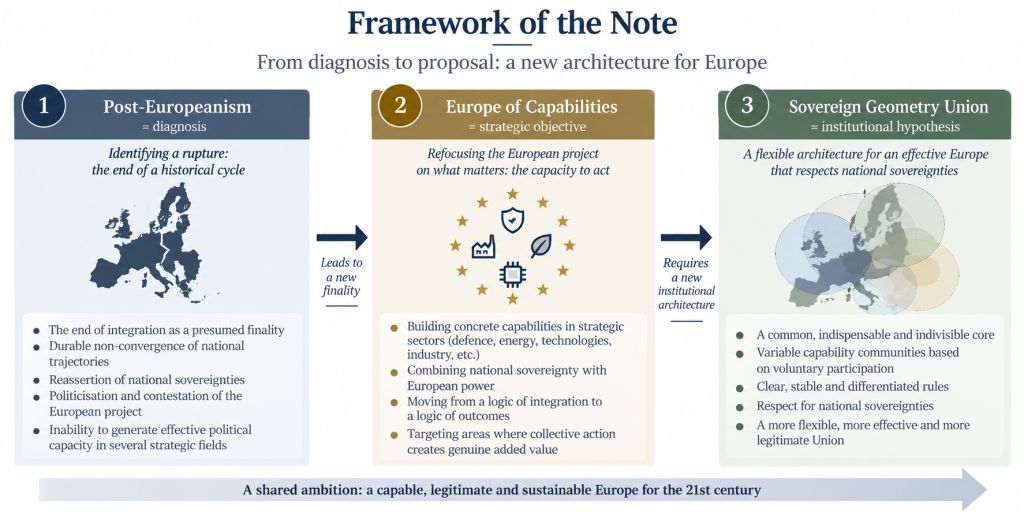
Post-Europeanism designates this change of condition. A Europe of Capabilities constitutes its strategic purpose. A Sovereign-Geometry Union is one possible institutional translation of it.
The measure of European success should therefore evolve: not only how many competences have been transferred, but what political capacity has been obtained in return.
General Introduction: From Integration as a Method to Capacity as a Problem
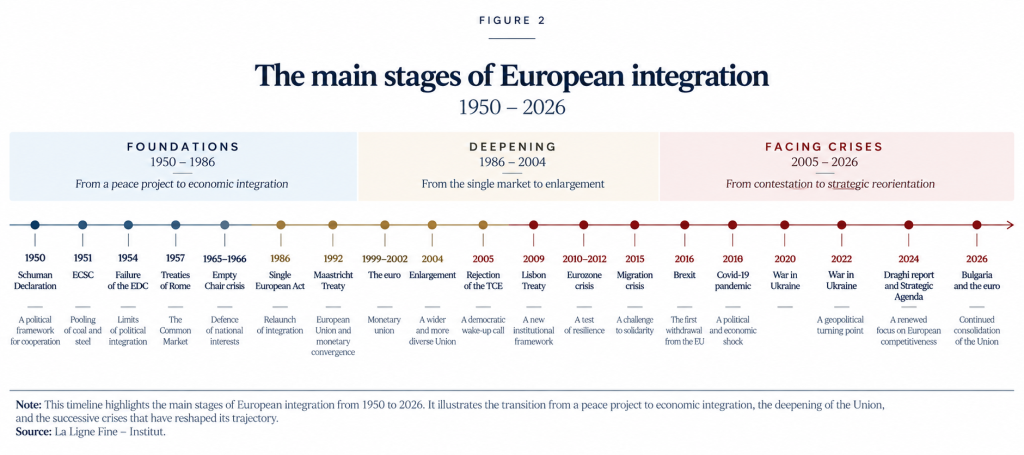
European integration developed from an intuition whose political significance is difficult, in retrospect, to overstate: after the catastrophes of the first half of the twentieth century, the lasting stabilisation of the continent could no longer rest solely on the classical balance among national powers. The very structure of their relations had to be transformed. Yet the method chosen was neither that of a federation created in a single constitutional act nor that of a simple international organisation charged with arbitrating occasional disputes between governments. It consisted in progressively organising interdependencies deep enough to alter interests, behaviour and, over time, the very conditions under which sovereignty was exercised. The Schuman Declaration of 9 May 1950 gave this intuition its founding formulation when it proposed placing Franco-German coal and steel production under a common High Authority so that war between the two countries would become not merely politically improbable but materially far more difficult. Sectoral pooling therefore served a purpose that went well beyond economic management: it was intended to transform the conditions of power in Europe and replace rivalry with organised interdependence.
This method was one of the major innovations of the post-war European order. The European Coal and Steel Community, followed by the Treaties of Rome, did not presuppose the disappearance of national interests; on the contrary, they sought to reorganise them by creating fields in which cooperation gradually became more advantageous than competition. This logic subsequently inspired a major strand of the literature on integration. In The Uniting of Europe, Ernst B. Haas analysed the ECSC as a laboratory for a process through which cooperation in one sector could shift actors’ expectations and loyalties and generate new demands for integration in neighbouring sectors. This mechanism, at the heart of neofunctionalism, offered a particularly powerful theory of Community dynamics: integration did not have to be decided in its entirety in advance; it could develop through successive effects generated by the interdependencies it created.[10]
It would, however, be wrong to reconstruct the history of European integration as though this logic had ever constituted a unanimously shared doctrine or as though states had accepted from the outset their gradual transcendence. Community-building has constantly resulted from tension between competing conceptions of the European order. From the first treaties onward, supranationalism coexisted with an intergovernmental logic in which national governments remained decisive actors whenever they considered their fundamental interests to be at stake. Stanley Hoffmann had already identified this limit in the mid-1960s by challenging the idea that functional dynamics observed in certain economic sectors would necessarily extend into the areas most directly connected to political sovereignty. His analysis of the resilience of the nation-state was a reminder that integration never develops in a political vacuum: it encounters societies, governments, national histories and hierarchies of interest that cannot simply be absorbed by Community dynamics.[11]
This tension has remained constitutive of contemporary Europe. The European Union is neither an ordinary international organisation, since its institutions possess autonomous competences and its law has substantial effects within national legal orders, nor a federal state with a sovereign political centre capable of exercising the full range of core state functions. It is the product of a historical accumulation of compromises that have allowed states to exercise certain competences jointly without dissolving their own political existence. Andrew Moravcsik offered a particularly important interpretation of this dynamic by showing that several major stages of integration can be explained not as the gradual disappearance of national interests, but as the result of national preferences and intergovernmental negotiations in which states accepted European commitments when they judged them compatible with their economic and political interests.[12]
The tension between integration and sovereignty is therefore not a recent pathology of the Union. It belongs to its history. What has changed is the configuration in which this tension must now be organised. For several decades, disagreements over Europe’s ultimate nature could be contained within a general dynamic of deepening. Governments could disagree on the final objective while still accepting further integration where it produced sufficiently identifiable benefits. Completion of the internal market, the opening of borders, Economic and Monetary Union and enlargement to Central and Eastern Europe could all be supported for different reasons: for some, they were stages in an integration process destined to become more political; for others, they increased the prosperity or influence of states without prejudging a federal destination. Ambiguity over the final purpose did not necessarily prevent the process from advancing.
The Treaty on European Union still bears the imprint of this dynamic by describing the Union as ‘a new stage in the process of creating an ever closer union among the peoples of Europe’. This formulation is sometimes read in an excessively teleological way, as if it legally fixed a federal destination for the Union. It nevertheless expresses an indisputable historical reality: European integration was long conceived as a cumulative process in which deepening cooperation constituted the general direction of travel.[13]
What characterises the contemporary period is precisely the weakening of this assumption. Integration continues, and in some areas it is still deepening, but it no longer enjoys the same political status. It is no longer presumed to be the natural response to every European problem. Debates over defence, energy, taxation, industry, migration and borders reveal far more complex configurations: the same government may support highly ambitious European action in one field while demanding substantial national autonomy in another. The classic distinction between ‘pro-European’ and ‘Eurosceptic’ governments is therefore increasingly inadequate for understanding the coalitions that actually form.
This change does not mean that states have once again become hostile to all forms of integration. It means that European preferences have become more sectoral, conditional and strategic. The question is no longer simply whether an actor supports ‘more Europe’, but in which areas it considers that common action effectively strengthens its interests, security or decision-making capacity. This development is all the more important because the Union itself now frames its priorities in language markedly different from that which dominated the decades of internal-market consolidation. The European Council’s Strategic Agenda for 2024-2029 describes an international environment shaped by ‘strategic competition’, increasing instability and challenges to the rules-based international order; it sets priorities that include strengthening defence readiness and capabilities, reducing harmful dependencies, securing supply chains, mastering critical technologies and consolidating European sovereignty in strategic sectors.[14]
This shift is not merely lexical. It reflects a change in the nature of the problem confronting the Union. The European Community was primarily designed to organise interdependence among Europeans. Contemporary Europe must increasingly learn to use these interdependencies as resources for external political capacity. The first project sought to neutralise power competition within the continent; the second requires Europeans to determine how they can act in an environment in which power competition remains structurally important.
There is therefore a profound asymmetry between the political space European integration has helped to build and the international system in which that space is embedded. Within the Union, a large share of relations once handled through bilateral bargaining, economic coercion or national competition is now governed by rules, courts and institutional mechanisms. Outside the Union, the instruments of power have not disappeared. On the contrary, sanctions, technological control, the strategic use of supply chains, competition for raw materials, large-scale industrial investment, economic coercion and rearmament play a growing role in international relations. Europe’s success in institutionalising power relations among its members does not, by itself, guarantee its ability to act in an environment that has not undergone the same transformation.
This contradiction has become particularly visible as the global economic and technological hierarchy has evolved. Mario Draghi’s 2024 report on the future of European competitiveness does not describe a Europe devoid of resources; it describes a Europe whose productivity growth, investment capacity and position in several critical technologies have become insufficient in relation to the transformation of international competition. The problem, therefore, is not the disappearance of European power but its conversion: how can a large market, abundant savings, competitive firms, infrastructure, scientific expertise and considerable regulatory capacity be transformed into instruments that allow Europeans to shape the conditions of their own action more effectively?[15]
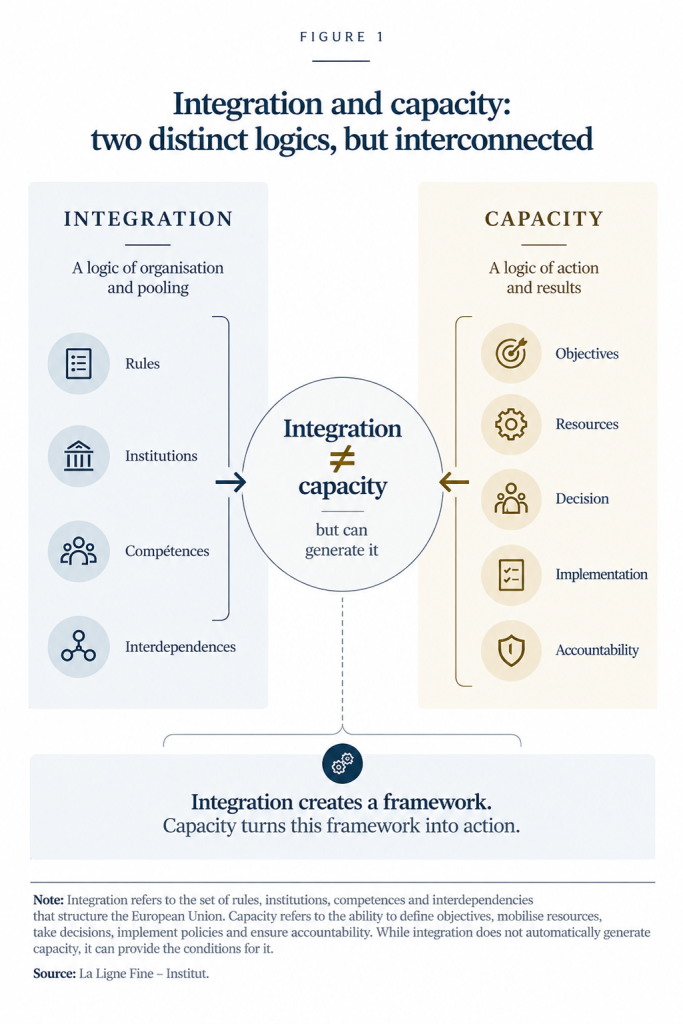
It is precisely here that the distinction between integration and capacity becomes necessary. Integration describes a degree of common organisation: shared rules, institutions, competences and interdependencies. Capacity refers to something else: the ability to set an objective, assemble the means required to achieve it, arbitrate among competing interests and assume political responsibility for the consequences of the decision. The two concepts can reinforce one another, but they are not equivalent. A policy may be highly Europeanised without the actors concerned sharing the same understanding of the strategic objective to be pursued; conversely, a limited group of states may be able to produce significant collective action without the entire policy field being integrated at Union level.
This distinction leads to a reconsideration of several episodes commonly described simply as ‘European crises’. The euro-area crisis did more than reveal insufficient solidarity among Member States; it showed that extremely deep monetary integration could precede the existence of the fiscal and political capacities necessary for its stabilisation. The 2015 migration crisis did more than expose ideological differences among governments; it highlighted the difficulty of reconciling an integrated area of free movement with profoundly different national conceptions of borders, asylum and political community. Brexit did more than demonstrate that a state could leave the Union; it reminded Europeans that economically rational integration does not necessarily neutralise the question of political control. The pandemic showed both the persistence of national reflexes in an emergency and the ability of states to construct new European instruments rapidly when the scale of the problem made their common interest sufficiently clear. The war in Ukraine has finally confronted the Union with an issue that several decades of strategic stability had partly pushed into the background: the military, industrial, energy and political means required to contribute to shaping the continent’s security order.
Taken separately, none of these episodes demonstrates the exhaustion of the European project. Taken together, however, they suggest that the framework within which the European question is posed has changed. The challenge is no longer merely to extend or perfect integration. It is to assess what integration actually enables Europeans to do.
The concept of post-Europeanism developed in this note is situated within this transformation. The prefix ‘post-‘ denotes neither the disappearance of Europe nor a period after the European Union. It refers to moving beyond a particular intellectual framework: one in which integration implicitly constituted the primary measure of European progress. Post-Europeanism begins when integration itself must be justified by the political effects it produces and when diversity in national preferences is no longer necessarily interpreted as a temporary lag destined to disappear over time.
The point is therefore not to oppose a supposedly ‘Europeanist’ era characterised by unity to a ‘post-Europeanist’ era characterised by national withdrawal. Such a construction would be historically false: conflicts of interest, state resistance and disputes over sovereignty have accompanied integration from the outset. What changes is the way non-convergence can be conceived. As long as differentiated integration is treated as a transition – with some states moving faster than others towards the same destination – it remains compatible with the classical paradigm. The change becomes much more profound when several degrees of integration are accepted as potentially durable and politically legitimate without all states ultimately being expected to reach the same level in every area.
Such a development does not necessarily lead to less Europe. It may produce the opposite effect. Once integration ceases to be treated as a uniform objective, it can become much deeper where its strategic value is demonstrable. From this perspective, it is entirely coherent to advocate far more ambitious pooling in defence, certain technologies, industry or energy while considering that more limited harmonisation may be preferable in other sectors. Post-Europeanism therefore does not replace integration with sovereignism; it changes the criterion by which different levels of action are chosen.
This approach also requires the question of sovereignty to be reconsidered. European controversies often treat sovereignty as a matter of where a competence is located: a policy belongs either to the state or to the Union, and any transfer to the latter is therefore assumed to represent an equivalent loss for the former. This remains an important legal perspective, but it is no longer sufficient to describe the contemporary conditions of political action. An actor’s freedom also depends on its material capacities. A state can retain a competence in full while depending on external actors for the technologies, finance, raw materials or military means required to exercise it. In that case, its legal autonomy is real but its strategic freedom remains constrained. Conversely, exercising a competence jointly can produce greater autonomy when it makes it possible to assemble a critical mass that would be impossible to reach separately.
The question addressed by this note can therefore be formulated precisely: what European architecture would make it possible to preserve a common political space robust enough to safeguard the Union’s essential achievements, while allowing durable and legally organised degrees of integration in those areas where states have different interests, capacities and political preferences?
The Sovereign-Geometry Union is proposed as one possible answer to this question. It is neither the necessary conclusion of post-Europeanism nor an institutional model whose superiority is assumed in advance. It is a strategic hypothesis that must be tested against the concrete conditions under which the Union functions: coherence of the internal market, primacy and effectiveness of common law, financial solidarity, democratic legitimacy, governance of differentiated policies, prevention of opportunistic behaviour, relations between large and small states, compatibility with enlargement and preservation of a common capacity to decide.
The Sovereign-Geometry Union is proposed as one possible answer to this question. It is neither the necessary conclusion of post-Europeanism nor an institutional model whose superiority is assumed in advance. It is a strategic hypothesis that must be tested against the concrete conditions under which the Union functions: coherence of the internal market, primacy and effectiveness of common law, financial solidarity, democratic legitimacy, governance of differentiated policies, prevention of opportunistic behaviour, relations between large and small states, compatibility with enlargement and preservation of a common capacity to decide.
The argument that follows therefore begins with a methodological precaution: diagnosis and proposal must not be conflated. The Union may indeed be entering a post-Europeanist condition without a Sovereign-Geometry Union necessarily constituting the best institutional response. The robustness of the concept cannot depend on acceptance of the proposed solution. The first task is to determine whether the integrationist purpose is undergoing a structural transformation; the second is to understand what consequences this transformation entails for sovereignty and political capacity; only the third is to examine whether durable and organised differentiation can provide a sufficiently coherent architecture for the Europe now emerging.
I. The Integrationist Paradigm and Its Exhaustion
1.1. 1945-1957: Integration as a Historical Response to the European Problem
The emergence of the European Community cannot be understood apart from the collapse of the preceding European order. The Second World War had not only destroyed infrastructure, displaced populations and ruined several economies; it had profoundly discredited the idea that the continent’s security could be durably guaranteed by the coexistence of independent national powers whose relations would continue to be organised primarily through balance, alliances and, ultimately, force. In 1945, the political reconstruction of Western Europe therefore had to meet two imperatives that might appear contradictory: to restore states capable of guaranteeing democracy, social protection and economic development, while preventing the recovery of their power from reproducing the rivalries that had contributed to earlier catastrophes.
The Community solution was precisely an attempt to escape this dilemma. It did not require nations to disappear; it sought to change the way in which some of their strategic functions were exercised. Pooling coal and steel therefore responded to a logic of security as much as to an economic one. The Schuman Declaration of 9 May 1950 was explicit on this point: the French proposal was to place all Franco-German coal and steel production under a common High Authority, within an organisation open to other European countries, in order to make a new war between France and Germany ‘not merely unthinkable, but materially impossible’. The instrument was economic; its purpose was political. The choice of sectors was not incidental: coal and steel still formed the foundations of industrial reconstruction and military capacity. Placing them under a common authority meant acting directly on the material conditions of power.[16]
This historical point matters for the rest of the argument. The original Community project was not born from a theory according to which every national competence was ultimately destined to be transferred to a higher level. It first emerged from the identification of a political problem for which targeted pooling provided an answer. Integration therefore appeared less as an abstract end than as a method for reconciling the continued existence of states with the transformation of their relations. From this perspective, national sovereignty was not simply curtailed by the existence of a common institution: its exercise was modified so as to produce a collective outcome that states could not secure as reliably through traditional diplomacy alone.
The European Coal and Steel Community, established by the 1951 Treaty of Paris, gave this method its first institutional expression. Six states – France, the Federal Republic of Germany, Italy, Belgium, the Netherlands and Luxembourg – accepted that an independent High Authority should exercise powers no longer derived exclusively from coordination among governments. The arrangement could not yet be described as a federation, but it already went beyond classical intergovernmental cooperation. The ECSC possessed its own institutions and introduced into European relations a principle that would become central: certain decisions could be entrusted to a common body because the interests concerned had themselves been made interdependent.[17]
This innovation must nevertheless be placed in its geopolitical environment. Western European integration did not develop in a ‘unipolar moment’ or in a world freed from power politics. On the contrary, it emerged in the early years of the Cold War, as the division of Europe became institutionalised and the security of Western Europe depended heavily on the American presence and the Atlantic Alliance. The Federal Republic of Germany had to be reintegrated into a Western order compatible with French security requirements; European economies had to be rebuilt; and the Soviet threat strengthened the case for a political organisation of Western Europe. From the outset, therefore, the European Community developed within a broader strategic system combining American protection, economic reconstruction and the institutionalisation of relations among Europeans. This makes it impossible to portray the Union as the product of a post-geopolitical world: integration was conceived precisely in an environment of power, but its primary function was to neutralise power competition within the Western European space.
The attempt to establish a European Defence Community in the early 1950s immediately revealed the limits of the method as it approached core sovereign functions. The treaty establishing the EDC was signed in 1952 but never entered into force, after the French National Assembly refused in 1954 to continue the ratification process. The failure is revealing. It shows that states can accept substantial supranationality in some sectors while remaining far more reluctant where defence, the armed forces and ultimate control over force are concerned. Community history therefore does not follow a uniform curve of ever-deeper integration. From the earliest years, it alternated between advances, resistance and sectoral selection according to the political sensitivity of the competences involved.
Following this failure, European relaunch occurred precisely through the economic sphere. The Treaties of Rome of 25 March 1957 created the European Economic Community and Euratom. The EEC aimed progressively to establish a common market, bring Member States’ economic policies closer together and promote the harmonious development of economic activities. The treaty’s preamble declared the determination to lay ‘the foundations of an ever closer union among the peoples of Europe’, a formula that would become one of the markers of Community-building. Yet moving from the pooling of two industrial sectors to the establishment of a common market represented a considerable change of scale: the objective was no longer merely to manage a few strategic resources jointly, but gradually to transform the economic environment in which governments, firms and citizens made their decisions.[18]
It is this dynamic that Ernst Haas sought to theorise in The Uniting of Europe. His analysis of the Community process did not rest on the idea that a pre-existing federal will would gradually impose its programme on the states. It focused on the mechanisms through which cooperation in one field generates new coordination problems, shifts actors’ interests and can encourage the extension of integration into adjacent sectors. The concept of spillover became central to the literature because it helps explain how an initially limited project can generate its own dynamic of deepening.[19]
This reasoning is particularly useful for understanding the historical strength of the Community method. As economies become more integrated, decisions taken in one state more readily produce consequences for its partners; economic actors demand common rules; and existing institutions identify new sectors in which the absence of coordination reduces the effectiveness of policies already adopted. Integration thus generates interdependencies that may call for new forms of integration. This dynamic does not necessarily depend on an explicit constitutional design. It can arise from the successive resolution of practical problems.
One of the strengths of this method was precisely that it enabled European integration to advance without immediately settling the question of its ultimate political destination. Federalists could interpret the Communities as the beginning of a transformation leading gradually to genuine political union. Governments more attached to their autonomy could, by contrast, support sectoral cooperation they considered consistent with their interests without accepting the idea of a future European state. Community-building long prospered on this productive ambiguity: states could agree on the movement without necessarily sharing the same conception of its endpoint.
This characteristic must be kept in mind when seeking to understand the current exhaustion of the integrationist paradigm. The problem is not that the original project failed. On the contrary, it succeeded remarkably well in fulfilling a large part of its historical function. Relations among the states participating in European integration were progressively framed by a dense set of rules, institutions, negotiating procedures and common interests. War between members of the Union became politically inconceivable; national economies reached a degree of interdependence that would have been difficult to imagine in the aftermath of the Second World War; internal borders were largely opened; and large areas of public policy came to be developed within a European framework.
The contemporary question arises precisely from this success. An instrument originally designed to organise cooperation in certain fields gradually produced a highly integrated economic, legal and political space. As this process developed, integration ceased to be merely a method applied to particular problems and became, in part of the European discourse, a general measure of progress in Community-building. It is this shift – from integration as a means to integration as a horizon – that must now be examined.
1.2. A Constitutive Tension: The European Community Between Supranationality and the Persistence of States
The image of European integration as a gradual movement from the national to the supranational level has long exercised considerable influence over the narrative of integration. It does indeed correspond to part of institutional development: Community competences expanded, the role of the European Parliament increased, the Court of Justice consolidated the autonomy of the European legal order, and majority voting progressively replaced unanimity in several fields. But this representation becomes misleading when it turns a real development into a necessary trajectory. The history of the Union is not one of the continuous effacement of states; it is one of growing interweaving between supranational institutions and national governments, in which both dimensions have been strengthened, transformed and at times opposed to one another.
This observation lay at the heart of Stanley Hoffmann’s critique in his 1966 article, Obstinate or Obsolete? The Fate of the Nation-State and the Case of Western Europe. Hoffmann denied neither the originality nor the depth of economic integration. He did, however, challenge the idea that the dynamics observed in those sectors would necessarily lead to equivalent integration in the areas most directly connected to states’ fundamental choices. The distinction between low politics and high politics, although subsequently debated and refined, captured a durable difficulty: integration becomes politically more sensitive as it reaches the functions through which national communities define their security, solidarity and place in the world.[20]
The French case under Charles de Gaulle offers one of the best-known illustrations. Gaullist European policy cannot be reduced either to opposition to Community cooperation or to simple defensive nationalism. De Gaulle considered that some form of European organisation was necessary if the continent’s states were to preserve a capacity for action in relation to the two Cold War superpowers. But he rejected the idea that this organisation should rest on the gradual construction of a supranational authority endowed with a legitimacy independent of that of the nations. His project for a ‘Europe of States’ or ‘Europe of Nations’ therefore sought to reconcile continental cooperation with the political primacy of national governments.
The so-called ‘Empty Chair’ crisis of 1965-1966 crystallised this opposition. For several months France ceased participating in Council meetings, notably amid disagreement over the financing of the Common Agricultural Policy and the extension of majority voting. The Luxembourg Compromise of January 1966 ended the crisis by recognising, as a political practice rather than a legally binding rule, the possibility of continuing discussions when a state considered that ‘very important interests’ were at stake. The episode demonstrated that Community institutions did not develop independently of states’ ability to impose limits when they believed the balance between the national and Community levels was threatened.
Such resistance did not, however, prevent integration from advancing. This is precisely what makes the European experience difficult to fit into classical categories of political science. The development of the supranational level did not necessarily occur at the expense of states; it often provided their governments with new instruments for pursuing objectives they could not achieve alone. States accepted common constraints while using the Union as a multiplier of influence, a mechanism for economic stabilisation and a framework within which to negotiate their own interests.
This interpretation lies at the heart of Andrew Moravcsik’s liberal intergovernmentalism. In his analysis of major European choices, integration results first from national preferences shaped by domestic economic and political constraints, and then from negotiations among governments with unequal bargaining resources. Supranational institutions play an important role, particularly by guaranteeing the credibility of the commitments concluded, but they do not make state interests secondary. The advance of integration can therefore be understood as a rational decision by governments to limit certain margins of manoeuvre when common commitments provide greater benefits or secure agreements they regard as essential.[21]
This perspective is particularly useful in avoiding two symmetrical simplifications that continue to structure part of the European debate. The first interprets every extension of common competences as a necessary defeat for national sovereignty. The second regards the same extension as proof of an inexorable march towards a federal structure. In practice, governments have often accepted integration precisely because they saw it as a means of achieving their own objectives more effectively. Sovereignty has therefore not only been transferred; it has also been exercised through new institutions.
This point is central to the concept of post-Europeanism developed here. If states have never ceased acting according to national interests and European integration was able to advance because it made their cooperation beneficial, the contemporary question changes in nature. The issue is not to lament the ‘return’ of national interests as though they had disappeared for several decades. They never did. The issue is to understand why the mechanisms that once made them compatible with a general dynamic of integration have become more difficult to reproduce.
The expansion in the number of policy fields concerned provides a first explanation. A Community responsible for commercial or agricultural policies does not require the same level of political consent as a Union intervening in monetary policy, borders, justice, taxation, foreign policy or defence. As European competences move closer to the constitutive functions of the state, the trade-offs they entail become more politically visible and more likely to be contested. Citizens may accept a technical standard being drawn up at European level without constantly questioning the location of sovereignty; the situation is different when the debate concerns taxation, the reception of migrants, military engagement or the distribution of resources among territories.
A second explanation lies in the growing number and heterogeneity of Member States. The Community of the 1950s rested on six Western European countries that were deeply different but confronted by a relatively narrow set of common economic and strategic constraints. Successive enlargements have been among the greatest historical achievements of European integration, but they have altered the institutional problem. A Union of twenty-seven states brings together economies with different structures, distinct constitutional traditions, divergent histories of sovereignty and geopolitical perceptions that do not overlap. Relations with Russia are not viewed in the same way from Warsaw, Lisbon or Rome; the energy preferences of France, Germany and Poland differ; and conceptions of migration policy vary profoundly across societies and governments.
This heterogeneity does not mean that the Union is condemned to impotence. It does, however, require abandoning an overly simple assumption: that time, economic interdependence and membership of common institutions would gradually be sufficient to homogenise political preferences. European experience instead shows that states can become extraordinarily interdependent while continuing to diverge on fundamental questions. Market integration does not necessarily erase differences in strategic culture; a common currency does not spontaneously generate a common understanding of fiscal solidarity; and sharing a legal order does not eliminate disputes over the scope of the primacy of European law or the limits of Union competences.
A third explanation concerns the gradual democratisation and politicisation of European issues themselves. For a significant part of Community history, European policies could advance under what some scholars described as a ‘permissive consensus’: integration generated relatively little electoral mobilisation and governments retained substantial room for manoeuvre when negotiating European compromises. This situation gradually changed as the Union entered more sensitive policy areas and as its decisions became more visible in national debates. Liesbet Hooghe and Gary Marks theorised this shift towards a ‘constraining dissensus’, in which integration becomes an object of partisan competition, political identities carry greater weight and governments have less room for manoeuvre vis-à-vis their electorates.[22]
This development does not necessarily constitute a failure of European integration. It can also be understood as a normal consequence of its politicisation. The more significant the competences exercised by the Union, the more likely its choices are to be contested; the more it intervenes in the distribution of resources, economic regulation or identity-related questions, the more inevitable political opposition becomes. The idea of an increasingly political Union that could indefinitely retain the technocratic consensus of its first decades was, in that respect, difficult to sustain.
The change of era therefore does not consist in the sudden reappearance of the nation. It never disappeared. It consists in the growing impossibility of keeping the question of Europe’s final purpose outside political conflict. The Union must now operate while its members and their citizens do not necessarily share the same conception of the endpoint, and while this divergence is no longer marginal enough to be treated as temporary resistance to integration.
It is precisely this transformation that prepares the shift from a paradigm of convergence to a question of differentiation. As long as divergences among members could be regarded as temporary, multi-speed integration remained compatible with the idea of a common destination. Once those divergences become durable and concern the very purpose of the Union, the institutional question changes: it is no longer simply how some states can move faster, but whether the same political community can legitimately organise several permanent degrees of integration.
This question cannot, however, be addressed without first examining the period during which the assumption of progressive convergence reached its peak. The institutional transformations running from the Single European Act through Maastricht, the euro and the enlargements following 1989 gave particular force to the integrationist paradigm. It was also during this period that several of the contradictions which would become much more visible from the 2000s onward accumulated.
1.3. 1986-2004: The High Point of European Convergence and Its Ambiguities
1986-2004: The High Point of European Convergence and Its Ambiguities
The period opened by the Single European Act and extending through the major enlargements of the early 2000s probably represents the moment when the assumption of progressive European convergence enjoyed its greatest historical force. This sequence combined three mutually reinforcing movements: deepening of the internal market, the institutional transformation brought about by Maastricht, and the political reunification of part of the continent after the collapse of the Soviet bloc. For roughly fifteen years, integration was no longer presented only as a method for stabilising Western Europe; it increasingly appeared as the natural political framework for organising the continent.
The Single European Act, signed in 1986, marked a decisive stage by setting the objective of completing the internal market by 1992. Removing physical, technical and fiscal barriers to movement was not simply a matter of trade liberalisation. It required substantial rule-making, greater mutual recognition and the extension of procedures designed to prevent unanimity from systematically blocking the measures required by the common market. Economic deepening therefore had institutional consequences: for the market to function, the Union had to be able to decide more, and more effectively.[23]
The Maastricht Treaty then crossed a threshold of a different nature. Signed in 1992, it formally established the European Union, created Union citizenship, deepened cooperation in several fields and organised the process leading to Economic and Monetary Union. The single currency was especially significant because it went far beyond reducing transaction costs. Entrusting monetary policy to a common independent central bank meant removing from participating states a traditional instrument of economic policy and accepting that the consequences of this decision would be shared over the long term.
This moment could lend credibility to the idea that the functional dynamic of integration was gradually approaching areas traditionally associated with sovereignty. After the market, the currency; after the currency, perhaps one day fiscal policy, diplomacy or defence. Yet the Maastricht architecture itself already demonstrated that convergence remained incomplete. The pillar structure, the various forms of opt-out and the retention of intergovernmental logics in foreign and security policy showed that states did not wish to apply the same degree of supranationality to every policy area.
The French referendum on Maastricht, narrowly approved in September 1992, also reminds us that institutional deepening was not automatically accompanied by an equivalent deepening of political consensus. Integration could advance legally while becoming more politically contested. This divergence, still limited in the early 1990s, would later assume much greater importance.
The end of the Cold War nevertheless seemed to give the European project a new historical legitimacy. The collapse of the Soviet bloc produced not only a geopolitical transformation; it also changed the way Western Europe understood its own construction. The Union became one of the principal instruments for the democratic and economic stabilisation of the states of Central and Eastern Europe. Membership was no longer conceived merely as entry into a market or an institutional system, but as anchoring within a political order based on democracy, the rule of law and the market economy.
From this perspective, the enlargements of 2004 and 2007 represented a major historical success. They helped overcome the political division inherited from the Cold War and extended the European legal order across a large part of the continent. At the same time, however, this success transformed the very conditions of integration. The Union became more diverse economically, historically and geopolitically. The new members did not enter the Union with understandings of sovereignty identical to those of the founding states. For several Central and Eastern European societies, national sovereignty only recently recovered after decades of Soviet domination could not be treated as a mere political inheritance destined gradually to fade. Accession to the Union reflected a desire to consolidate that sovereignty within a Western framework just as much as a desire to participate in a supranational dynamic.
This difference in historical trajectory would become decisive as European debates turned to the rule of law, migration, relations with Russia and the depth of political integration. Once again, it illustrates that membership of the Union does not produce a uniform interpretation of what the Union should become.
The period 1986-2004 must therefore be understood with care. It did represent the high point of a dynamic of convergence: never before had so many competences been pooled, so many states sought to join the project, or the idea of continuous integration appeared so credible. Yet this dynamic simultaneously accumulated three tensions that would become more visible in the following decade: the gap between institutional deepening and political consent; the extension of integration into fields where national preferences remained strong; and the growing heterogeneity of a Union whose members did not necessarily share the same conception of its ultimate purpose.
1.4. 2005: The Rupture of the European Constitutional Narrative
2005: The Rupture of the European Constitutional Narrative
The rejection of the Treaty establishing a Constitution for Europe by French voters on 29 May 2005, followed by Dutch voters on 1 June, was important not because it halted every dynamic of integration, but because it exposed a difficulty that had previously remained partly contained: the Union’s legal and institutional advance was no longer sufficient to guarantee political support for its trajectory. The constitutional project was intended precisely to make the Union’s architecture more legible, simplify the existing treaties and give more explicit expression to the political nature of European integration. Its rejection therefore carried a symbolic significance greater than that of a simple disagreement over a legal text. It revealed that institutional deepening could itself become an object of democratic contestation.[24]
Two excessive interpretations should nevertheless be avoided. The first is to treat 2005 as definitive proof of popular rejection of Europe. The French and Dutch votes combined very different motivations: social criticism, economic concerns, opposition to liberalism, rejection of institutional deepening, protest against incumbent governments, and mistrust of the Union’s functioning. It would therefore be misleading to read them as a homogeneous mandate for general renationalisation. The second excessive interpretation is to claim that the Lisbon Treaty, signed in 2007 and entering into force in 2009, simply ‘circumvented’ the popular vote. Lisbon did indeed retain an important share of the constitutional project’s institutional innovations, but it did so in a different legal form, by amending the existing treaties rather than replacing them with a single constitutional text.
What matters more for the analysis of the integrationist paradigm is the change in political climate that followed this sequence. After 2005, the idea of a major constitutional relaunch of the Union became much more difficult to sustain politically. Institutional reforms continued, but they were presented more in terms of efficiency, simplification and management of enlargement than as a political leap towards a federal union. European vocabulary changed accordingly. Federalism remained present in certain parties, parliamentary groups and intellectual circles, but became less central in governmental language, which increasingly favoured more open formulations such as ‘European sovereignty’, ‘strategic autonomy’ or ‘Europe as a power’.
This development does not mean that the integrationist purpose disappeared immediately. Rather, it ceased to be expressed as explicitly. The Union continued to operate according to a cumulative logic: extension of co-decision, development of common policies, strengthening of the European Parliament, and consolidation of the area of freedom, security and justice. Yet the relationship between these advances and a shared political destination became more ambiguous. Integration continued without a clear agreement on its endpoint.
This ambiguity is essential to understanding the following period. As long as the Union’s economic and political results were broadly perceived as positive, the absence of consensus on the ultimate destination could remain manageable. It became more problematic when successive crises forced states to take decisions directly involving fiscal solidarity, border sovereignty, energy choices or military security. In these fields, integration could no longer advance through the technical accumulation of rules alone; it required explicit political arbitration.
1.5. The Euro-Area Crisis: Monetary Interdependence and Insufficient Political Capacity
The euro-area crisis was probably the first moment at which the gap between the level of integration and political capacity became so stark. The single currency had eliminated exchange-rate risk among participating states, strengthened financial integration and created a common monetary policy conducted by the European Central Bank. But it had also produced a structural asymmetry: states shared a currency without having a genuine common stabilisation budget, a fully completed banking union or a political mechanism comparable to that of a federal state for absorbing asymmetric shocks.
This architecture had been identified from the outset as incomplete by part of the economic and institutional literature. It rested on the assumption that national fiscal rules, market discipline and the gradual convergence of economies would be sufficient to guarantee the stability of the whole. The 2008 financial crisis and the subsequent European sovereign-debt crisis exposed the limits of this assumption. The difficulties faced by Greece, Ireland, Portugal and Cyprus and, in different configurations, Spain and Italy progressively transformed a financial problem into a political crisis of European solidarity.
The paradox is central. Monetary integration had made economies sufficiently interdependent that the disorderly default of one state could threaten the entire area, yet it had not created the political instruments required to manage that interdependence immediately. Responses had to be constructed under pressure: the European Financial Stability Facility, the European Stability Mechanism, assistance programmes, interventions by the European Central Bank, reforms to fiscal governance and, later, the establishment of the banking union. The European Stability Mechanism was created through a separate intergovernmental treaty, illustrating the extent to which the response to the crisis required innovations situated at the boundary between the Community method and cooperation among states.[25]
The crisis therefore demonstrated two apparently contradictory realities. First, the depth of integration made a simple return to national autonomy impossible: economies were too interdependent for each government to act as if its choices had no effects on the others. Second, that interdependence had not produced consensus on how the costs of stabilisation should be distributed. Creditor and debtor states did not necessarily share the same conception of responsibility, solidarity or moral hazard. The Union was integrated enough to make common action necessary, but not politically convergent enough to make that action self-evident.
This contradiction produced intense politicisation. In several southern countries, adjustment programmes were perceived as policies imposed from outside and associated with a loss of democratic control. In several northern states, support mechanisms were portrayed as an unjustified socialisation of costs resulting from national decisions deemed irresponsible. The same institutions could therefore be accused simultaneously of imposing too much discipline and organising too much solidarity. This tension reveals the structural difficulty of a system in which economic sovereignty is shared without the existence of a fully unified political community capable of assuming the transfers and trade-offs involved.
The European Central Bank’s response also illustrated the gap between institutional capacity and political legitimacy. Mario Draghi’s famous July 2012 commitment to do ‘whatever it takes’ to preserve the euro marked a decisive moment in stabilising the monetary union. It also revealed how an independent institution, originally designed around the objective of price stability, had become in practice one of the principal actors preserving the political integrity of the euro area. Capacity existed, but it was concentrated in an institution whose mandate had not been designed to substitute for genuine common fiscal decision-making.[26]
The euro-area crisis therefore demonstrates neither the failure of the single currency nor the mechanical necessity of a fiscal federation. It establishes something more precise: the more integrated a policy becomes, the more it generates requirements for capacity and political responsibility that cannot sustainably be treated as mere technical externalities. Integration produces its own institutional requirements, but those requirements encounter the limits of national consent.
This first major crisis of twenty-first-century Europe thus introduced a theme that would recur repeatedly: the Union does not necessarily lack rules; it sometimes lacks mechanisms capable of converting those rules into common action that is sufficiently rapid, legitimate and politically owned.
1.6. The 2015 Migration Crisis: Free Movement, Borders and Political Community
The 2015 migration crisis revealed a different contradiction. Whereas the euro crisis primarily concerned economic and fiscal solidarity, migration directly engages the relationship between territory, political identity and sovereignty. The Schengen area had progressively removed controls at internal borders between participating states, facilitating the movement of people and becoming one of the most visible achievements of integration. But this internal freedom necessarily depended on the collective capacity to organise control of external borders and distribute responsibilities for asylum.
The rapid arrival of very large numbers of asylum seekers and migrants in 2015 exposed the limits of this architecture. Countries on the Union’s external borders, particularly Greece and Italy, faced substantial logistical and administrative pressure. Germany adopted an especially open reception policy, while several Central and Eastern European states rejected relocation mechanisms proposed at European level. In September 2015 the Council adopted decisions providing for the relocation of asylum seekers from Italy and Greece, but their implementation was contested and incomplete.[27]
The crisis is often described as a confrontation between European solidarity and national selfishness. That account is insufficient. The disagreement also concerned the very definition of legitimate competence. For some governments, free movement within the Union necessarily implied stronger solidarity in managing asylum and external borders. For others, decisions concerning the permanent admission of foreign populations belonged to national political authority and could not legitimately be imposed by a European majority.
The distinction is fundamental. States disagreed not only over the means of achieving a common objective; they diverged over where the power to decide should itself be located. Migration policy therefore engaged a deeper dimension of sovereignty than many internal-market policies. It concerned the capacity of a political community to determine the conditions of access to its territory, the composition of its population and the resulting obligations of solidarity.
The case law of the Court of Justice and proceedings brought against several states that refused to implement the relocation decisions confirmed the existence of a European legal obligation, but they did not remove the underlying political disagreement. In 2020, the Court notably found that Poland, Hungary and the Czech Republic had failed to fulfil their obligations under the relocation decisions. The episode therefore demonstrates that the existence of common law does not automatically guarantee the existence of a community of political preferences on which that law can rest sustainably.[28]
This sequence reveals another limit of the convergence paradigm. Institutional interdependence can make common action necessary without generating the political agreement required to make that action legitimate in the eyes of all members. In fields with a strong identity or distributive dimension, integration does not necessarily reduce divergence; it can instead make it more visible by compelling states to arbitrate collectively questions they would previously have addressed separately.
The migration crisis also showed that states remain the first actors in an emergency. Several governments temporarily reintroduced controls at internal borders, and Germany, like other states, took national decisions before European mechanisms were fully mobilised. This does not mean that Schengen failed. It is a reminder that national political infrastructures retain a direct capacity for response that the Union does not always possess to the same degree.
The lesson differs from that of the euro area, but it leads to the same conclusion. In both cases, integration created deep interdependencies that made purely national action insufficient. In both cases, too, the existence of a common interest did not spontaneously produce a common will regarding the modalities of action. The European difficulty therefore lies less in identifying shared problems than in the capacity to transform a community of problems into a community of decision.
1.7. Brexit: The Reversibility of Integration and the Question of Control
The British referendum of 23 June 2016 introduced a rupture of a different kind. For the first time, a Member State decided to leave the Union by using the procedure laid down in Article 50 of the Treaty on European Union. The United Kingdom’s effective withdrawal on 31 January 2020 demonstrated that European integration is both legally and politically reversible. That may appear obvious today; it was far less so before the referendum. For several decades, the European process had operated almost exclusively through enlargement and deepening. Brexit introduced the possibility of movement in the opposite direction.
The British vote nevertheless requires the same caution in interpretation as the referendums of 2005. Brexit cannot be reduced to a single cause. Immigration, parliamentary sovereignty, perceptions of budgetary contributions, regulation, partisan divisions and territorial fractures all played different roles. The slogan ‘Take back control’, however, captured with remarkable effectiveness the political core of the Leave campaign: the question of control.
This concept is directly relevant to the problem of post-Europeanism. The British debate was not simply a confrontation between openness and closure, or internationalism and nationalism. It concerned a fundamental question: at what level must political decisions be capable of being taken and sanctioned? Supporters of Remain emphasised above all the economic, commercial and geopolitical benefits of Union membership. Supporters of Leave built part of their success on the claim that those benefits had been obtained at the price of an excessive limitation on national decision-making capacity.
The argument can be disputed on its merits; it nevertheless reveals a problem of legitimation. A political organisation cannot sustainably justify constraints solely by demonstrating their economic rationality. It must also be able to show that accepted constraints increase, in an identifiable way, the political capacity of members or citizens. When that relationship becomes invisible, integration may be perceived not as a multiplier of sovereignty but as dispossession.
Brexit also revealed that existing differentiation is not always sufficient to keep a state within the Union. The United Kingdom already benefited from major opt-outs: it did not participate in the euro, was not part of Schengen and had several specific arrangements. The assumption that differentiated integration is necessarily sufficient to accommodate national preferences is therefore false. Institutional flexibility can reduce some conflicts, but it cannot resolve a profound political disagreement over the nature of membership itself.
Brexit did not, however, trigger a general dynamic of withdrawal. Negotiations between the Union and London even demonstrated strong cohesion among the remaining twenty-seven states in defending the integrity of the internal market and its four freedoms. This is important in avoiding a declinist interpretation. The Union is reversible, but it retains enough political and economic value that the British withdrawal did not inaugurate a general cycle of disintegration.
Brexit therefore reveals less the collapse of the Union than the emergence of a new constraint: integration can no longer be treated as politically irreversible or naturally legitimate. It must demonstrate its value to states and citizens, and that value cannot be assessed solely by the density of law produced or the volume of economic exchange. It must be translated into capacity for control, protection and influence.
1.8. The Covid-19 Pandemic: The Return of the State and European Innovation
The Covid-19 pandemic offers a particularly revealing illustration of the relationship between national reflexes and European capacity. When the health crisis reached Europe in early 2020, the first responses were largely national. Border controls were reintroduced, restrictions appeared on exports of medical equipment, and health strategies diverged sharply. This sequence is sometimes used to demonstrate the fragility of European solidarity. Above all, it reveals an institutional reality: in an emergency directly affecting health, public order and political responsibility, national governments remain the first actors required to answer to their citizens.
This initial phase does not exhaust the analysis. The European response subsequently strengthened. The Commission coordinated the procurement of vaccines on behalf of Member States, while the Union introduced several economic support mechanisms. The most important decision was the creation of NextGenerationEU, a temporary recovery instrument financed through borrowing by the Union on capital markets. The package adopted in 2020 amounted to EUR 750 billion at 2018 prices, more than EUR 800 billion at current prices after adjustment, and was structured in particular around the Recovery and Resilience Facility.[29]
The institutional significance of this decision is considerable. Until then, common European borrowing had remained confined to much more limited operations. NextGenerationEU authorised the Commission to borrow on a large scale in order to finance expenditure and transfers to Member States. It did not create a permanent fiscal union, and its exceptional nature was politically emphasised from the outset. It nevertheless demonstrated that states can accept an innovation that would have appeared difficult only a few years earlier when they perceive the common nature of the shock clearly enough.
The pandemic therefore provides an important counterpoint to overly deterministic readings of integration. European institutions do not necessarily advance because a functional logic makes the next step inevitable. They can advance when states judge that a European instrument serves their interests in the face of a problem whose scale exceeds their separate capacities. The dynamic is therefore both functional and political: interdependence creates the need, but decision requires convergence of interests and governmental consent.
This finding strengthens the hypothesis of a Europe of Capabilities. NextGenerationEU is less proof of an inevitable march towards a federal budget than evidence that a common capacity can be created when it responds to a clearly identified problem. European innovation then appears as a strategic choice rather than as an automatic extension of the integration process.
The health crisis also shows that state and Union are not necessarily opposites. States exercised their emergency competences while subsequently constructing a complementary European response. Levels of action overlapped. This institutional plurality, sometimes described as a weakness, can also constitute a resource provided that the distribution of responsibilities remains intelligible.
This point should be retained: the Union does not need to replace the state in order to produce capacity. It can increase the capacity of states when a problem justifies collective action and European instruments are designed around that purpose.
1.9. The War in Ukraine: The Test of Power
Russia’s full-scale invasion of Ukraine on 24 February 2022 is finally revealing in a different way. Unlike the preceding crises, it directly confronts the Union with a major war on the continent, the military security of its members and the question of Europe’s strategic order. It therefore requires the Union to act in a domain in which its institutional model has historically developed with far greater caution.
The European response has been substantial. The Union adopted successive packages of sanctions against Russia, provided considerable economic and financial assistance to Ukraine and used the European Peace Facility to finance military equipment. It also accelerated policies aimed at reducing energy dependence on Russia and opened a much broader debate on the European defence industry. The European Council now explicitly places the strengthening of European defence readiness and capabilities among the Union’s strategic priorities.[30]
These decisions show that the Union can mobilise instruments of power and that it would be wrong to reduce it to a merely normative organisation. They also reveal, however, the limits of its strategic capacity. The continent’s military security continues to depend heavily on NATO and therefore on the United States; defence capabilities are held primarily by Member States; European military industries remain fragmented; and national perceptions of threats and long-term objectives diverge.
The war did not create these weaknesses. It made them more visible. Debates on European strategic autonomy, burden-sharing within NATO, industrial capabilities and dependence on American equipment all predate 2022. The Russian invasion, however, transformed their degree of urgency. The question is no longer simply whether Europe should, in the long term, develop more of its own means; it directly concerns its ability to contribute to shaping the continent’s security order.
The contradiction with which this introduction began appears here in its clearest form. Europe has succeeded in institutionalising power within its own space, but it remains embedded in an international system in which military, economic and technological power continues to structure relations among actors. It possesses economic weight sufficient to impose significant costs through sanctions, yet it does not possess a unified political or military chain of command comparable to that of a state. It can finance, coordinate, regulate and support; it faces greater difficulty when required to define a continental security strategy on its own.
The war in Ukraine therefore does not prove that a European federation is necessary. It demonstrates instead that a Union capable of organising relations among its members effectively must now answer a question that could partly be deferred in a more stable strategic environment: what capabilities must Europeans be able to build and exercise together if they are not to depend entirely on external actors in defining the conditions of their security?
This question marks the boundary between the old paradigm and the one now taking shape. Integration built the European space. Power is once again becoming the political problem to which that space must respond.
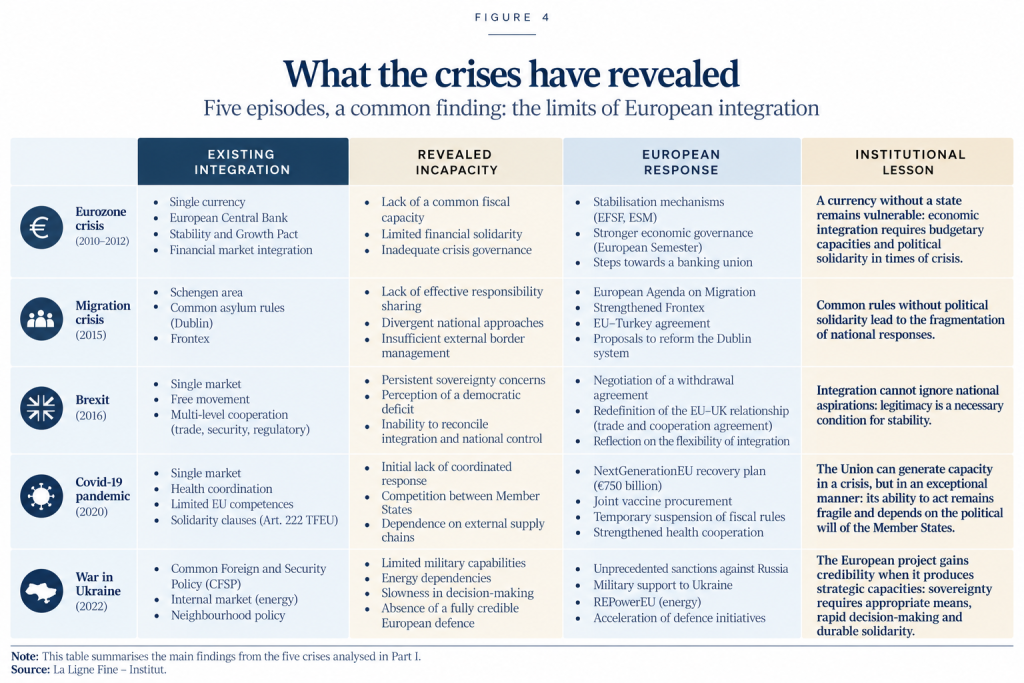
1.10.What the Crises Have Really Changed: From Presumed Convergence to Demonstrated Capacity
The crises that have followed one another since the beginning of the 2010s are often presented as so many proofs of the Union’s fragility. This reading is not wrong, but it is incomplete. Each crisis has also produced innovations: new financial mechanisms after the euro crisis, the strengthening of Frontex and reform of migration policy, institutional cohesion during the Brexit negotiations, exceptional common debt after the pandemic, and sanctions and military-support instruments following the invasion of Ukraine. The Union is therefore not merely paralysed by crises; it is also transformed by them.
What changes more profoundly is the criterion used to legitimate European action. Historical arguments associated with peace, reconciliation and the common market remain important, but they no longer suffice to justify every new step. Common policies are increasingly assessed according to their ability to produce an identifiable outcome: stabilising a currency, controlling a border, securing a supply, financing investment, supporting an industry or contributing to security.
This shift corresponds to a broader evolution in the Union’s legitimacy. As direct memory of the world wars recedes and the fundamental achievements of integration are increasingly taken for granted by many citizens, historical justification necessarily loses part of its mobilising force. The Union is increasingly confronted with a form of performance legitimacy: it is judged by what it actually enables Europeans to do.
It would nevertheless be simplistic to reduce this development to a purely transactional logic. European institutions still rest on values, rules and a conception of cooperation that cannot be reduced to an immediate cost-benefit calculation. But the stability of any political order also depends on its ability to provide the public goods it promises. The state itself does not derive legitimacy solely from identity or law; it also derives it from the ability to protect, decide and organise solidarity. It would be paradoxical to expect less from a Union that has become deeply political.
The consequence of this change for the integrationist paradigm is significant. Deepening can no longer be treated as a sufficient indicator of European success. Extending a competence without producing identifiable capacity may increase complexity without strengthening political autonomy. Conversely, cooperation limited to a group of states may produce major strategic capacity even if it does not immediately involve every member.
The transition from a logic of presumed convergence to one of demonstrated capacity therefore constitutes the real thread running through the transformations observed. The Union is not abandoning integration; it is entering a period in which every new act of integration must increasingly demonstrate what it actually delivers.
It is at this point that the concept of post-Europeanism becomes necessary. It is not intended to describe all European crises or artificially reduce them to a single cause. It names the political change visible behind them: integration is no longer a sufficient principle for ordering every European response.
The following chapter must therefore examine the second component of this transformation: the growing politicisation of Europe’s final purpose itself, through the renewed assertion of national political communities, the persistence of the federal project and the emergence of durable dissensus over what the Union should become.
II. The Politicisation of Europe: Nations, Federalism and Dissensus
The exhaustion of the integrationist paradigm does not mean that the European Union has ceased to produce integration, nor that its citizens are uniformly turning away from the European project. It corresponds to a more precise transformation: integration has become an object of ordinary political conflict. What could once be negotiated mainly among governments, administrations and Community institutions is now exposed more directly to electoral cleavages, national identities and controversies over the distribution of resources, borders and sovereignty. Europe has therefore not simply become ‘less consensual’; it has become more political in the fullest sense of the term, that is, more exposed to confrontation among competing conceptions of the collective interest.
Liesbet Hooghe and Gary Marks described this development as the transition from a permissive consensus to a constraining dissensus. Their argument is not that citizens suddenly discovered the existence of the Union or that governments lost all freedom of action. Rather, the growing visibility of European issues progressively changed the conditions of integration: public preferences, party strategies and identity questions weigh more heavily on decisions concerning the allocation of competences between the national and European levels. From this perspective, integration can no longer be understood exclusively as a functional response to interdependence; it must also be analysed as a political choice subject to democratic and identity-based constraints.[31]
This transformation is essential to understanding post-Europeanism. The phenomenon does not begin when the Union stops moving forward, but when further integration can no longer be presumed politically desirable irrespective of the field concerned. A government may support additional integration in defence while simultaneously rejecting greater fiscal harmonisation; a state may defend the internal market while contesting a common migration policy; a party historically supportive of the Union may favour greater European industrial autonomy without endorsing the prospect of federation. The relevant cleavage is therefore increasingly less one that mechanically pits ‘pro-Europeans’ against ‘anti-Europeans’ than one concerning the nature, fields and conditions of collective action.
2.1. From Consensual Europe to Contested Europe: The Normalisation of European Political Conflict
A significant part of Community history unfolded under a particular configuration: integration generated far-reaching effects without necessarily constituting one of the principal cleavages in national political competition. Voters could support or punish governments primarily on the basis of national economic, social or institutional policies, while the major European orientations were the subject of relatively broad agreement among governing parties. This did not imply enthusiastic or uniform support for integration. It meant instead that integration remained sufficiently distant from the main electoral conflicts to leave political elites considerable room for manoeuvre in negotiating Community compromises.
This situation gradually eroded. The referendums on Maastricht and later on the constitutional treaty were early manifestations of this politicisation, which then spread into ordinary electoral competition. The euro crisis placed Europe at the centre of debates on austerity, redistribution and fiscal sovereignty; the migration crisis connected it to borders, identity and immigration; Brexit turned Union membership itself into a referendum issue; and the European ecological transition now generates controversies over competitiveness, the social cost of regulation and industrial policy. Europe is no longer simply the framework within which certain policies are made: it has itself become one of the objects of political conflict.
This normalisation of conflict has an important consequence. In a democracy, politicisation is not in itself a dysfunction. It may even be understood as the normal corollary of the importance acquired by the Union. An institution that regulates the market, helps define energy policies, sets climate targets, organises part of commercial policy and intervenes in border management cannot reasonably remain outside democratic conflict. The real difficulty therefore lies not in the existence of dissensus, but in the fact that Europe’s architecture was largely built during a period in which that dissensus was less structuring.
This distinction prevents the contemporary development from being reduced to a simple ‘rise of Euroscepticism’. The term covers attitudes too diverse to constitute a sufficient explanatory category on its own. It may refer to opposition to particular European policies, a desire to return competences to states, criticism of institutional functioning, rejection of the single currency or, in the most radical cases, a wish to leave the Union. Treating these positions as equivalent confuses criticism of European action with opposition to the very existence of the Union.
The 2024 European elections illustrate precisely this diversification. Alongside groups traditionally supportive of integration, the legislature resulting from the vote brought together several distinct conservative, national-conservative and sovereigntist families: the European Conservatives and Reformists, Patriots for Europe and Europe of Sovereign Nations. At the constitutive session in July 2024, these groups held 78, 84 and 25 seats respectively out of 720; they nevertheless formed neither a unified coalition nor a homogeneous doctrine regarding Europe’s future.[32]
The politically significant development is therefore not only the increased electoral weight of formations critical of integration. It also lies in the fragmentation of their European projects. Some seek to rebalance the Union in favour of the Council and national governments; others defend national primacy in several fields while maintaining membership of the common market; still others adopt a more radical stance towards Union law. This diversity shows that the renewed assertion of national political communities does not mechanically produce a single alternative model.
The politicisation of Europe therefore produces a paradox. It weakens the possibility of integration driven mainly by expertise and elite compromise, but at the same time makes European integration more explicitly democratic: its purposes must now be defended, debated and arbitrated. This change forces both supporters and critics of integration to specify what they actually expect from the Union. It is no longer enough to invoke ‘Europe’ as a moral horizon or ‘sovereignty’ as an abstract principle. Both must be translated into institutional, economic and strategic choices.
It is precisely at this level that the contemporary European debate becomes more interesting than the traditional opposition between ‘more’ and ‘less’ Europe. Politicisation forces an answer to a question long deferred: which functions should actually be exercised at European level, under what rules, and to produce what results? It is progressively replacing the quantitative debate over the extent of integration with a qualitative debate over its utility, legitimacy and capacity.
2.2. The Enduring National Dimension: Not the Disappearance of Europe, but the Persistence of Political Communities
The contemporary reassertion of national sovereignties is often described as a step backwards, or even as the resurgence of a political principle that European integration was meant to transcend. Such a reading confuses two distinct phenomena: the persistence of nations as political spaces and the resurgence of nationalism as a doctrine of exclusion or confrontation. Member States can remain deeply attached to their national institutions without calling into question the existence of a common European order; conversely, support for integration does not necessarily erase the national differences that structure collective preferences.
The nation retains several functions in Europe that integration has so far transferred only partially. It remains, first and foremost, the principal space in which political responsibility is organised. National governments are appointed and sanctioned by national electorates; they conduct most fiscal and social policies; they possess general administrations, armed forces and the main mechanisms of redistribution. Even when their decisions are deeply constrained by European law, citizens continue to see the state as the primary authority responsible for security, living standards, public services and social cohesion.
This persistence is not merely institutional. It also reflects political solidarities that remain far denser within states than at Union level. Social-protection systems involve major transfers among social groups and territories; national budgets continuously redistribute resources without every transfer having to be renegotiated politically. Such mechanisms rest on a sufficiently shared understanding of membership in a political community. The Union has its own budget, cohesion funds and exceptional instruments of solidarity, but it has not reached a comparable degree of mutualisation.
The difficulty is especially visible when integration reaches highly distributive policies. The euro crisis demonstrated this clearly: solidarity among states does not operate politically in the same way as redistribution within a single state. Transfers quickly raise questions of responsibility, reciprocity and the duration of commitments. What is accepted within a national political community can be much more difficult to legitimate between distinct political communities.
Defence provides another example. Europeans can recognise common threats and support deep military cooperation while retaining different strategic cultures. The decision to deploy armed forces, accept casualties or define a vital interest remains one of the strongest expressions of political responsibility. The fact that such decisions remain overwhelmingly national therefore reflects more than institutional delay: it reflects the current absence of a European political space possessing the degree of consent required to assume such responsibility fully.
This analysis helps explain why attempts to build a European political identity do not mechanically replace national identities. European identity can be layered on top of them; it does not have to supplant them in order to exist. The problem arises when integration is conceived as though the strengthening of one necessarily required the weakening of the others. A durable European architecture must instead begin from the possibility of multiple loyalties and different levels of solidarity.
The argument is particularly important for an enlarged Union. Central and Eastern European states often joined the Union after recovering a political sovereignty of which they had been deprived, or whose exercise had been severely constrained, during the Cold War. It would be historically reductive to interpret their attachment to certain national competences as merely a cultural lag behind a more integrationist Western model. Understandings of sovereignty are also shaped by different historical trajectories.
Ivan Krastev has notably emphasised this divergence in his analysis of Europe’s fractures after 1989. Without offering an institutional theory of differentiated integration, his work helps explain how migration, demography, emigration and the memory of communism contributed to making Central European societies particularly sensitive to certain questions of political control and collective identity. The East-West divide cannot therefore be reduced to a moral opposition between ‘European’ societies and ‘anti-European’ governments; it also rests on different historical experiences of sovereignty and openness.
Recognising the persistence of national political communities does not, however, imply that the state is always the most effective scale of public action. This is precisely where classical sovereignism reaches its own limit. The state may remain the principal locus of democratic legitimacy while no longer possessing, in some sectors, the critical mass required to exercise its choices autonomously. Retaining legal competence does not guarantee control over the corresponding capacities.
This distinction between legitimacy and capacity is essential. It prevents us from inferring from the persistence of national political communities that general renationalisation would constitute a strategy of sovereignty. In fields where technological, industrial, financial or military dependencies exceed the national scale, deciding alone may amount to little more than formal autonomy. A nation can be politically sovereign and materially dependent.
Post-Europeanism must make it possible to hold these two observations together: the nation remains one of the principal loci of political legitimacy in Europe; it is no longer always a sufficient scale for strategic capacity. A European doctrine that recognises only the second half of this proposition risks colliding with democratic reality; a sovereignist doctrine that recognises only the first risks ignoring the reality of power relations.
2.3. There Is No Single ‘Europe of Nations’, but Several Doctrines of Sovereignty
Public debate frequently groups under the expression ‘Europe of nations’ political projects whose objectives differ substantially. Such simplification is understandable in electoral competition, but problematic in strategic analysis. Defending state primacy in certain policies, opposing the extension of majority voting, seeking a revision of European competences or challenging the primacy of Union law do not necessarily reflect the same political conception.
A first family can be described as intergovernmental. It accepts the existence of strong European institutions and common policies, but considers that governments should remain the principal holders of political legitimacy and retain control over strategic decisions. This conception is not inherently Eurosceptic. It belongs to the history of European integration itself and can, in different contexts, be associated with the Gaullist tradition, certain Nordic conceptions of cooperation or governments especially attached to the role of the European Council.
A second approach is better described as rebalancing sovereignism. It does not necessarily seek withdrawal from the Union, but aims to return certain competences to states, limit expansive interpretations of European law and favour voluntary cooperation in fields where interests converge. This family often considers that integration has passed the point at which the gains from common action compensate for losses of democratic control in certain policies.
A third family adopts a more radical critique of supranationality. It contests the very idea that a European legal order should permanently prevail over certain national constitutional norms and seeks to transform the Union into a much looser form of cooperation among independent sovereignties. Depending on the parties concerned, this position can range from far-reaching treaty revision to implicit or explicit acceptance of the possibility of withdrawal.
Finally, there is a fourth configuration, often less visible in traditional classifications: states or governments that are strongly supportive of certain forms of integration while remaining deeply attached to national autonomy in other fields. Poland, for example, can support ambitious European military cooperation and a strong American presence on the continent while remaining far more cautious about other transfers of sovereignty. Denmark long maintained several opt-outs from the European project while participating closely in the internal market; the 2022 referendum led the country to abolish its opt-out from the Common Security and Defence Policy, a particularly clear illustration of the evolving and sectoral nature of national preferences.
These configurations show that European sovereignty cannot be analysed along a single axis running from ‘less Europe’ to ‘more Europe’. Preferences are multidimensional. A state may seek more Europe in defence, less in taxation, maintain a particular position on the currency and fully support the internal market. The relevant level of integration therefore depends on the policy concerned, the perception of national interests and the assessment of the capacities produced.
It is precisely this reality that the Sovereign-Geometry Union will seek later to institutionalise. But it can become a coherent doctrine only if differentiation is distinguished from the opportunistic selection of rules. It will never be enough simply to observe that states want to ‘choose’. It will be necessary to determine according to what principles those choices can remain compatible with the existence of a common order.
2.4. European Federalism: The Strength of the Diagnosis and the Uncertainty of the Solution
Faced with the renewed assertion of national political communities, the federal proposition retains powerful intellectual coherence. It begins from a difficult-to-dispute observation: several of the challenges confronting Europeans exceed the capacity of most Member States acting alone. The investment required in certain critical technologies, the defence of the continent, the energy transition, security of supply chains, monetary stability and global trade negotiations all involve resources and power relations whose relevant scale is at least continental. From this perspective, European weakness would result less from excessive integration than from its incompleteness.
Federalist reasoning is particularly compelling when it highlights the asymmetries of the existing architecture. A common currency without fiscal capacity comparable to that of a state; a single market without a genuinely integrated capital market; a common commercial policy without a fully unified foreign policy; national defence industries operating within a largely common strategic space: each of these configurations can be understood as the result of integration sufficiently advanced to create interdependence, but insufficient to generate all the capacities required to govern it.
The European Parliament itself advocated substantial treaty reform in 2023, including an extension of qualified-majority voting and new competences in several fields. This position demonstrates the persistence of an institutional current in favour of deeper political integration, even though such reform would require the agreement of the states under the procedures laid down by the Treaties (European Parliament, 2023, resolution on proposals for amendment of the Treaties).
Federalism also offers the advantage of institutional coherence. If a policy is genuinely European, it may appear logical for it to be accompanied by an authority capable of deciding, a budget capable of financing those decisions, and identifiable democratic accountability. Some of the Union’s problems arise precisely from the accumulation of common competences without an equivalent political executive. Federalism proposes to resolve this contradiction by bringing the level of capacities closer to the level of decision.
Yet the strength of the diagnosis is not enough to establish the viability of the solution. The argument that a European policy would become more effective if it were more deeply integrated does not demonstrate the existence of democratic consent to transfer the corresponding competence permanently to a federal authority. Between the functional need to act together and the formation of a federal political community lies a space that technocratic reasoning alone cannot bridge.
Comparison with the United States is often misleading in this respect. The American federation rests on a constitutional history, political citizenship, fiscal institutions and a conception of sovereignty that cannot simply be transposed to Europe. The Union does not begin from a set of constituent units integrated within a single federal state, but from states with different constitutions, tax systems, languages, diplomatic and military traditions, and historical memories. The possibility of European federalisation cannot therefore be deduced mechanically from the relatively small size of its states compared with major powers.
The difficulty becomes still clearer when enlargement is considered. A Union of more than thirty members will bring together societies with even more diverse levels of development, strategic perceptions and political conceptions. If federalisation presupposes a sufficiently high degree of prior preference homogeneity, enlargement may make those conditions harder to achieve at the very moment when it increases the need for common capacities.
It would, however, be equally wrong to conclude that federalism is politically impossible by nature. European history is made up of decisions once regarded as improbable: a common currency, the removal of internal borders, exceptional common debt and European financing of military equipment. Political preferences evolve under the effects of crises and changes in the international system. The analytical question is therefore not to proclaim federation impossible, but to assess whether it currently constitutes the trajectory most compatible with the diversity of preferences and the observable degree of consent.
At this stage, the conclusion must remain cautious: the federalist argument correctly identifies the insufficiency of certain common capacities, but it sometimes tends to conflate the need for scale with the need for institutional uniformity. The fact that defence, industry or energy require more collective action does not necessarily imply that all states must simultaneously transfer the same competences to the same level or through the same institutions.
It is precisely this distinction that opens the conceptual space for post-Europeanism. The answer to insufficient capacity may be more integration in certain fields without making more integration the Union’s general purpose.
2.5. From Dissensus over Policies to Dissensus over Purpose
The deepest development in the European system may lie less in the intensity of disagreements than in their object. An international organisation can function durably despite numerous conflicts among its members if they share a relatively stable conception of what it is meant to be. Increasingly, however, the European debate concerns that question itself. Conflict no longer concerns only agricultural policy, fiscal rules or migration quotas; it concerns the type of union that these policies are supposed gradually to produce.
Several visions therefore coexist within the same institutions. For some actors, the Union should become a genuine political power with autonomous capacity in core sovereign domains. For others, it should remain a hybrid construction combining an integrated market, common policies and national sovereignties. Others seek to reorient it more clearly towards a confederation of states. These positions are not merely theoretical: they shape controversies over unanimity, the primacy of law, the budget, common borrowing, enlargement and defence.
The coexistence of these visions does not necessarily make the Union ungovernable. Its history shows, on the contrary, that it has often advanced precisely because it allowed states to pursue different purposes within the same architecture. But this ambiguity becomes more difficult to sustain when the policies to be adopted involve major transfers of resources or decisions that directly engage core state functions.
The Commission’s 2017 White Paper is particularly revealing of this uncertainty. Rather than propose a single trajectory, it set out five scenarios ranging from a focus on the single market to deeper integration, including the possibility that states wishing to ‘do more’ in particular areas could advance together. This methodological choice is itself significant: even the institution historically associated with deepening integration acknowledged that there was no longer a single self-evident trajectory for the Union.
The European Council’s Strategic Agenda 2024-2029 further reinforces this change of vocabulary. It does not present institutional deepening as the central objective; it reasons first in terms of security, defence, competitiveness, resilience, sovereignty and enlargement. The issue is less how far the Union should extend than what it must be capable of doing in a more unstable world.
This shift is the point of transition towards post-Europeanism. Yet simply observing the plurality of purposes is not enough to justify a new concept. European studies already possess highly developed analytical tools for describing the politicisation of integration, the persistence of states, differentiation and identity-based constraints. If the term post-Europeanism is to have a distinct analytical value, it must therefore be clear what it adds to this literature and under what conditions it can be distinguished from a mere synonym for postfunctionalism or differentiated integration.
That is the purpose of the following part: to define post-Europeanism rigorously, establish its conceptual boundaries and determine whether it genuinely captures a new condition of European integration.
The analysis continues the conceptual logic already developed in the second version, while considerably strengthening the academic foundations and drawing a sharper distinction between post-Europeanism and neighbouring concepts.
III. Defining Post-Europeanism: From a Change in Political Climate to a Paradigm Shift
The term ‘post-Europeanism’ has analytical value only if it designates something other than the sum of the crises experienced by the Union, the progress of Eurosceptic parties or the now long-established existence of differentiated forms of integration. A new concept is not justified merely because it offers new vocabulary for phenomena already adequately explained; it must identify a transformation that existing categories capture only imperfectly when considered separately. Only under that condition can post-Europeanism claim to provide a useful framework for analysing the contemporary European period.
The hypothesis defended here is that this transformation concerns above all the political purpose of integration. Since the first Communities, states have always differed over the desirable scope of common competences, the role of supranational institutions and the possibility of political union. It would therefore be historically false to claim that a federal consensus long prevailed before being abruptly overturned by the recent rise of sovereignism. The consensus that actually structured much of European integration was narrower but also more important: despite disagreement over the endpoint, the principal actors generally accepted that deepening cooperation and integration constituted the normal direction of the process.
Post-Europeanism begins when that presumption itself becomes open to question. Integration is not abandoned; it loses its status as an implicit finality. It must now be justified by the effects it produces, by the legitimacy accompanying it and by the capacities it enables Europeans to acquire. This change appears less spectacular than the withdrawal of a Member State or an open institutional crisis, but it reaches more deeply into the logic of the project. The issue is no longer simply how to continue integration; it becomes possible to accept that several European trajectories may remain durably different without that plurality necessarily being interpreted as a temporary anomaly.
This development requires a rigorous definition; otherwise post-Europeanism risks becoming an all-encompassing concept in which Euroscepticism, sovereignism, differentiation, institutional fatigue and geopolitical decline are indiscriminately combined. Such conceptual inflation would deprive it of explanatory value.
3.1. What Post-Europeanism Does Not Mean
The first precaution is to distinguish post-Europeanism from anti-Europeanism. The prefix post- does not mean ‘after Europe’ in the sense of the disappearance of the European project. It refers to a condition that follows the predominance of a particular paradigm of integration. The object of the concept is therefore not the survival of the Union as an organisation, but the intellectual framework through which its development is understood.
This distinction is fundamental because the available indicators do not support the idea of a general collapse in attachment to the Union. Brexit demonstrated the legal and political reversibility of European membership, but it did not trigger a sequence of successive withdrawals. The euro, by contrast, has expanded since its creation, while Schengen, despite temporary reintroductions of controls and the tensions to which it is exposed, remains one of the most deeply integrated free-movement areas in the world. Post-Europeanism therefore cannot be built on a thesis of general disintegration that the facts do not support.
Nor should it be equated with Euroscepticism. The literature on Euroscepticism has long distinguished different degrees of contestation, ranging from principled opposition to integration to more limited criticism of specific policies or transfers of competence. Paul Taggart and Aleks Szczerbiak notably proposed the now classic distinction between hard and soft Euroscepticism precisely to avoid treating fundamental opposition to the European project as equivalent to criticism of some of its forms or policies. Post-Europeanism belongs to a different register: it does not primarily describe a favourable or hostile attitude towards the Union, but the conditions under which its institutional choices are now assessed.[33]
A government can therefore be strongly committed to European membership while fitting perfectly within a post-Europeanist condition if it considers that integration should be deepened in some fields but not in all. Conversely, a Eurosceptic party does not automatically express a post-Europeanist thought: it may simply seek to return competences to states without formulating any new conception of the European order. Post-Europeanism is therefore a category for understanding the system, not a political family.
Nor is it synonymous with sovereignism. Sovereignism generally places the restoration or protection of national decision-making capacity at the centre of its reasoning. Post-Europeanism begins from a different premise: sovereignty is not necessarily maximised when decision-making remains located at national level. In several sectors, the absence of material capacity can make legally intact autonomy largely formal. A post-Europeanist policy may therefore support deeper integration where collective action actually increases the capacity of participating states. This is one of the central paradoxes of the approach: rejecting integration as a general finality can lead to advocating much more ambitious integration where it produces demonstrable strategic capacity.
Post-Europeanism should not be used as a synonym for European decline either. Europe’s relative demographic or economic weight in the world, lags in certain technological sectors and difficulties in defence are distinct strategic problems. They make the question of European capacities more urgent, but they do not define the concept. An economically highly dynamic Europe could equally enter a post-Europeanist phase if its states ceased to regard uniform integration as the Union’s natural political trajectory.
Finally, post-Europeanism is not differentiated integration. The latter is an observable institutional phenomenon that is extensively documented. Post-Europeanism seeks to describe the paradigm shift that occurs when differentiation is no longer understood only as a temporary instrument facilitating the later integration of all members, but as one of the potentially permanent characteristics of the European political order.
These distinctions delimit the concept negatively. They do not yet establish positively what would characterise a genuinely post-Europeanist condition.
3.2. A Definition of Post-Europeanism
Post-Europeanism can be defined as the phase of European integration in which integration no longer constitutes a presumed political finality but an instrument subject to requirements of legitimacy, effectiveness and capacity; this phase is characterised by the durable plurality of European purposes, the possibility of differentiated degrees of integration, and a shift from a logic of institutional convergence to a logic of the effective exercise of sovereignty.
Each element of this definition matters. The first break concerns the place of integration itself. Under the classical paradigm, its pace and modalities could be debated, but it benefited from a positive presumption: a more Europeanised policy generally appeared as a further stage in Community-building. Under a post-Europeanist condition, that presumption disappears. Integration becomes one instrument among others of public action and must be assessed according to whether it can produce a political result that the national level or other forms of cooperation could not achieve with comparable effectiveness.
The change goes beyond a simple invocation of subsidiarity. That principle is already embedded in the Treaties and, in areas outside the Union’s exclusive competence, asks whether the objectives of an action can be better achieved at European rather than national, regional or local level. Post-Europeanism raises a broader question: not only which level is technically appropriate for a given policy, but what general political architecture should result if answers to that question remain durably different across states and policy areas.[34]
The second characteristic is therefore the plurality of purposes. Members of the Union may share a fundamental interest in preserving the internal market, continental stability or certain legal principles while not wishing to transform the whole into the same political form. One state may seek much deeper fiscal integration; another may prioritise defence; a third may wish to preserve greater autonomy in taxation or social policy. As long as such differences are interpreted as temporary differences of pace along an identical trajectory, they do not alter the integrationist paradigm. They become post-Europeanist when they are accepted as potentially durable political choices.
The third characteristic concerns the criterion of legitimacy. Integration must now produce identifiable capacity. This notion should not be understood in narrowly technocratic terms. Political capacity is not merely the existence of a budget or an administration; it requires the ability to define an objective, assemble the means necessary to achieve it, decide within a timeframe compatible with action, and assume political responsibility for the decision. Integration is therefore relevant only if it increases one or more of these dimensions without disproportionately degrading the legitimacy of the whole.
This reformulation explains why post-Europeanism does not necessarily correspond to a movement of disintegration. In defence or critical technologies, capacity analysis may support pooling on a much greater scale than today. In other policies, it may instead justify preserving or restoring greater autonomy to states. The concept does not predetermine the direction in which competences should move; it changes the reasoning through which that direction is chosen.
This relative neutrality is indispensable to its analytical value. If post-Europeanism systematically meant ‘less Union’, it would merely be a variant of sovereignism. If it meant ‘more integration where necessary’ while assuming that such necessity would progressively extend across all policies, it would become another formulation of classical functionalism. Its value lies precisely in allowing different conclusions across different sectors.
3.3. Three Criteria for Identifying a Post-Europeanist Condition
A conceptual definition must be capable of being confronted with reality. Three cumulative criteria make it possible to distinguish a merely conflictual situation from a genuinely post-Europeanist condition.
The first is the durable weakening of a common integrationist purpose. This does not mean that a majority of states rejects any further integration, but that there is no longer a broadly shared presumption that current divergences are destined to be absorbed into an increasingly homogeneous union. Repeated debates over ‘circles’, ‘coalitions of the willing’, enhanced cooperation and differentiated formats then become more than temporary responses to blockage: they indicate the possibility of a durably plural architecture.
The second criterion is political acceptance of non-convergence. Differentiated arrangements have long existed within the Union, but many were historically conceived as temporary or exceptional. Euro-area convergence criteria illustrate this: except where a specific opt-out applies, Member States are legally expected to adopt the single currency once the conditions are fulfilled. Post-Europeanism begins in earnest when differentiation ceases to be understood solely as a deviation from an ultimately uniform norm.
The third criterion is the evolution of the principle of evaluation. A European decision is judged less by the amount of integration it represents than by the capacity or protection it produces. Contemporary European political language is revealing in this respect. Concepts such as ‘European sovereignty’, ‘resilience’, ‘economic security’, ‘reducing dependencies’ and ‘strategic autonomy’ now occupy a much more prominent place in official documents. The European Council’s Strategic Agenda for 2024-2029 explicitly links prosperity, competitiveness, defence, strategic technologies and the Union’s ability to defend its interests in an environment of global competition.[35]
The Draghi report on European competitiveness reflects the same shift. Its reasoning does not call for deeper integration merely to satisfy an institutional logic; it identifies sectors in which fragmented markets, investment and industrial policies reduce Europe’s ability to respond to international competition. The justification for common action becomes directly capacity-based: acting together is warranted where insufficient critical mass, fragmented resources or external dependency prevents Europeans from achieving their objectives.[36]
These three criteria explain why the contemporary situation cannot be reduced to a simple rise in Euroscepticism. A post-Europeanist condition can coexist perfectly well with strong demand for European action. Indeed, it becomes especially visible when citizens or governments ask for more Europe in certain fields while rejecting the idea that this demand should justify general transfers of competence.
Post-Europeanism therefore changes the question itself. The classical debate asked: how much integration are we prepared to accept? The post-Europeanist debate asks: which forms of European action actually produce the sovereignty, capacity or protection being sought?
3.4. Post-Europeanism and Postfunctionalism: Explaining Dissensus or Thinking the Order That Follows It
The proximity between post-Europeanism and the postfunctionalist theory of European integration requires particular clarification. Without it, the new concept would risk merely reformulating an already well-established academic literature.
Postfunctionalism, developed notably by Hooghe and Marks, seeks to understand why European integration – long explained mainly through economic interdependence, governmental interests or the action of supranational institutions – encounters growing political constraints. Its contribution is in particular to reintroduce identity, politicisation and party competition into the explanation of institutional choices. Once Europe becomes politically visible and questions of belonging are mobilised electorally, governments can no longer negotiate transfers of competence with the same autonomy as during the era of permissive consensus.[37]
Postfunctionalism is therefore an explanatory theory of the constraints weighing on integration. It helps explain why functional interdependence does not necessarily translate into more supranationality and why politicisation can interrupt or redirect dynamics previously described by neofunctionalism.
Post-Europeanism operates at a different level. Its primary purpose is not to explain why integration has become more difficult. It asks what political form may emerge once it is accepted that this difficulty is not temporary and that the plurality of purposes may be permanent. In other words, postfunctionalism describes the transition from consensus to dissensus; post-Europeanism seeks to conceptualise the political order that becomes necessary once dissensus is no longer regarded as a temporary obstacle to be overcome.
The difference can be expressed as follows: postfunctionalism primarily asks about the constraints on integration; post-Europeanism asks how non-convergence should be organised.
This distinction should not be exaggerated in order to manufacture an artificial academic rupture. Post-Europeanism is indebted to postfunctionalist scholarship because it supplies part of the diagnosis on which the concept rests. Its potential contribution lies elsewhere: in transforming that diagnosis into a question about the durable nature of the European system.
The value of the concept will therefore depend on its ability to generate specific institutional hypotheses. If it merely observes that national identity constrains integration, it adds almost nothing to the existing literature. If, however, it enables us to think about a Union in which diversity of purpose becomes constitutive rather than residual, it can offer a framework different from one that simply contrasts continuation and blockage of integration.
3.5. Differentiated Integration: An Established Phenomenon That Is Not Enough to Define Post-Europeanism
The second body of literature from which the concept must be distinguished is that on differentiated integration. At first sight, the proposal for a Sovereign-Geometry Union might appear to be merely a reformulation of already familiar mechanisms. The euro area does not include every Union member; Schengen has its own geography; some justice policies have long been subject to opt-outs; Permanent Structured Cooperation in defence and the European Public Prosecutor’s Office illustrate other forms of differentiated participation. The Treaties themselves provide for enhanced cooperation, allowing at least nine states to deepen certain policies where the objectives sought cannot be achieved within a reasonable period by the Union as a whole.[38]
Differentiation is therefore neither new nor marginal. Frank Schimmelfennig and Thomas Winzen offer a systematic analysis in Ever Looser Union? Differentiated European Integration. Their work shows that differentiation responds to several logics: it can enable states that do not yet possess the necessary capacities to join a common policy gradually, but it can also provide durable room for manoeuvre to states that contest integration in sensitive fields.[39]
The distinction between instrumental and constitutional differentiation is particularly useful. In the first case, the gap is mainly linked to capacities or timing and may be temporary. In the second, it results from a durable political preference for a different level of integration. The first logic remains entirely compatible with a common destination; the second already begins to challenge the idea of uniform final convergence.
It is precisely from this second logic that post-Europeanism can be constructed, without being reduced to it. Differentiated integration describes an architecture or mechanism; post-Europeanism describes a transformation in the purpose of the system. A Union may be differentiated while remaining deeply integrationist if its differences are understood as temporary stages on a common trajectory. It becomes post-Europeanist when non-convergence itself acquires durable political legitimacy.
The distinction between a ‘multi-speed Europe’ and ‘sovereign geometry’ is decisive here. The expression ‘multi-speed’ implicitly assumes the same route and the same destination: some participants simply move faster than others. Sovereign geometry rests on a more radical hypothesis, but one that is also more consistent with some observable developments: depending on the policy, not all states are necessarily destined to reach exactly the same institutional destination.
The implications of this hypothesis should not be underestimated. The Union was historically built around common law whose unity and effectiveness are fundamental resources. Turning differentiation into a general principle without defining its limits could damage the internal market, multiply statuses, create first- and second-class members and encourage cherry-picking. Schimmelfennig and Winzen rightly stress that differentiated integration must be assessed in light of its effects on Union unity, solidarity among members and political equality among states.[40]
Post-Europeanism therefore cannot serve as a general justification for every form of differentiation. On the contrary, it requires a theory of limits. Some dimensions probably have to remain indivisible if the Union is to continue to exist as a coherent political order; others can accommodate different levels of participation. The analytical challenge lies precisely in drawing the boundary between the two.
This question leads to the central problem of this note. If European success can no longer be measured simply by the degree of integration, and if national sovereignty alone is not sufficient to guarantee a real capacity for action, a third criterion is required to arbitrate among levels of decision-making.
That criterion is capacity. The transition from post-Europeanism as a diagnosis to a Europe of Capabilities as a theoretical proposition is therefore the next stage of the argument. It requires returning to the concept of sovereignty itself: not to diminish its legal significance, but to show that sovereignty can no longer be conceived independently of the material, political and strategic means through which it is exercised.
IV. From Integration to Capacity: Reformulating European Sovereignty
The shift in European debate towards the question of capacities requires us to revisit a concept that integration has made more complex without ever making it disappear: sovereignty. It is still too often understood through a binary alternative. A competence is either national, in which case the state remains sovereign, or European, in which case it has surrendered part of that sovereignty. This reasoning retains clear legal relevance, but it becomes insufficient when the aim is to measure the real capacity of a political actor to determine its choices, implement them and bear their consequences.
Sovereignty can no longer be analysed solely as the formal location of competence. It must also be related to the material, institutional and strategic means that allow that competence to produce effects. A state may retain the full legal right to decide in a field while depending, for the effective exercise of that decision, on infrastructure, capital, technology or security guarantees that it does not control. Conversely, transferring or jointly exercising a competence can, in some circumstances, increase the freedom of action of participating states by giving them access to resources they could not mobilise separately.
This distinction does not abolish national sovereignty; it changes the way it is analysed. It requires us to distinguish sovereignty as competence from sovereignty as capacity.
4.1. From Legal Sovereignty to Effective Sovereignty
In its classical definition, sovereignty refers to the existence of a supreme authority capable of deciding in the last instance over a given territory and population. This conception remains foundational to the international legal order and the constitutional organisation of states. The European Union has never abolished this reality. It is founded on treaties concluded among sovereign states that determine the competences conferred on the common institutions. The principle of conferral set out in Article 5 of the Treaty on European Union specifically recalls that the Union acts only within the limits of the competences conferred upon it by the Member States.[41]
But legal sovereignty alone does not describe a political actor’s real autonomy. In a system of deep interdependence, a state may formally possess the power to decide while lacking the ability to alter substantially the conditions under which that decision produces effects. The distinction between legal independence and material dependence is particularly visible in technological, energy, financial and military sectors.
Energy provides a clear example. A state can retain full competence over energy policy while depending heavily on external suppliers, transnational networks or technologies it does not control. Its legal sovereignty remains intact, but its strategic autonomy is constrained. European debates on reducing energy dependencies after Russia’s invasion of Ukraine placed this question of real capacity back at the centre. The REPowerEU strategy, presented in 2022, aimed to reduce dependence on Russian fossil fuels and accelerate diversification of supplies.[42]
The same logic applies to critical technologies. A state may possess the legal power to regulate artificial intelligence, telecommunications or digital infrastructure without controlling the semiconductors, computing capacity, platforms or industrial chains necessary for their development. In such a case, regulatory freedom is not equivalent to technological autonomy. European semiconductor policy, notably through the European Chips Act, responds precisely to the vulnerability created by the global concentration of production and to the need to strengthen European industrial capacities.[43]
Effective sovereignty can therefore be understood as the combination of four dimensions: legal competence, material capacity, decision-making autonomy and political will. This is not intended as a scientific formula in the strict sense, but as an analytical grid designed to avoid a common confusion between the right to decide and the power to obtain results.
From this perspective, sovereignty is not necessarily diminished when a competence is exercised collectively. It can be reconfigured. If pooling makes it possible to acquire negotiating, financing or productive capacity that no participant could achieve separately, the apparent transfer of competence can produce a substantial gain in autonomy. The Union has already experimented with this logic in several fields.
The common commercial policy provides the clearest example. No Member State acting alone would possess bargaining power equivalent to that of the European internal market when negotiating with the United States, China or other major trading blocs. Transferring commercial competence to the Union has limited states’ ability to negotiate individually, but it has simultaneously increased their collective weight in the international trading system. National sovereignty has not simply been reduced; it has been converted into common capacity for action.
This logic is more difficult to reproduce in fields where national preferences are less homogeneous or the political costs of decision are higher. Commercial policy can be negotiated at European level without requiring from citizens the same degree of political identification as a redistributive budget or a military decision. Common capacity therefore depends both on the resources available and on the degree of consent to their pooling.
A theory of European sovereignty cannot therefore be limited to asking which competences should be transferred. It must examine in which fields pooling genuinely increases capacity and in which it risks producing more conflict than effectiveness.
4.2. Scale as a Strategic Problem
European debate is often structured around subsidiarity: a policy should be exercised at the most appropriate level. But the choice of scale is not merely an administrative question. It becomes strategic when fixed costs, network effects or the size of international actors make certain capacities very difficult to sustain nationally.
Defence is an obvious example. European states collectively possess significant military budgets, high-performing industries and professional armed forces. Yet fragmentation in procurement, standards, doctrines and industrial chains reduces the effectiveness of these resources. Both the Commission and the Council have stressed the need to increase joint procurement, strengthen the European defence technological and industrial base and reduce capability gaps.[44]
The problem is therefore not simply the level of expenditure. It is the conversion of dispersed national spending into capabilities that can be used collectively. A sovereignty that remained entirely national but produced twenty-seven procurement systems, incompatible standards and significant external dependencies could be legally complete while remaining strategically inefficient.
The same logic applies to digital infrastructure. Developing data centres, advanced computing capacity or secure communications networks requires investment on a scale that few states can sustain alone at a level comparable to major American or Chinese actors. Scale then becomes a question of capacity: what size of market, volume of financing and degree of industrial coordination are necessary for a policy to be genuinely credible?
The Draghi report identifies fragmentation precisely as one of the obstacles to European competitiveness. Its diagnosis is not that Europe lacks all necessary resources, but that those resources are divided among capital markets, regulatory frameworks and national strategies that are insufficiently connected, reducing Europe’s ability to finance and develop large firms in capital- and technology-intensive sectors.[45]
The problem can be reformulated simply: sovereignty is more credible when the scale of decision corresponds to the real scale of the problem.
This does not automatically imply privileging the Union. Some policies are more effectively exercised at national or local level, particularly where collective preferences differ or where economies of scale are limited. A capacity-based approach is therefore not centralising by principle. It requires the gains from scale to be weighed against the political costs of integration.
It is precisely this comparison that is often missing from European debate. Federalists sometimes infer from the existence of a transnational problem the need for a uniform common authority. Sovereignists, conversely, tend to assume that retaining national competence guarantees autonomy. A capacity-based approach requires both sides of the equation to be examined: what additional resources does common scale make available, and what costs does it generate in legitimacy, flexibility or diversity?
4.3. A Highly Integrated Union Can Remain Strategically Fragmented
The European Union today embodies an institutional paradox. Few political entities have achieved such a high degree of economic and legal integration among sovereign states. Yet in several sectors decisive to contemporary power, capacities remain fragmented or strongly dependent on external actors.
This is particularly visible in defence. The Union has policies, funds and coordination mechanisms, but the collective defence of the continent rests first on NATO. Member States retain almost all military capabilities, chains of command and decisions on deployment. This architecture may be rational and compatible with state preferences; it nevertheless shows that a high level of economic integration does not mechanically produce an equivalent level of strategic integration.
Foreign policy faces a comparable difficulty. The Union has a High Representative, a European External Action Service, a network of delegations and numerous economic instruments. Yet decisions under the Common Foreign and Security Policy generally remain subject to unanimity, which can limit the speed or ambition of collective action. Here again, the difficulty does not arise solely from an institutional deficit; it also reflects real divergences of interest and strategic culture.
Industrial policy provides another example. The internal market has substantially reduced economic barriers among states, but industrial policies, state aid and investment strategies remain largely national. This configuration can create tensions when states possess very unequal fiscal capacities. Larger countries can support strategic sectors more easily, while smaller states fear that looser state-aid rules could fragment the internal market.
European integration has therefore produced major regulatory capacity without always creating the instruments needed to steer investment collectively or finance common strategic priorities. This is precisely what the current debate on European competitiveness is bringing to the fore.
The issue is not that regulatory capacity is inherently inferior to industrial or military capacity. Normative power can be extremely effective. The internal market allows the Union to impose standards that influence companies far beyond its borders. Competition policy and digital regulation are genuine instruments of power. But normative power remains insufficient when it is not backed by corresponding capacities for financing, innovation or projection.
The resulting risk is one of asymmetry: Europe may define the rules of a sector while the dominant technologies, infrastructure or firms are located elsewhere. It retains the capacity to regulate, but not necessarily equivalent control over the value chain.
This observation reinforces the idea that a highly integrated Union can remain strategically fragmented. Integration is a condition for certain capacities, but it does not create them automatically. It must be connected to sufficiently precise political objectives and instruments.
4.4. From Normative Power to Capacity Power
The concept of ‘normative power’ has long captured one of the European Union’s distinctive features. Ian Manners notably argued that European influence rested not only on coercion or military power, but on its ability to diffuse norms and standards through the attractiveness of its legal and institutional model.[46]
This perspective remains relevant. The Union still possesses exceptional regulatory power, particularly when it acts through the internal market. The size of that market compels many multinational companies to comply with European rules, producing effects beyond the Union’s borders. Anu Bradford described this phenomenon as the ‘Brussels Effect’: the Union’s capacity to externalise its standards de facto because of the weight of its market and the rigidity of certain regulatory requirements.[47]
Yet this form of power encounters limits in an international environment increasingly structured by technological and industrial rivalry. Regulation can impose standards; it cannot guarantee that the companies able to produce the corresponding technologies will be European. It can control access to the market; it does not automatically create value chains, computing infrastructure or energy capacity necessary for autonomy.
Moving towards ‘capacity power’ therefore does not mean abandoning the Union’s normative role. It means adding another dimension: the ability to produce, finance, secure and deploy the means required to achieve its objectives.
This development is already visible in institutional language. Concepts such as economic security, resilience, critical technologies and the reduction of dependencies now occupy a growing place in European strategies. The European Economic Security Strategy presented in 2023 identifies four main categories of risk: resilience of supply chains; physical and cyber security of critical infrastructure; technology security and technology leakage; and the risk that economic dependencies may be weaponised for coercive purposes.[48]
This framework marks an important shift. Trade and interdependence are no longer considered solely as sources of prosperity and stabilisation; they are also analysed as potential sources of vulnerability. A supply chain may increase economic efficiency while creating strategic risk if it depends on an actor capable of using that dependency as political leverage.
The Union therefore faces a delicate task: preserving the benefits of openness while reducing dependencies considered excessive. This logic amounts neither to autarky nor to a simple continuation of economic liberalisation. It requires the selective identification of vulnerabilities and the targeted construction of capacities.
Post-Europeanism has a direct application here. If integration is to be assessed by the capacities it produces, Europe should not seek to make all policies uniform. It should identify those for which common critical mass is indispensable to strategic autonomy.
4.5. Capacity Communities: An Intermediate Unit Between the State and the Uniform Union
The capacity-based logic points towards a form of organisation that corresponds neither to strictly national action nor to uniform integration of all members. These may be described as capacity communities: groups of states that agree to pool certain instruments on a durable basis because collective exercise produces a strategic capacity superior to what they could achieve separately.
The concept does not designate an existing legal category. It is an analytical tool for thinking about possible forms of differentiated integration. A capacity community would be defined not by a general political identity or a desire to converge towards a single institutional model, but by a concrete objective: collectively possessing a means of action that participants consider necessary.
Defence offers an obvious field of application. States sharing a comparable perception of threats could decide to integrate certain procurement systems, command structures, air-defence capabilities, logistics or ammunition production more deeply. The aim would not be immediately to create a federal European army, but to reduce the fragmentation that prevents existing expenditure from producing sufficient capacity.
The same logic could apply to space. European programmes such as Galileo and Copernicus already demonstrate that large-scale strategic infrastructure can be designed and financed collectively. In the digital field, some states could deepen joint investment in high-performance computing, cybersecurity or data infrastructure. In energy, differentiated cooperation could be organised around interconnections, nuclear power, hydrogen or other technologies according to national choices.
A capacity community nevertheless requires several conditions. It must respond to an identifiable interest; participants must accept the corresponding costs; decision-making mechanisms must be effective enough to avoid paralysis; responsibilities must be defined; and the cooperation must not create externalities incompatible with the internal market or with the Union’s fundamental obligations.
This last point distinguishes a capacity community from a simple ad hoc coalition. The objective is not to juxtapose a series of agreements outside the Treaties. It is to consider how deeper forms of cooperation could be embedded within a coherent European framework.
This logic already exists in part. Enhanced cooperation allows a group of at least nine states to advance in certain areas within the framework of Union institutions and law. Permanent Structured Cooperation in defence likewise allows states meeting certain criteria and accepting more binding commitments to develop capabilities together.[49][50]
Existing mechanisms, however, are still conceived largely as specific instruments rather than as the organising principle of a durably differentiated European architecture. The concept of capacity community is intended precisely to explore this transition: from enhanced cooperation as an exception to capacity-based differentiation as a normal modality in selected fields.
4.6. Capacity as a Criterion for Institutional Arbitration
If capacity becomes the principal criterion for assessing the relevance of European action, it must not itself become vague. Any public policy can claim to produce a ‘capacity’. The term must therefore be associated with specific criteria.
The first is the existence of a scale deficit. Common action is more justified where states acting separately cannot reach sufficient critical mass. This is the case for certain infrastructure, very costly industrial programmes or commercial negotiations with major powers.
The second is the existence of significant cross-border externalities. National policy may be insufficient when its effects extend far beyond national borders. Energy security, digital networks and some environmental policies follow this logic.
The third is the possibility of sufficient political convergence. Technical effectiveness is not enough. Common capacity requires participants to share at least a minimal definition of the objective and to accept the necessary costs. In fields where preferences are too divergent, uniform integration may produce more blockage than power.
The fourth criterion is legitimacy. The more a policy concerns distributive or core sovereign choices, the stronger the mechanisms of democratic control must be. A European capacity without identifiable political responsibility may be technically effective yet politically fragile.
The fifth criterion concerns compatibility with the common order. Differentiated cooperation must not undermine the fundamental rules that allow the internal market, Union law and common institutions to function.
These criteria make it possible to move beyond an abstract debate over the optimal amount of Europe. They lead to a more demanding method: for each field, compare the capacity obtained through common action with the political, institutional and democratic costs of pooling.
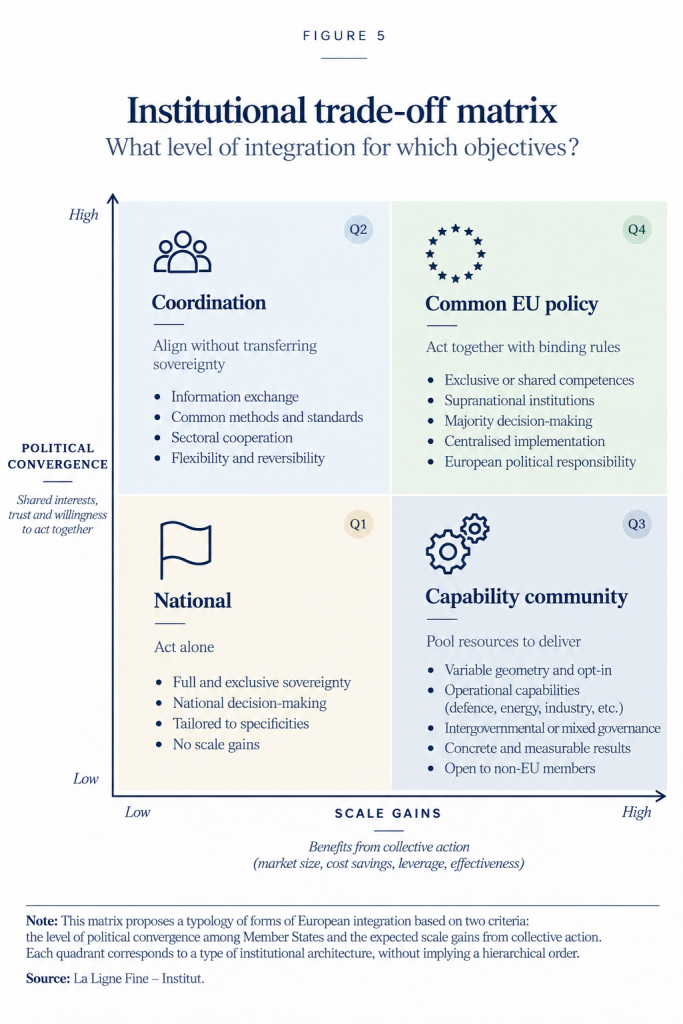
This logic can lead to very different conclusions depending on the policy. It may justify much stronger integration in defence or innovation financing, while supporting greater diversity in other areas where economies of scale are limited or national preferences are durably incompatible.
4.7. The Post-Europeanist Paradox: More Europe Where Europe Actually Produces Sovereignty
Here one of the most important paradoxes of the argument appears. Post-Europeanism may lead to more integration than the current model in certain sectors precisely because it refuses to make integration a uniform finality.
This paradox distinguishes the concept from classical sovereignism. If sovereignty is understood as the capacity to control one’s choices, the collective exercise of certain functions can increase effective sovereignty. States unable separately to finance a major industrial programme or secure strategic infrastructure can become more autonomous by pooling their means.
The same reasoning distinguishes the approach from automatic federalism. Pooling does not have to be general in order to be deep. Very advanced integration can be envisaged in a limited set of policies without implying the creation of a European federal state competent across all fields.
This perspective therefore reverses the traditional debate. The question is no longer whether a policy should be ‘national’ or ‘European’ according to a prior doctrine of sovereignty. It is which configuration best maximises capacity, legitimacy and autonomy simultaneously.
Post-Europeanism therefore does not mean the end of integration. It means the end of integration as a sufficient measure of European progress. The Union’s success should no longer be assessed primarily by the quantitative expansion of its competences, but by its ability to transform European resources into power to act. This implies a new hierarchy: integration becomes the means, capacity the criterion, and effective sovereignty the purpose.
This reformulation leads directly to the institutional question. If not all states wish to exercise the same competences jointly, while some fields nevertheless require much deeper pooling, how can this diversity be organised legally without undoing the unity of the Union? The hypothesis of a Sovereign-Geometry Union is intended to answer this question.
V. The Sovereign-Geometry Union: Organising Differentiation Without Undoing the Union
If post-Europeanism designates the end of uniform integration as a presumed horizon, and if capacity becomes the principal criterion for arbitrating among levels of action, the institutional question becomes unavoidable. Can a Union composed of states that do not necessarily wish to participate to the same degree in every policy remain coherent enough to preserve its legal order, internal market and decision-making capacity? Can differentiation become something other than an accumulation of exceptions created over successive crises? Can it be organised as a durable political architecture without turning the Union into a mere optional cooperation area?
The hypothesis of a Sovereign-Geometry Union responds to this difficulty. The term designates neither a new organisation outside the present Union nor a Europe in which each state could freely select the obligations it prefers. It refers to an architecture in which a common political and legal foundation remains mandatory, while certain capacities can be exercised by differentiated groups of states according to their interests, means and willingness to commit, without universal participation necessarily being treated as the normal endpoint of the process.
The hypothesis therefore rests on a distinction between two dimensions that have long been partly conflated: unity of the European order and uniformity of integration. The first is indispensable to the Union’s existence; the second is not necessarily so. A political community can possess institutions, rules and common interests while accepting different degrees of participation in certain policies. The difficulty is determining how far this distinction can be taken without compromising the coherence of the whole.
The proposal is credible only if it starts from the system that actually exists. The European Union is already deeply differentiated. The question is therefore not whether variable geometry should be introduced into an otherwise uniform structure, but whether the forms of differentiation accumulated over several decades can be organised according to a more coherent political logic.
5.1. Differentiation Is Not an Anomaly of the Union: It Already Belongs to Its Functioning
The image of a Union in which all twenty-seven members exercise all the same competences in the same way does not correspond to institutional reality. European integration has long contained different regimes of participation: some linked to objective capacity criteria, some to political choices, and others to clauses negotiated during treaty reforms or enlargements.
The euro area provides the most structuring example. Since the introduction of the single currency, not all Union members have ever belonged simultaneously to monetary union. With Bulgaria’s entry on 1 January 2026, twenty-one states now use the euro, while several Union members remain outside it. This differentiation is distinctive because most Member States without a permanent opt-out are legally expected to adopt the euro once they meet the convergence criteria; the Treaty, however, establishes no mandatory timetable for doing so, allowing very different timelines in practice.[51][52]
Schengen has a different geography again. The free-movement area partly exceeds the Union’s institutional borders because it also includes non-member states, while its implementation has historically involved differentiated participation and special regimes. This configuration demonstrates that a highly integrated European policy can exist within a perimeter that does not coincide exactly with that of the Union.
Permanent Structured Cooperation in defence is another important precedent. Provided for by Article 42(6) of the Treaty on European Union and Protocol No 10, PESCO allows states with sufficient military capabilities and willing to accept more binding commitments to develop enhanced cooperation within the Union framework. In 2026, twenty-six Member States participate in this structure, which is based on legally binding commitments and joint capability-development projects. The logic is particularly close to the one envisaged here: not all Member States are required to reach the same degree of commitment simultaneously, but those wishing to deepen cooperation can do so within a European framework.[53]
The European Public Prosecutor’s Office provides a different but equally illuminating example. Created through enhanced cooperation, it investigates and prosecutes offences affecting the Union’s financial interests. In August 2026, twenty-five states participate, while Denmark and Ireland remain outside the mechanism. Here too, an institution with genuine supranational powers operates without universal participation.[54]
Finally, the general mechanism of enhanced cooperation provided for in Article 20 of the Treaty on European Union explicitly allows at least nine states to use Union institutions and competences to advance in certain fields when the objectives sought cannot be achieved within a reasonable period by the Union as a whole. Such cooperation must comply with the Treaties and Union law, remain open to other states and may not undermine the internal market or the competences, rights and obligations of non-participating states.[55]
These examples show that differentiation is neither a recent drift nor an anomaly that the Union must necessarily eliminate. It is already one of the instruments through which the Union reconciles the heterogeneity of its members with the pursuit of common policies. The Commission explicitly acknowledged this in its 2017 White Paper on the Future of Europe: among the five scenarios presented was one in which ‘those who want more do more’, allowing certain states to deepen cooperation in specific fields without waiting for the Union as a whole.[56]
The issue, therefore, is not whether the Union is already differentiated. It is. The real question is what political status that differentiation should receive.
Until now, European architecture has generally treated differentiation as a pragmatic adaptation to a particular difficulty. It accommodates a national exemption, allows some states to move faster, manages an enlargement or unlocks a policy blocked by unanimity. In most cases, it has not been elevated into a general principle of organisation. A Sovereign-Geometry Union precisely asks what would happen if this hierarchy were reversed: the common foundation would remain uniform, but differentiation would become a normal modality for certain strategic functions.
5.2. From a Multi-Speed Europe to Organised Non-Convergence
The theoretical break proposed here must be specified. A ‘multi-speed Europe’ can remain entirely integrationist in its finality. It assumes that all members follow the same route and differ only in pace. Some move faster, others have transitional periods, but the endpoint remains implicitly shared. This representation has long structured the interpretation of several forms of differentiation.
The Sovereign-Geometry Union begins from a more demanding hypothesis: there may be areas in which states are not ultimately destined to converge towards the same level of integration. The difference is no longer merely temporal; it becomes political. A state could participate durably in an advanced level of military integration without joining a fiscal union of equivalent intensity; another could choose to deepen monetary or budgetary integration while maintaining a distinct position in certain dimensions of defence. Such trajectories would not be interpreted as delays to be corrected, but as politically legitimate configurations provided that common obligations are respected.
The decisive formula is therefore durable differentiation without compulsory final convergence. This does not mean that every form of differentiation should become permanent. Some genuinely reflect differences in capacity and are intended to disappear. A state joining the Union may need a transitional period before applying certain policies; a candidate for the euro must meet economic and legal criteria before accession. Post-Europeanism does not artificially convert such temporary differences into constitutional choices. It simply recognises that some divergences among states arise not from the time needed for convergence, but from political preferences that may reasonably remain different.
The literature on differentiated integration helps capture this distinction. Schimmelfennig and Winzen show that differentiation can respond either to capacity problems, particularly in the context of enlargement, or to much more durable divergences over sovereignty and identity. In the first case, the gap tends to be transitional; in the second, it can acquire a constitutional dimension. The Sovereign-Geometry Union consists precisely in taking this second possibility seriously.[57]
This development would have a major consequence for the definition of European success. Even today, universal participation tends implicitly to be regarded as superior to differentiated participation: the more states a policy includes, the more accomplished it appears. A capacity-based approach would change that judgement. Cooperation involving twelve states but producing genuine industrial, military or technological capacity could be politically more significant than an agreement among twenty-seven limited to the lowest common denominator.
The proposal does not amount to systematically privileging smaller formats. A decision at twenty-seven remains preferable where substantive convergence is possible. Unity itself produces power: market size, regulatory weight, commercial capacity and political solidarity. Differentiation should therefore serve a precise purpose rather than become an institutional reflex. But where the requirement of universal participation durably reduces action to an insufficient level, more integrated cooperation among willing states should be treated as a normal component of the architecture.
This logic produces a different conception of unity. Unity would no longer necessarily consist in every policy being exercised identically by every member, but in the existence of a common framework capable of organising their differences. In other words, the objective would not be unity through uniformity, but an organised unity of difference.
This formulation must not, however, conceal the principal difficulty. Every political organisation requires a minimum of indivisibility. If every competence becomes negotiable, common law ceases to be common; if every obligation can be refused, integration degenerates into opportunistic cooperation. Sovereign geometry is therefore conceivable only if what cannot be differentiated is rigorously identified.
5.3. First Level: Defining the Indivisible Common Foundation
The hypothesis of a differentiated Union must begin not with flexibility, but with its limits. The more participation in policies varies, the more necessary it becomes to identify the elements without which Union membership would lose its substance. The issue is not merely legal; it is constitutional in the material sense. The task is to define the minimum conditions under which several differentiated configurations of integration can continue to belong to the same political community.
The internal market is clearly one such element. Its functioning requires sufficiently homogeneous common rules on free movement, competition, economic standards and legal recognition. Allowing states freely to select the constraints associated with the market while retaining full access to its benefits would quickly create distortions incompatible with its coherence. Differentiation must therefore distinguish strategic policies in which participation can vary from obligations that are functionally indispensable to the common economic space.
Respect for the European legal order is a second component that is difficult to divide. A differentiated Union could not function if each government were able unilaterally to determine which European decisions it considered applicable. Differentiation must be organised through law itself, not against it. This is already the principle of enhanced cooperation: participating states move further in a specific field, but the mechanism remains embedded in the Treaties and must respect the common acquis.
This requirement is particularly important because sovereignty can be interpreted in very different ways. Sovereign geometry cannot mean recognising a general right of unilateral derogation. Such an architecture would rapidly turn the Union into an unstable contractual system in which every decision became open to renegotiation. The sovereignty of participants is exercised in the choice to enter differentiated mechanisms, in their governance and in the procedures established to amend or, where appropriate, leave them; it cannot authorise disregard for rules to which they have validly consented.
The principles set out in Article 2 of the Treaty on European Union must also form part of the foundation: respect for human dignity, freedom, democracy, equality, the rule of law and human rights. Differentiation in policies cannot reasonably become differentiation in fundamental democratic requirements. Without this shared normative minimum, it becomes difficult to justify the mutual recognition on which much of the Union’s functioning rests.[58]
The foundation must also include the institutions necessary for the existence of the whole. The Commission, Council, European Council, Parliament, Court of Justice and other common bodies would not disappear in a sovereign-geometry system. On the contrary, their role in safeguarding overall coherence could become even more important precisely because the architecture would be more differentiated.
The exact content of this foundation cannot, however, be decreed in the abstract. It should be determined according to a functional principle: what is indivisible is that whose differentiation would compromise either the existence of the common political order or the functioning of capacities in which all members have chosen to participate.
This definition is more demanding than a simple list of policies. It requires interdependencies to be examined. Some fiscal rules, for example, may remain national; others may be necessary for the internal market or a common fiscal capacity to function. Some elements of migration policy may accommodate differing preferences, whereas certain obligations relating to external-border control become necessary for free movement to function. The boundary between foundation and differentiation cannot therefore be drawn once and for all; it must emerge from analysis of the systemic effects of each choice.
5.4. Second Level: Strategic Capacities with Differentiated Participation
Around this common foundation, a second level could develop consisting of policies in which some states accept much deeper commitments. Here the Sovereign-Geometry Union would genuinely differ from current practice: differentiated policies would no longer be merely devices for overcoming a temporary blockage, but permanent capacity communities with appropriate governance and resources.
Defence is probably the most obvious field. Some states could accept common commitments on procurement, industrial programming, stockpiles, command or financing that went significantly beyond the present Common Security and Defence Policy. PESCO already demonstrates that European law allows more binding commitments for willing states. Moving towards a genuine capacity community would, however, require much more substantial integration of decisions and resources.
Strategic industry would provide a second field. States wishing to develop joint capacities in semiconductors, artificial intelligence, space or critical infrastructure could establish multiannual programmes with common financing and specific governance rules. The principal criterion would not be a desire to create a general European industrial policy, but the identification of precise dependencies or scale deficits.
Energy could justify still more complex configurations because national choices differ profoundly. France, Germany, Poland and the Nordic countries have neither identical energy mixes nor the same preferences regarding nuclear power. Seeking complete uniformity could be politically pointless. Differentiated groups could instead develop common capacities in nuclear energy, grids, storage, hydrogen, interconnections or procurement where their interests converge.
A similar logic could apply to certain dimensions of taxation, investment financing or border protection. The list should not, however, become indefinitely expandable. Sovereign geometry has value only if differentiation corresponds to an identifiable gain in capacity. It must not become an institutional device for arbitrarily removing fields from common law.
Participation in these communities should also remain open. A state initially outside a capacity should be able to join when it meets the defined conditions and accepts the corresponding obligations. This principle already exists in enhanced cooperation and is an important safeguard against closed clubs. Differentiation should not create a permanent hierarchy among members, but enable several forms of commitment.
This openness distinguishes a Sovereign-Geometry Union from a directorate formed by a few major powers. Differentiated capacities should not be organised solely according to demographic or economic weight. Small states may possess technological, geographical or military assets of great importance in a particular field. A capacity-based architecture should therefore rest on contribution and commitment rather than on a predetermined hierarchy among members.
5.5. Third Level: Preserving a Legitimate Sphere of National Autonomy
The coherence of the model also depends on its ability to recognise that deeper integration is not necessary in every field. If every policy ultimately becomes absorbed into the common level or into a capacity community, sovereign geometry would amount to little more than another stage of centralisation. The proposal would then differ little in substance from a gradual federal strategy.
Some policies may remain primarily national when they meet at least two conditions: the capacity benefit of further integration is limited, and the diversity of political preferences is sufficiently pronounced that harmonisation would generate greater democratic cost than collective gain.
The difficulty is to avoid drawing up an ideological catalogue of such competences in advance. Taxation, social protection, education, culture or certain family policies are often associated with national sovereignty, yet each contains cross-border dimensions that may justify European coordination. Conversely, some policies now exercised largely at national level may become more effectively common as technologies or power relations evolve.
The principle must therefore remain analytical. The aim is not to protect a fixed list of national prerogatives forever, but to recognise that political diversity can be legitimate rather than merely an obstacle to be eliminated. The system must be able to tolerate that diversity when it compromises neither fundamental rights nor the functioning of the common foundation.
This recognition has an important democratic function. A Union that sought to manufacture political homogeneity where European societies remained deeply divergent would risk increasing contestation of the European level. Keeping some choices close to the political communities willing to assume their consequences can therefore contribute to the stability of the whole.
Such a conception of subsidiarity would be more political than the one usually invoked. It would ask not only whether the Union can technically act better, but whether the expected gain in capacity genuinely justifies uniformising political choices.
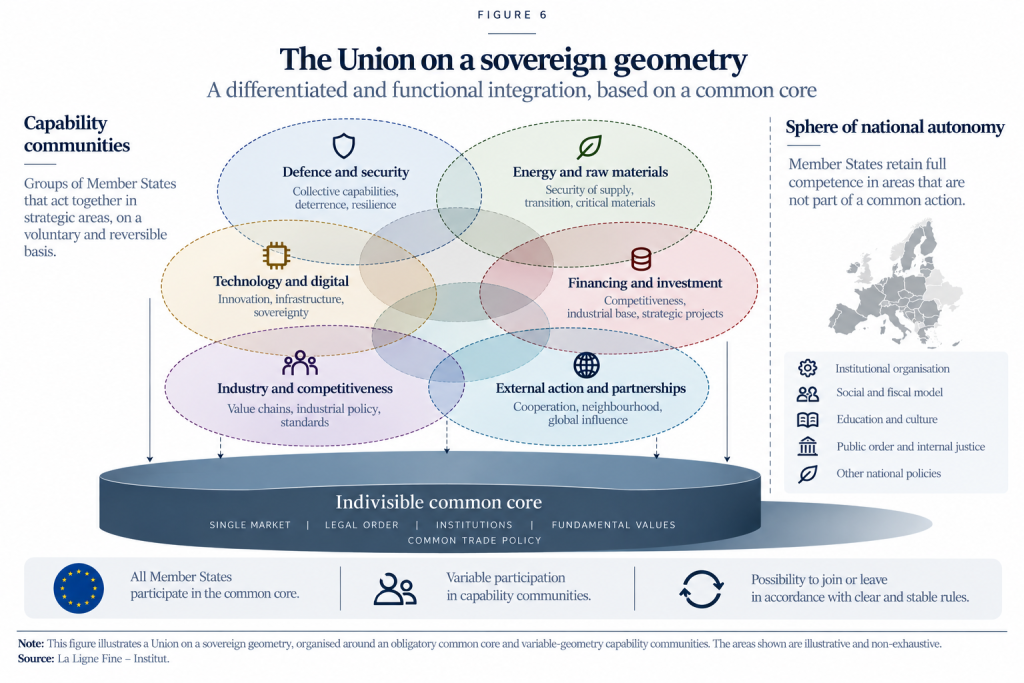
5.6. Governing a Differentiated Union: The Decisive Question of Decision-Making
The three-level architecture resolves nothing if it is not accompanied by a clear theory of decision-making. A Sovereign-Geometry Union could quickly become more complex than the Union is today if every policy had entirely separate rules, budgets and institutions. Differentiation must therefore not merely be authorised; it must be governable.
The first principle should be correspondence between participation and decision. States that accept obligations and finance a capacity must have the power to decide how it is used, within the limits set by common law. States outside the capacity should not be able to block a policy whose costs they refuse to bear; conversely, participants should not be able to impose direct financial consequences on non-participants for decisions to which the latter have not subscribed.
The principle appears obvious, but its application becomes complex where differentiated policies affect the market as a whole or involve common institutions. Decisions internal to a capacity must therefore be distinguished from decisions capable of affecting the common foundation. The former could be taken exclusively by participants; the latter should involve Union institutions and, depending on their scope, all Member States.
Voting rules are equally central. If a capacity community remains subject to unanimity, it risks reproducing the same difficulties as the Union at a smaller scale. The decision to join could require the explicit consent of the state, but day-to-day functioning should generally rely on majority rules defined in advance. Accepting a common capacity means accepting that every decision can no longer depend on a permanent national veto.
Financing should follow a similar logic. A strategic policy cannot depend indefinitely on improvised contributions. Participants should accept stable rules, potentially linked to national income, use of the capacity or multiannual financing commitments. Without budgetary predictability, pooling remains nominal.
Political responsibility is finally the most delicate issue. Who is accountable to citizens for a decision taken by a community of fifteen states, financed through a specific budget but implemented in part by the Commission or a European agency? An overly complex architecture could produce an even greater dilution of responsibility than that already attributed to the Union.
Institutional mechanisms should therefore be kept as simple as possible. Each capacity community does not necessarily need its own executive, parliament and court. Existing institutions could in part be used in differentiated formations, as already occurs in some fields. The objective should be to preserve a common institutional system as far as possible while modulating participation rights in certain decisions.
Sovereign geometry should be differentiated in commitments, not anarchic in institutions.
5.7. Democratic Legitimacy: Differentiating Capacities Without Fragmenting Accountability
The democratic question is probably the most difficult test for any differentiated architecture. Organising groups of states technically around common capacities would be relatively straightforward; determining before whom decisions at that level must be justified is much harder.
The European Parliament represents all Union citizens. If only some states participate in a policy, should all Members of the European Parliament vote on its financing or on decisions directly concerning participants alone? Conversely, creating separate parliamentary formations risks fragmenting the institution and producing different categories of representatives.
National parliaments raise the opposite difficulty. They possess strong democratic legitimacy within each state, particularly in taxation or defence, but a juxtaposition of national controls does not automatically create common accountability. A policy may be supported by fifteen parliaments separately without any forum existing in which its overall direction is genuinely debated.
No simple solution imposes itself. Several mechanisms could be combined: European Parliament scrutiny for dimensions involving the Union budget or common law; specific procedures for representatives of participating states where only their resources are committed; stronger scrutiny by national parliaments for decisions involving core sovereign functions; and an obligation for executives responsible for a capacity to present their objectives, results and expenditure regularly.
The general principle should be clear: the more autonomous power a common capacity exercises, the more it must be accompanied by identifiable political accountability.
This requirement once again distinguishes the Sovereign-Geometry Union from a simple multiplication of intergovernmental coalitions. The aim is not to shift decisions into less accountable informal formats, but to make common action possible while preserving the visibility of those who decide and bear the consequences.
Legitimacy does not, however, rest on procedures alone. It also depends on outcomes. A democratically impeccable institution that cannot produce the capacities for which it was created may lose political support; conversely, an efficient organisation without transparent accountability may generate lasting distrust. A post-Europeanist architecture must therefore seek to combine two forms of legitimacy that have sometimes been opposed in European debate: legitimacy through consent and legitimacy through capacity.
5.8. The Risk of a Multi-Class Europe
The first serious objection to a Sovereign-Geometry Union concerns the possibility of a durable hierarchy among states. If some participate simultaneously in the currency, defence, a fiscal capacity, strategic industry and foreign policy while others remain mainly members of the internal market and common legal order, the Union could gradually organise itself around a centre and a periphery.
This risk cannot be dismissed by declaration alone. Durable differentiation necessarily creates asymmetries of power. States that finance and direct more common policies may acquire greater influence over the overall direction of the system. Non-participants may face decisions taken without them that nevertheless have indirect consequences for their economies or security.
The literature on differentiated integration highlights precisely this risk of multi-level membership and the tensions it may create with equality among members.[59]
Several safeguards are therefore necessary. Access to differentiated capacities must remain open according to transparent criteria. The common foundation must guarantee fundamental legal equality among all Member States. Policies pursued by advanced groups must not become a means of indirectly changing internal-market rules without the participation of others. Common institutions must continue to protect the Union’s general interests.
Above all, one reality must be accepted: institutional equality does not already mean identical situations. States do not have the same population, economic power, military capabilities or participation in every policy. The issue is not to eliminate every asymmetry, but to determine whether it is sufficiently regulated not to become political subordination.
A legitimate sovereign geometry must therefore not create a first Europe and a second Europe. It must create several levels of engagement within the same political Europe.
5.9. The Risk of Cherry-Picking: Why Sovereign Geometry Cannot Become an À La Carte Europe
The second objection is probably the most intuitive. If states can choose their levels of participation, why would they not systematically select the benefits while leaving costly policies to others? Such a development would quickly dismantle the solidarities on which the Union rests.
A strict distinction must therefore be drawn between the choice to join a capacity and the choice to obey common rules.
The former can be differentiated. The latter cannot. A state might choose not to participate in an advanced common defence capacity where it is not legally required to do so; it could not, however, ignore the internal-market rules by which it remains bound. A participant in a differentiated industrial policy would have to accept the financial obligations, governance rules and control mechanisms associated with it. Flexibility concerns the scope of commitment, not its implementation.
This distinction is absolutely central. Without it, the model would indeed become an à la carte Europe and would probably lead to disintegration. With it, sovereign geometry resembles instead a system of complete institutional contracts: the decision to enter remains voluntary where the policy lies outside the common foundation, but membership creates precise and legally enforceable obligations.
Exit costs may even be necessary in policies involving long-term common investment. A state cannot reasonably participate in financing infrastructure for several years and then withdraw while leaving the remaining participants to bear all commitments already undertaken. Exercising sovereignty also implies responsibility for commitments freely accepted.
5.10.The Risk of Institutional Complexity
The third objection concerns legibility. The Union is already frequently criticised for the complexity of its procedures and the difficulty of identifying which level is responsible for a decision. Adding multiple circles of integration could make the system still harder to understand.
This risk is real. A differentiated architecture is relevant only if it simplifies politically what is currently blocked institutionally. If it produces dozens of special statuses and different rules in every sector, it may reduce capacity rather than increase it.
Sovereign geometry should therefore not be conceived as a system of fixed and exhaustive circles in which each state receives a permanent category. The metaphor of concentric circles is useful for representing several levels of engagement, but can be misleading if it suggests the existence of a single ‘core’ always composed of the same members.
A capacity-based logic points instead towards functional geometry. Groups may vary by field. The states most integrated in monetary affairs are not necessarily those wishing to go furthest in defence; those cooperating on energy may differ from those developing a common fiscal capacity. Geometry is therefore not a general hierarchy of states, but an overlay of sectoral configurations.
Such an architecture would be harder to represent graphically than a Europe of three circles, but it corresponds more closely to the reality of preferences. Above all, it avoids creating a permanent directorate of the same states.
Its legibility would depend on using common institutions, procedures and principles to the greatest possible extent. Diversity should concern substantive participation, not the constant reinvention of law.
5.11.Conditions for the Viability of a Sovereign-Geometry Union
Analysis of the risks clarifies what would distinguish a durable architecture from a simple multiplication of exemptions. At least six conditions appear necessary. First, there must be a legally uncontestable common foundation. Without it, differentiation becomes fragmentation.
Second, differentiation requires a capacity-based justification. Differentiated cooperation must respond to a problem that common action can address significantly better than separate action. Differentiation cannot serve as a general pretext for calling common policies into question.
Third, participants must bear responsibility. Those who decide must finance and assume the consequences of their choices. No group should be able systematically to transfer the costs of its policy to non-participants.
Fourth, the architecture must remain open. A capacity must be joinable by any member that meets the relevant criteria and accepts the obligations. Geometry must remain mobile.
Fifth, institutional compatibility is essential. Differentiated capacities should, as far as possible, use the Union’s legal order and institutions in order to avoid multiplying competing structures.
Sixth, there must be democratic legitimacy. Every deeper form of integration must be accompanied by mechanisms of scrutiny proportionate to the power actually exercised.
A seventh, more political condition must be added: differentiation must be acknowledged as an organisation of diversity, not used discreetly as a means of reaching a future uniformity that states have not accepted. Without transparency about finality, the model would reproduce precisely one of the ambiguities that post-Europeanism is intended to overcome.
The genuine break would therefore not lie in the use of entirely new mechanisms. Many of the instruments already exist. It would lie in the doctrine organising them. The Union would cease to treat differentiation as an anomaly tolerated while awaiting future convergence and would begin to use it as one of the principles for reconciling political unity, democratic diversity and the construction of capacities.
This hypothesis cannot, however, be evaluated solely through its institutional coherence. It must be tested against the transformations that will concretely shape the next European decade: new enlargements, strategic competition, technological dependencies, war on the continent, the role of the United States, China’s rise and domestic economic constraints. An architecture becomes relevant only if it enables the Union to respond to these realities more effectively.
The final part therefore subjects the Sovereign-Geometry Union to this prospective test: to what extent can organised differentiation make a Europe potentially enlarged to more than thirty states more governable and capable by 2035, and under what conditions might it instead accelerate fragmentation?
VI. Enlargement, Power and Governability: The European Union Facing the 2035 Horizon
The hypothesis of a Sovereign-Geometry Union cannot be assessed solely on the basis of its institutional coherence. It matters only if it provides a credible response to the transformations likely to determine the European Union’s development over the coming decade. Those transformations make the question of architecture more pressing than it was at the beginning of the 2010s. The Union must simultaneously prepare for new enlargements, strengthen economic and technological competitiveness, contribute more substantially to the continent’s security and preserve its decision-making capacity in an international system in which interdependence no longer neutralises power relations. These issues are not separate. They converge on a single question: how far can an organisation designed to bring an increasing number of states into the same legal order continue to deepen its policies uniformly without making the formation of a common political will more difficult?
It would be excessive to conclude that a Union of thirty or thirty-five members would necessarily become ungovernable. The history of European integration itself cautions against such institutional determinism. Successive enlargements have not prevented the adoption of major common policies, and qualified-majority voting already allows decisions to be taken in a large number of fields without the individual assent of every government. A larger membership therefore does not mechanically produce paralysis. It does, however, alter the structure of European compromise: more governments mean more economic configurations, sectoral interests, constitutional traditions and strategic perceptions to reconcile. This is particularly important in policies still subject to unanimity or touching the most sensitive dimensions of national sovereignty. The issue is therefore not arithmetic. It is the combination of widening the Union’s political perimeter with deepening policies that require high levels of trust, solidarity and strategic convergence if they are to function.
Enlargement is, in this respect, the first test of the future coherence of the European model. Since the Cold War, it has been one of the Union’s most effective instruments of transformative power. The integration of Central and Eastern European countries did more than enlarge the internal market; it helped anchor a significant part of the continent within a political order based on representative democracy, the rule of law, the market economy and institutional cooperation. Membership thus exercises a power of attraction that remains one of Europe’s principal geopolitical assets. The perspective now offered to Ukraine, Moldova and the Western Balkans extends this logic. In an environment shaped by Russia’s war against Ukraine and by competition over the political organisation of the European space, enlargement can no longer be analysed as a mere policy of neighbourhood administration; it is a strategic choice about Europe’s future political borders.
The European Council now explicitly links enlargement with internal reform. Its Strategic Agenda 2024-2029 describes enlargement both as a ‘geostrategic investment in peace, security, stability and prosperity’ and as a process that must be accompanied by the internal reforms necessary for the Union itself to function. This wording matters because it shifts part of the burden of adaptation. Historically, accession negotiations have mainly asked whether candidate states were capable of adopting the acquis communautaire and meeting the Union’s political, economic and legal criteria. The present sequence increasingly requires the reverse question: is the Union itself institutionally prepared to integrate several new members without weakening its decision-making capacity, budget or the coherence of its principal policies?[60]
This question is particularly sensitive in the Ukrainian case. Ukraine’s eventual accession would have a political and strategic significance of a different order from a primarily economic enlargement. It would bring into the Union a large state with a major agricultural sector, undergoing deep economic and institutional transformation, and whose security is directly connected to the future relationship between Russia and the European continent as a whole. The European Council continues to place support for Ukrainian sovereignty, the accession process and stronger European defence readiness within the same strategic environment. It would therefore be artificial to treat enlargement, budgetary policy, defence and institutional reform as separate questions: they are progressively becoming different dimensions of the same problem of European capacity.[61]
The budgetary difficulty illustrates this interdependence. Integrating new states whose income per capita remains below the Union average would necessarily alter the balance of cohesion policy and, in Ukraine’s case, of the Common Agricultural Policy. The issue is not simply the amount of transfers that would be required. It concerns the priorities of a European budget already facing growing demands in defence, industrial policy, energy transition, innovation and external support. Enlargement therefore forces the Union to choose among uses of common resources that were previously easier to compartmentalise. The more costly European strategic policies become, the less possible it is to treat institutional architecture and financing as two independent problems.
Enlargement also changes the geography of European preferences. The Union of the 1990s already contained major divergences, but the centre of gravity of its strategic concerns still lay largely in Western Europe. The enlargements of 2004 and 2007 profoundly transformed that configuration. Perceptions of Russia, the relationship with the United States, the role of NATO, energy policy and sensitivity to national sovereignty are now structured by markedly different historical experiences. Ukraine’s eventual entry would reinforce this eastward shift. This should not be taken to imply the existence of homogeneous geographical blocs: national positions are too complex to be reduced to an East-West opposition. Enlargement nevertheless objectively increases the diversity of historical experiences from which states define their interests.
This development directly affects the plausibility of uniform integration. The more members the Union has, the more likely it becomes that coalitions of states willing to move further will differ from one field to another. Countries with an especially acute perception of the military threat in the East may seek deeper defence cooperation; euro-area states may have specific interests in monetary and fiscal governance; other coalitions may form around nuclear power, energy interconnection, critical technologies or border protection. Enlargement therefore does not merely make unanimity more difficult. It increases the probability of a Europe structured by several maps of cooperation that do not perfectly overlap.
From this perspective, differentiated integration could become less a concession to heterogeneity than a means of preventing heterogeneity from blocking necessary capacities. This conclusion must nevertheless be handled with care. Differentiation can also become an instrument of hierarchy. If new members were durably confined to peripheral status while a group of older members controlled most monetary, fiscal, military and industrial capacities, the Union would move towards an architecture in which formal legal equality concealed structural political inequality. A Sovereign-Geometry Union would then cease to organise diversity and instead become a multi-class Europe.
The viability of differentiation therefore depends on a principle made still more important by enlargement: participation in a capacity should depend on accepted commitments and objective criteria specific to that capacity, not on how long a state has belonged to the Union or on membership of a predefined political core. This logic could produce unexpected configurations. A new state could remain in transition in some economic policies while rapidly becoming central to strategic cooperation in another field. The military and industrial experience acquired by Ukraine since 2022, for example, shows that a future member would not necessarily be merely a beneficiary of European defence capacity; it could also become one of its most significant contributors. A genuinely functional geometry must allow this kind of recomposition.
Enlargement therefore supports a first conclusion: the European problem of the 2030s will probably not be to choose between widening and deepening in the traditional sense. It will be to organise a Union in which enlargement of the common political foundation coexists with variable deepening of strategic capacities. Such an architecture cannot yet be taken for granted; it is precisely one of the hypotheses that must be compared with alternative trajectories.
6.1. A Transformation of the International System That Changes the Value of European Capacity
The second constraint is external. It arises from the development of an international system in which trade, technology, energy, infrastructure, sanctions and industrial policies are increasingly used as instruments of power. It would be excessive to describe this as a simple return to nineteenth-century geopolitics or a repetition of the Cold War. Contemporary economic interdependencies are far deeper, there are more actors and the boundaries between cooperation and rivalry remain porous. Yet the assumption that intensified exchange would progressively reduce the centrality of power relations has become much harder to sustain.
European institutions themselves have incorporated this transformation. The European Council’s Strategic Agenda 2024-2029 describes a global environment shaped by ‘strategic competition’, instability and attempts to challenge the rules-based international order; it directly connects European security with competitiveness, critical technologies, reduced strategic dependencies and defence capacity. The European Economic Security Strategy adopted in this new context starts from a comparable intuition: some interdependencies that increase prosperity can also create vulnerabilities when they involve technologies, infrastructure or supply chains capable of being used for coercion.[62][63]
This is not a break with the entire historical logic of European integration. Integration has precisely demonstrated that highly institutionalised interdependence can reduce incentives for confrontation among participants. But the Union’s capacity to transform relations among its members never meant that the international system outside it would evolve in the same way. Europe’s singularity may in fact lie in this asymmetry: Member States have extensively juridified their mutual relations while their external environment remains structured by actors capable of using trade, technology, energy and military force strategically.
This situation creates a particular problem for the Union because its power has historically developed most strongly in those areas where its institutional architecture is most integrated. The internal market and common commercial policy have given it considerable regulatory and negotiating capacity; the single currency has created a major international financial asset; competition law and European regulation shape the strategies of some of the world’s largest companies. By contrast, the fields in which power depends on rapidly concentrating resources, defining common vital interests or accepting strategic risk remain more fragmented.
The transformation of the international system is progressively reducing the possibility of compensating for this fragmentation through economic mass alone. The Draghi report on competitiveness starts precisely from the observation that several conditions which supported European development in previous decades have become less favourable: weaker productivity growth, high energy costs, major investment needs and intensified global technological competition. Europe still has substantial savings, human capital, infrastructure, companies and scientific capability; the issue is how these resources can be mobilised rapidly enough and at a scale sufficient to preserve an autonomous technological and industrial position.[64]
The question of European capacity should therefore be understood as a problem of conversion rather than one of an absolute lack of resources. The continent is not devoid of military means, but they remain divided among national structures, doctrines and fragmented industries. It does not lack savings, but its capital markets remain less integrated than those of the United States and struggle to channel sufficient financing towards some high-growth technology firms. It possesses an advanced scientific base, but encounters difficulty in transforming some innovations into globally significant industrial actors. It has a large energy market, but remains subject to very different national choices and varying external dependencies. The strategic challenge is therefore not artificially to replace twenty-seven national sovereignties with a single European sovereignty; it is to determine which fragments of capacity must be combined to generate a power to act that current dispersion does not provide.
The relationship with the United States illustrates this difficulty without being reducible to a simple opposition between dependence and autonomy. The transatlantic alliance remains structural to European security and NATO is the principal framework for the collective defence of an overwhelming majority of Member States. This relationship does not, however, imply a permanent identity of interests. The United States has its own industrial, technological, commercial and geopolitical priorities; its commitment in Europe necessarily depends on American political choices over which Europeans have no control. Strategic autonomy should therefore not be understood as a search for separation or equidistance between allies. It is more usefully defined as Europe’s capacity to possess the instruments necessary for transatlantic cooperation to be a choice rather than the consequence of a material inability to act otherwise.
China presents a different configuration. It is simultaneously a major economic partner, an industrial and technological competitor and, in some sectors, a source of dependencies whose excessive concentration the Union now seeks to reduce. The de-risking strategy adopted by European institutions reflects precisely a desire to avoid the two extremes of uncontrolled dependence and generalised decoupling. The aim is not to eliminate trade, but to ensure that alternatives exist when concentration in a supply chain or technology creates strategic vulnerability. A capable Europe is therefore not an autarkic Europe. It is a Europe capable of choosing its dependencies.
Russia, finally, places the question of capacity in its most immediate military dimension. The war in Ukraine has demonstrated the importance of ammunition stocks, production capacity, air-defence systems, intelligence and industrial depth in high-intensity warfare. It has also shown that Europe’s security cannot be dissociated from American capabilities, even though Europeans collectively possess an economic weight that should in theory allow them to assume a much greater share of their own defence. The contradiction is less that of a ‘weak’ Europe than of a Europe whose resources are not organised according to a sufficiently coherent logic of power.
Across these three relationships – with the United States, China and Russia – the same conclusion emerges: autonomy is not measured by the number of competences that remain legally national. It depends on the possibility of avoiding external decisions being imposed for lack of alternative means. This functional definition of sovereignty is essential if European debate is to escape two symmetrically inadequate positions: one that treats any pooling as a loss of sovereignty, and another that assumes any transfer of competence automatically increases collective power.
6.2. From Pacifying Interdependence to Vulnerable Interdependence
One of the most important intellectual transformations of recent years concerns the way Europe understands interdependence. For much of Community history, interdependence could be conceived as a political resource in itself. Bringing European economies closer together was intended precisely to raise the cost of confrontation and create sufficiently dense cross-cutting interests to stabilise relations among states. This logic has been extraordinarily effective within the Union.
The difficulty appears when this reasoning is projected onto the international system as a whole. Interdependence produces comparable pacifying effects only when actors possess sufficient confidence in the continuity of exchange and do not use dominant positions as instruments of coercion. Where a relationship is deeply asymmetric, one actor’s dependence can become another’s capacity for pressure. Henry Farrell and Abraham Newman conceptualised this reality through the notion of weaponized interdependence, showing how states occupying central positions in certain economic and financial networks can exploit those structures for strategic purposes.[65]
Recent European experience confirms the relevance of this reasoning. Dependence on Russian energy was not in itself the result of a single error or homogeneous European naivety; it reflected different economic, geographical and industrial choices across countries. The gradual break with that dependence after 2022 nevertheless showed how cost-based optimisation can become a vulnerability when political parameters change. REPowerEU responds directly to this new reading by seeking to diversify supplies, reduce consumption of Russian fossil fuels and accelerate the development of alternatives.[66]
The same reasoning applies to critical technologies, raw materials and certain industrial components. The objective is not to produce in Europe everything that is consumed there. Such a strategy would sacrifice some gains from specialisation without guaranteeing genuine autonomy. The task is rather to identify points of dependence whose interruption or political exploitation could prevent Europeans from exercising a choice considered essential.
This leads to a less absolute conception of sovereignty: managed dependence. In an open economy, autonomy does not mean the absence of interdependence, but the ability to prevent any particular dependency from becoming irreplaceable. Supplier diversification, stockpiles, minimum domestic capacities, industrial alliances and European pooling are different ways of reaching that objective.
The Sovereign-Geometry Union could find here a more substantive justification than the mere desire to circumvent institutional blockages. European states do not each need to possess every technology, industry and resource required for autonomy. Such duplication would be economically inefficient and, in many sectors, unrealistic. They can instead organise internal interdependence so that essential capacities are collectively available. Sovereignty then becomes less the self-sufficiency of each nation than collective control over the vulnerabilities on which their freedom of choice depends.
This conception does not eliminate the question of how such capacities are distributed. On the contrary, it makes it more politically important. If some states become the main European suppliers of a strategic technology or piece of equipment, external dependence must not simply be replaced by poorly regulated internal political dependence. Building common capacities therefore requires financing, governance, solidarity and access mechanisms robust enough for participating states to regard pooling as an increase in autonomy rather than as the transfer of dependence to another European partner.
The historical intuition of Community-building reappears here in a renewed form. In the 1950s, pooling coal and steel sought to transform the material resources of power into instruments of internal political interdependence. In twenty-first-century Europe, part of the challenge may consist in organising certain internal strategic interdependencies deeply enough to reduce collective vulnerability to the outside world. There is therefore a possible continuity between the original project and a Europe of Capabilities, though their immediate purposes are no longer identical. Early integration was designed above all to make intra-European war impossible; the construction of capacities is now intended to preserve the freedom of action of Europeans operating in an environment in which power has not disappeared.
6.3. Differentiation Produces Power Only When It Matches the Nature of the Capacity Sought
The discussion of sovereign geometry must nevertheless avoid the opposite error: assuming that differentiation is, by definition, more effective than action at twenty-seven. Some forms of European power depend precisely on the unity of all members. Commercial policy is the clearest case. The Commission’s bargaining capacity vis-à-vis a major power or trading partner derives from the size of the market it represents. Fragmenting that competence among groups of states would mechanically reduce each group’s negotiating power and could undermine the internal market itself. In this field, uniformity is not merely an institutional preference: it is a resource of power.
The same is true of part of competition policy and the rules necessary for the internal market. Their value derives from the existence of a single framework whose provisions companies cannot freely choose according to the territory in which they operate. Excessive differentiation would generate transaction costs, regulatory arbitrage and distortions that would directly weaken one of the Union’s principal economic assets.
Conversely, some capacities depend less on universal participation than on the depth of commitment. Defence provides the clearest example. Cooperation among twenty-seven states in which each retains the possibility of sharply limiting its commitments may produce less capacity than a smaller format in which participants accept common planning, multiannual financial commitments and genuine interoperability. The same logic may apply to extremely costly industrial investments or certain technological infrastructures.
Between these two categories lies a third set of policies in which unity of framework must be combined with differentiated capacities. Critical technologies are a good example. Market regulation, competition rules and certain economic-protection mechanisms benefit from remaining European, while not all states possess the same comparative advantages or the same willingness to invest in each value chain. A European semiconductor strategy therefore does not require twenty-seven countries to build identical factories; it requires national and European investment to be sufficiently coordinated for the continent as a whole to control the segments regarded as essential.
Sovereign geometry makes sense only on the basis of this distinction. It is not a doctrine of maximum differentiation, but a doctrine matching the political perimeter to the nature of the capacity sought. Where universality directly produces power, unity should be protected. Where depth of commitment is decisive, more limited participation may be preferable. Where both dimensions must be combined, the architecture should enable differentiated capacities within a common framework.
This framework also avoids one of the concept’s principal dangers: turning it into an ex post justification for every coalition of the willing. Cooperation among a few states is not necessarily effective simply because it is smaller. It may reproduce national rivalries, multiply duplication or exclude actors with important capabilities. Analysis must always begin again from the function sought, the resources required and the externalities produced.
Differentiation is therefore not the purpose of a Sovereign-Geometry Union. It is only an instrument. The purpose remains the production of greater political capacity under conditions compatible with the plurality of national wills.
6.4. Four Trajectories for the European Union by 2035
Prospective comparison helps situate the Sovereign-Geometry Union among the principal conceivable trajectories. The objective is neither to assign artificial numerical probabilities to each scenario nor to claim that the Union will follow a pure model. Political systems generally evolve through combinations of several logics. The exercise is instead to identify the principles that would organise each trajectory and the contradictions each would face. The federal trajectory: closing the gap between interdependence and capacity through political deepening.
The first scenario would be one of substantial federalisation. It would extend the diagnosis that part of Europe’s difficulties derives from the incompleteness of integration. Economic, monetary, energy and security interdependencies have become deep enough to require instruments of government comparable in nature to those available to federal states: larger fiscal resources, wider use of majority voting, a durable borrowing capacity, stronger defence coordination and a more direct ability to define a common foreign policy.
This trajectory has a coherence that should not be underestimated. One of the Union’s principal weaknesses lies precisely in the separation between highly integrated policies and decision-making mechanisms that remain partly dependent on coordination among governments. A more federal structure could reduce this asymmetry. The common currency would be backed by stronger fiscal instruments; industrial investment would have access to more substantial common resources; foreign policy could be less exposed to individual vetoes; and political responsibility for certain decisions might become more identifiable.
Federalism also offers a powerful strategic argument. Faced with actors whose decision-making centres can rapidly mobilise very large military, industrial and technological resources, European fragmentation is a disadvantage. Establishing a common political authority could, in theory, improve coherence of action and reduce the time required for negotiation among governments.
The main difficulty therefore does not lie in the functional rationality of this option. It lies in its political conditions. A federation is not simply a more efficient set of decision-making procedures; it requires a community capable of accepting that major decisions may be taken against the explicit preference of some of its constituent parts and nevertheless remain regarded as legitimate. Majority rule is politically ordinary within a state because opposition to a decision does not generally call membership of the community into question. At European level, this degree of political solidarity is not uniform.
This difficulty increases as the policies concerned approach core sovereign functions. A European majority may be readily accepted for internal-market regulation; it does not necessarily generate the same legitimacy in taxation, major fiscal transfers, defence choices or foreign policy. The federal obstacle is therefore not merely institutional. It lies in the relationship between common power and political consent.
Enlargement makes this equation more complex still. A Union of more than thirty members would probably need majority mechanisms and common resources even more, yet it would simultaneously bring together more diverse societies. The functional rationale for federalisation could therefore increase at the same time as its political difficulty. It would be imprudent to declare this trajectory impossible: crises can transform preferences rapidly and European history contains several institutional ruptures once regarded as improbable. Nothing, however, justifies treating federalisation today as the automatic continuation of existing trends.
The Confederal Trajectory: Restoring National Control at the Cost of More Limited Common Capacity
The second scenario would move in the opposite direction. In response to contestation of supranationality and the persistence of strong national political identities, states would rebalance the Union in favour of intergovernmental cooperation. Some competences might be returned or less strictly harmonised; the European Council and Council would acquire an even more central political role; unanimity would be preserved in sovereign fields; and the ability of supranational institutions to initiate policy or interpret law would be more clearly circumscribed.
Such a development would respond to a real problem of legitimacy. It would bring some decisions closer to the arenas in which democratic control remains most easily identifiable and allow governments to adapt certain policies more closely to national preferences. In fields where the gains from uniformity are limited, such flexibility could even improve effectiveness.
The difficulty appears as soon as this architecture is confronted with sectors in which individual European states possess insufficient capacity. The legal renationalisation of a competence creates neither a military industry nor digital autonomy nor commercial power comparable to that of the single market. In several fields, it could even reduce effective sovereignty by diminishing the critical mass available to states.
A deep confederalisation would therefore still have to preserve highly integrated common policies in those sectors where cooperation clearly produces capacity. At that point, it would already resemble a form of functional differentiation rather than a general return to the state. A Europe genuinely reduced to minimal cooperation among twenty-seven or more than thirty governments could preserve more formal sovereignty while collectively losing a significant share of its economic and strategic influence.
The principal risk of this trajectory is therefore to confuse legal control with freedom of action. It would respond to demands for national control, but could intensify European states’ dependence on actors operating at a larger scale. The ‘Europe of nations’ reaches its structural limit here: nations remain essential to legitimacy, but individually they do not necessarily possess all the capacities corresponding to the functions they wish to control.
The Fragmentation Trajectory: Preserving the Formal Architecture While Allowing Common Capacity to Erode. The third scenario would involve neither a federal decision nor an explicit confederal reform. It would correspond to a more discreet evolution in which institutions continued to function, the Treaties remained formally unchanged and the internal market survived, while the Union’s ability to define strategic orientations gradually declined.
It would be misleading to equate this scenario with collapse. Political organisations can retain their institutions for a long time while their relative influence declines. The Union would continue to adopt rules, administer funds, conclude trade agreements and organise interactions among its members. What would erode would be less its existence than its ability to shape the external conditions in which it operates.
Several mechanisms could produce this outcome: a proliferation of vetoes and exceptions, growing reliance on coalitions outside the European framework, widening industrial divergences driven by unequal fiscal capacities, prolonged technological dependencies, military underinvestment, or an inability to adapt the budget to new priorities. The Union would continue to exist, but the distinction between institutional integration and strategic power would become more visible.
This scenario is particularly important because it is probably the most difficult risk to identify politically. Spectacular disintegration would immediately provoke a reaction. A gradual loss of capacity, by contrast, can coexist with many indicators of normal functioning. Europe could remain one of the world’s largest markets while becoming less able to shape technological standards; maintain high military spending while becoming more dependent on American capabilities; possess large savings while underfinancing its strategic firms.
The principal danger for the Union would then be not disappearance, but a growing separation between institutional permanence and political capacity. It is this trajectory that gives the debate on the post-integration era its strongest justification: an organisation can be highly integrated and nevertheless lose relative power if accumulated integration is no longer converted into instruments suited to its environment.
The Sovereign-Geometry Trajectory: Differentiating Integration to Concentrate Capacity. The fourth scenario would consist in progressively accepting more structural differentiation. The Union’s legal and economic foundation would remain common, but some states could establish more advanced forms of integration in policies where their preferences and interests converge, without presuming that every member must ultimately join them. The Union would no longer be defined by an identical level of integration, but by the articulation between common political membership and several capacity communities.
The principal strength of this trajectory is that it corresponds to a tendency already present in the Union without immediately requiring a constitutional rupture comparable to the creation of a federation. The euro, Schengen, enhanced cooperation, PESCO and the European Public Prosecutor’s Office show that several perimeters can coexist within or around the same architecture. The novelty would therefore not lie in differentiation itself, but in its political status: it would cease to be systematically interpreted as an exception or a stage preceding convergence.
Such a development could facilitate enlargement by avoiding absolute identity of integration levels as a condition of political coherence. It could also allow sufficiently committed coalitions to develop strategic capacities without waiting for improbable unanimity. Above all, it would be compatible with the observation that national preferences are multidimensional: the states most ambitious in defence are not necessarily the same as those seeking to deepen fiscal or energy integration.
But the risks of this trajectory are considerable. Poorly regulated differentiation could create first- and second-class members, multiply institutional costs, fragment democratic accountability and gradually turn the internal market into a space of permanent negotiation. Advanced groups could become informal directorates dominated by the most powerful states; outside states could bear consequences of decisions in which they did not participate; and the boundary between legitimate differentiation and cherry-picking could become difficult to maintain.
A Sovereign-Geometry Union therefore cannot be regarded as superior by definition. It is rather the trajectory that attempts to respond simultaneously to the two constraints identified in this note: the persistence of national political communities that do not necessarily wish to converge towards the same institutional destination, and the growing inability of those same states to exercise separately certain dimensions of their effective sovereignty.
Its plausibility depends on strict conditions: protection of an indivisible common foundation; precise definition of fields open to differentiation; an obligation for participants to assume fully the financial and political responsibilities of their commitments; openness of capacities to states wishing to join; institutional safeguards for non-participants; and mechanisms of democratic control proportionate to the power exercised. Without these conditions, sovereign geometry would amount to no more than the fragmentation it claims to organise.
6.5. A More Plausible Trajectory Than a Certain Destination
Prospective analysis does not justify concluding that the European Union will necessarily evolve towards sovereign geometry. Nor are the four trajectories described mutually exclusive. The Union could simultaneously develop more federal elements in some policies, restore greater national latitude in others and rely more extensively on differentiated coalitions. European history even suggests that such hybridisation is more likely than a constitutional transformation entirely consistent with a single theoretical model.
The relevant question is therefore less the ‘victory’ of one scenario than the dominant logic that will structure future trade-offs. If every crisis continues to be interpreted as proof that further integration of all members is required, the integrationist paradigm will remain central. If the priority becomes the general return of competences to national level, a confederal dynamic will prevail. If no reform succeeds in adapting institutions to new constraints, the risk of functional fragmentation will increase. The post-Europeanist hypothesis is confirmed if Europeans begin to regard it as politically normal for certain capacities to be exercised at different levels without interpreting that diversity as a temporary failure of convergence.
Seen in this light, the Sovereign-Geometry Union appears less as a constitutional model to be established in a single act than as a possible rationalisation of trends already under way. Its interest lies precisely in the possibility of replacing an empirical accumulation of exceptions, opt-outs, enhanced cooperation and ad hoc coalitions with an explicit doctrine. The task would be to move from reluctant or pragmatic differentiation towards differentiation politically organised around a principle: pool a competence when collective exercise produces superior capacity, preserve unity when unity itself is a resource of power, and maintain national autonomy when harmonisation does not generate a gain large enough to justify its political cost.
This logic guarantees neither unity nor power. It nevertheless provides a more demanding criterion than the alternatives traditionally proposed. It requires us to stop treating the degree of integration as an end in itself and national sovereignty as a quantity that automatically decreases whenever a competence is exercised jointly. Instead, it directs attention to the political result achieved.
In this respect, the 2035 horizon is less a forecast deadline than an intellectual test. The Union will probably be more diverse, face a more demanding strategic environment and be required to finance capacities far more costly than those of previous decades. Under those conditions, the question structuring its evolution may no longer be whether it should become ‘more European’ or ‘less European’. It may be which forms of organisation allow Europeans to remain effectively in control of a sufficient share of their choices.
It is on this question, rather than on the abstract continuation of integration, that the transition towards a post-Europeanist order may ultimately turn.
General Conclusion: From Post-Europeanism to a Europe of Capabilities
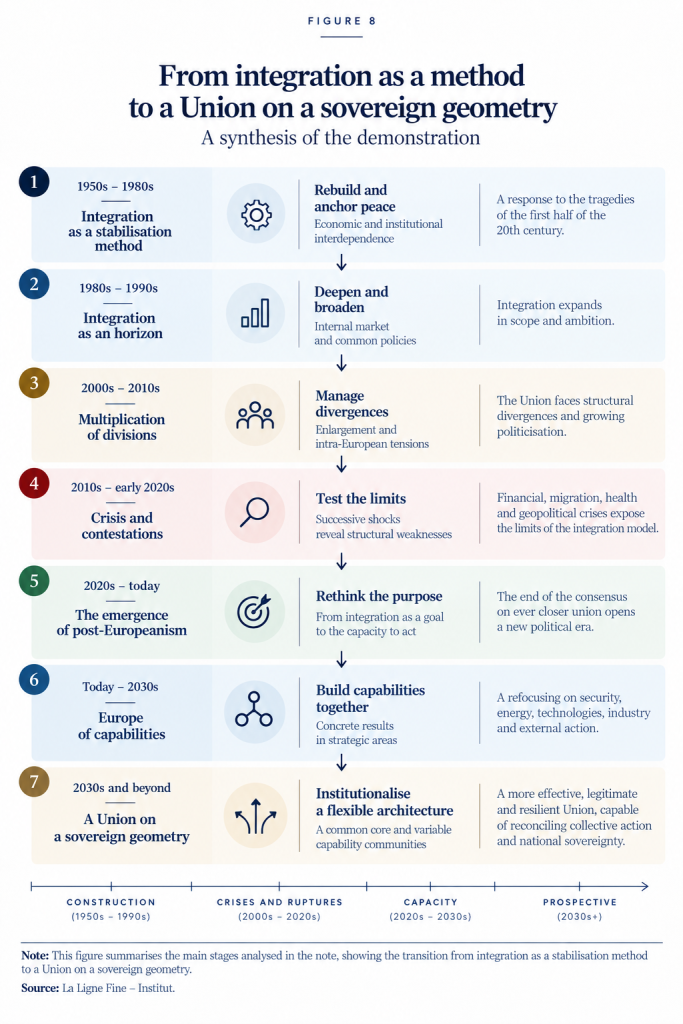
European integration has not entered a phase that can reasonably be described as its transcendence or disappearance. It remains the principal political, legal and economic framework through which European states organise their relations, negotiate part of their external interests and exercise several competences that could no longer easily be returned to the national level. The internal market, the single currency for a majority of Member States, the common commercial policy, the Schengen area, the European legal order and the coordination mechanisms developed through successive crises have created a degree of interdependence that makes a return to a simple juxtaposition of entirely autonomous sovereignties improbable. Post-Europeanism therefore cannot be understood as announcing an ‘after-Europe’. It designates a much more precise transformation: the gradual exhaustion of integration as a political horizon sufficiently consensual to order the Union’s future trajectory on its own.
This distinction matters because it allows European debate to move beyond an intellectually insufficient opposition. For several decades, controversies over the Union’s future were organised around the alternatives of deepening versus returning competences, federalisation versus national sovereignty, ‘more’ versus ‘less’ Europe. That opposition increasingly fails to describe actual European choices. The same government can today support much deeper military cooperation, defend common industrial policy, seek stronger European control of external borders and simultaneously reject further harmonisation in other fields. Such positions are not necessarily incoherent. They reflect the possibility that the relevant level of action varies according to the nature of the problem, the capacities sought and the degree of political convergence among the states concerned.
The history of integration itself counsels against the idea of a uniform trajectory. From the first Communities onward, European construction developed through a combination of supranational logic and intergovernmental bargaining. Neofunctionalism correctly identified the capacity of some integrated policies to generate spillover into other sectors; intergovernmentalism equally forcefully recalled that states never ceased to defend national preferences and accepted European commitments where those commitments secured benefits that could not be obtained as effectively separately. Postfunctionalist scholarship then showed how the extension and politicisation of integration progressively subjected this dynamic to the constraints of identity, electorates and partisan conflict.[67][68][69][70]
The contemporary change therefore does not lie in the belated discovery that nations resist. Nations never disappeared from European integration. It lies more in the growing difficulty of assuming that divergences among states are temporary deviations along a common trajectory. Currency, defence, taxation, energy, migration, technology and relations with major powers involve conceptions of sovereignty and national interests that are not guaranteed to converge at the same pace or towards the same destination. The more the Union enlarges and the more politically sensitive the functions it is called on to exercise become, the less this diversity can be treated as a mere imperfection that time or economic integration will necessarily erase.
It is at this level that the concept of post-Europeanism acquires its analytical reach. It does not designate a party family and is not another name for Euroscepticism. It designates the phase in which integration itself becomes an object of political choice and must be justified by the results it makes possible. Under this configuration, a new European competence no longer necessarily constitutes progress merely because it is exercised at a more integrated level; conversely, retaining a competence nationally no more guarantees real sovereignty if the state holding it lacks the material means to exercise it autonomously. The criterion of judgement must therefore shift.
This shift leads to the central proposition of the note: the contemporary European problem concerns less the level of integration than the political capacity produced by that integration. Capacity must be understood broadly. It presupposes legal authority to decide, but also the economic, industrial, technological or military resources required to translate decision into effect, sufficient autonomy from external actors, and political will capable of accepting the costs of action. Effective sovereignty is therefore neither synonymous with national competence nor with European transfer; it depends on the articulation of competence, means, autonomy and will.
The strategic environment makes this reformulation particularly necessary. European institutions themselves have progressively adopted a vocabulary giving greater prominence to economic security, critical dependencies, competitiveness, defence and sovereignty in strategic sectors. The European Council’s Strategic Agenda 2024-2029 explicitly links the Union’s prosperity and security to its capacity to reduce certain dependencies, strengthen its industrial base, develop critical technologies and assume greater responsibility for defence. The Draghi report frames the problem in similar terms by identifying fragmented investment, slowing productivity, energy costs and lagging performance in several technologies as constraints on Europe’s ability to preserve its economic model and autonomy under intensified global competition.[71][72]
This new environment does not render the Community acquis obsolete. It reveals instead the incompleteness of the transformation it produced. Europe has been remarkably successful at institutionalising power relations among its members; it has not yet developed an equivalent capacity to organise power externally. It possesses a continent-sized market, an international currency, leading companies and research centres, abundant savings, significant defence industries and globally recognised regulatory power. Its problem lies less in a total absence of resources than in the difficulty of aggregating them and directing them towards common strategic objectives.
The principal risk of the coming years therefore does not necessarily lie in the Union’s collapse. A more discreet hypothesis deserves greater attention: a growing separation between institutional permanence and strategic capacity. The Union could continue to regulate a vast market, adopt standards, administer funds and produce substantial law while becoming relatively less capable of shaping the technologies on which it depends, the security of its environment, industrial standards or major geopolitical choices. Such a development would be entirely compatible with the survival of all its institutions. It would nevertheless amount to a form of relative decline.
A capacity-based approach does not, however, support general centralisation. Some of Europe’s principal assets derive their power precisely from the unity of the common framework. Commercial policy would lose much of its weight if fragmented among several groups of states. The internal market cannot function durably if its fundamental rules become optional. The primacy and effectiveness of European law in fields conferred on the Union are conditions of trust and mutual recognition among members. Any future reform must therefore begin with an essential distinction between what can be differentiated and what must remain indivisible.
It is within this space that the hypothesis of a Sovereign-Geometry Union is situated. It does not seek to transform the Union into a catalogue of policies in which each state participates at will. Such a logic would cause the Union to disappear as a coherent political order. It rests instead on the existence of a binding common foundation around which several degrees of engagement could be organised in fields where unanimity among twenty-seven – and potentially more in the future – is neither indispensable to the functioning of the system nor sufficient to produce the capacity sought.
The idea is not alien to European institutional history. The euro area, Schengen, enhanced cooperation, Permanent Structured Cooperation in defence and the European Public Prosecutor’s Office have already produced several geographies of integration. Article 20 of the Treaty on European Union legally organises the possibility for at least nine states to deepen cooperation under certain conditions without immediately imposing that integration on other members. The Commission itself envisaged in 2017 a scenario in which states wishing to ‘do more’ could deepen certain policies together.[73][74]
The proposed innovation therefore does not lie in discovering differentiation. It lies in the political status that would be accorded to it. Until now, much differentiated integration has been conceived either as a transitional mechanism, a negotiated exception or a practical solution to the impossibility of moving forward immediately at twenty-seven. A Sovereign-Geometry Union would require accepting that some differences may be durable without the states concerned necessarily being regarded as committed to compulsory final convergence. This would mark the passage from a multi-speed Europe, whose destination remains implicitly identical, to a Europe of functional geometries in which the depth of integration would legitimately vary according to the capacities sought.
Such an architecture carries risks serious enough to prevent it from being presented as an obvious solution. Insufficiently regulated differentiation could increase institutional complexity, create a hierarchy among members, strengthen the relative power of large states or enable opportunistic selection of the Union’s benefits. Scholarship on differentiated integration rightly underlines that generalising differentiation can affect political unity, solidarity and equality among members if it is not accompanied by corrective mechanisms. The concept of a Sovereign-Geometry Union must therefore be treated as a hypothesis subject to conditions, not as the necessary culmination of European history.[75]
Enlargement nevertheless makes this hypothesis increasingly difficult to exclude from debate. The European Council now explicitly links future enlargements to the need to reform the Union itself. A Europe including Ukraine, Moldova and several Western Balkan states would be more significant geopolitically but also more heterogeneous. Requiring this entire configuration to achieve uniform institutional convergence in every policy could reduce common capacity for action precisely as external constraints increase. Conversely, turning new members into a permanent periphery around a more integrated Western core would undermine the legitimacy of enlargement and the Union’s political equality. Functional differentiation that is open and reversible in terms of participation can offer an intermediate path, provided that the same access rules apply to old and new Member States alike.[76]
The European question of the next historical cycle could therefore be formulated differently from previous decades. The issue would no longer be whether states should progressively surrender sovereignty to a single European sovereignty, nor whether they should instead recover full control over competences already pooled. It would be to determine in which configurations the collective exercise of a competence genuinely increases Europeans’ capacity to choose and act.
This requires treating integration as an instrument rather than as a strategy in itself. A more integrated European policy may be desirable where it provides critical mass that states no longer possess separately; it may be useless if it adds only another layer of decision-making; it may even be counterproductive where preference diversity is so great that the required uniformity destroys more legitimacy than it creates capacity. Symmetrically, national sovereignty may be indispensable where it corresponds to the most legitimate locus of political responsibility, but insufficient where the scale of required resources clearly exceeds that of the state.
Post-Europeanism therefore leads less to choosing between nation and Europe than to abandoning the idea that this opposition can still structure the debate on its own. The nation remains an essential space of democracy, solidarity and responsibility. The Union remains an indispensable space of law, interdependence and potential power. The strategic question is how to organise their relationship according to the functions that must be performed.
From this perspective, the Sovereign-Geometry Union is an attempt to turn plurality from a temporary weakness into a political architecture. Its promise would be an organised unity of difference: the same European framework, non-negotiable common obligations and, around that framework, more integrated capacities for states willing to accept the corresponding responsibilities. Its risk would be to turn diversity into fragmentation if limits, safeguards and responsibilities were not defined with sufficient rigour.
The choice cannot therefore be reduced to an opposition between federation and disintegration. Between the two lies a political space that remains imperfectly organised but is already visible in Union practice. The real issue of the coming years will be whether this space remains an accumulation of exceptions or becomes coherent enough to provide an enlarged Europe with a doctrine of governability.
Under this interpretation, the post-Europeanist transition would mean neither less Europe nor more Europe as a matter of principle. It would mean a Europe in which the degree of integration is subordinated to the political capacity sought.
In that sense, the proposal can be summarised in a formula that does not claim to constitute an exhaustive theory of the Union but provides a criterion for arbitration: the success of European integration should no longer be assessed only by the number of competences transferred or the degree of institutional uniformity achieved, but by the political capacity obtained in return.
Strategic Recommendations
Such an evolution cannot result from a single constitutional act. Given current divergences among Member States and the complexity of a general treaty revision, the most credible hypothesis is progressive transformation, beginning with doctrinal clarification and more coherent use of instruments already available before considering, where experience requires it, their legal consolidation. The priority should therefore not be immediately to proclaim a new European model, but to create the conditions for testing whether a more systematic organisation of differentiation actually improves collective capacity.
1. Politically Define the Foundation That Cannot Be Differentiated
The first step towards sovereign geometry should not be to identify fields from which states might exempt themselves from common action. It should be positively to define what makes the Union indivisible. The internal market, effectiveness of law in conferred competences, the principles of Article 2 of the Treaty, common institutions and the obligations necessary for fair competition are the first elements of this foundation. Other policies can also be regarded as structurally common where fragmentation would directly reduce their capacity, notably commercial policy.
The objective is not immediately to produce a new constitutional catalogue, but to establish a principle: flexibility may concern only what does not compromise the functioning of the common political space. Such clarification would distinguish differentiated integration from cherry-picking and answer one of the strongest objections to a more flexible Europe.
2. Assess European Policies According to Their Contribution to Capacity
The second reform is methodological above all. Before any major new proposal for integration, institutions and states should be able to answer a series of simple questions: what incapacity is European action intended to correct? What critical mass does it require? Must all states participate for the action to be effective? Would more limited participation accompanied by deeper commitments produce greater capacity? What effects would result for non-participants and for the internal market?
This logic would extend the principle of subsidiarity without being reduced to it. The issue would no longer be merely whether objectives can be better achieved at European level, but to compare explicitly several possible perimeters of action. In an increasingly heterogeneous Union, the relevant choice is not always between the national level and the Union as a whole; it may also lie in closer European cooperation among some members.
3. Identify a Limited Number of Priority Strategic Capabilities
Differentiation should not become a general doctrine applied simultaneously to every policy. Initial experimentation should instead focus on a limited number of fields where the capacity deficit and the benefits of scale are sufficiently established. Defence and its industrial base, certain critical technologies, strategic infrastructure, energy and innovation financing are the principal candidates.
The final choice should depend on more precise economic and strategic analysis. But the principle is clear: a few European capacities with real resources, objectives and responsibilities are preferable to a proliferation of mechanisms whose political ambition exceeds the means available.
4. Turn Enhanced Cooperation into a Genuine Instrument of Capacity
Article 20 TEU already provides a basis enabling at least nine states to move forward where a solution applicable to the Union as a whole cannot be obtained within a reasonable period. Yet this instrument remains relatively underused compared with the possibilities it offers.
A review should therefore examine the political and procedural obstacles limiting its use, the possibility of attaching specific financing to it more easily, and the conditions under which common institutions could support cooperation with a genuine strategic dimension. The objective would not be to bypass non-participating states, but to prevent their lack of interest in a particular policy either from forcing them to participate or from preventing willing states from building a more ambitious capacity.
5. Systematically Link Differentiated Integration and Differentiated Responsibility
No deepening should be possible without corresponding responsibility. States deciding to enter a common capacity must accept its financial costs, control mechanisms and decision rules. Voluntary participation cannot mean that obligations remain voluntary once the commitment has been made.
This rule must also protect non-participants. A capacity community should not be able to impose direct budgetary charges on them or indirectly change rules belonging to the common foundation without their participation in the decision. The legitimacy of sovereign geometry will depend to a large extent on this correspondence between rights, costs and decision-making power.
6. Keep Capacity Communities Open
Differentiation must never take the form of a closed core. Any form of deeper cooperation should remain accessible to Member States wishing to join later and meeting the necessary criteria. This condition is especially important in view of future enlargements.
Sovereign geometry should allow a future member quickly to become central to a capacity in which it possesses a particular advantage or political will, without waiting for convergence across all other policies. Openness is therefore both a guarantee of equality and an instrument for adapting the Union.
7. Build Democratic Accountability at the Same Pace as Common Capacity
The more politically sensitive the functions exercised by cooperation, the less it can operate as a simple technical arrangement among executives. Defence, financial resources and large-scale industrial policies require identifiable democratic scrutiny.
It would not be desirable immediately to create a separate parliament for each geometry. Priority should instead be given to intelligent use of existing institutions: the European Parliament where Union competences and resources are mobilised; national parliaments where core sovereign prerogatives or substantial national contributions are engaged; and joint procedures where both levels are concerned. The principle should remain that the power to decide, the power to scrutinise and financial responsibility should, as far as possible, follow the same perimeter.
8. Make Internal Reform an Explicit Dimension of Enlargement
The Union cannot continue to treat enlargement solely as a process for transforming candidate states. The European Council already recognises the need to carry out internal reforms in parallel. This orientation should become more operational.[77]
Before each major new sequence of accessions, the Union should assess the consequences for its budget, decision-making mechanisms, common policies and the fields in which differentiated formats may become necessary. The objective is not artificially to slow enlargement, but to avoid a geopolitically relevant choice eventually degrading the governability of the whole.
9. Reject the Artificial Opposition Between European Autonomy and Alliances
A Europe of Capabilities should not be constructed as a policy of systematic distancing from the United States or NATO. The transatlantic relationship remains essential to the continent’s security. The strategic issue is different: an alliance is more balanced when its members possess a real capacity to assume their responsibilities.
Developing European capacities should therefore be presented as a means of strengthening European states’ ability to choose and contribute, not as a quest for absolute autonomy. This avoids a sterile opposition between Atlanticism and European sovereignty.
10. Gradually Change the Political Criterion of ‘European Progress’
The most important reform may also be the least institutional. European debate still often uses the degree of integration as an implicit measure of ambition: a more European policy is assumed to be more advanced, while a more national competence is treated as a regression. This framework prevents calm assessment of the relevance of different levels of action.
That criterion should gradually be replaced by a more functional question: which level of organisation gives Europeans the greatest capacity to decide and act compatible with their political consent?
This change abolishes none of the traditions of European debate. Federalists may conclude that much deeper integration is necessary in some fields; defenders of national sovereignty may demonstrate that the national level remains preferable in others. But both positions will have to meet the same requirement: establish what the proposed architecture actually enables Europeans to do.
It is probably under this condition that the Union can move beyond an institutional debate that has too often become self-referential. The decisive question is no longer how much Europe should be produced. It is what kind of Europe makes its members politically more capable.
[1] https://eur-lex.europa.eu/eli/treaty/teu_2016/2024-09-01
[2] European Council, 2024, https://www.consilium.europa.eu/fr/european-council/strategic-agenda-2024-2029/).
[3] Hoffmann, 1966, https://www.jstor.org/stable/20027004
[4] Hooghe & Marks, 2009, https://doi.org/10.1017/S0007123408000409
[5] European Commission, 2017, https://commission.europa.eu/publications/white-paper-future-europe_fr
[6] Schimmelfennig & Winzen, 2020, https://academic.oup.com/book/36955 ; https://academic.oup.com/book/36955/chapter-abstract/322249151
[7] European Commission, 2024, https://commission.europa.eu/topics/competitiveness/draghi-report_en
[8] European Council, 2024, https://www.consilium.europa.eu/fr/european-council/strategic-agenda-2024-2029/
[9] Schimmelfennig & Winzen, 2020, https://academic.oup.com/book/36955/chapter-abstract/322248412
[10] Haas, 1958/2004, The Uniting of Europe – European Parliament
[11] Hoffmann, 1966, Obstinate or Obsolete? – JSTOR
[12] Moravcsik, 1993, Preferences and Power in the European Community
[13] European Union, consolidated version of the Treaty on European Union, Article 1, EUR-Lex – Treaty on European Union
[14] European Council, 2024, Strategic Agenda 2024-2029
[15] European Commission, 2024, The Draghi report: The future of European competitiveness
[16] European Union, 1950, https://european-union.europa.eu/principles-countries-history/history-eu/1945-59/schuman-declaration-may-1950_fr
[17] European Coal and Steel Community, 1951, https://eur-lex.europa.eu/legal-content/FR/TXT/?uri=CELEX:11951K/TXT
[18] European Economic Community, 1957, https://eur-lex.europa.eu/legal-content/FR/TXT/?uri=CELEX:11957E/TXT
[19] Haas, 1958, https://www.europarl.europa.eu/100books/en/detail/38/the-uniting-of-europe-political-social-and-economical-forces-1950-1957
[20] Hoffmann, 1966, https://www.jstor.org/stable/20027004
[21] Moravcsik, 1993, https://doi.org/10.1111/j.1468-5965.1993.tb00477.x
[22] Hooghe & Marks, 2009, https://doi.org/10.1017/S0007123408000409
[23] European Union, 1992, https://eur-lex.europa.eu/legal-content/FR/TXT/?uri=CELEX:11992M/TXT
[24] European Union, 2007, https://eur-lex.europa.eu/legal-content/FR/TXT/?uri=CELEX:12007L/TXT
[25] European Stability Mechanism, https://www.esm.europa.eu/about-us/history
[26] European Central Bank, 2012, https://www.ecb.europa.eu/press/key/date/2012/html/sp120726.en.html
[27] Council of the European Union, 2015, https://eur-lex.europa.eu/legal-content/FR/TXT/?uri=CELEX:32015D1601
[28] Court of Justice of the European Union, 2020, https://curia.europa.eu/jcms/upload/docs/application/pdf/2020-04/cp200040fr.pdf
[29] European Commission, https://commission.europa.eu/strategy-and-policy/recovery-plan-europe_fr
[30][30] European Council, 2024, https://www.consilium.europa.eu/fr/european-council/strategic-agenda-2024-2029/
[31] Hooghe & Marks, 2009, A Postfunctionalist Theory of European Integration
[32] European Parliament, 2024, 2024 European election results
[33] Taggart & Szczerbiak, 2002, https://www.sussex.ac.uk/webteam/gateway/file.php?name=epern-working-paper-6.pdf&site=266
[34] European Union, Article 5 of the Treaty on European Union, https://eur-lex.europa.eu/eli/treaty/teu_2016/art_5/oj
[35] European Council, 2024, https://www.consilium.europa.eu/fr/european-council/strategic-agenda-2024-2029/
[36] European Commission, 2024, https://commission.europa.eu/topics/competitiveness/draghi-report_en
[37] Hooghe & Marks, 2009, https://doi.org/10.1017/S0007123408000409
[38] European Union, Article 20 of the Treaty on European Union, https://eur-lex.europa.eu/eli/treaty/teu_2016/art_20/oj
[39] Schimmelfennig & Winzen, 2020, https://academic.oup.com/book/36955
[40] Schimmelfennig & Winzen, 2020, https://academic.oup.com/book/36955/chapter-abstract/322248412
[41] European Union, Article 5 TEU, https://eur-lex.europa.eu/eli/treaty/teu_2016/art_5/oj
[42] European Commission, 2022, https://commission.europa.eu/strategy-and-policy/priorities-2019-2024/european-green-deal/repowereu-affordable-secure-and-sustainable-energy-europe_fr
[43] European Union, 2023, Regulation establishing a framework of measures for strengthening Europe’s semiconductor ecosystem, https://eur-lex.europa.eu/eli/reg/2023/1781/oj
[44] European Council, 2024, https://www.consilium.europa.eu/fr/european-council/strategic-agenda-2024-2029/
[45] European Commission, 2024, https://commission.europa.eu/topics/competitiveness/draghi-report_en
[46] Manners, 2002, https://doi.org/10.1111/1468-5965.00353
[47] Bradford, 2020, https://global.oup.com/academic/product/the-brussels-effect-9780190088583
[48] European Commission, 2023, https://commission.europa.eu/strategy-and-policy/priorities-2019-2024/stronger-europe-world/european-economic-security-strategy_en
[49] European Union, Article 20 TEU, https://eur-lex.europa.eu/eli/treaty/teu_2016/art_20/oj
[50] European Union, Article 42(6) and Protocol No 10 TEU, https://eur-lex.europa.eu/legal-content/FR/TXT/?uri=CELEX:12016M042
[51] European Central Bank, 2026, https://www.ecb.europa.eu/press/pr/date/2026/html/ecb.pr260101~c830245e42.en.html
[52] European Commission, https://economy-finance.ec.europa.eu/euro/enlargement-euro-area/who-can-join-and-when_en
[53] PESCO, https://www.pesco.europa.eu/about/
[54] European Public Prosecutor’s Office, https://www.eppo.europa.eu/about/members_en
[55] European Union, Article 20 TEU, https://eur-lex.europa.eu/eli/treaty/teu_2016/art_20/oj
[56] European Commission, 2017, https://commission.europa.eu/publications/white-paper-future-europe_en
[57] Schimmelfennig & Winzen, 2020, https://academic.oup.com/book/36955
[58] European Union, Article 2 TEU, https://eur-lex.europa.eu/eli/treaty/teu_2016/art_2/oj
[59] Schimmelfennig & Winzen, 2020, https://academic.oup.com/book/36955/chapter-abstract/322248412
[60] European Council, 2024, https://www.consilium.europa.eu/fr/european-council/strategic-agenda-2024-2029/
[61] European Council, 18 June 2026, https://www.consilium.europa.eu/en/press/press-releases/2026/06/18/european-council-conclusions-on-ukraine-and-on-european-defence-and-security/
[62] European Council, 2024, https://www.consilium.europa.eu/fr/european-council/strategic-agenda-2024-2029/
[63] European Commission, 2023, https://commission.europa.eu/strategy-and-policy/priorities-2019-2024/stronger-europe-world/european-economic-security-strategy_en
[64] European Commission, 2024, https://commission.europa.eu/topics/competitiveness/draghi-report_en
[65] Farrell & Newman, 2019, https://doi.org/10.1162/isec_a_00351
[66] European Commission, https://commission.europa.eu/strategy-and-policy/priorities-2019-2024/european-green-deal/repowereu-affordable-secure-and-sustainable-energy-europe_fr
[67] Haas, 1958, https://www.europarl.europa.eu/100books/en/detail/38/the-uniting-of-europe-political-social-and-economical-forces-1950-1957
[68] Hoffmann, 1966, https://www.jstor.org/stable/20027004
[69] Moravcsik, 1993, https://doi.org/10.1111/j.1468-5965.1993.tb00477.x
[70] Hooghe & Marks, 2009, https://doi.org/10.1017/S0007123408000409
[71] European Council, 2024, https://www.consilium.europa.eu/fr/european-council/strategic-agenda-2024-2029/
[72] European Commission, 2024, https://commission.europa.eu/topics/competitiveness/draghi-report_en
[73] European Union, Article 20 TEU, https://eur-lex.europa.eu/eli/treaty/teu_2016/art_20/oj
[74] European Commission, 2017, https://commission.europa.eu/publications/white-paper-future-europe_en
[75] Schimmelfennig & Winzen, 2020, https://academic.oup.com/book/36955
[76] European Council, 2024, https://www.consilium.europa.eu/fr/european-council/strategic-agenda-2024-2029/
[77] European Council, 2024, https://www.consilium.europa.eu/fr/european-council/strategic-agenda-2024-2029/