
Pôle thématique : RIDS – Relations internationales, Défense et Sécurité
Date de publication : 16 janvier 2026
February 24, 2022 marks a historic break for European security. By launching a full-scale invasion of Ukraine, Russia is putting an end to more than thirty years of strategic illusions about the sustainable pacification of the continent. For France, this shock acts as a brutal revelation: high-intensity inter-state warfare is no longer a legacy of the twentieth century, but a contemporary reality, likely to take hold over time. Since then, Paris has embarked on a profound transformation — sometimes belated, but now assumed — of its strategic posture, its military doctrine and its political discourse.
The return of war in Europe: a belated but decisive strategic shock
For a long time, France approached Russia through the prism of strategic dialogue and the management of peripheral crises. After the Cold War, Moscow was perceived less as a direct threat than as a difficult but unavoidable partner in a cooperative international order. This approach survives despite major warning signs: the war in Georgia in 2008, the annexation of Crimea in 2014, the militarization of the information and cyber space, Russian interventions in Syria and Africa.
The invasion of Ukraine in 2022 puts an end to this ambiguity. Emmanuel Macron then stated it bluntly: « war has returned to Europe ». This observation ushers in a paradigm shift. Russia is no longer just a disruptive actor, but an assumed revisionist power, ready to use armed force to reshape the European security order. The National Strategic Reviews (NSRs) of 2022 and 2025 recorded this evolution: Russia was gradually designated as the main and lasting threat to the security of France and the continent.
Doctrinal reorientation and accelerated rearmament
Faced with this rupture, the French response has been based on a massive rearmament and a doctrinal overhaul. The 2024–2030 Military Programming Law, with a budget of €413 billion, represents an unprecedented increase in the defence effort (+40%). This investment aims to fill vulnerabilities revealed by the war in Ukraine: insufficient ammunition stocks, gaps in ground-to-air defence, industrial dependencies, saturation of cyber capabilities.
But the most significant evolution is conceptual. The RNS 2025 explicitly introduces the idea of a « war-ready economy » and a « moral rearmament » of the Nation. It is no longer just a question of maintaining a complete army model, but of preparing the entire state—institutions, industry, society—for the possibility of a major conflict within the next decade. This shift reflects a consideration of the long term and systemic nature of the confrontation with Russia.
New fronts: cyber, information, influence
The Russian threat is not limited to the conventional military field. It unfolds in a hybrid space, where the boundaries between peace and war are deliberately blurred. Cyberattacks, influence operations, sabotage, energy pressure and information manipulation are now central instruments of Russian strategy.
France has adapted its response accordingly. The strengthening of the cybersecurity of critical infrastructures, the increase in counter-intelligence capabilities and the fight against information manipulation testify to a more global approach to security. The public attribution of cyber operations to Russian military intelligence — notably via the APT28 group — illustrates an assumed change: that of « naming and shaming », intended both to inform public opinion and to deter the adversary by exposing its methods.
A firmer discourse to prepare public opinion
This strategic adaptation has been accompanied by a significant hardening of the political discourse. Where diplomatic restraint previously dominated, the French authorities are now assuming more direct communication on the Russian threat. Presidential speeches, strategic documents and ministerial speeches converge towards the same objective: to prepare public opinion for a permanently degraded security environment.
This pedagogy of threats responds to a democratic imperative. The social acceptance of the defence effort — budgetary, industrial, sometimes human — cannot be achieved without a minimum of transparency. The growing reference to « resilience », « fortitude » or collective mobilization reflects the State’s desire to involve citizens in this new strategic phase, without giving in to alarmism.
Alliances and Europe: towards a strategic post-Europeanism
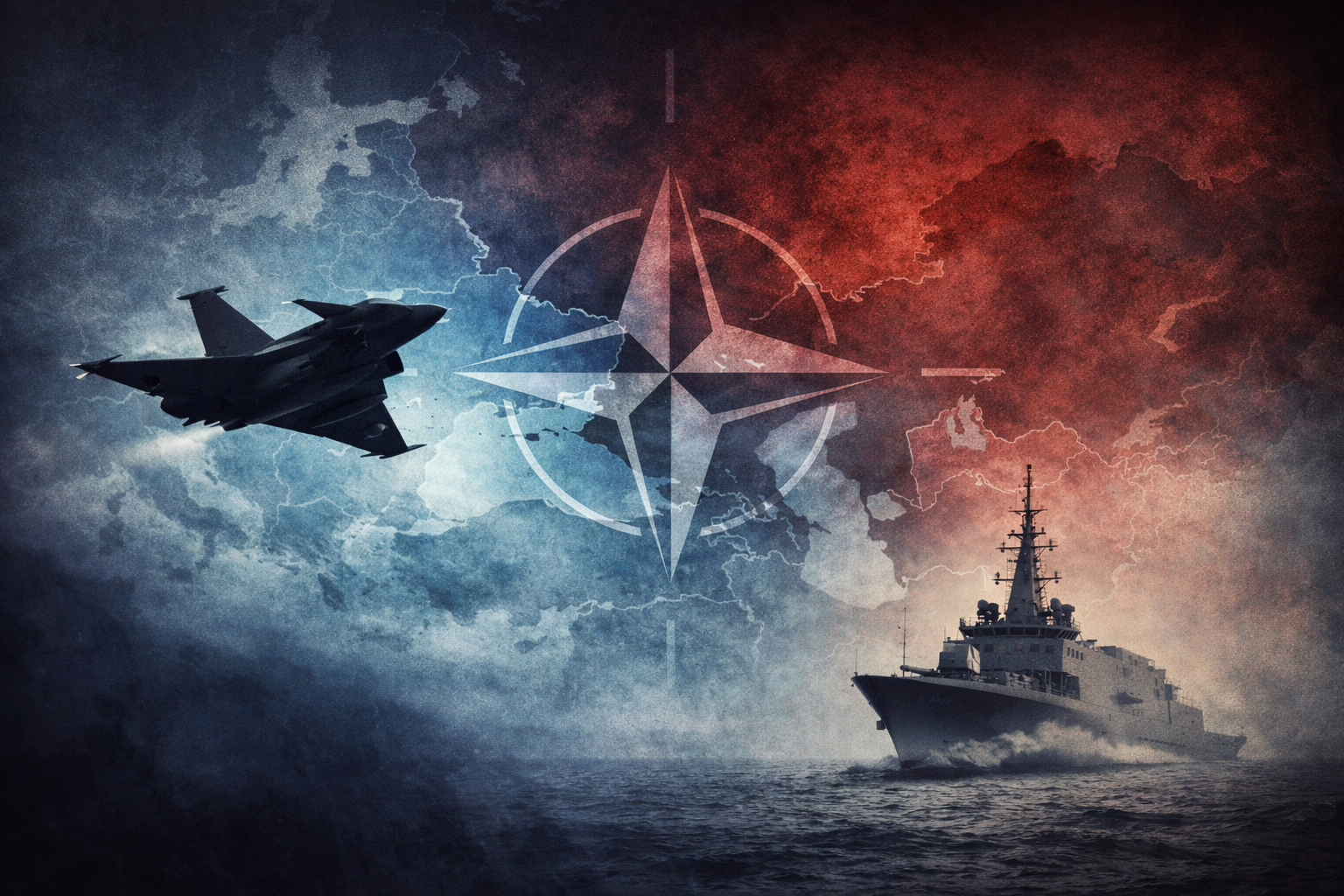
The war in Ukraine has also reshuffled the cards of European security. NATO, once considered to be losing relevance, is once again becoming central. The accession of Finland and Sweden marks an assumed return to the logic of collective deterrence in the face of Moscow.
In this context, what can be described as « post-Europeanism » is emerging: not a rejection of the European Union, but the recognition that the continent’s security is now built through coalitions of the willing, flexible formats and strengthened partnerships between states ready to take on strategic risk. France plays the role of architect, seeking to articulate national sovereignty, European cooperation and Atlantic anchoring.
Maintaining national cohesion over the long term
The real challenge of this transformation lies in its political and social sustainability. Faced with a patient adversary, capable of setting its strategy in the long term, France will have to maintain national unity without weakening its democratic balance. This presupposes a lasting consensus on the main defence orientations, beyond political alternations, but also clear, accessible and honest communication with citizens.
The success of this strategic shift will not be measured solely in military capabilities or voted budgets. It will depend on the ability of French society to understand, accept and support a prolonged security effort, without renouncing its values. It is at this price that France will be able to hold out in the long term in the face of a Russian threat that is now recognized as structural — and contribute, with its partners, to the future stability of the European continent.
The Fine Line – Institute
La Ligne Fine – Institut is an independent think tank dedicated to the analysis of security, defence and strategic sovereignty issues. It produces strategic notes, opinion pieces and analyses intended to inform public debate and strategic decision-making.