
The Forms of the Russian Threat: From Military Coercion to Invisible War
Thematic Cluster: RIDS – International Relations, Defence and Security
Published date: December 20, 2025
Since the outbreak of the war in Ukraine in February 2022, the perception of the Russian threat in Europe has changed profoundly. The open military aggression against a sovereign state has put an end to a long period of strategic ambiguities and revealed the coherence of a comprehensive coercive strategy, deployed by Russia well beyond the conventional battlefield alone.
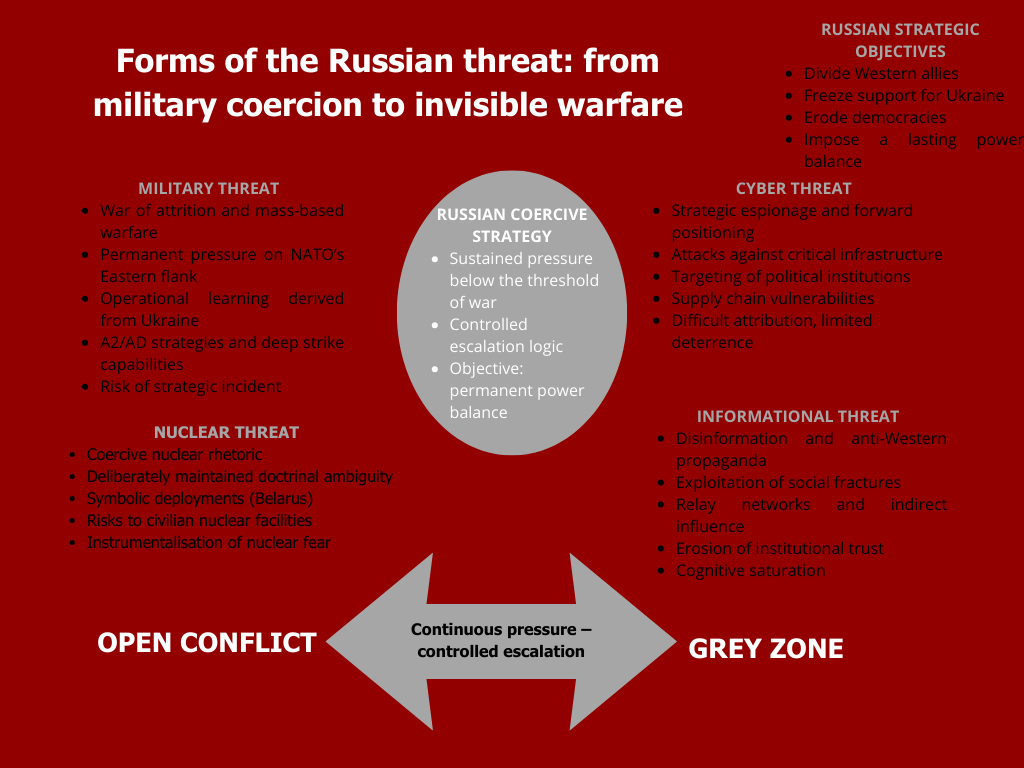
The diagram presented aims to make this reality clear: Russia is not only waging a military war, but a multidimensional war, combining armed coercion, hybrid actions, informational pressure and the instrumentalization of nuclear risk, in an assumed logic of lasting confrontation with Western democracies.
A structured and assumed coercive strategy
At the heart of the Russian system is a coercive strategy based on three constant principles:
- Lasting pressure below the threshold of war : Moscow favours actions that remain, as far as possible, below the formal threshold of direct armed conflict with NATO, in order to limit the risks of uncontrolled escalation while maintaining permanent tension.
- A controlled logic of escalation : Russia plays on the ambiguity, gradation and reversibility of its actions, in order to test the resilience of adversaries, exploit their divisions and maintain strategic initiative.
- The objective of a permanent balance of power : it is not just a question of winning one-off victories, but of imposing a lasting climate of instability, fear and doubt, favourable to Russian interests.
This strategy is part of a fluctuating grey area, located between formal peace and open conflict, and mobilizes several registers of threat simultaneously.
The military threat: force as the basis of coercion
The military threat remains the central pillar of the Russian system. The war in Ukraine has confirmed the return of a logic of attrition, based on mass, strategic depth and endurance, rather than on rapid and decisive operations.
Russia exerts permanent pressure on NATO’s eastern flank, through military deployments, large-scale exercises, violations of air and sea space, and aggressive postures near allied borders. The Ukrainian conflict is also an operational learning laboratory, allowing Moscow to adapt its doctrines, chains of command and industrial capabilities.
A2/AD (anti-access and area denial) strategies, depth strikes, and the proliferation of conventional and unconventional vectors increase the risk of a strategic incident, whether intentional or accidental, that could cause rapid escalation.
The cyber threat: a permanent and invisible front
The cyber threat is fully in line with this logic of coercion below the threshold of war. It combines strategic espionage, pre-positioning in adversarial networks and targeted attacks against critical infrastructure (energy, telecommunications, transport, health).
Political and administrative institutions are regularly targeted, as are supply chains, whose vulnerability is exploited to create cascading effects. The difficulty of attributing attacks and the relative weakness of deterrent mechanisms in cyberspace offer Moscow a privileged field of action.
This cyber dimension contributes to maintaining a diffuse, permanent insecurity, difficult to perceive by citizens but strategic in its effects.
The Informational Threat: The Weapon of Confusion
Information warfare is a central lever of Russian strategy. Through disinformation, anti-Western propaganda and the systematic exploitation of social fractures, Moscow seeks to erode trust in democratic institutions.
The use of relay networks, bots, indirect actors or instrumentalized media allows for low-cost, difficult-to-trace, and highly destabilizing influence. The objective is not necessarily to convince, but to saturate the cognitive space, to blur the points of reference and to make any strategic reading confusing or questionable.
This information saturation weakens social cohesion and complicates political decision-making, in times of crisis as well as in times of peace.
The nuclear threat: fear as a strategic tool
Finally, the nuclear threat, although generally indirect, plays a structuring role in Russia’s coercive posture. Repeated nuclear rhetoric, doctrinal ambiguity and symbolic deployments (particularly in Belarus) aim to instill fear and dissuade Western support for Ukraine.
The endangerment of civilian nuclear facilities, such as in Zaporizhzhia, is also part of this strategy of psychological pressure. It is less a question of an imminent use of nuclear weapons than of its permanent instrumentalization as a factor of strategic paralysis.
Grey zone and open conflict: a deliberately blurred border
All of these threats are part of a continuous dynamic ranging from the grey zone to open conflict. This porosity is deliberately maintained by Moscow in order to keep its opponents in uncertainty and to complicate collective responses.
Russian strategic objectives
Through this multidimensional strategy, Russia is pursuing clear objectives:
- Divide Western allies, exploiting their political, economic and societal differences;
- Freezing or weakening support for Ukraine, increasing the political and psychological cost of engagement;
- Erode democracies, undermining trust in institutions and decision-making processes;
- Impose a lasting balance of power, favourable to a redefinition of the European security order.
Conclusion
The Russian threat cannot be understood or dealt with in a sectoral way. It is global, scalable and deeply hybrid. The visual presented, and the present explanatory document, aim to provide a clear reading grid of this strategic reality, in order to feed the public debate, strengthen collective understanding and shed light on future security choices.
Understanding this threat is a prerequisite for responding effectively — militarily, politically, but also democratically.