

Series: Child Protection
Thematic cluster: ISS – Health, Society, Inclusion
Authors: Ismail BOUGHIOUL, Marine GOUAISBAUT, Maëlle AUBERT
Published Date: March 25, 2026
- Context and positioning
The 1970s were a pivotal period in the evolution of family law in France. Until this period, the legal organization of the family remained largely structured by the principles inherited from the Civil Code of 1804, based on the notion of paternal power. In this context, the father had preponderant legal authority over the children and the family organization, while the mother occupied a legally subordinate position.
From the end of the 1960s, several social and cultural transformations contributed to calling this model into question. The increase in women’s professional activity, the evolution of family structures, the rise of egalitarian demands as well as the social mobilizations of the late 1960s, in particular the events of May 1968, contributed to a redefinition of family relations.
These developments are gradually leading to a rethinking of family law and public policies. The family is no longer considered solely as a private sphere governed by a hierarchical authority, but as a relational space in which equality between parents, the protection of the child and the support of educational functions must be reconciled.
In this context, public action is moving towards a profound reform of family law and a transformation of child protection policies. The public authorities are seeking not only to redefine the relationships of authority within the family, but also to develop support and accompaniment systems for parents.
This evolution is also part of a broader movement towards the professionalization of social intervention. Psychologists, social workers and special educators are gradually occupying an increasing role in the analysis of family situations and in the implementation of public policies.
Thus, the 1970s and 1980s were a major moment of transition: the family gradually ceased to be considered as a totally autonomous private sphere and became an area in which public intervention could be justified in the name of child protection and support for parents.
This evolution is structured around several important stages:
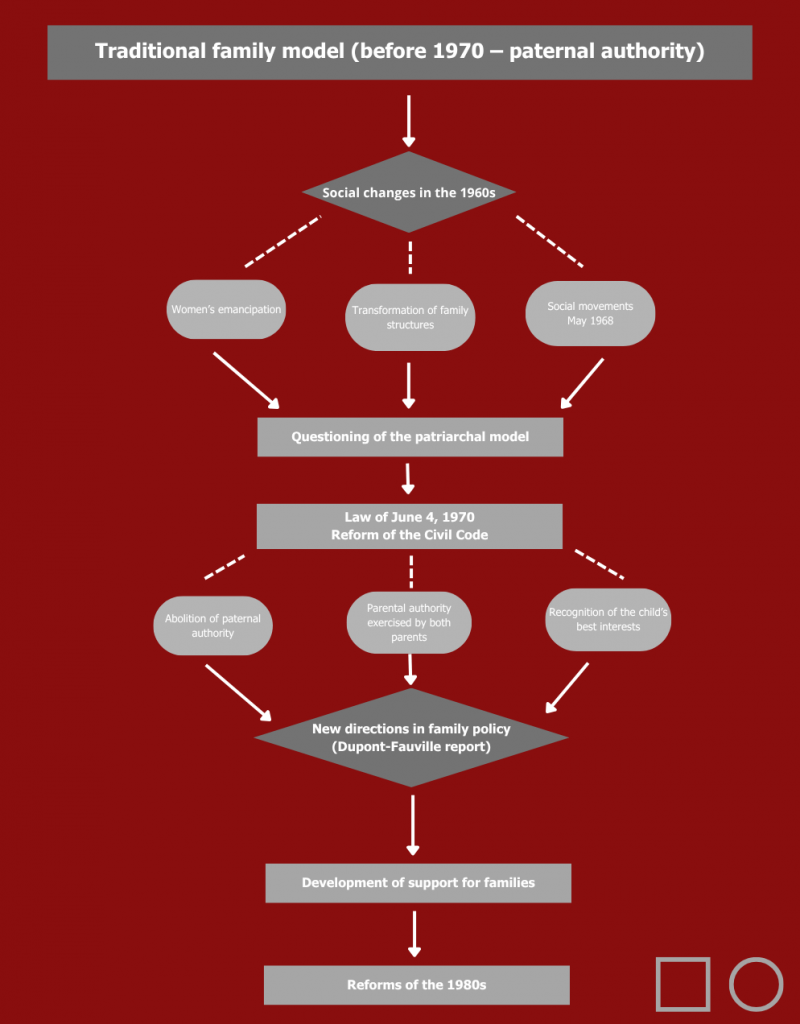
- the reform of the law on parental authority with the law of 4 June 1970;
- reflections on the adaptation of family policies, in particular through the Dupont-Fauville report;
- the legislative reforms of the 1980s aimed at consolidating co-parenting and strengthening the consideration of the child in family decisions.
- The transformation of family law: the law of 4 June 1970
The law of 4 June 1970 on parental authority was a major turning point in the history of family law in France. It marks the abandonment of the patriarchal model inherited from the Civil Code and introduces a profoundly renewed conception of the relationship between parents and children.
Until this reform, French law was based on the notion of paternal authority, which conferred on the father a dominant legal power in the family organization. This conception reflected a hierarchical vision of the family in which the father exercised almost exclusive authority over the children. The 1970 reform amended several provisions of the Civil Code, in particular articles 371 et seq., in order to replace paternal authority with the concept of parental authority.
The end of paternal power
The Act of 4 June 1970 legally abolished the concept of paternal authority and affirmed the principle of equality between parents in the exercise of educational responsibilities. From now on, parental authority is exercised jointly by the father and the mother. Important decisions concerning the child must be taken jointly, which reflects a profound transformation of the family model. This evolution marks an important break in the legal conception of authority within the family: it is no longer conceived as a hierarchical power exercised by the father, but as a shared responsibility between the two parents.
Affirmation of the child’s interests
The reform also enshrines the idea that parental authority must be exercised in the interest of the child. Article 371-1 of the Civil Code now defines parental authority as a set of rights and duties whose purpose is the interest of the child. This formulation marks a major evolution in family law: the child gradually becomes a subject of law whose needs and development must be taken into account.
This transformation is helping to shift legal attention. The family is no longer organized solely around the authority of the parents, but around the protection and development of the child.
- The Dupont-Fauville Report and the Evolution of Family Policies
The transformations of family law are also accompanied by a broader reflection on the evolution of public policies in the field of family and child protection. In this context, the Dupont-Fauville report is an important step in the reflection carried out by the public authorities on the adaptation of social policies to the transformations of society.
An analysis of changes in the family
The report highlights the profound transformations that family structures have undergone since the 1960s. Among the changes identified are the increase in divorces, the diversification of family forms and the evolution of parental roles.
These changes lead to questions about the adequacy of existing public policies. The report stresses the need to adapt social measures in order to better support families facing educational, economic or relational difficulties.
Recommendations to strengthen support for families
The report recommends the development of support and support systems for families, particularly those facing vulnerable situations.
In particular, it stresses the importance of strengthening social services, promoting the prevention of educational difficulties and supporting parents in the exercise of their responsibilities.
This orientation marks an important change in the conception of public intervention: the objective is no longer only to control or sanction problematic family situations, but also to prevent difficulties and to support parents in their educational role.
- The reforms of the 1980s: consolidation of co-parenting
The changes initiated in the 1970s continued during the 1980s with several reforms intended to strengthen the role of both parents in the child’s education and to adapt family law to social changes.
These reforms are part of a context marked by the increase in separations and divorces, which leads the public authorities to rethink the organization of parental authority after the breakdown of the couple.
The evolution of the law on parental authority
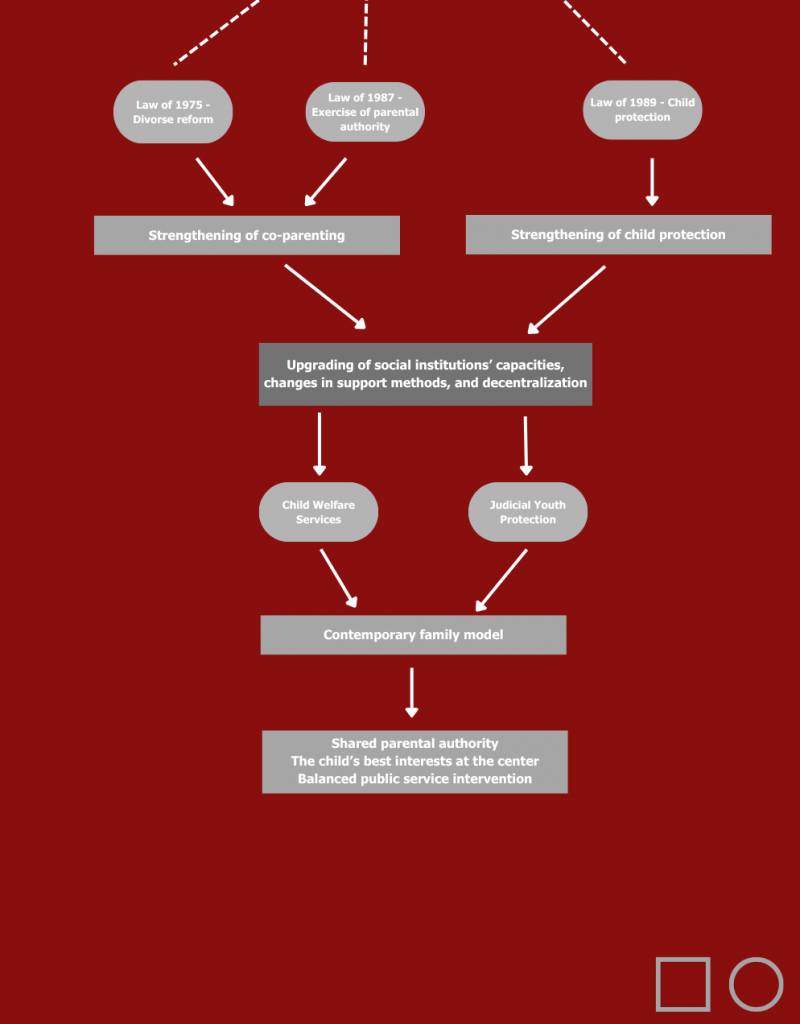
reforms consolidate the principle of co-parenting. The Act of 22 July 1987 on the exercise of parental authority states in particular that the separation of the parents must not jeopardize the relationship between the child and each of them.
This reform enshrines the principle that parents continue to exercise their child-rearing responsibilities jointly even after separation, unless the judge decides otherwise. This development contributes to strengthening the legal recognition of co-parenting and to maintaining the involvement of both parents in the child’s life.
Increased attention to the child’s situation
At the same time, the reforms of this period strengthen the consideration of the situation and needs of the child in judicial and administrative decisions. Child protection is gradually becoming a field structured by more complex public policies, mobilizing judicial institutions, social services and educational actors.
- The rise of child and social professionals
The legal and institutional transformations of the 1970s and 1980s were also accompanied by a significant change in the actors involved in child protection. The professions of social work and psychology are playing an increasingly important role in supporting families and assessing risk situations for children. Among the institutions concerned are:
- Child Welfare (ASE);
- the Judicial Protection of Youth (PJJ)
These institutions participate in the implementation of child protection policies that are based on both judicial intervention and social support for families.
This development reflects an expansion of the role of the State in the family sphere.
Public intervention is no longer limited to extreme situations of abuse, but extends to prevention and parenting support actions.
- A sustainable transformation of the family model
The turn of the 1970s and 1980s marked a profound transformation of the family model in France. Three major developments can be identified:
- the gradual disappearance of the patriarchal model based on paternal power;
- recognition of equality between parents in the exercise of parental authority;
- the affirmation of the interests of the child as a structuring principle of family law and public policies.
These transformations contribute to redefining the relationship between the family and public institutions. While the family remains a central space for socialization and education, it is also becoming an area in which the public authorities intervene to guarantee the protection of children and to support parents.
- An ambivalent evolution: between the empowerment of families and the growing intervention of the State
The reforms of the 1970s and 1980s reflected a structuring tension between two logics. On the one hand, they strengthen equality between parents and place the interests of the child at the centre of family decisions, which helps to recognise the autonomy and responsibility of families.
On the other hand, these developments are accompanied by an extension of public intervention. Judicial institutions, social services and child care professionals are playing an increasing role in the assessment of family situations and in the implementation of child protection policies.
This duality reflects the emergence of a regulatory model in which the State becomes both the guarantor of the protection of children and the accompaniment of parents, without replacing family authority. As François de Singly analyses, this period corresponds to the emergence of a relational family, based on negotiation and mutual recognition rather than on traditional hierarchical authority. For her part, Irène Théry emphasizes that developments in family law seek to reconcile family autonomy and child security, a balance that remains at the heart of contemporary policies.
- Conclusion
The reforms of the 1970s and 1980s profoundly transformed family law in France. The transition from paternal authority to shared parental authority marks the abandonment of the patriarchal model that has structured the Civil Code since the nineteenth century and enshrines the principle of equality between parents.
At the same time, the interests of the child are gradually becoming a central principle of family law and public policy, guiding both judicial decisions and social intervention mechanisms.
Finally, this period is characterized by a growing professionalization of child protection and an expansion of the role of public institutions in supporting families. These transformations have laid the foundations for the contemporary model of family policy and child protection, based on a balance between family autonomy, parental responsibility and public intervention to ensure the safety and development of children.
Appendices:
Appendix 1: Chronology of the main reforms of family law and child protection.
- 1970 – Law No. 70-643 of 4 June 1970 on parental authority
→Abolition of the notion of paternal authority in the Civil Code.
→ Establishment of parental authority exercised jointly by the father and the mother.
→ Affirmation of the principle that parental authority must be exercised in the best interests of the child.
- 1975 – Law of 11 July 1975 reforming divorce
→ Introduction of divorce by mutual consent.
→ Increased recognition of the role of both parents in decisions about children after separation.
- 1984 – Law of 22 July 1983 and Law of 7 January 1983 (decentralisation)
→ Transfer of important responsibilities in the field of child welfare to the departments.
→ Strengthening the role of local authorities in child protection policies.
- 1987 – Law No. 87-570 of 22 July 1987 on the exercise of parental authority
→ Affirmation of the principle of co-parenting.
→ Maintaining the link between the child and each of his or her parents after a separation, unless the judge decides otherwise.
- 1989 – Law of 10 July 1989 on the prevention of ill-treatment of minors
→ Strengthening of reporting and prevention systems.
→ Better coordination between judicial, social and educational institutions in child protection.
Appendix 2: Diagram of the evolution of the family model
Appendix 3: Excerpts from legal texts and reports
Civil Code – Article 371-1
» Parental authority is a set of rights and duties whose purpose is the interest of the child.
It belongs to the father and mother until the child reaches the age of majority or emancipation to protect him in his safety, health and morality, to ensure his education and to allow his development. »
Law of 4 June 1970 on parental authority
This Act amends the provisions of the Civil Code relating to paternal authority and introduces the concept of parental authority exercised jointly by both parents. It is a major step in the evolution of family law towards a more egalitarian model.
Dupont-Fauville Report (Ministry of Social Affairs, 1970s)
The report stresses the need to adapt family policies to social transformations and recommends in particular:
- the development of support systems for families;
- the strengthening of social services working with children;
- the implementation of actions to prevent educational and family difficulties.
Annex 4: Key Child Protection Actors
The professionals
Several categories of professionals are involved in supporting families and protecting children:
- psychologists
- social workers
- Special Educators
- Social workers
- Magistrates specialising in family affairs and child protection
Institutions
- Child welfare (ASE): Departmental service responsible for the administrative protection of minors in danger or at risk of danger. Its missions include:
- support for families in difficulty;
- measures for the placement of children;
- prevention and parenting support actions.
- Judicial Protection of Youth (PJJ): A department of the Ministry of Justice responsible for the care of minors who are the subject of a judicial decision, in particular in the context of child protection or juvenile justice. The PJJ intervenes in particular in:
- the educational follow-up of minors;
- support for families;
- the implementation of educational measures ordered by the judges.
Bibliography
Academic books and articles:
- François de Singly, La sociologie de la famille, Paris, Armand Colin, 2005.
- Irène Théry, La famille entre droit et société, Paris, PUF, 1990.
- Didier Demazière, Sociologie des familles, Paris, La Découverte, 2010.
- Jean Carbonnier, Flexibility of Law and Social Change, Paris, PUF, 1979.
Legislation:
- French Civil Code, Articles 371 to 387 relating to parental authority.
- Law No. 70-643 of 4 June 1970 on parental authority.
- Law No. 87-570 of 22 July 1987 on the exercise of parental authority.
- Act of 10 July 1989 on the prevention of ill-treatment of minors.
Official reports and documents:
- Dupont-Fauville Report, Reflections on Family Policies and Child Protection, Ministry of Social Affairs, 1970.
- Ministry of Social Affairs, Evolution of Family Policy in France, 1970s-1980s.