
Global posture in the face of a long-term threat
Credibility – Consistency – Resilience
Thematic Cluster: RIDS – International Relations, Defence and Security
Published date: December 20, 2025
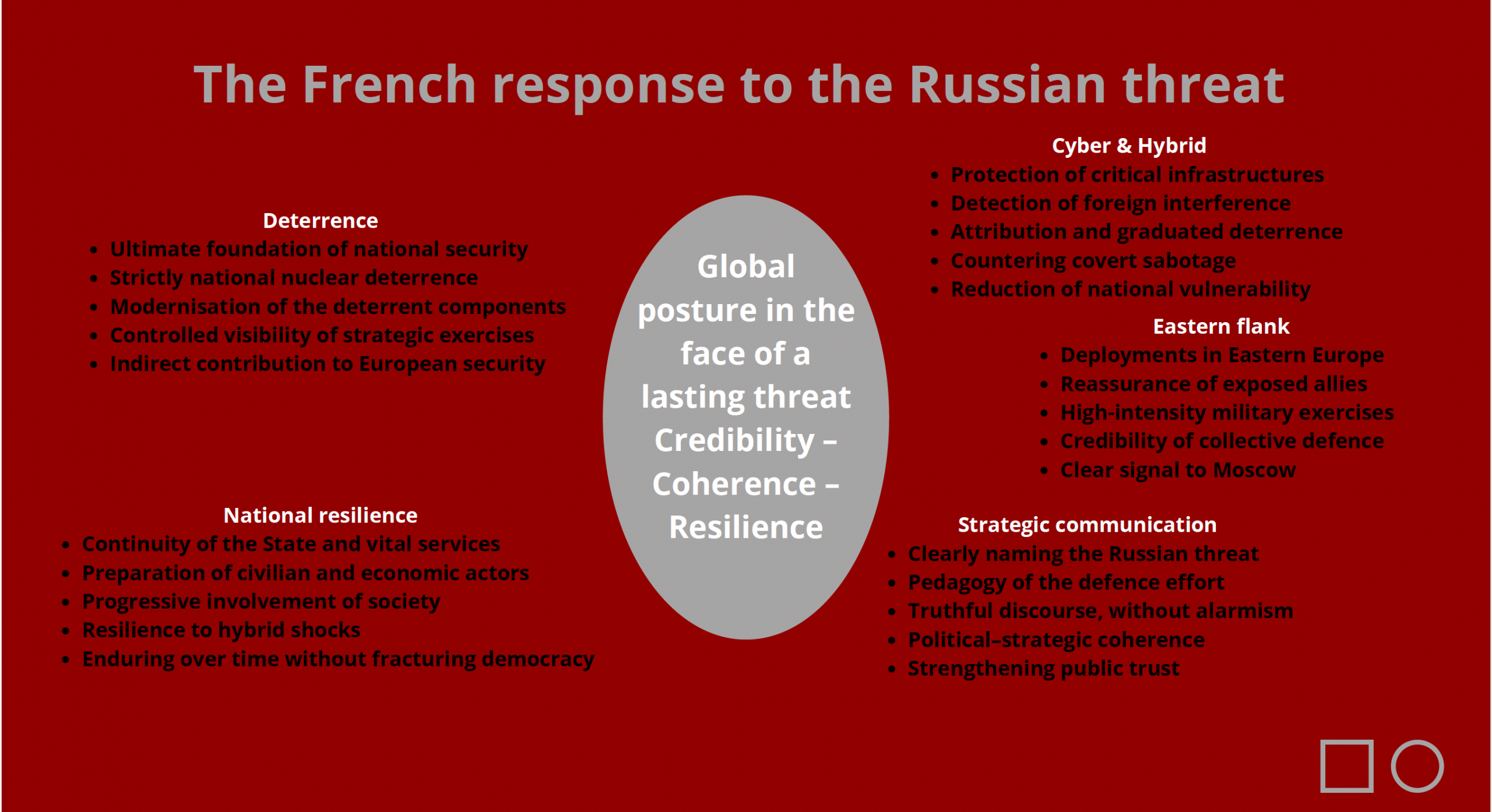
This document accompanies the summary map presenting the French strategic response to the Russian threat. It aims to explain the logics, priorities and balances that structure France’s action in the face of a threat that is now identified as long-lasting, multifaceted and systemic.
Unlike a strictly military approach, the French response is based on a global posture, combining deterrence, conventional deployments, the fight against hybrid threats, strategic communication and strengthening national resilience. The objective is not to outbid each other, but to stabilise the balance of power over the long term.
- Deterrence: The Ultimate Foundation of National Security
Nuclear deterrence remains the central foundation of French security. It is strictly national, placed under the exclusive authority of the President of the Republic, and is not subject to any decision-sharing. In the context of the Russian threat, France has reaffirmed the credibility of its deterrence by:
- the continuous modernization of its two components (oceanic and airborne),
- maintaining a robust chain of command,
- controlled visibility of the exercises, intended to strengthen credibility without causing escalation.
Without constituting an « extended » deterrence in the Anglo-Saxon sense, French deterrence contributes indirectly to European security by strengthening the Alliance’s global shield and complicating any major attempt at strategic coercion.
- East flank: credibility of the collective defence
In the face of Russian pressure on Eastern Europe, France has strengthened its presence on NATO‘s eastern flank, in particular by:
- regular deployments in Central and Eastern Europe,
- participation in multinational battlegroups,
- high-intensity exercises to demonstrate rapid reaction capability.
This posture meets a twofold objective:
- reassure the most exposed allies,
- send Moscow a clear signal of credibility and solidarity.
It is a question of showing that any attempt at territorial destabilization would be met with an immediate collective response.
- Cyber & Hybrid: Protecting the Nation in the Grey Zone
The confrontation with Russia is taking place largely below the threshold of armed conflict, in cyberspace and hybrid fields. France has therefore strengthened its capabilities in four main areas:
- protection of critical infrastructure (energy, telecoms, transport, health),
- detection of foreign interference and influence operations,
- improvement of attribution capabilities, a condition for graduated deterrence,
- fight against invisible sabotage and indirect destabilizing actions.
The aim is to reduce national vulnerability, increase costs for the adversary and make its operations less effective or even counterproductive.
- Strategic communication: naming the threat, preparing society
A major turning point in the recent period lies in the evolution of the State’s strategic communication. France is now responsible for:
- to clearly name the Russian threat,
- to develop a pedagogy of the defence effort,
- to speak the truth, without minimisation but without alarmism.
This Communication aims to ensure policy–strategic coherence between acts, speeches and reference documents, while strengthening public trust.
Informing becomes a security lever in its own right: a society that understands the threat is less vulnerable to manipulation and influence operations.
5. National resilience: holding on for the long term
Finally, the French response is part of a long-term approach. In the face of a persistent threat, the priority is to be able to hold on without fracturing democracy.
This involves:
- guarantee the continuity of the State and vital services,
- preparing civil and economic actors for crisis situations,
- gradually involve society in a logic of resilience,
- Strengthen the collective capacity to absorb repeated hybrid shocks.
National resilience is not a militarization of society, but a democratic insurance in the face of strategic uncertainty.
Conclusion
The French response to the Russian threat is based on a demanding balance: to be firm without being provocative, prepared without being alarmist, resolute without renouncing democratic principles.
This global posture – credible, coherent and resilient – has a central objective:
preserve the freedom of decision of France and its allies in the face of a strategy of sustainable coercion.