
Understanding war as a sustainable strategic instrument
Thematic Cluster: RIDS – International Relations, Defence and Security
Published date: December 20, 2025
Introduction – Breaking the diplomatic illusion
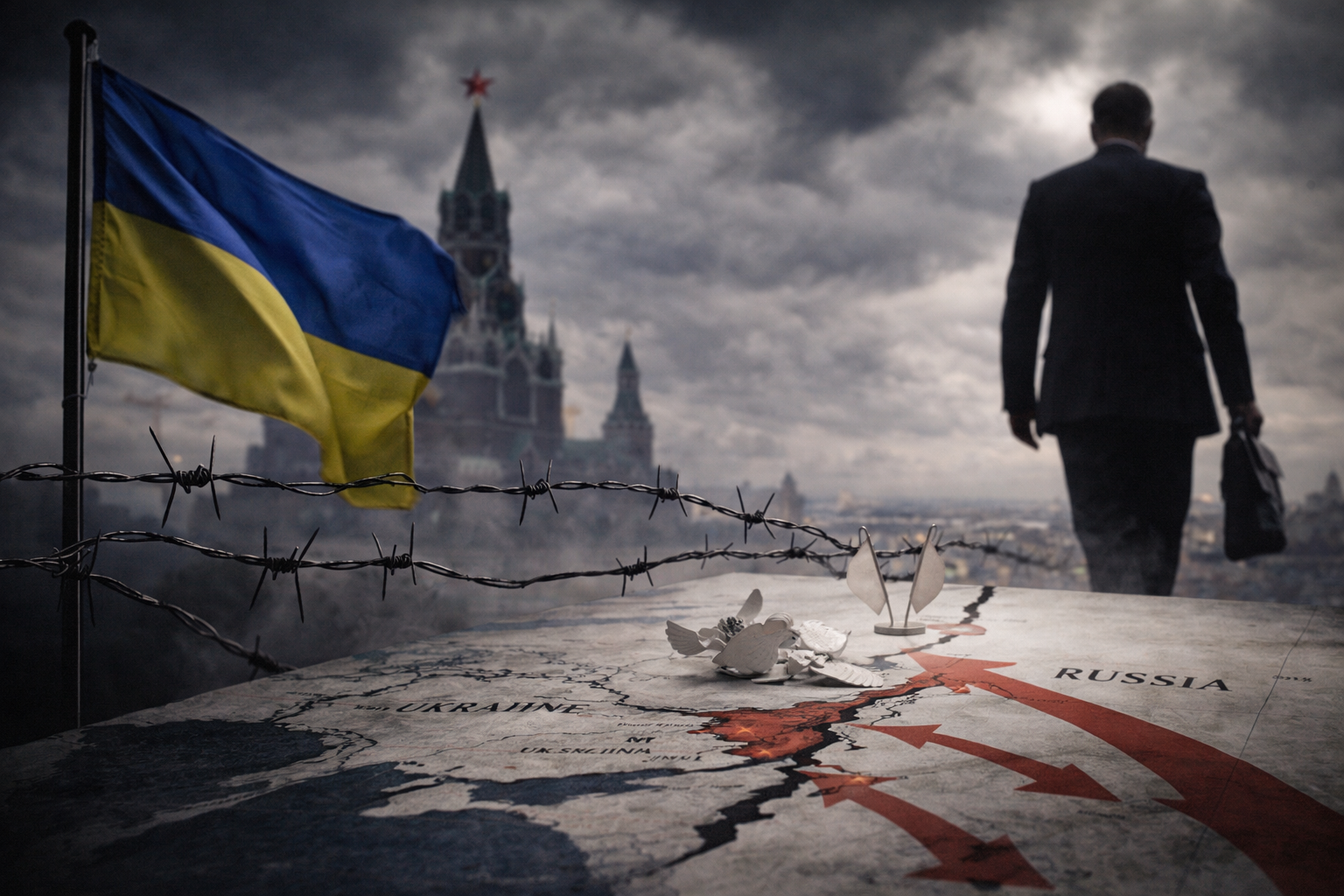
Since February 2022, part of the European public debate has continued to be structured by a recurring expectation: that of a rapid negotiated peace between Russia and Ukraine. This expectation is based on an implicit but rarely questioned hypothesis: Russia would like to end the war, but would be prevented from doing so by exogenous factors – rigidity of positions, lack of credible mediation, Western one-upmanship.
This memo defends the opposite thesis: Russia is not seeking peace, because war is today a central tool of its power strategy, both external (recomposition of the European security order) and internal (stabilization of the regime). From this perspective, peace is not an objective, but a transitional state acceptable only if it enshrines a favourable balance of power.
Understanding this logic is essential to properly calibrate European policies of deterrence, support for Ukraine and democratic resilience.
- War as a strategic mode of action, not as a diplomatic failure
Contrary to a classic Western interpretation, the war is not perceived in Moscow as a failure of diplomacy, but as one of its legitimate extensions. This vision is part of a long-standing Russian strategic tradition, where the distinction between peace and war is deliberately blurred.
In the case of Ukraine, the war meets several structuring objectives:
- Challenging the post-1991 European order, based on the sovereignty of states and the enlargement of Euro-Atlantic institutions;
- Re-establish a sphere of influence, in which Russia reserves the right to oversee, or even veto, the strategic choices of its neighbours;
- To demonstrate the primacy of the balance of power over international law, perceived as an asymmetrical Western instrument.
In this logic, ending the conflict without tangible gains would be interpreted not as a virtuous de-escalation, but as a strategic defeat, likely to encourage further challenges to Russian authority, both externally and internally.
- Negotiation as a tactical lever, not as a political horizon
Russian calls for negotiation, which have been recurrent since 2022, must be analysed not as signals of compromise, but as tactical tools for managing the conflict.
These diplomatic sequences serve several functions:
- Buying time to rebuild military capabilities or adapt the war economy;
- Fragmenting the opposing camp, by fuelling differences between European states on the level of support for Ukraine;
- Maintain ambiguity, by projecting the image of a reasonable Russia in the face of a West presented as ideological or warmongering;
- To influence public opinion, by exploiting war fatigue, inflation and the social costs of the conflict.
In this context, negotiation is not conceived as a process aimed at a stable peace, but as an informational and political maneuver in the service of confrontation.
- War as a pillar of the regime’s internal stability
Domestically, the war plays a structuring role for the Russian government. It allows:
- to justify political repression in the name of national security;
- to neutralize the opposition, assimilated to relays of the enemy;
- to mobilize society around a narrative of a besieged fortress;
- to reorient the economy towards a logic of military production, creating social and industrial dependencies.
In this context, a peace without victory would pose a major problem of legitimacy for the regime. It would open up a space for questioning the human, economic and moral cost of war, which the government is precisely seeking to avoid.
War thus becomes an instrument of government, and not a parenthesis.
- A long-term strategy of attrition in the face of democracies
Russia’s strategy is based on a central assumption: democracies are less enduring than authoritarian regimes. Moscow is betting on:
- the wear and tear of Western public opinion;
- electoral cycles;
- internal social tensions;
- the difficulty of maintaining a sustained political consensus.
With this in mind, peace is not sought, because time is on Russia’s side. Each additional month of conflict is seen as an opportunity to erode Western cohesion, even if the military situation remains costly.
- Strategic consequences for Europe and France
If Russia does not seek peace, there are several implications:
- Diplomacy alone is insufficient : it must be backed by credible deterrence;
- Duration becomes the central parameter : support for Ukraine, industrial effort, social cohesion;
- Communication must be realistic : prepare societies for a long conflict, without false hopes;
- Democratic resilience is becoming a battlefield in its own right.
To persist in the illusion of a quick peace is to politically disarm European societies.
Conclusion – Thinking differently about peace
To say that Russia is not seeking peace does not mean to give up any prospect of a settlement. This means understanding that peace will not come from a unilateral concession, but from a stabilized balance of power, in which Moscow will consider the continuation of the conflict more costly than its end.
Peace, in this context, is not a prerequisite for security: it is the product of it.