
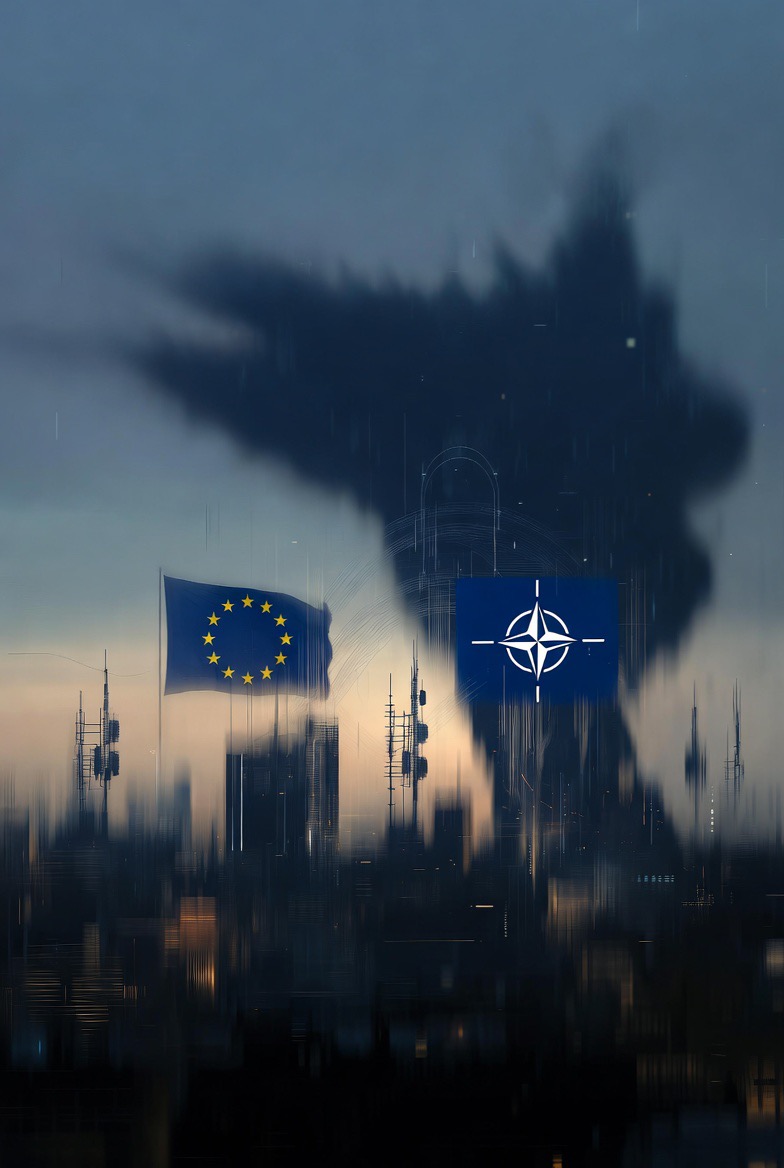
From the suspicion of obsolescence to the structuring pillar of European security
Thematic Cluster: RIDS – International Relations, Defence and Security
Published date: January 9, 2026
Introduction – The return of an alliance that was thought to be outdated
Until a few years ago, NATO appeared to be an alliance that was losing its meaning: enlarged, bureaucratized, dependent on the United States, it seemed ill-suited to hybrid challenges, external operations and the transformation of the battlefield.
The war unleashed by Russia against Ukraine in February 2022 has brutally reversed this perception. In just a few weeks, the Atlantic Alliance has once again become the central framework for collective defence in Europe.
This return is not an ideological reflex, but a strategic reality : in the face of a major, lasting and assumed state military threat, no other structure today has the necessary capabilities, credibility and integration.
- The strategic shock of 2022: the end of illusions
The invasion of Ukraine has put an end to three structuring illusions in Europe:
- The illusion of lasting peace on the continent;
- The illusion of a Russia deterred by economic interdependence;
- The illusion of a European security that can be built without a balance of power.
In this context, NATO has regained its primary role: deterring, reassuring and defending.
France itself, despite being the bearer of a critical discourse on the Alliance (to the point of speaking of « brain death » in 2019), has carried out a rapid pragmatic realignment, recognising NATO’s rediscovered centrality in the face of the Russian threat.
- What NATO does that no one else does
NATO is not just a political alliance. It is an integrated military machine.
Its unique strengths:
- Permanent collective military planning;
- A proven operational chain of command;
- Regular high-intensity exercise;
- Real interoperability between allied forces;
- A credible deterrent based on the American presence.
Neither the European Union nor ad hoc coalitions currently have such a level of operational integration.
- The eastern flank: a full-scale test of Allied credibility
Since 2022, NATO has transformed its posture on its eastern flank:
- Enhanced forward deployments (Baltic, Poland, Romania);
- Moving from a logic of « symbolic presence » to a posture of forward defense ;
- Increased integration of national forces into multinational arrangements.
France is actively participating in this dynamic, particularly in Romania, illustrating a major doctrinal change: the defence of allied territory is once again becoming central, in the same way as external operations.
- Nordic enlargement: Finland and Sweden, a strategic indicator
The accession of Finland and Sweden to NATO is one of the major geopolitical upheavals of the decade.
It reveals several trends:
- The perception of a direct Russian threat, even among historically non-aligned states;
- The continued attractiveness of NATO’s Security Guarantee;
- Russia’s strategic failure to contain the enlargement of the Alliance.
This enlargement significantly strengthens NATO’s posture in Northern Europe, while sending a clear message to Moscow that aggression has the opposite effect to that intended.
- NATO and European Defence: complementarity, not substitution
NATO’s return in force does not signal the failure of European defence, but redefines its contours.
The current strategic reality is that of a post-Europeanism in security :
- NATO provides collective defence and deterrence;
- The European Union is acting on Ukraine’s capabilities, industry, resilience and support;
- States retain control over sovereign choices.
Seeking to pit NATO and Europe against each other has become counterproductive. European security is now based on a hybrid, pragmatic, multi-level architecture.
- For France: a return to an assumed but non-aligned strategic Atlanticism
For Paris, NATO’s newfound centrality does not mean either the renunciation of strategic autonomy or systematic alignment.
The French position is based on three balances:
- To be a credible pillar of the Alliance;
- Preserve national sovereignty, particularly nuclear sovereignty;
- Continue to structure a complementary European capacity.
This positioning allows France to carry weight in the Alliance while avoiding exclusive strategic dependence.
Conclusion – An alliance that has become indispensable again, but under conditions
NATO has become central again because the world has become dangerous again. It is now the minimum basis of collective security in Europe.
But its future centrality will depend on several factors:
- The European capacity to assume an increasing share of the effort;
- The political coherence of the allies;
- The credibility of global deterrence in the face of Russian escalation.
In this context, NATO is not an end in itself, but an indispensable tool for a broader strategy of stability, resilience and sustainable deterrence.