
Understanding the contemporary conflict between formal peace and open war
Thematic Cluster: RIDS – International Relations, Defence and Security
Published date: December 20, 2025
Introduction – The end of the clear line between peace and war
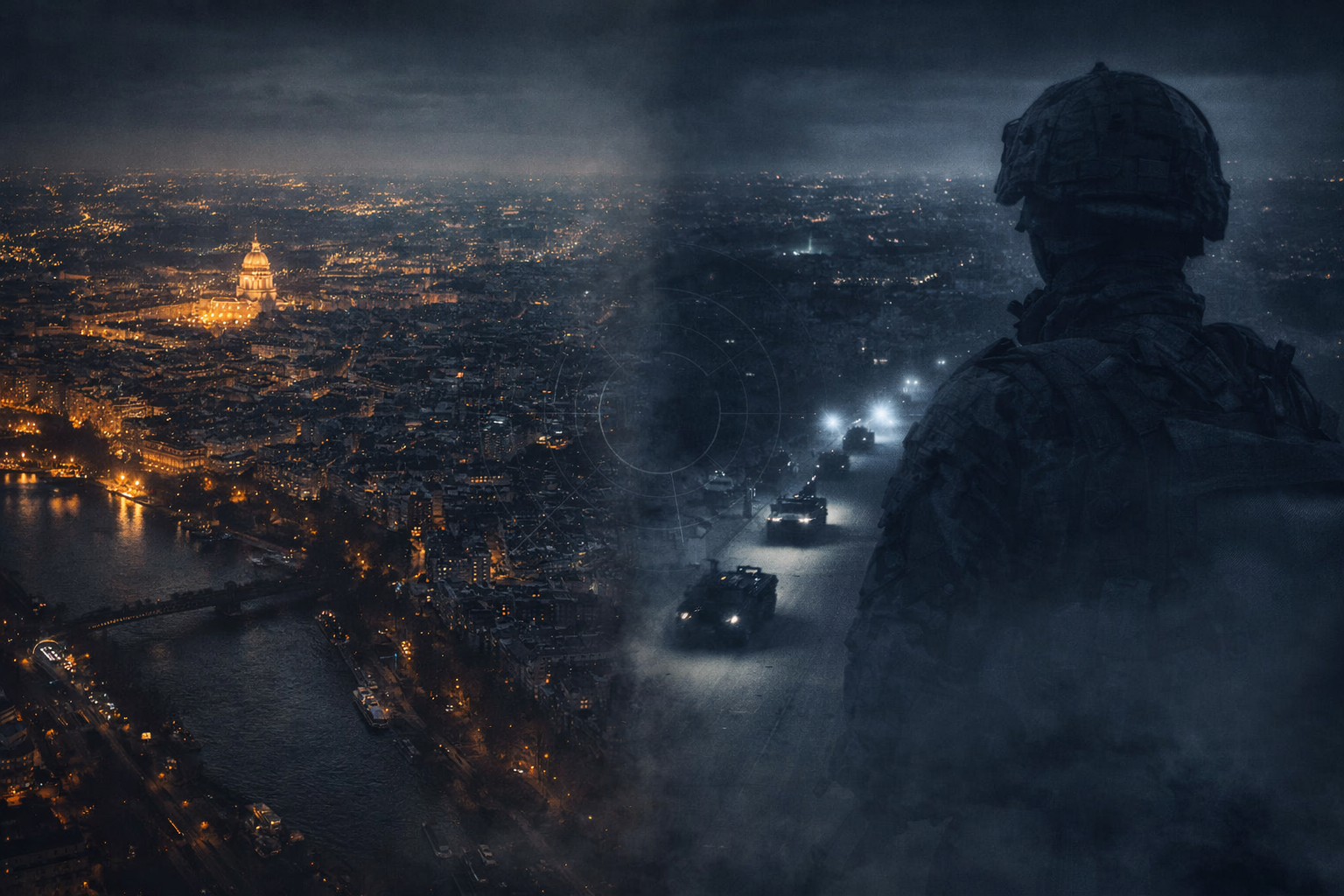
Contemporary conflict no longer begins with a declaration of war, nor is it limited to armed confrontations. It is now part of an intermediary, unstable, ambiguous, permanent zone: the grey zone.
It is in this space that Russia deploys most of its strategy against Western democracies. A strategy designed to weaken without triggering, use without provoking a direct military response, and exploit the legal, political, and cognitive blind spots of open societies.
Understanding the grey area has become essential to understanding the real nature of the Russian threat — and, more broadly, of the conflicts of the 21st century.
- Operational definition of the grey zone
The grey area refers to all hostile actions:
- below the threshold of declared armed conflict ;
- difficult to attribute or legally qualifie;
- designed to produce lasting political, social or strategic effects.
It is not a transitory state, but an assumed, structured and permanent mode of conflictuality.
The grey zone is neither peace nor war: it is a war without words, without classic symbols, but with very real effects.
- Russian strategic logic: winning without a battle
Russia is part of a strategic tradition where victory does not necessarily involve direct military confrontation.
Main objectives:
- Fragmenting opposing societies;
- Erode trust in institutions;
- Delegitimizing democratic governments;
- Achieve political gains without military escalation.
This logic is based on a central calculation: democracies are more vulnerable to wear and tear than to shock.
- Typical instruments in the grey zone
Information and cognition
- Disinformation, misinformation, indirect propaganda;
- Informational saturation rather than a single lie;
- Relativization of truth (« everything is equal »);
- Exploitation of existing controversies.
The objective is not to convince, but to disorient, create doubt and cognitive fatigue.
Cyber and digital
- Massive espionage and pre-positioning;
- Discreet sabotage of critical infrastructure;
- Pressure on local authorities, hospitals, public services;
- Reversible attacks, neither too visible nor too destructive.
Cyber is the ideal tool in the grey zone: inexpensive, difficult to attribute, politically ambiguous.
Economic and energy pressures
- Blackmail on supplies;
- Market manipulation;
- Targeted destabilization of strategic sectors.
Here again, the objective is not a sudden collapse, but a gradual weakening.
Indirect military intimidation
- Border manoeuvres;
- Violations of airspace or seaspace;
- Nuclear rhetoric;
- Symbolic deployments.
Armed force remains present, but used as a psychological tool, not as an instrument of immediate combat.
- Why the grey zone is dreadful for democracies
Democracies are structurally exposed to the grey zone for several reasons:
- Commitment to the rule of law and evidence;
- Long time frame for political decision-making;
- Freedom of expression exploitable for hostile purposes;
- Media and social fragmentation.
The grey zone exploits precisely these strengths to turn them into vulnerabilities.
- The strategic trap: acting too little or too much
Faced with the grey area, two symmetrical errors threaten:
- The sub-reaction
→ trivialization, denial, loss of credibility.
- Overreaction
→ attacks on freedoms, panic, internal fractures.
The central difficulty lies in the correct response that is graded and readable, proportionate and coherent.
- Challenges for France: seeing, naming, lasting
To deal with the grey area, France must act on several levers:
- Detection : intelligence, cyber, information monitoring;
- Graduated attribution : to say what is known, what is probable, what is uncertain;
- Pedagogy : explain without dramatizing;
- Resilience : preparing society to absorb shocks.
The grey zone imposes a profound transformation of the strategic culture: thinking of the conflict as a continuum, not as a clean break.
- The grey zone as a sustainable state
The war in Ukraine does not mark the end of the grey zone, but its institutionalisation.
Even in the event of a ceasefire or a freeze in the conflict, hybrid, informational and cyber operations will continue — and even intensify.
The grey zone is destined to become the strategic normality of relations between antagonistic powers.
Conclusion – Naming the invisible war to better contain it
Not naming the grey area means being subjected to it. To overexpose it is to risk amplifying it.
The effective answer lies in a middle way:
strategic lucidity, democratic pedagogy and collective resilience.
In this new age of conflicts, victory is no longer measured only in conquered territories, but in societies that hold together.