

Operation Absolute Resolve Series
Thematic Cluster: RIDS – International Relations, Defence and Security
Authors: Ismaïl BOUGHIOUL, Yaël LOPEZ-TORRES
Published date: February 4, 2026
- Context and positioning
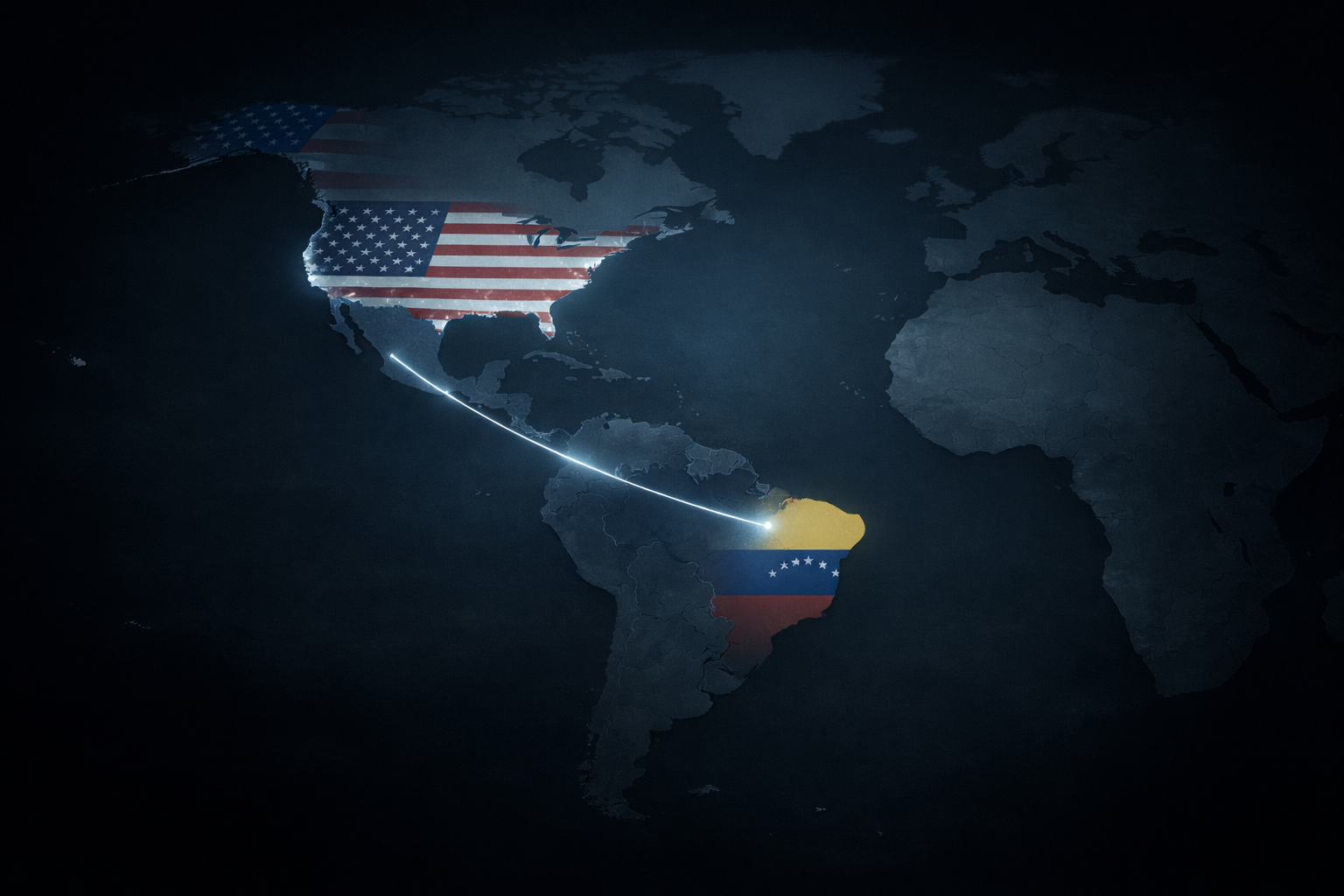
On January 3, 2026, a U.S. military operation led to the capture of Venezuelan President Nicolás Maduro, marking a historic upheaval in the country’s political regime. Donald Trump has publicly announced that the United States intends to « lead the country » until a transition is established that is described as « safe and adequate ».
In the weeks that followed, Delcy Rodríguez consolidated her position as interim president, and called for cooperation with the U.S. authorities. U.S. officials have said they are avoiding a new military push, but not ruling it out, but are promoting a process of stabilization and political normalization, including the possibility of reopening the U.S. embassy in Caracas and coordinating various public policies.
This scenario is therefore based on the assumption of a political transition dominated by strategic cooperation between the Venezuelan interim authorities and the United States, with significant influence from Washington on the political, security and economic axes of the transition.
- Factual basis of the scenario
- Political and diplomatic oversight
U.S. Secretary of State Marco Rubio told the Senate that the administration sees « significant progress » since Maduro’s capture and that there are no plans for further U.S. military action in the near term. He cited in particular coordinating with the interim president on priorities such as political and economic stabilization, and eliminating the direct influence of powers such as Iran, China or Russia.
- Progressive institutional normalization
The U.S. administration has appointed Laura Dogu as chargé d’affaires of the Venezuela Affairs Unit in Bogotá, in preparation for a partial resumption of operations in Caracas. The appointment signals a new step towards strengthening diplomatic presence and institutional cooperation with Venezuela after seven years without diplomatic relations.
- Description of the scenario
- Transitional governance under U.S. supervision
In this scenario, during the political transition process, executive power is exercised by a figure from the existing Venezuelan institutional framework (Delcy Rodríguez or a consensual replacement), but with significant U.S. oversight and influence on key strategic decisions, including:
- Internal security and the reorganization of the armed forces.
- Political « stabilization », conceived as a gradual transition towards a revitalized political order.
- The management of strategic resources, in particular the oil industry, in coordination or under the influence of Washington.
- The Strategic Realignment of Non-American Allies
This model is based on a logic of controlled coercion, rather than direct and permanent military occupation, which aims to avoid institutional collapse while directing policy choices towards strategic objectives aligned with American interests.
- Analytical implications of the scenario
- Policy implications
Domestic and international legitimacy
The political legitimacy of the transitional government is based both on the internal institutional anchoring (the Supreme Court of Justice, and in particular on the support of the Venezuelan armed forces) and on Washington’s diplomatic support.
However, this legitimacy is contested by part of the Venezuelan political opposition and by several international actors, who consider the American operation a violation of national sovereignty and international law. Reactions within the international community are diverse, with some countries remaining reserved while others stress the need to respect the international legal framework. The legitimacy of internal politics and economic stability are the necessary conditions to allow the return of millions of exiled Venezuelans.
Supervised integration of the opposition
Institutional opposition can be integrated selectively and in a controlled manner, in order to give the appearance of a democratic transition. This approach aims to prevent an open rift with local forces while directing policy towards objectives compatible with Washington.
Such a mechanism tends to produce artificial coalitions, perpetuate impunity for acts of corruption and human rights violations committed by the armed forces, reinforcing procedural legitimacy without necessarily guaranteeing an immediate democratic institutional transition.
Meanwhile, the transitional government continues to promote forms of reconciliation with the victims of political repression and part of the opposition. These may include legal concessions, such as the recent general amnesty law, announced by Delcy Rodriguez, which covers the period of political violence from 1999 to the present.
Stabilization of law and order
The absence of a massive resumption of violence since the initial operation indicates a relative stabilization of law and order, although effective control remains fragile and dependent on the discipline of the armed forces and security services.
- Economic implications
Oil and Strategic Resources
Consultations have recently been observed between the U.S. administration and oil companies on the management of Venezuelan exports, particularly with regard to exports to the United States. It has been reported that Caracas and Washington have agreed to transfer tens of millions of barrels to the United States as part of an energy deal (in the range of 30 to 50 million barrels).
This mechanism is part of a logic of partial control of oil revenues and may pave the way for increased participation of foreign companies in the Venezuelan energy sector.
Interests of American and European companies
In this scenario, the revival of the oil industry and the reduction of barriers to investment could favour contracts for Western companies in the fields of energy and raw materials (critical minerals such as lithium, cobalt, nickel), provided that political stability and legal certainty improve.
- Geopolitical implications
Cuba
Secretary Rubio’s statements to the Senate suggest a strategy aimed at regime change in Cuba without direct U.S. intervention. In this context, Washington continues to exert pressure on Venezuela to sever its historical ties with Cuba. The interruption of Venezuelan oil deliveries to the island is further aggravating the energy crisis and its consequences on the population.
Russia
According to recent analyses, Maduro’s kidnapping and political reconfiguration in Venezuela have helped reduce Russian influence in the region as part of a reshaping world order, even as Moscow will seek to exploit the situation diplomatically.
China and Iran
China’s economic presence, historically important in Venezuelan energy and mining contracts, could be limited or renegotiated in a logic that favors Western investment.
Iranian energy and military ties, previously associated with Caracas, are also reduced in this scenario, even if discreet dependencies may persist.
These effects should be interpreted as relative strategic realignments, rather than as a definitive erasure of these influences.
- Strategic conditions and risks
- Feasibility conditions
- Expanded recognition of the transitional government by key regional actors.
- Indicators of gradual economic stability.
- Maintaining sufficient internal order to avoid a tipping over into civil war or territorial break-up.
- Clear and transparent institutional arrangements to organise a future phase of electoral transition.
- Risks
- Ongoing internal contestations, which can arise if the political and military elites believe that their interests are threatened.
- International legal challenges to the legality of the intervention and seizure of power, which fuel criticism of violations of international law.
- Lasting political polarization, with social segments wary of a transition perceived as imposed from the outside.
- Conclusion
The US-led cooperation and transition scenario describes a trajectory in which Washington exerts significant influence on Venezuela’s political, security, and economic reconstruction after the capture of Nicolás Maduro. This trajectory is supported by recent official statements by the US authorities and the first initiatives observed in terms of institutional normalisation and energy coordination.
The political implications show conditional internal legitimacy, while the economic dimensions suggest a central role for hydrocarbons and strategic resources in the reconfiguration of relations between Caracas and Washington. Geopolitically, the scenario implies a readjustment of external influences, including a relative loss of Russian influence in a broader framework of global competition.
Finally, medium-term viability will depend on the ability of this transitional government to strengthen its internal legitimacy, to revive the economy, to manage the risks of protest and to maintain a coherent institutional balance. This scenario remains plausible if and only if internal and external conditions converge towards lasting stabilization rather than protracted conflict.
Bibliography
Reporting and Analytics:
- Atlantic Council, U.S. Policy Options in Venezuela After Maduro, January 2026.
- Brookings Institution, Making sense of the US military operation in Venezuela, January 2026.
- Atlantic Council, What to watch in a post-Maduro Venezuela, January 2026.
- Council on Foreign Relations (CFR), Venezuela: Political Transition and U.S. Strategic Interests, January 2026.
Press articles
- Agence France-Presse (AFP), « Delcy Rodríguez invites Venezuelan opposition to stay in Washington, » January 29, 2026.
- Anadolu Agency, « China Condemns U.S. Strikes in Venezuela, » January 3, 2026.
- Anadolu Agency, « Russia Calls on the United States to Release Nicolás Maduro, » January 4, 2026.
- El País, « Delcy Rodríguez anuncia una amnistía general para los presos políticos en Venezuela, » January 30, 2026.
- Euronews, « Spain and five Latin American countries condemn the capture of Nicolás Maduro, » January 5, 2026.
- Financial Times, « U.S. to Pay Monthly Venezuela ‘Budget’ From Oil Proceeds via Qatar Fund, » January 29, 2026.
- Reuters, « U.S. Names New Top Envoy for Venezuela After Maduro Capture, » January 22, 2026.
- Reuters, « Rubio Cites Venezuela Progress, Says U.S. Not Planning More Use of Force, » January 28, 2026.