
Operation Absolute Resolve Series
Thematic Cluster: RIDS – International Relations, Defence and Security
Authors: Ismaïl BOUGHIOUL, Yaël LOPEZ-TORRES
Published Date: March 25, 2026
Executive Summary
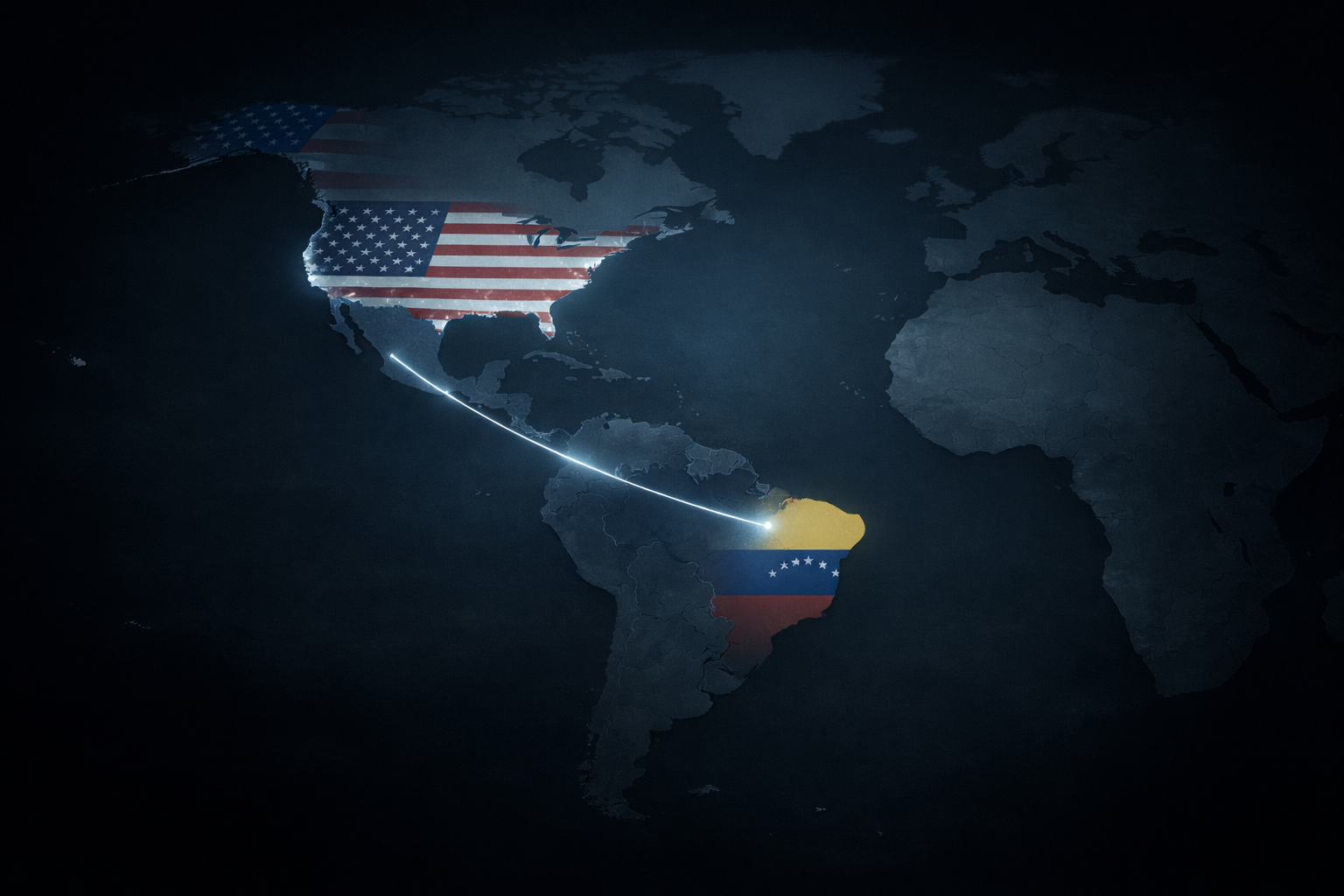
This memo analyzes a scenario in which a U.S. military intervention would initially neutralize Venezuela’s executive branch and bring about a political transition. However, despite this tactical success, the country would enter a phase of prolonged instability characterized by political, institutional and security fragmentation.
The central argument of this scenario is based on the idea that rapid military success does not guarantee the political consolidation of a fragile state. In a context marked by weak institutions, fragmented political elites and economic dependence on oil, the transition could lead to a lasting political impasse, preventing any rapid stabilization.
The analysis highlights the causal mechanics of the scenario, identifies empirical indicators to observe its evolution, and examines the geopolitical implications for the United States and the region.
- Structural context of Venezuela
An economy that is extremely dependent on oil
Venezuela has the world’s largest proven oil reserves, estimated at around 303 billion barrels, making it a potentially major energy player. However, actual production is well below this potential.
While production exceeded 3 million barrels per day in the early 2000s, it fell to around 900,000 to 1 million barrels per day in the years 2024-2025, due to international sanctions, deteriorating infrastructure and lack of investment in the oil industry.
This dependence on oil is a major vulnerability: the country’s economic reconstruction depends largely on the ability to revive this sector.
Economic fragility and social crisis
The Venezuelan economic crisis is part of a long period of GDP contraction, very high inflation and deterioration of public services.
Even when some official indicators point to a recent economic recovery, many analysts point out that inflation and low purchasing power continue to weigh heavily on the population.
This economic fragility severely reduces the ability of a possible transitional government to quickly stabilize the political and social situation.
A major regional migration crisis
The Venezuelan crisis has also caused one of the largest population displacements in the world. According to the United Nations High Commissioner for Refugees, nearly 7.9 million Venezuelans have left their country since 2014, mainly to other Latin American countries such as Colombia, Peru or Brazil.
This mass migration is already creating political and economic pressure on neighbouring states and could increase in the event of prolonged instability.
- Mechanics of the scenario: from tactical victory to political deadlock
To understand this scenario, it is necessary to analyze the causal chain that transforms an initial military success into lasting political fragmentation.
In many contemporary contexts, external military intervention can bring about the rapid fall of an executive power without allowing for the rapid reconstruction of stable political institutions. Similar dynamics have been observed in contexts such as Iraq or Libya, where the disappearance of a strong central power has created an institutional vacuum that is quickly exploited by competing actors.
In the case of Venezuela, the combination of weakened institutions, internal political divisions, and an economy heavily dependent on the oil sector could turn an initial military victory into a lasting political stalemate.
This dynamic can be described through four successive phases.
Phase 1: Military intervention and fragile political transition
In this scenario, a U.S. military intervention or multinational operation would:
- the rapid neutralization of the executive power in place
- the partial disorganization of loyalist forces
- the installation of an interim government supported by Washington and some regional partners
However, this government rests on a fragile institutional foundation. State institutions have been weakened by several years of economic and political crisis, which limits their ability to ensure a stable transition.
The legitimacy of the new government could also be challenged by part of the population, especially if the transition is perceived as imposed from the outside.
Phase 2: Fragmentation of institutions and armed forces
The second phase of the scenario corresponds to a gradual fragmentation of political and security authority.
Fractures within the armed forces
The Venezuelan army, organized around the Fuerza Armada Nacional Bolivariana, is a central player in the political system. In a context of emergency imposed transition, internal divisions could appear between:
- officers supporting the transitional government
- factions remaining loyal to political structures inherited from Chavismo, particularly linked to the United Socialist Party of Venezuela
- regional commands seeking to preserve their autonomy and local resources.
These divisions could prevent the rapid reconstitution of a state monopoly on violence.
Institutional rivalries
At the same time, several institutional actors could challenge the authority of the central government:
- Regional Governors
- Judicial authorities
- Local Assemblies
Each player would seek to preserve its political and economic room for manoeuvre in an uncertain environment.
Multiplication of competing authorities
In some peripheral or border regions, non-state actors could exploit the institutional vacuum:
- local militias;
- paramilitary groups;
- criminal networks linked to drug trafficking or illegal mining.
This dynamic could lead to a partial territorial fragmentation of the country, in which different areas would be controlled by competing actors.
Phase 3: economic deadlock and social tensions
The third phase corresponds to economic stagnation preventing political consolidation
Insufficient oil production
The revival of the economy depends largely on the energy sector, which has historically been dominated by the national company PDVSA. However, several factors could limit a quick recovery:
- Severely degraded oil infrastructure
- Lack of foreign investment
- security instability in certain production areas.
Under these conditions, oil production could remain below its potential for a long time, preventing the state from generating the resources needed for reconstruction.
Low investor confidence
Political and institutional uncertainty could also discourage the international investment needed for economic recovery.
Persistent social tensions
The combination of high inflation, high unemployment and persistent poverty would continue to fuel social tensions. These factors could further weaken the transitional government and strengthen political dissent.
Phase 4: Indirect internationalization of the conflict
Internal political fragility paves the way for the indirect involvement of external actors. Some powers may seek to preserve their economic or strategic interests in the country. Venezuela could thus become a space of indirect competition between great powers, without direct military confrontation.
Structural bottlenecks
Several factors could prevent rapid stabilization:
- Lack of political consensus between the various opposition forces
- Rivalries between regional elites for the control of economic resources
- weak administrative capacity of the State
- Persistence of insecurity in certain border or mining regions.
These structural blockages could turn the political transition into a lasting institutional impasse.
- Observable Scenario Indicators
The evolution towards this scenario could be identified through several empirical indicators observable by international organizations and economic institutions.
Diplomatic fragmentation
- Partial international recognition of the transitional government
- Divisions between regional organizations and external powers
Security fragmentation
- Increasing localized armed incidents
- Loss of government control over certain regions
Evolution of the energy sector
- Sustained stagnation in oil production at around one million barrels per day
- Lack of major investments in the sector
Expansion of criminal networks
- Increase in cross-border trafficking
- Consolidation of non-state armed groups
Migration dynamics
- Resumption of migration flows to neighbouring countries
- increase in the number of regional refugees
- Theoretical framework applied
This scenario can be interpreted through several approaches to international relations. The realist theories associated with Hans Morgenthau and Kenneth Waltz put forward the search for power and security by states. In this perspective, an American intervention would aim to:
- reducing the influence of rival powers in the Western Hemisphere such as China, Russia and Iran.
- strengthen the strategic credibility of the United States in its sphere of influence
However, the distinction between hard power and soft power, developed by Joseph Nye, emphasizes that military power is not enough to stabilize a political system in the long term
In the Venezuelan case, the success of hard power (military intervention) does not guarantee the effectiveness of soft power(institutional reconstruction and political legitimacy). In a context where institutions are weakened and the security apparatus plays a central role in the balance of power, the rapid fall of the regime could create an institutional vacuum.
The army, organised around the Fuerza Armada Nacional Bolivariana, could then fragment between factions supporting the transitional government and units remaining loyal to the political structures inherited from Chavismo, notably linked to the United Socialist Party of Venezuela.
This institutional and security fragmentation could prevent the rapid reconstitution of a state monopoly on violence and complicate the reconstruction of a stable political order. Under these conditions, an initial military success could lead to a fragile transition rather than a rapid stabilization of the country.
- Strategic Gains and Risks for the United States
Short-term gains
In the short term, Washington could gain several strategic advantages:
- weakening of the influence of rival powers in the region
- Strengthening its strategic credibility with its allies
- Potential access to a major energy sector
Long-term risks
However, strategic risks remain significant:
- Rise of anti-Americanism in the region
- Financial and political costs of an extended commitment
- Persistent regional instability
- risk of strategic blowback, i.e. unexpected negative effects for the United States itself.
Conclusion
Even if a US military intervention were to quickly topple the current regime, stabilizing Venezuela would remain a major challenge. Institutional weakness, internal political divisions, and economic constraints could lead to a lasting political stalemate, characterized by fragmentation of power and persistent security instability.
In this context, strategic gains for Washington would remain uncertain and conditional, while risks to regional stability could increase.
Bibliography :
Theoretical works in international relations:
- Hans Morgenthau. Politics Among Nations: The Struggle for Power and Peace. New York: McGraw-Hill, 1948.
- Kenneth Waltz. Theory of International Politics. Reading: Addison-Wesley, 1979.
- Joseph Nye. Soft Power: The Means to Success in World Politics. New York: PublicAffairs, 2004.
Institutional sources and economic data:
- World Bank. World Development Indicators: Venezuela. Washington, DC, 2024.
- International Monetary Fund. World Economic Outlook Database: Venezuela. Washington, DC, 2024.
- Organization of the Petroleum Exporting Countries. Annual Statistical Bulletin. Vienna, 2023.
- United Nations High Commissioner for Refugees. Venezuela Situation: Refugee and Migration Data. Geneva, 2024.
- International Organization for Migration. Regional Response for Venezuelan Migrants and Refugees. Geneva, 2024.
- U.S. Energy Information Administration. Venezuela Country Analysis Brief. Washington, DC – Dates 2023
Strategic analyses and geopolitical studies:
- International Crisis Group. Venezuela Crisis Reports. Brussels.
- Center for Strategic and International Studies. Energy and Security in Venezuela. Washington, DC.
- Council on Foreign Relations. Venezuela’s Political and Economic Crisis. New York.
Scientific journal article:
- Bull, Benedicte, and Antulio Rosales. « The Crisis in Venezuela: Drivers, Transitions, and Pathways. » European Review of Latin American and Caribbean Studies, n°109 (2020).pp 1–20. Available on JSTOR.