

Pole: International Relations, Defence, Security
Author: Lucas PEREIRA DOS SANTOS, Diana MOSNEANU, Hugo FERNANDEZ CASTAGNEDE
Published Date: February 17, 2026
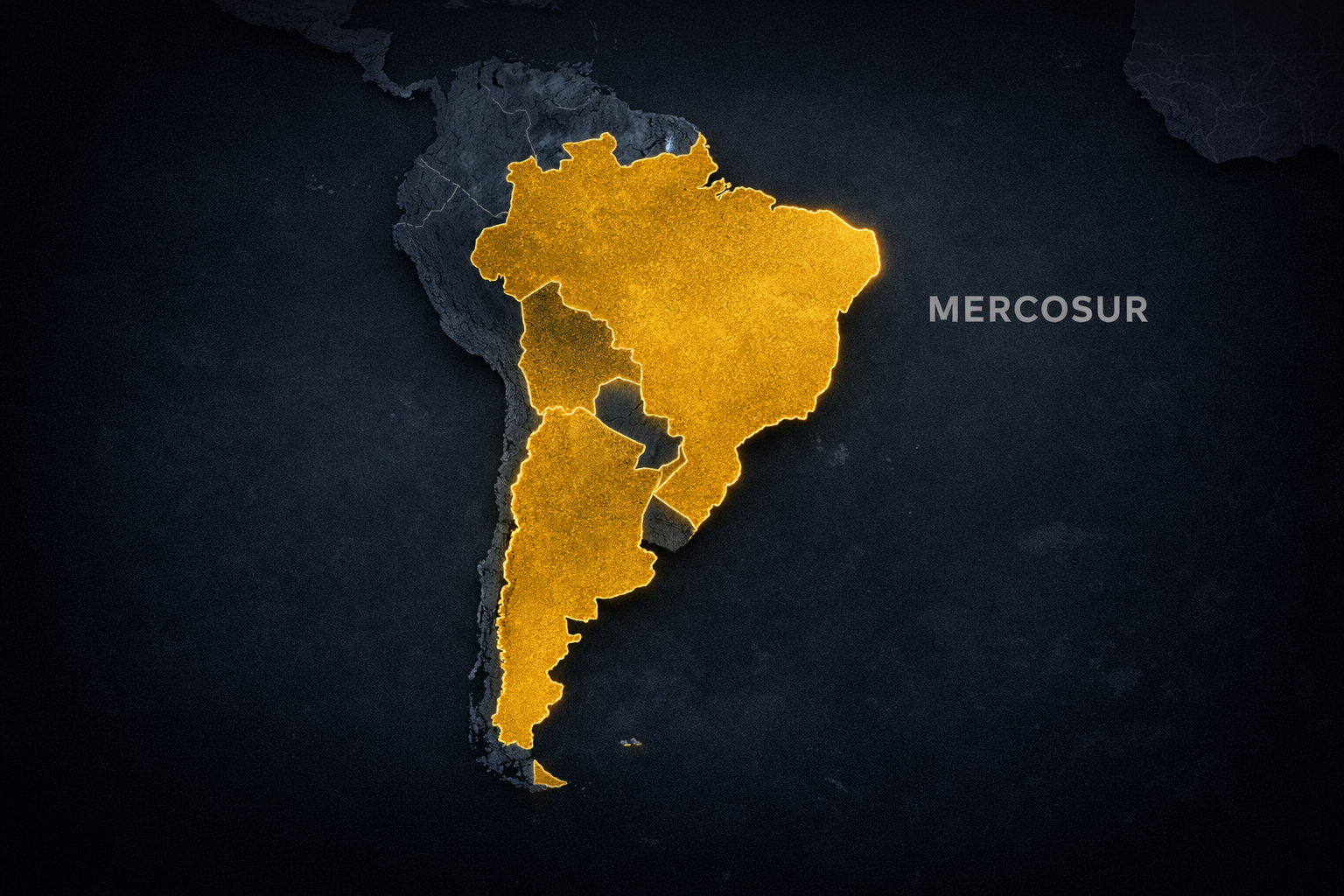
Born in the early 1990s, Mercosur is part of a regional and international context marked by the end of the Cold War. Today, the Southern Common Market includes Argentina, Brazil, Paraguay, Bolivia and Uruguay. It is a regional economic integration organization and a free trade area.
Its creation is part of a process of democratic transitions and exit from military regimes, which has fostered an unprecedented rapprochement between states long marked by mistrust and strategic competition, notably Brazil and Argentina. At the global level, the rise of trade multilateralism, inherited from the GATT (1947) and reinforced by the development of « open regionalism », has encouraged Latin American countries to strengthen their integration into the world economy[1].
Despite these ambitions, the construction of Mercosur raises several questions. Its organization is based on an intergovernmental system, marked by low supranationality and the primacy of national decisions, which limits its ability to go beyond the framework of simple coordination between States. This institutional weakness can be seen both as an obstacle to deepening integration and as a means of preserving political cohesion in a context of strong national sovereignty[2].
The process also faces significant constraints. Asymmetries between members, recurrent crises and divergences in national strategies compromise the implementation of common policies and weaken collective action. Integration therefore remains partial, oscillating between an ambitious project and persistent structural limitations. The question that arises from this is the following: What is the outcome of this major regional economic and trade integration project, Mercosur?
We will address this issue by analyzing the founding text of the economic group we are studying, and then its institutional formation. We will continue to study the internal tensions of its construction, and finally, we will exploit its role in globalization and show that it is a construction under external constraint.
- The Treaty of Asunción: Mercosur’s founding text
On March 26, 1991, in the Paraguayan capital of Asunción, the governments of Argentina, Brazil, Paraguay and Uruguay signed an international agreement known as the Treaty of Asunción[3], laying the legal and political foundations for Mercosur.
This treaty is the founding instrument of a regional organization aimed at promoting economic integration between these States through:
- Coordination of customs policies;
- The gradual reduction of customs duties;
- The establishment of a common external tariff.
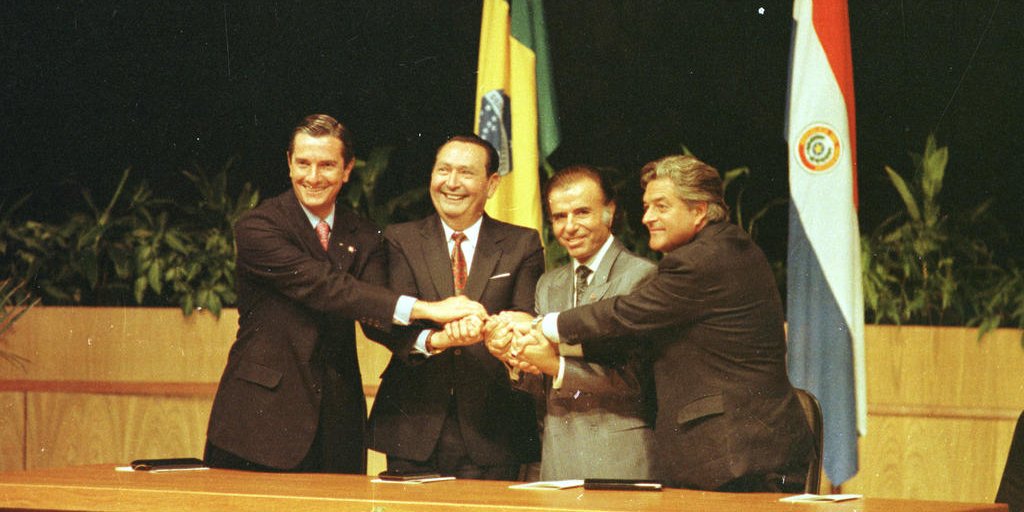
FRIOLIN, Valdir. Signing of the Treaty of Asunción. Pictured, from left to right: Presidents Fernando Collor de Mello (Brazil), Andrés Rodríguez (Paraguay), Carlos Menem (Argentina) and Luis Alberto Lacalle (Uruguay). RBS Agency (Rede Brasil Sul de Comunicação). Asunción. 1991.
In the text of the treaty itself, the signatories undertake:
- To establish the conditions for closer economic cooperation;
- To work for the free movement of goods, services, and factors of production;
- To define common rules to facilitate trade;
- To better coordinate their economic policies, the institutional basis of a common economic space.
The entry into force of the treaty, after ratification by the signatory countries, took place on 29 November 1991, officially placing Mercosur within the framework of international law. Since then, this organization has evolved, opening up to the accession of other South American countries and playing an important role in regional and global trade negotiations.
But regional integration within Mercosur is not limited to the simple facilitation of trade: it is thought of as a real instrument of development for its member states.
Regional integration within Mercosur is conceived as a Development Instrument for its Member States:
- By reducing external dependence;
- By strengthening collective international weight.
This integration is also based on a logic of regional complementarity, with each State exploiting its specific advantages, whether agricultural, industrial or technological, to create sustainable economic synergies and more balanced development throughout the region. So, this collaboration is born as much from an economic will as from a political project of regional stabilization.
But, after the political foundation of Mercosur by the Treaty of Asunción, it is necessary to institutionally build what has been decided.
- The institutional construction of Mercosur: a regionalism without supranationality.
The Ouro Preto Protocol[4], signed on 17 December 1994, gives Mercosur an international legal personality and a defined institutional architecture. This is essential to enable the Southern Common Market to function as an organized bloc capable of negotiating and acting internationally.
It records the formation of the main Mercosur bodies (see annex – « the table developed »):
Table: Mercosur institutions
| Institution | Lead role | Composition | Interactions |
| Council of the Common Market (CMC) | Supreme body, defines political orientations and priorities | Ministers of Foreign Affairs and the Economy | Oversees the CME and CCM, consults with FCES and Parlasur, guides the Secretariat |
| Common Market Group (CMG) | Executive body, implements the decisions of the CMC | Senior officials from ministries and central banks | Dependent on CMC for instructions, coordinates CCM |
| Mercosur Trade Commission (CCM) | Technical management of the customs union, trade directives | National Technical Representatives | Follows the guidance of the CME and the CMC |
| Economic and Social Consultative Forum (ESCF) | Advisory opinions on economic and social policies | Representatives of trade unions, employers and civil society | Consulted by the MCC, no binding authority |
| Mercosur Parliament (Parlasur) | Representative body, democratic legitimation | Nominated or elected national parliamentarians | Advisory only, limited influence on MCC decisions |
| Administrative Secretariat | Technical and logistical support, dissemination of standards | Administrative staff | Supports all bodies, no decision-making autonomy |
Mercosur exemplifies a model of regional integration based on the coordination of states rather than supranationality. The various institutions act mainly as instruments of consultation and implementation, without an autonomous power capable of directly constraining the Member States. This organisation, centred on national sovereignty, is both its strength and its limitation: it guarantees voluntary and flexible membership, making it possible to envisage enlargement to new members, but it slows down the uniformity of policies and the speed of decisions.
However, more than a project of economic collaboration, the creation of Mercosur is part of a vast political plan very clearly inspired in part by a common memory of unification dating back to the time of Bolivar.
- A major political project that is facing political and economic tensions.
Since the 1960s, several initiatives have sought to bring South American countries closer together diplomatically and institutionally:
- The Treaty of Montevideo (1960) and the creation of the Latin American Free Trade Organization (LAFTA);
- The debates around the Andean Community of Nations (CAN) and the Pacto Andino[5], signed in Cartagena on 26 May 1969;
- The Cusco Declaration (2004),[6] on the creation of a South American Community of Nations;
- Founding Treaty (2008),[7] entered into force on 11 March 2011.
A major project that quickly showed its limits. Several states have denounced the lack of concrete results and the weight of national political differences: in 2018, Argentina, Brazil, Chile, Colombia, Paraguay and Peru suspended their participation in the organization, and three countries, Colombia, Ecuador and Argentina, announced their permanent withdrawal.
These abandonments illustrate the failure of the supranational project, which has never managed to overcome national rivalries and to become a real instrument of continental political and economic coordination. Beyond the external affairs of this great project of South American union in which Mercosur is a part, the latter remains subject to internal tensions.
The construction of Mercosur is deeply conditioned by strong economic and political asymmetries between its member states, which limit the bloc’s ability to become a truly integrated common market:
- Brazil largely dominates the association and strongly influences tariff and trade decisions. In 2001, it accounted for about 72.5 per cent of Mercosur’s total GDP, compared with 24.8 per cent for Argentina, and only 1.1 per cent and 1.6 per cent for Paraguay and Uruguay[8].
- These imbalances are reflected in intraregional trade, which had reached about $54 billion in 2011 but accounted for only 11.7% of members’ total exports in 2024, a level close to that of 1990, showing the weak deepening of internal trade[9].
- Argentina, despite its historic industrial fabric, remains vulnerable to economic crises. The recession and financial crisis of 2001, under the presidency of Fernando de la Rúa (1937-2019), caused a massive devaluation of the peso and an economic collapse, reducing its ability to meet Mercosur’s commitments and increasing its trade dependence on Brazil.
- The smaller members, Uruguay and Paraguay, have adopted pragmatic strategies, favouring bilateral agreements and economic niches to compensate for their limited weight, which shows the difficulty of achieving structural convergence.
These economic asymmetries feed divergences in national strategies: Brazil and Argentina have alternated protectionism and openness depending on the period, while Uruguay and Paraguay have sought to attract investment and trade through flexible policies. On the political level, these tensions are reflected in the suspension and expulsion of members:
- Paraguay was suspended in 2012 after the controversial impeachment of President Fernando Lugo (born 30 May 1951);
- Venezuela, integrated in 2012 under Hugo Chávez (1954-2013), was suspended in December 2016 officially for undermining democratic principles and an internal economic crisis.
Events that illustrate the primacy of national sovereignty limit collective action and weaken the bloc’s political cohesion.
Representation of South America and Panama on the Mercator Planisphere[10]
At the economic level, the common market remains incomplete. The customs union has many exceptions to the common external tariff, and regional value chains are underdeveloped, largely dominated by Brazil. The Ouro Preto Protocol (1994), which was supposed to give the bloc a legal personality, did not overcome these limitations. International crises, such as the one in 2009, have shown that each country adjusts its tariff policy according to its national interests, often to the detriment of regional integration.
Externally, Mercosur’s trade also reveals the dependence of member states on non-bloc partners:
In 2024, trade with the European Union (EU) reached more than €111 billion, of which €89.5 billion went to Brazil, and the EU accounted for 16.8% of Mercosur’s total trade, behind China[11].
Mercosur thus shows that the South American regional construction, despite its economic and political instruments, remains fragile in the face of internal imbalances, national crises and external pressures. Divergences between members, both economic and political, have limited effective integration and prevented the emergence of a genuine common market, leaving the bloc to function primarily as a framework for inter-state coordination. Nevertheless, its weaknesses become even more evident when analysing the situation through the prism of globalisation.
- Mercosur in globalisation.
Mercosur’s international integration is largely based on an economy oriented towards raw materials and agricultural products, which profoundly influences its place in world trade. The bloc’s exports remain concentrated on products like soybeans, meat, corn, and natural resources, while high-value-added manufactured goods are relatively marginalized. This specialisation makes Mercosur economies sensitive to fluctuations in commodity prices, as shown by the fall in soybean and oil prices after 2012, which severely affected the export revenues of the main member states.
As a collective trading actor, Mercosur faces difficulties in defining a unified position vis-à-vis the major economic powers. Member States often have divergent priorities, which makes it difficult to formulate a common trade strategy. For example, some countries are exploring independent bilateral agreements or regional partnerships, which can come into tension with the commitments made at the Mercosur level. This lack of a coherent line makes collective decision-making slow and lackluster in multilateral forums like the World Trade Organization, where consensus is required to act on behalf of the bloc.
Mercosur’s place in globalisation reinforces the idea that the bloc is more of a framework for economic coordination than a truly integrated trade union. Member States remain strongly linked to external economies and their national strategies, whether in terms of diversifying partners, protecting their industries or responding to external shocks, continue to take precedence over collective objectives. This situation reflects the complexity of reconciling regional cooperation and global integration, and shows that globalisation, far from reducing internal divergences, can on the contrary amplify them for economic groups such as Mercosur.
Mercosur is thus a pragmatic regional integration, born of the rapprochement between South American countries emerging from dictatorship and inscribed in the dynamics of world trade. Designed to strengthen economic and political cooperation, it is based on intergovernmental institutions whose supranational weakness limits the uniform application of decisions and accentuates dependence on national strategies. Economic asymmetries between its members, diverging priorities and sensitivity to national crises and external markets are restricting the achievement of a genuine common market, making Mercosur more of a framework for coordination than for full integration. It thus represents an unfinished process of regional integration. These limits are all the more apparent in the current global context. The example of the negotiations with the European Union, which have been under way for more than twenty years without leading to an effective implementation of the agreement, illustrates both the internal difficulties of Mercosur in defining a common position and the complexity of the asymmetrical balance of power with more integrated regional groups. The European Union, often presented as a model of regional integration, is acting here as a revelation of Mercosur’s structural weaknesses.
Beyond these economic and institutional limits, the rise of China, which has become a major trading partner of South America, as well as the return of the United States to the dynamics of continental strategic competition, place Mercosur at a crossroads. In the absence of a clear collective strategy, its members risk becoming part of competing bilateral logics, further accentuating regional fragmentation. Conversely, institutional reform and a deepening of policy coordination could allow the bloc to once again become a relevant instrument of geoeconomic and geopolitical projection.
Mercosur represents an ambitious regional integration project, born of democratic transitions and the desire to stabilize relations between its members. It has made it possible to create a structured institutional framework, coordinate economic policies and strengthen the collective presence of States on the international scene.
However, the regional integration process remains incomplete. The institutions, centred on national sovereignty, are struggling to harmonise decisions and build a real common market. Economic asymmetries among members, diverging national priorities, and sensitivity to internal crises and external markets reinforce this dynamic, showing that integration remains gradual and dependent on internal political and economic developments. The construction of the bloc thus remains fragile, oscillating between collective ambition and structural constraints.
The agreement with the European Union illustrates this dynamic: it is a real test of Mercosur’s institutions, revealing the need to strengthen its institutional capacity to coordinate decisions, harmonise policies and honour ambitious external commitments. This agreement will assess the bloc’s internal coherence and highlight the challenges that remain to be overcome for regional integration to be fully consolidated.
Appendices
Mercosur institutions: the picture developed.
The Common Market Council (CMC) is the supreme body of Mercosur. It concentrates the highest political competence and directly embodies the sovereignty of the Member States. Its composition is exclusively governmental: it brings together the Ministers of Foreign Affairs and the Ministers of the Economy of the States Parties. There is no supranational body equivalent to the European Commission. The JMC sets the general guidelines for the integration process, sets political priorities and decides on major strategic issues. It is also the State party that has the formal competence to conduct international negotiations with external partners, including the European Union. Mercosur therefore does not negotiate as an autonomous entity, but as a coordination of sovereign states. Decisions adopted by the JMC are legally binding on Member States, but they do not have direct effect. They must be incorporated into national law in accordance with the constitutional procedures specific to each State. This lack of direct effect severely limits the speed and consistency of the application of standards. The CMC’s chairmanship is exercised on a six-monthly basis, which guarantees formal equality between states, but is detrimental to strategic continuity and long-term steering.
The Common Market Group (CMG) is the executive body of Mercosur. It is composed of senior officials from national administrations, mainly from the ministries of foreign affairs, economy and central banks. The GMC is responsible for implementing the guidelines set by the CMC, coordinating economic and trade policies, and preparing draft standards. In practice, it is within the GMC that most of the technical content of Mercosur is built. However, its action remains closely dependent on the instructions of national governments, which limits its capacity for autonomous initiative.
The Mercosur Trade Commission (CCM) is a technical body specialized in the management of the customs union. It intervenes on specific issues such as the common external tariff, rules of origin, trade regimes, trade defence measures or technical barriers to trade. It is composed of technical representatives of national administrations and acts within a framework strictly delimited by the CMC and the GMC. Its acts take the form of directives, which aim to clarify the application of existing rules without changing their general orientation. The CCM can also intervene in the management of minor commercial disputes, but it is neither an independent court nor a true dispute resolution mechanism.
The Economic and Social Consultative Forum (ESCF) aims to involve non-state actors in the integration process. It brings together representatives of trade unions, employers’ organisations and other components of civil society. The FCES can formulate opinions on Mercosur’s policies, particularly in the economic and social fields, but these opinions are not binding. It does not participate in decision-making and has no institutional leverage to directly influence trade negotiations. Its role therefore remains marginal in the effective functioning of Mercosur.
The Mercosur Administrative Secretariat is responsible for the technical and logistical functions of the bloc. It is responsible for archiving standards, disseminating institutional information and providing administrative support to other bodies. It has no political or normative power of its own and acts exclusively on the instructions of the decision-making bodies. This lack of autonomy confirms the non-supranational nature of Mercosur.
The Mercosur Parliament (Parlasur), born in Ouro Preto II (2005) from an objective of democratic legitimation more than a logic of decision-making efficiency, is the representative body of the bloc. It is composed of parliamentarians appointed or elected at the national level, according to procedures that vary from one State to another. Its role is exclusively advisory. It can adopt recommendations, declarations and political opinions, but it has no binding legislative power and does not participate in the adoption of Mercosur standards. Its real influence on international negotiations, including the EU-Mercosur agreement, therefore remains very limited[12].
Chronology
- October 30, 1947 – The GATT is signed in Geneva.
- February 18, 1960 – Signing of the Treaty of Montevideo creating the ALC.
- May 26, 1969 – Signing of the Cartagena Agreement (Andean Pact).
- August 12, 1980 – Signing of the Treaty of Montevideo establishing LAIA.
- November 30, 1985 – Signing of the Iguaçu Declaration between Argentina and Brazil.
- November 29, 1988 – Signing of the Argentina-Brazil Treaty on Integration, Cooperation and Development.
- 6 July 1990 – Signing of the Buenos Aires Act, commitment to a common market.
- 26 March 1991 – Signing of the Treaty of Asunción, the founding act of Mercosur.
- 29 November 1991 – The Treaty of Asunción enters into force.
- 17 December 1994 – Signing of the Ouro Preto Protocol, Mercosur’s legal personality.
- 1 January 1995 – Entry into force of the Common External Tariff (CET).
- June 25, 1996 – Chile becomes an associated state of Mercosur.
- 24 July 1998 – Signing of the Ushuaia Protocol on Democratic Engagement.
- January 7, 1999 – Devaluation of the Brazilian real, intrabloc crisis.
- 18 February 2002 – Signing of the Olivos Protocol on the Settlement of Disputes.
- 1 January 2004 – Entry into force of the Olivos Protocol.
- 8 December 2004 – Signing of the Cusco Declaration, launch of UNASUR.
- 9 December 2005 – Official decision to create the Mercosur Parliament (Parlasur).
- 6 December 2006 – Signing of the protocol of Venezuela’s accession to Mercosur.
- May 23, 2007 – Official installation of Parlasur in Montevideo.
- 23 May 2008 – Signing of the UNASUR Constitutive Treaty in Brasília.
- 11 March 2011 – Entry into force of the UNASUR Constitutive Treaty.
- June 22, 2012 – Paraguayan President Fernando Lugo is impeached.
- 29 June 2012 – Paraguay is suspended from Mercosur.
- July 31, 2012 – Venezuela officially joins Mercosur.
- 17 December 2015 – Guyana and Suriname become associated states.
- December 2, 2016 – Venezuela is suspended from Mercosur.
- 28 June 2019 – Announcement of the EU-Mercosur agreement in principle.
- 11 March 2020 – WHO declaration of the Covid-19 pandemic, weakened regional coordination.
- 7 December 2023 – Bolivia’s formal accession to Mercosur (national ratifications pending).
Bibliography and sources
Construction and nature of Mercosur
- ARNAUD, André-Jean. « Mercosur. A different path from the European Union? » Droit et société, n° 59, 2005. Available on https://shs.cairn.info/revue-droit-et-societe1-2005-1?lang=fr.
- DABÈNE, Olivier. « The revival of Mercosur. Ouro Preto II or the time of political reforms ». Critique internationale, n° 26(1), 2005, pp. 35-43. Available on https://doi.org/10.3917/crii.026.0035
- DABÈNE, Olivier. « The Union of South American Nations (UNASUR): the new pragmatic face of South American regionalism ». Les Études du CERI, 2010, 170-171, pp.20-25. Available at: https://sciencespo.hal.science/hal-01024149v1.
- CASTILHO, Marta; ZIGNAGO, Soledad. « Trade and FDI in a framework of regionalization. The case of Mercosur ». Economic Review, vol. 51, n°3, 2000, pp. 761-774. Available on https://www.persee.fr/doc/reco_0035-2764_2000_num_51_3_410553.
- SALUDJIAN, Alexis. « South American Economic Integration: A Critical Assessment of Two Decades 1990-2010 ». Recherches Internationales, n°93, 2012, pp. 107-124. Available on https://www.persee.fr/doc/rint_0294-3069_2012_num_93_1_1275.
- VAUTHIER BORGOES DE MACEDO, Borges de Macedo, Paulo Emílio. « The Foundational Myth of Mercosur and the European Union Analogy« . German Law Journal. 2019; 20(5):734-747. Available at: https://www.cambridge.org/core/journals/german-law-journal/article/foundational-myth-of-mercosur-and-the-european-union-analogy/9D97E2514416EE07F5B1939EB8B95D9C?utm_source=chatgpt.com.
- RAMANZINI Haroldo and LUCIANO Bruno Theodoro. « Regionalism in the Global South: Mercosur and ECOWAS in trade and democracy protection ». Third World Quarterly. 2020. DOI: 10.1080/01436597.2020.1723413.
- COUNCIL ON FOREIGN RELATIONS. « Mercosur: South America’s Fractious Trade Bloc ». Council on Foreign Relations Backgrounder. 2021. Updated January 29, 2026. Available at: https://www.cfr.org/backgrounder/mercosur-south-americas-fractious-trade-bloc.
Institutions, Law and Governance
- JACOB DE FRADERA, V. « Mercosur: Obstacles to Legal Integration within Mercosur ». In BOSSE-PLATIÈRE, I.; RAPOPORT, C. (ed.), ABC of European Union Law. In honour of Catherine Flaesch-Mougin, Presses universitaires de Rennes, 2017, pp. 359-364. Available on https://doi.org/10.3917/pur.bosse.2017.01.0359
- PEÑA-PINON, Mariana. « A Court of Justice for Mercosur? True-false progress towards a strengthened institutionalization ». Revue Québécoise de droit international, vol. 25-1, 2012, pp. 119-154. Available on https://www.persee.fr/doc/rqdi_0828-9999_2012_num_25_1_1260.
- OTTO, Samira. « A common monetary authority: the chimera of Mercosur ». International Journal of Comparative Law, vol. 60, n°4, 2008, pp. 957-974. Available on https://www.persee.fr/doc/ridc_0035-3337_2008_num_60_4_19724
- DRI, Clarissa. The Construction of the Mercosur Parliament: Regionalism and Democracy in South America. Larcier, 2014. Available on https://shs.cairn.info/la-construction-du-parlement-du-mercosur–9782879745824?lang=fr.
- MORRONE, Federica. « Nasce il parlamento del Mercosur ». Civitas Europa, n°18, June 2007, pp. 179-181. Available on https://www.persee.fr/doc/civit_1290-9653_2007_num_18_1_1468.
Economic asymmetries and international integration
- JEDLICKI, Claudio. « Mercosur in Brazilian foreign policy in recent decades ». Tiers-Monde, vol. 42, n°168, 2001, pp. 817-840. Available on https://www.persee.fr/doc/tiers_1293-8882_2001_num_42_168_1551.
- SALUDJIAN, Alexis. « The model of exclusionary growth and economic insecurity in Mercosur since 1990 ». Tiers-Monde, vol. 46, n°184, 2005, pp. 883-905. Available on https://www.persee.fr/doc/tiers_1293-8882_2005_num_46_184_5617
- SILVA, Orlando Monteiro da ; MOREIRA, Felipe Dias Gomes. « A queda da importância das tarifas aduaneiras como restrição ao comércio do Brasil ». Revista de Economia e Sociologia Rural, vol. 57, n°1, Jan./Mar. 2019. Available on https://doi.org/10.1590/1234-56781806-94790570105.
- MENDONÇA, Helder Ferreira de ; DA SILVA, Anabel. « Moeda única no Mercosul ». Brazilian Journal of Political Economy, Vol. 24, No. 1, Jan./Mar. 2004. Available on https://www.scielo.br/j/rep/a/phhkKnWS55Hg7NwHKz6v3SG/?lang=pt.
- MARCELO ALMEIDA MEDEIROS DE, Clarissa DRI FRANZOI. « Which Brazilian policy for regionalism? Discourse and institutional development in Mercosur ». Estudios Internacionales, vol. 45, n°175, 2013, pp. 41-61. Available on https://halshs.archives-ouvertes.fr/halshs-00877486.
- EUROPEAN COMMISSION. « EU trade relations with Mercosur. Facts, figures and latest developments ». European Commission – Trade and Economic Security. 2024. Available at: https://policy.trade.ec.europa.eu/eu-trade-relationships-country-and-region/countries-and-regions/mercosur_en.
Governance, legitimation and comparisons
- SANTANDER, Sébastian. « The legitimisation of the European Union by exporting its model of integration and regional governance. The case of the Southern Common Market (Note) ». Études internationales, vol. 32, n°1, 2001, pp. 51-67. Available on https://doi.org/10.7202/704256ar.
- SANTANDER, Sébastian. « Mercosur and its Member States: Inter-State Asymmetries, an Obstacle to Integration? ». On MUSSET, Alain; SORIA, Victor M. (ed.), Alena-Mercosur: enjeux et limites de l’intégration américaine, Éditions de l’IHEAL, 2001. Available on https://doi.org/10.4000/books.iheal.542.
- QUATTROCCHI-WOISSON, Diana. « Latin American populisms put to the test by European models of interpretation ». Vingtième Siècle, revue d’histoire, n°56, October-December 1997, pp. 161-183. Available on https://www.persee.fr/doc/xxs_0294-1759_1997_num_56_1_4500.
- ALBUJÀR, S. « Decentralization and External Action of Local and Regional Authorities in South America: Towards a Territorial Diplomacy? ». International Relations, vol. 179, n°3, 2019, pp. 25-39. Available on https://doi.org/10.3917/ri.179.0025.
- MALAMUD, Andrés ; DE SOUSA, Luís. « Parlamentos supranacionais na Europa e na América Latina: entre o fortalecimento e a irrelevância ». Contexto Internacional, Vol. 27, No. 2, Dec. 2005. Available on https://www.scielo.br/j/cint/a/TnnzHpxtRWbsrqsvt77hZdC/?lang=pt.
- TROTIGNON, Jérôme. « Latin American Trading Groups: Building or Stumbling Blocks? A Gravity Model With Panel Data ». SSRN Electronic Journal. 2007. Available at: https://journals.openedition.org/cal/8040#citedby
- BOUZAS, Roberto. « Compensating Asymmetries in Regional Integration Agreements: Lessons from Mercosur ». Edited by Giordano, P., Lanzafame, F., Meyer-Stamer, Asymmetries in Regional Integration and Local Development. Published by Inter-American Development Bank. Washington D.C. 2011. https://doi.org/10.18235/0012309.
Primary Sources
- Interregional Framework Agreement on Cooperation between the European Community and its Member States and the Southern Common Market (Mercosur) – Joint Declaration on the Political Dialogue between the EU and Mercosur, signed in Madrid on 15 December 1995. Official Journal L 069/4, 19 March 1996. Available on https://op.europa.eu/en/publication-detail/-/publication/79b6183e-977b-446f-af3a-6930dbbcf8b9?utm_source=chatgpt.com.
- Treaty of Asunción, Treaty establishing the Southern Common Market (Mercosur), signed in Asunción on 26 March 1991. Available on https://www.mercosur.int/documento/tratado-asuncion-constitucion-mercado-comun/.
- Protocolo de Ouro Preto, Protocolo Adicional al Tratado de Asunción sobre la Estructura Institucional del Mercosur, 17 diciembre 1994. Available on https://www.mercosur.int/documento/protocolo-ouro-preto-adicional-tratado-asuncion-estructura-institucional-mercosur/.
- Mercosur. Organizational charter. Available on https://www.mercosur.int/en/about-mercosur/organizational-chart.
- EUROPEN COMMISSION: Directorate-General for Trade and Economic Security. Economic analysis of the negotiated outcome of the EU-Mercosur partnership agreement (EMPA). Publications Office of the European Union, 2025. Available on https://data.europa.eu/doi/10.2781/1755921.
- FRIOLIN, Valdir. Signing of the Treaty of Asunción. Pictured, from left to right: Presidents Fernando Collor de Mello (Brazil), Andrés Rodríguez (Paraguay), Carlos Menem (Argentina) and Luis Alberto Lacalle (Uruguay). RBS Agency (Rede Brasil Sul de Comunicação). Asunción. 1991.
- Treaty constituting the Union of the Nations of South America. Brasilia, 23 May 2008. Entered into force on 11 March 2011, in accordance with Article 26. Authentic texts: Dutch, English, Portuguese and Spanish. Registered with the United Nations Secretariat, Ecuador, March 11, 2011. Available on: https://treaties.un.org/doc/Publication/UNTS/Volume%202742/Part/volume-2742-I-48456.pdf.
[1] SALUDJIAN, Alexis. « South American Economic Integration: A Critical Assessment of Two Decades 1990-2010 ». International Research, n°93, 2012, pp. 107-124. Available onhttps://www.persee.fr/doc/rint_0294-3069_2012_num_93_1_1275.
[2] RAMANZINI Haroldo and LUCIANO Bruno Theodoro. « Regionalism in the Global South: Mercosur and ECOWAS in trade and democracy protection ». Third World Quarterly. 2020. DOI: 10.1080/01436597.2020.1723413.
[3] Treaty of Asunción, Treaty establishing the Southern Common Market (Mercosur), signed in Asunción on 26 March 1991. Available onhttps://www.mercosur.int/documento/tratado-asuncion-constitucion-mercado-comun/.
[4] Protocolo de Ouro Preto, Protocolo Adicional al Tratado de Asunción sobre la Estructura Institucional del Mercosur, 17 December 1994. Available onhttps://www.mercosur.int/documento/protocolo-ouro-preto-adicional-tratado-asuncion-estructura-institucional-mercosur/.
[5] TROTIGNON, Jérôme. « Latin American Trading Groups: Building or Stumbling Blocks? A Gravity Model With Panel Data ». SSRN Electronic Journal. 2007. Available at: https://journals.openedition.org/cal/8040#citedby.
[6] DABÈNE, Olivier. «The Union of South American Nations (UNASUR): the new pragmatic face of the
South American regionalism ». Les Études du CERI, 2010, 170-171, pp.20-25. Available on: https://sciencespo.hal.science/hal-01024149v1.
[7] Treaty establishing the Union of South American Nations. Brasilia, 23 May 2008. Entered into force on 11 March 2011, in accordance with Article 26. Authentic texts: Dutch, English, Portuguese and Spanish. Registered with the United Nations Secretariat, Ecuador, March 11, 2011. Available on: https://treaties.un.org/doc/Publication/UNTS/Volume%202742/Part/volume-2742-I-48456.pdf.
[8] BOUZAS, Roberto. « Compensating Asymmetries in Regional Integration Agreements: Lessons from Mercosur ». Edited by Giordano, P., Lanzafame, F., Meyer-Stamer, Asymmetries in Regional Integration and Local Development. Published by Inter-American Development Bank. Washington D.C. 2011. https://doi.org/10.18235/0012309.
[9] COUNCIL ON FOREIGN RELATIONS. « Mercosur: South America’s Fractious Trade Bloc ». Council on Foreign Relations Backgrounder. 2021. Updated January 29, 2026. Available on: https://www.cfr.org/backgrounder/mercosur-south-americas-fractious-trade-bloc.
[10] This representation evokes central ideas related to the construction of Mercosur: only the founding countries remain full members; the associated countries are the members of the Latin American Integration Association; Venezuela has been suspended and Bolivia is in the process of joining. French Guiana is a European enclave, and escapes the projects of institutional regional integration within the framework of Mercosur. We have also chosen to erase the Falkland Islands.
[11] EUROPEAN COMMISSION. « EU trade relations with Mercosur. Facts, figures and latest developments ». European Commission – Trade and Economic Security. 2024. Available on: https://policy.trade.ec.europa.eu/eu-trade-relationships-country-and-region/countries-and-regions/mercosur_en.
[12] DABÈNE, Olivier. « The revival of Mercosur. Ouro Preto II or the time of political reforms ». International Critic, n° 26(1), 2005, pp. 35-43. Available onhttps://doi.org/10.3917/crii.026.0035.