

Series: Child Protection
Pole: Health, Society, Inclusion
Author: Maëlle AUBERT, Marine GOUAISBAUT
Published Date: February 17, 2026
- Context and positioning
International recognition of children’s rights was not immediately obvious as a legal or political matter. Children were long considered as beings to be protected within the family sphere, the child was gradually recognized as a subject of rights, holder of fundamental freedoms requiring specific protection from States.
These international texts are now central to understanding child protection, because they have gradually changed the way we look at children: from a vulnerable status to that of an individual with universal rights that must be guaranteed by public policies. They also provide a major reference framework for national institutions and child protection mechanisms: by setting common principles, they guide public action and serve as a basis for legislative reforms. They also influence the way in which States define their obligations towards children, structure their social policies, and supervise the practices of child protection actors (social services, educational institutions). Finally, by gradually disseminating a universal vision of children’s rights, these texts also contribute to transforming social norms related to childhood.
This evolution is the result of a long international process structured around three major texts:
- The Geneva Declaration of 1924
- The Declaration of the Rights of the Child of 1959
- The International Convention on the Rights of the Child (CRC) adopted in 1989
- What is the International Convention on the Rights of the Child (CRC)?
The International Convention on the Rights of the Child (CRC) is an international treaty adopted by the United Nations General Assembly on November 20, 1989. The convention is now the most widely ratified international text in the field of human rights: 196 states have ratified it. The United States is one of the only states that has not ratified it.
The CRC is a major turning point in international child protection, as it establishes a comprehensive and universal legal framework, precisely defining the rights of the child and the obligations of States. It is becoming an essential reference text for national child protection systems, including France.
- Fundamental rights affirmed by the CRC
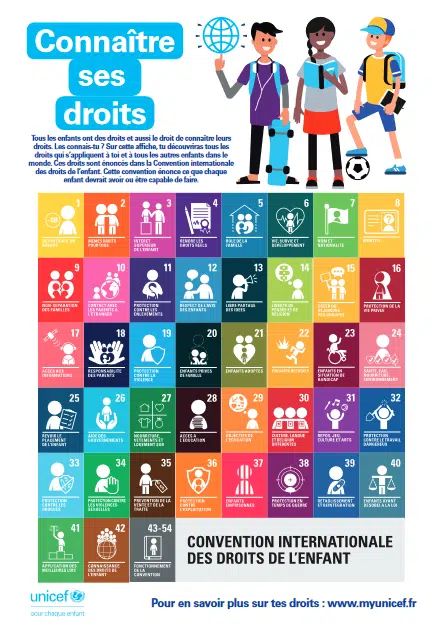
The CRC brings together all the fundamental rights recognized to children. It affirms that all children, without distinction, must enjoy civil, political, economic and social rights.
The essential guiding principles:
- Non-discrimination (art.2),
- The best interests of the child as a primary consideration in any decision concerning him or her (art.3),
- The right to life, survival and development (art.6),
- The right of the child to express his or her opinion freely and to be heard (art. 12).
The convention also guarantees concrete rights such as the right to education, health, identity, protection from violence, exploitation or abuse, and recognizes the responsibility of states in their implementation. This global approach requires States to think about child protection through structured public policies, and no longer only through ad hoc assistance mechanisms.
- A text with legal obligations
Unlike previous declarations (1924 and 1959), the CRC is a legally binding instrument: ratifying states undertake to adapt their national legislation in order to respect the rights recognized in the Convention. This implies a concrete transformation of national legal systems: States must not only recognize these rights, but also put in place institutions, public policies and protection mechanisms to ensure their effectiveness.
- International monitoring mechanism
Signatory states must produce regular reports submitted to the United Nations Committee on the Rights of the Child, which is responsible for assessing the conformity of national policies with the principles of the Convention. This mechanism does not create direct sanctions, but it reinforces international diplomatic and normative pressure, especially through official recommendations. It also contributes to producing a form of standardization of children’s policies, by disseminating common standards and making visible the inadequacies of States.
- How did we get to this point (1924-1959-1989)?
- The Geneva Declaration: The Birth of an International Framework
Historical Background
The Geneva Declaration was adopted in 1924 by the Sté des Nations, in a context marked by the social and humanitarian consequences of the First World War. The war has caused a major crisis in Europe: poverty, famine, orphanages, population displacement and severe vulnerability of children. The need for protection then appears to be an international issue.
The League of Nations, created in 1919 (Treaty of Versailles), was the first international organization aimed at maintaining peace in Europe and structuring international cooperation. It brought together about 42 states and was dissolved in 1946.
This declaration marks a first turning point: it recognizes that children require special attention and that States have a moral responsibility towards them, even if this responsibility is still largely vague.
Objectives and limitations
The 1924 Declaration establishes general principles affirming that the child must be protected, fed, cared for and rescued as a priority. It is the first international recognition of the duty of protection towards children.
However:
- This text remains very brief
- The declaration does not create any legal obligation
- It reflects a paternalistic vision of the child
The child is perceived above all as a fragile being in need of assistance and compassion, rather than as an individual with his or her own rights. The objective is more humanitarian than legal, and implementation depends entirely on the will of States.
Major players
The adoption of this declaration was strongly influenced by the humanitarian mobilizations of the time, particularly by international philanthropic organizations concerned about the situation of children in Europe.
Associations such as Save the Children play an important role in spreading the idea that child protection must become an international issue. Thus, the declaration is first and foremost the product of a transnational humanitarian movement, rather than a solid political consensus between states.
- The Declaration of the Rights of the Child (1959): a decisive step in the recognition of the rights of the child
Why a new declaration?
The 1959 Declaration was adopted by the UN General Assembly to modernize and deepen the 1924 Declaration. The post-war context plays a decisive role: the Second World War highlighted the scale of violence against civilians, including children, reinforcing the need for a universal framework for the protection of human rights.
The 1950s were also marked by a rise in the role of international organizations in defining universal standards, particularly with the adoption of the Universal Declaration of Human Rights (1948). Child protection is gradually becoming part of this broader movement to recognize universal fundamental rights.
This statement therefore testifies to a change of perspective: the child is no longer just a victim of wars, but becomes a subject in need of specific protections.
Contributions of the 1959 declaration
The 1959 text affirms 10 fundamental principles:
- The right to a name and a nationality;
- The right to education;
- The right to medical care;
- The right to protection from exploitation;
- The right to grow up in a supportive environment.
The declaration reinforces the recognition of a state responsibility towards the child. It affirms that States must ensure an enabling development environment, which paves the way for a more institutional approach to child protection.
However, it too remains legally non-binding. However, it contributes to gradually transforming social and institutional representations, by establishing the idea that child protection is a collective international commitment.
- The International Convention on the Rights of the Child (1989): consolidation and internationalization of children’s rights
Why was the CRC necessary?
Between the 1960s and 1980s, several factors accelerated the transformation of children’s rights:
- Increasing armed conflict and humanitarian crises affecting children
- Growing mobilization of international organizations and NGOs
- Awareness of intra-family and institutional violence
- Rising concerns about child labour, child poverty and access to education
These issues show the limits of previous declarations: despite affirmed universal principles, violations persist on a large scale. The lack of legal obligations made it difficult to effectively implement international protection.
The CRC thus appears to be a response to the need to transform moral principles into concrete legal commitments.
A comprehensive approach to children’s rights
The CRC recognises both:
- Civil and political rights (freedom of expression, right to identity)
- Social rights (education, health)
- Protection rights (violence, exploitation, abuse)
It is one of the first international treaties to explicitly affirm that the child is not only vulnerable but also an actor, capable of expressing choices and being heard. Thus, the Convention is not limited to protecting children against the risk of conflict, it also requires them to be guaranteed a space for participation in decisions that concern them, which constitutes a major evolution in the way child protection is conceived.
- France’s role: ratification and impact in French law
France was very early on involved in international dynamics related to child protection. It participates in the major stages of the construction of international standards, in particular through the UN, and gradually adopts these principles in its national legal system.
France ratified the CRC in 1990, in a context of broad international adherence to the treaty. This ratification is part of a logic of consolidation of child protection law but also of a political will to align with international standards.
Effects on French law
The CRC has influenced several legislative and jurisprudential developments in France, including
- Progressive recognition of the child as a holder of rights
- The centrality of the best interests of the child in judicial decisions
- Developments in Family Law and Child Protection Policies
More concretely, the CRC has reinforced the idea that the child must be heard in certain legal proceedings, and that placement decisions must include the child’s best interests as a priority. It has also served as a reference in several public debates and reforms concerning child protection, particularly on the issues of abuse and care for children in care.
- And now? Contemporary Issues in International Children’s Law and the French Situation
Today, the CRC remains a reference text, but its application remains uneven depending on the State. Contemporary challenges show that children’s rights are facing new forms of vulnerability: forced migration, climate crises, inequalities in access to education, child poverty, and increased exposure to online violence.
In France, despite advanced legal recognition, child protection policies are regularly criticized, particularly on the lack of reception facilities, the difficulties related to children in care, and territorial inequalities in care. Thus, even if France claims to be a State that respects international commitments, the concrete implementation of the fundamental principles of the CRC remains a major public policy issue.
Appendices
Sources
- United Nations, Geneva Declaration on the Rights of the Child, League of Nations, 1924.
- United Nations, Declaration of the Rights of the Child, General Assembly Resolution 1386 (XIV), 20 November 1959.
- United Nations, Convention on the Rights of the Child, United Nations General Assembly, November 20, 1989, entered into force September 2, 1990.
- Committee on the Rights of the Child, Periodic reports submitted by France under the Convention on the Rights of the Child (latest concluding observations available).
- Committee on the Rights of the Child, General Comment No. 5: General Measures of Implementation of the Convention on the Rights of the Child, 2003.
- Committee on the Rights of the Child, General Comment No. 12: The Right of the Child to be Heard, 2009.
- Committee on the Rights of the Child, General Comment No. 14: The right of the child to have his or her best interests a primary consideration, 2013.
- UNICEF France, The CRC explained to children (educational sheet).
- Public life, Rights of the child: 5 questions on the International Convention on the Rights of the Child (CRC).
- Defender of Rights, Annual Report on the Rights of the Child (latest edition available).
- Council of Europe, Recommendation Rec(2005)5 on the rights of children living in institutions.
- Ministry of Justice / Ministry of Solidarity, The implementation of the International Convention on the Rights of the Child in France (presentation file / summary sheet).
- National Observatory for Child Protection (ONPE), Children’s Rights in Child Protection Policies (note or thematic report).