


Governing child protection: who really drives a decentralized public policy?
Series: Child Protection
Thematic cluster: HSI – Health, Society, Inclusion
Authors: Ismaîl BOUHIOUL
Published Date: September 16, 2026
Executive Summary
Child protection presents a rather particular institutional difficulty: the rights it must guarantee are part of a national framework, whereas their implementation is largely the responsibility of the departments. Child welfare (ASE) is placed under the authority of the president of the departmental council, who organizes, in particular, the reception and accommodation of children in care.
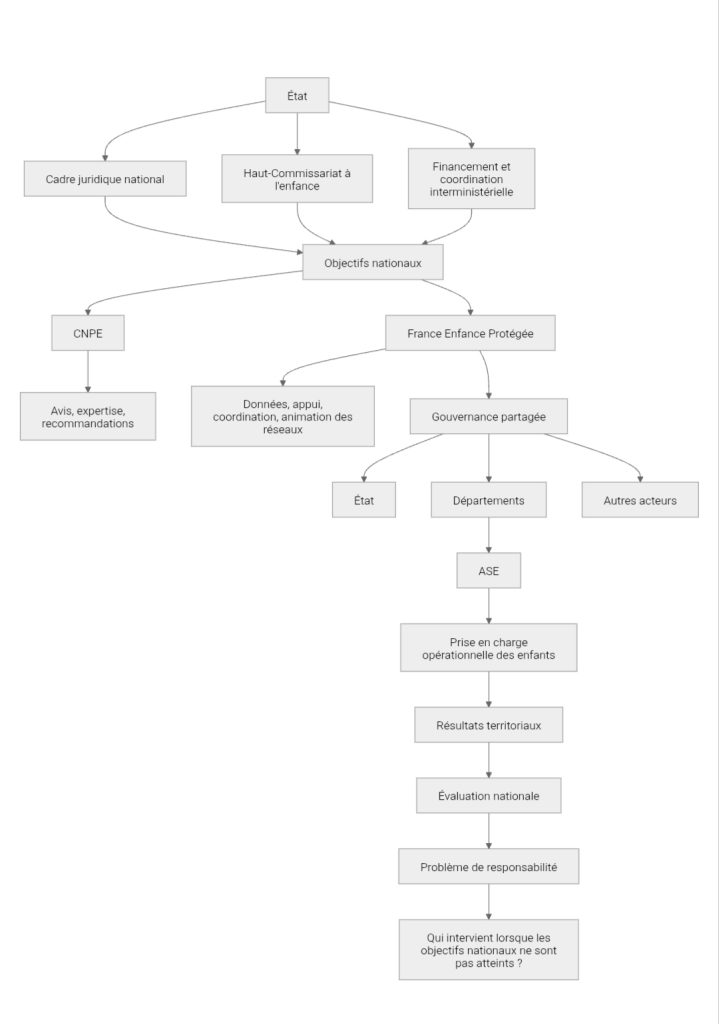
For several years, however, the State has strengthened its presence in the sector. The National Council for Child Protection (CNPE), France Enfance Protégée and, since 2025, the Office of the High Commissioner for Children have been involved at different levels: expertise, coordination, network leadership, political impetus and evaluation. Decree No. 2025-118 entrusts the High Commissioner with the mission of contributing to the definition, coordination, implementation and evaluation of policies conducted in the field of children.
However, this increase in power does not change the fundamental distribution of competences. None of these actors has general management power over the departments. The system has therefore been enriched with national instruments without giving rise to an equivalent chain of responsibility.
This question takes on a concrete dimension when we relate the institutional organisation to the conditions of care. At the end of 2024, 392,600 children and young people under the age of 21 were benefiting from at least one ASE measure. The departments then devoted 11.7 billion euros to child protection. The DREES also notes territorial differences in expenditure and care arrangements.[1]
The question is not whether all communities should operate in the same way. Such a requirement would be difficult to reconcile with decentralization and with very different territorial realities. The problem arises when this diversity leads to lasting differences in the exercise of rights that are the same for all children.
The memo therefore advocates a change in national management rather than a general recentralisation. The challenge would be to define a limited number of verifiable guarantees, to have common indicators and to provide for a graduated response when the discrepancies become significant or persistent. Above all, this would make it possible to determine, in each situation, who should act, with what means and at what level a correction should be initiated.
I. A national architecture that is now dense, but without a real pilot
1. A decentralised but nationally regulated policy
Child protection cannot be understood on the basis of a simple division between a State that would set the rules and departments that would implement them. Legally, the competence of the ASE does indeed belong to the department: the service is placed under the authority of the president of the departmental council, who organizes the necessary resources for the reception and accommodation of the children entrusted to care.
However, this operational competence does not erase the role of the State. The State remains responsible for the national normative framework and intervenes in several policies that directly affect the protection of children: justice, health, education, housing and the fight against poverty. It also has national tools for knowledge, evaluation and coordination.
The difficulty comes from this superimposition. The day-to-day organisation of child protection varies from one territory to another, while the rights it must guarantee do not vary. A child entrusted to ASE remains the holder of the same rights, regardless of the department in which he or she is cared for.
This difference between the unity of the standard and the diversity of its implementation is not, in itself, a dysfunction. Decentralization presupposes precisely a capacity for local adaptation. It becomes a problem of governance when differences in resources or organization result in a lasting change in the real level of protection.
The available data give an idea of the scale of the phenomenon. At the end of 2024, 392,600 children and young people under the age of 21 were benefiting from at least one ASE measure. The departments had spent €11.7 billion on child protection, of which about 80% was on ASE care measures.[2]
From this point on, the question of steering is no longer just about the legal distribution of powers. It is about the system’s ability to identify the gaps between what the law provides for and what the child actually receives.
2. The CNPE: an expert body, not a command authority
The 2022 reform strengthened the National Council for Child Protection. Article L. 147-13 of the Code of Social Action and Families entrusts it with the mission of issuing opinions and formulating proposals relating to the prevention and protection of children. Its composition brings together representatives of the State, magistrates, departments, professionals, associations, training organisations and supported persons, with a college made up of children and young people who are protected or leaving child protection systems.[3]
This choice reveals the function attributed to the CNPE. It is less a question of creating an additional administration than of bringing into the same body actors whose experiences and interests do not necessarily coincide. The CNPE can thus contribute to producing a collective reading of the sector’s difficulties.
However, this function has a clear institutional limit: an opinion is not equivalent to an administrative decision. The CNPE can document a difficulty or recommend a change without being able to directly force a department to modify its organization.
It is therefore necessary to distinguish between the influence on public policy and the ability to direct its implementation. The CNPE intervenes in the first field. The operational responsibility of the ESA remains elsewhere.
3. The High Commission: a centre of impetus that does not eliminate the duality between the State and the departments
The creation of the High Commission for Children in 2025 responds to another difficulty. Decree No. 2025-118 of 10 February 2025 places the High Commissioner under the Minister for Children and entrusts him with the tasks of defining, coordinating, promoting, implementing and evaluating policies relating to children. He also coordinates interministerial work in this area. [4]
This function responds to the internal fragmentation of the State. Policies that influence child protection are the responsibility of several ministries and administrations. A decision taken in the social field may, for example, depend on measures relating to justice, education, health or housing.
The High Commissioner can therefore provide a political support for interministerial action that would otherwise be in danger of remaining dispersed. However, it does not solve the second part of the problem: the department remains competent for the organization of the ASE. The High Commissioner coordinates government action; he does not become the hierarchical superior of the presidents of departmental councils.
The creation of the Office of the High Commissioner thus strengthens national management without changing the logic of decentralization. It is precisely this coexistence that makes it necessary to clarify responsibilities.
4. France Enfance Protégé: institutionalised cooperation
France Enfance Protégée occupies a different position. Created under the law of 7 February 2022, the public interest grouping is a national operator whose governance involves the State, the departments and other actors.
The constitutive agreement amended in February 2026 shows the importance given to this shared representation. The board of directors has 35 members, with a higher representation of the relevant departments and local authorities than the State. Funding is also based on a contribution from the State and the departments and local authorities concerned.
This arrangement is consistent with a policy whose implementation is decentralized. It makes it possible to circulate expertise and to organize cooperation between the two levels. However, it has a limitation: a mechanism designed to share governance cannot, on its own, determine who is responsible for a result when it is not achieved.
France Enfance Protégée can produce knowledge, lead networks and promote the dissemination of practices. Its function is not to replace the authorities who have operational skills. This distinction becomes important when we seek to move from a logic of coordination to a logic of results.
II. Strengthened governance, but still fragmented responsibility
1. When the competence and the means are not at the same level
The main blind spot of the system appears when a right is recognized by law but the conditions for exercising it depend on insufficient local capacity. The department may be legally competent while encountering a difficulty that it cannot solve alone: lack of places, shortage of professionals, difficulties in accessing housing or saturation of certain systems.
In such a situation, automatically designating the department as responsible for the result can be reductive. But attributing responsibility to the State on the sole ground that the norm is national is just as reductive. The division of powers does not, on its own, provide an answer to the question of who should correct the discrepancy.
It is this intermediate zone that deserves to be treated as a problem of governance. Legal competence is identifiable; political responsibility for the result is much less so. However, a public policy cannot be evaluated in the long term if failures can always be referred to another level of decision-making.
2. Shared governance cannot become a responsibility without an incumbent
France Enfance Protégée illustrates this difficulty. The financing of the GIP is legally based on a contribution from the State and the departments, in accordance with Article L. 147-15 of the CASF and the constitutive agreement. For 2026, the departmental contributions were set by Decree No. 2026-786 of 12 August 2026.[5]
The principle of joint participation is consistent with the governance of the group. However, it should not be inferred from this that all responsibility becomes collective. A decision can be taken by several people; responsibility for a result must remain attributable.
For a steering mechanism to be really usable, it is necessary to be able to reconstruct the decision-making chain: what objective had been set, which authority had the competence, what resources were available, what result was obtained and, above all, what response should be followed when the gap persists.
This requirement changes the function of coordination. A meeting between institutions is not a result of public policy. It is only valuable if it makes it possible to decide who acts, within what timeframe and according to what criteria the action will be reassessed.
3. Territorial equality as a steering criterion
The existence of differences between departments is not enough to demonstrate a failure of decentralization. The territories have neither the same costs, nor the same demography, nor the same medico-social offer. The relevant question lies elsewhere: do these differences have an impact on the rights actually exercised by children?
Data from the DREES show discrepancies in expenditure and the methods of care. In 2024, the average annual expenditure on childcare per beneficiary was €42,400 at the national level, with variations linked in particular to the structure of the childcare offer.[6]
It would therefore be irrelevant to seek strict equality of means. A rural department may need a different organization from a metropolitan department. On the other hand, the variation in resources should not lead to making certain rights more difficult to exercise.
The criterion of territorial equality must therefore be moved: it is not a question of obtaining identical organisations, but of verifying that organisational differences remain compatible with a common level of protection. Two departments can spend different amounts and obtain comparable results; conversely, similar means can produce very different situations.
This approach leads us to look at performance indicators differently. The question is no longer just how much a department spends or how many structures it has, but what these resources actually make it possible to achieve for children.
4. Data conditions the ability to govern
National management here comes up against a more technical, but decisive, difficulty: the available data do not always allow for a sufficiently detailed comparison of pathways. The DREES is an essential source of knowledge, while the departmental observatories and the work of France Enfance Protégée complete this information. However, their alignment around common indicators would make it possible to better identify discrepancies.
The most useful indicators would be those that make it possible to monitor the child’s real pathway: waiting time for an appropriate solution, number of changes of place of care, retention of siblings, access to care, school continuity, leaving the ASE with a stable solution or even vacancies in specialized positions.
These data would have a different function than that of a simple statistical table. They would make it possible to link a result to a responsibility and to identify the moment when a difficulty ceases to be a one-off and becomes structural.
The National Assembly’s commission of inquiry into the shortcomings of public policies on child protection devoted a significant part of its report to governance and relations between the State and the departments. In particular, it noted the difficulties of national management and made recommendations to strengthen it.[7]
Data then becomes an instrument of administrative power: those who have a common measure can objectify a discrepancy, ask for an explanation, and follow up on a correction. Without this capacity, the discussion remains largely focused on the means and constraints specific to each institution.
III. Moving from a governance of coordination to a governance of accountability
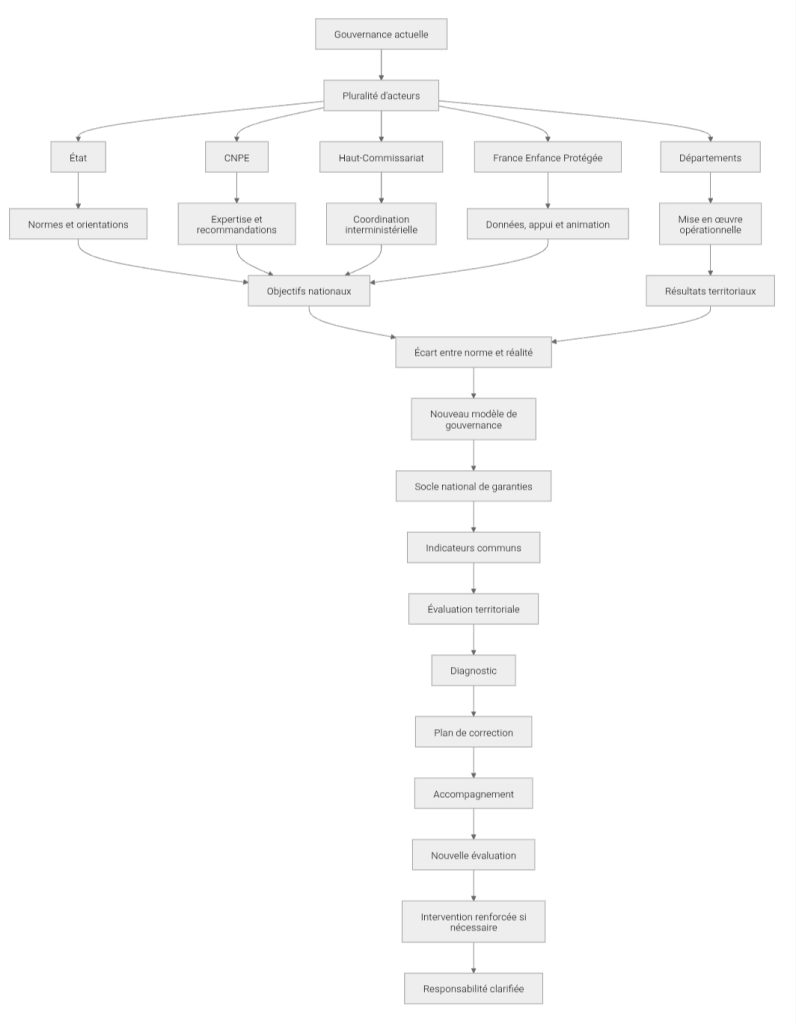
France now has enough institutions to produce expertise and organize coordination. Adding an additional structure would therefore not solve the problem identified. Rather, the difficulty is to ensure that existing structures can be linked to measurable objectives and identifiable accountability.
1. Defining a national base of guarantees
The first step would be to retain a limited base of common indicators. It would not be a question of imposing a uniform organization on the departments. Their freedom of organization would remain intact, subject to compliance with legal obligations. On the other hand, certain results should be able to be monitored everywhere according to comparable definitions.
The choice of indicators must remain directly linked to the rights and conditions of care. The duration of derogatory childcare solutions provides information, for example, on the ability to offer an appropriate solution; changes in childcare location make it possible to monitor the stability of the pathway; the situation of young adults sheds light on the effectiveness of care up to the age of 21.
The same reasoning can be applied to housing, health, schooling, human resources and youth participation. The aim is not to produce a ranking of departments, but to make the gaps visible enough to be explained.
| Axle | Proposed indicator | Purpose |
| Home | Average duration of derogatory solutions | Measure the ability to quickly propose a suitable solution |
| Career | Average number of changes of place of reception | Measuring the stability of the course |
| Siblings | Share of siblings welcomed together when it corresponds to the interests of the children | Measuring the effectiveness of the maintenance of fraternal ties |
| Young adults | Share of young people receiving care up to the age of 21 when they meet the legal requirements | Measuring the effectiveness of the law |
| Accommodation | Share of exits with a stable housing solution | Measuring Readiness for Autonomy |
| Health | Time to access appropriate care | Measuring the effectiveness of access to care |
| Education | Rate of school break-up or change | Measuring educational continuity |
| Human Resources | Vacancy rates for specialized posts | Identify structural capacity constraints |
| Participation | Share of personalised projects that effectively integrate the young person’s voice | Measuring the participation of the people concerned |
| Piloting | Existence and monitoring of a departmental correction plan when indicators are permanently degraded | Turning data into action |
2. Plan a response when the gap becomes sustainable
An indicator is only of interest if it modifies public decision-making. When a department has long-term results below the common base, the response should not be automatic or identical in all cases.
A first step could be to establish a diagnosis with the department and the national actors concerned. It would then be necessary to determine whether the difficulty stems from a lack of reception capacity, a recruitment problem, a failing organization or an external constraint, for example in access to housing or care.
The correction could then take several forms: capacity building, support for recruitment, training, support for cooperation with institutions, mobilization of housing schemes or improvement of access to health care and schooling. A new evaluation would make it possible to verify whether the situation is improving.
This mechanism has an institutional interest: it avoids placing decentralization in front of an overly simple alternative between abandonment and recentralization. National intervention could first aim to restore the territory’s ability to respect the common core, before considering more restrictive measures when difficulties persist.
3. Distributing responsibility according to the levers actually held
The clarification of responsibilities must start from existing competences rather than from a new architecture.
The State should be accountable for the national framework: definition of common guarantees, interministerial coherence, availability of data, evaluation and intervention when persistent discrepancies call into question these guarantees. This responsibility also implies addressing the difficulties that fall under national policies and that the departments cannot solve alone.
The departments would retain responsibility for the operational organisation of the ASE, the quality of the care within their competence, the management of the pathways and the adaptation of the measures to local realities.
The CNPE and France Enfance Protégée would be mainly responsible for providing expertise, data, evaluation, dissemination of practices and the participation of the people concerned. The High Commission would retain a political and interministerial coordination function.
This distribution makes it possible to lay down a simple rule: the institution that is responsible for a result must have a real capacity to act on the factors that determine it. Otherwise, the system produces a responsibility in principle without any real leverage.
4. Assessing decentralization on the basis of rights effectively guaranteed
This proposal changes the way in which decentralisation is evaluated. The debate is often organised around legal competence, financing or administrative organisation. These elements remain essential, but they do not in themselves tell us whether the policy works.
The starting point should be the child. What level of protection is the Republic able to guarantee when a child is under the care of the ASE? The answer does not assume that all the departments have the same resources or that they use the same structures. It assumes that the differences observed can be related to the results obtained.
This approach also leads to a distinction between acceptable and worrying differences. A one-off variation may be the result of a particular local situation. A long-term deviation, which concerns a fundamental right and which ordinary mechanisms do not allow to be absorbed, calls for a national response.
The relevant criterion is therefore not the existence of a difference between departments. It is its unjustified nature with regard to the rights that the system must guarantee. This distinction could constitute the starting point for a genuine national doctrine for steering child protection.
Conclusion
Child protection now has a much denser institutional set than it was before. The CNPE produces expertise, France Enfance Protégée organises cooperation between several actors and the High Commission strengthens interministerial coordination. However, the departments retain the main operational levers of ASE.
The problem is therefore not the absence of actors. Rather, it lies in the fact that their functions do not yet form a sufficiently clear chain of responsibility. When national law is not effectively guaranteed in a department, it remains difficult to determine precisely where the responsibility for the result lies and which institution should initiate the correction.
General recentralization is not necessarily the most coherent response. It would profoundly change the current balance without automatically resolving the difficulties of capacity, recruitment or access to services that produce certain territorial differences.
Another way is possible: maintaining departmental competence while strengthening the national management of results. This implies determining some common guarantees, having comparable data and providing for a graduated response when the discrepancies become persistent.
In the end, the issue is less about who should run the system as a whole than about making responsibility traceable. When a child’s right is not respected, it must be possible to identify the competent authority, the means at its disposal, the causes of the gap and the measure that must be taken to remedy it. It is on this condition that institutional coordination will be able to produce something other than a juxtaposition of actors: a real capacity to guarantee the rights of the child.
Bibliography
Legal texts
- Constitution of 4 October 1958, in particular Article 72 relating to the free administration of local authorities.
- Code of Social Action and Families, in particular Articles L. 221-1, L. 221-2, L. 147-13, L. 147-14 and L. 147-15. Version in force in 2026. Légifrance.
- Law No. 2022-140 of 7 February 2022 on the protection of children, Official Journal of the French Republic, 8 February 2022. Légifrance.
- Decree No. 2025-118 of 10 February 2025 establishing a High Commissioner for Children, Official Journal of the French Republic, 11 February 2025. Légifrance.
- Decree of 16 February 2026 approving the amendments to the constitutive agreement of the public interest grouping « France Enfance Protégée (FEP) », Official Journal of the French Republic, 28 February 2026. Légifrance.
- Decree No. 2026-786 of 12 August 2026 setting the amount of the financial contribution of the departments to the operation of the public interest grouping « France Enfance Protégée » for the year 2026, Official Journal of the French Republic, 15 August 2026. Légifrance.
Reports and institutional data
- National Assembly, Commission of Inquiry on the Shortcomings of Public Child Protection Policies, Report made on behalf of the Committee of Inquiry on the Shortcomings of Public Child Protection Policies, No. 1200, XVIIth Legislature, 1 April 2025.
- National Assembly, Commission of Inquiry into the Shortcomings of Public Child Protection Policies, Minutes of the hearing of Mr. Sébastien Vincini, President of the Haute-Garonne Departmental Council, Minutes No. 22, 4 February 2025.
- DREES. Tarayoun, Tedjani, with Élisa Abassi, Moussa Keita and Klara Vinceneux, Child welfare. Beneficiaries, measures and associated departmental expenditures. 2026 edition, Les Dossiers de la DREES, n° 138, 30 June 2026.
- DREES, End of 2024, 392,600 children and young people under the age of 21 benefit from a child welfare measure, 20 April 2026.
- Court of Auditors, The care of young adults leaving child welfare, Annual Public Report 2025, 19 March 2025.
Institutional sources
- National Council for Child Protection (CNPE), « Missions and functioning of the National Council for Child Protection », Ministry for Children.
Appendices
Annex 1: Current National Child Protection Governance Architecture
Appendix 2: From Coordination Governance to Accountability Governance
Annex 3: Proposal for a national core of indicators
| Proposal for a national core of indicators | |||
| Axle | Proposed indicator | Purpose | |
| Home | Average duration of derogatory solutions | Measure the ability to quickly propose a suitable solution | |
| Career | Average number of changes of place of reception | Measuring the stability of the course | |
| Siblings | Share of siblings welcomed together when it corresponds to the interests of the children | Measuring the effectiveness of the maintenance of fraternal ties | |
| Young adults | Share of young people receiving care up to the age of 21 when they meet the legal requirements | Measuring the effectiveness of the law | |
| Accommodation | Share of exits with a stable housing solution | Measuring Readiness for Autonomy | |
| Health | Time to access appropriate care | Measuring the effectiveness of access to care | |
| Education | Rate of school break-up or change | Measuring educational continuity | |
| Human Resources | Vacancy rates for specialized posts | Identify structural capacity constraints | |
| Participation | Share of personalised projects that effectively integrate the young person’s voice | Measuring the participation of the people concerned | |
| Piloting | Existence and monitoring of a departmental correction plan when indicators are permanently degraded | Turning data into action | |
[1] DREES, Child welfare. Beneficiaries, measures and associated departmental expenditure. 2026 edition, Les Dossiers de la DREES, n° 138, 30 June 2026
[2] Code of Social Action and Families, art. L. 221-1, version in force since February 9, 2022, amended by Law No. 2022-140 of February 7, 2022 on the protection of children, art. Available on Legifrance.
[3] Ministry of Labour, Health, Solidarity and Families, « National Council for Child Protection – The missions of the CNPE », n.d. Available on https://solidarites.gouv.fr.
[4] Decree No. 2025-118 of 10 February 2025 establishing a High Commissioner for Children, Official Journal of the French Republic, 11 February 2025, art. 2. Available on Legifrance
[5] Constitution of 4 October 1958, art. 72, in particular its third paragraph: « Under the conditions provided for by law, these communities shall be freely administered by elected councils.
[6] DREES, « Child welfare. Beneficiaries, measures and associated departmental expenditure – 2026 edition », Les Dossiers de la DREES, n° 138, 30 June 2026. Available at: https://drees.solidarites-sante.gouv.fr/publications-communique-de-presse/les-dossiers-de-la-drees/260630-aide-sociale-enfance-2026.
[7] National Assembly, Commission of Inquiry on the Shortcomings of Public Child Protection Policies, Report on the Shortcomings of Public Child Protection Policies, No. 1200, XVIIth Legislature, tabled on 1 April 2025, Volume I. Available at: https://www.assemblee-nationale.fr/dyn/17/rapports/cease/l17b1200_rapport-enquete.