


The Taquet law: strengthening the rights of children in care, between legal ambition and limits of effectiveness
Series: Child Protection
Thematic Cluster: HSI – Health, Society and Inclusion
Authors: Ismaïl BOUGHIOUL
Published Date: August 17, 2026
Executive Summary
Promulgated on February 7, 2022, Law No. 2022-140 on the protection of children, known as the « Taquet Law », is an important reform of French child protection law. However, it does not call into question the institutional organisation of Aide sociale à l’enfance (ASE), the French child welfare service, which remains mainly the responsibility of the french departments. The reform has a greater impact on the content of the obligations incumbent on child protection actors and on the rights recognised for children and young people supported.
This development is particularly visible in several provisions of Title I of the law, which is devoted to improving the daily lives of protected children. In particular, the text strengthens the rules relating to the preservation of sibling ties, regulates the use of certain forms of accommodation and extends the care of young adults. Other provisions concern protection against violence, procedural guarantees in educational assistance, foster carers, maternal and child health services, the management of child protection policy and unaccompanied minors.
Two provisions in particular make it possible to measure this evolution. Article 7 created Article L. 221-2-3 of the Code of Social Action and Families (CASF), in order to provide a framework for the reception of minors and young people under 21 years of age. The new rule favours childcare by a foster carersor in an authorised establishment or service and limits the possibilities of derogatory care. The legislator’s choice is therefore to transform an administrative practice into a legally regulated rule, with a temporal limitation of derogatory solutions.
Section 10 is a second important example. It strengthened the right to care for young adults under the age of 21 who had actually been cared for by the ASE before they reached the age of majority and who did not have sufficient resources or family support. The Council of State specified in 2024 that this provision opens, when these conditions are met, a right to new coverage up to the age of 21.
These two examples show, however, that the strengthening of the legal norm does not automatically guarantee its effectiveness. The law sets national obligations, whereas their implementation is largely based on varying departmental capacities: number of places available, professionals, housing, support systems and financial resources. The problem is therefore no longer just to determine what the law provides, but to ascertain the extent to which the institutions are actually able to respect the rights enshrined in the law.
The challenge of the Taquet law can thus be analysed as a movement towards the legalisation of child protection: public policy objectives are gradually transformed into more precise legally precise obligations and rights. However, this legalization reveals a tension between the unification of the level of legal requirements and the territorialization of the means of implementation.
- A law that does not refound the ASE but redefines the level of protection required
To understand the Taquet law, it must first be placed in the context of recent developments in child protection law. The law of 5 March 2007 had notably strengthened prevention and confirmed the role of the department in the organisation of child protection. The law of 14 March 2016 then placed greater emphasis on the fundamental needs of the child, the stability of his or her care pathway and preparation for his or her autonomy. The law of 7 February 2022 is part of this continuity: it does not create a new organisation for child protection, but reinforces the legal requirements that this organisation must meet. The department remains at the centre of the system. Article L. 221-2 of the CASF places the ASE service under the authority of the President of the Departmental Council. The Taquet law does not therefore abolish the decentralization of child protection. Rather, it adds new obligations to a system whose implementation remains territorialized.
It is precisely this articulation that constitutes one of the main legal issues of the reform. The legislator may define at the national level the rights to be enjoyed by the child, but their practical realization still depends on the capacity of the communities responsible for implementing them.
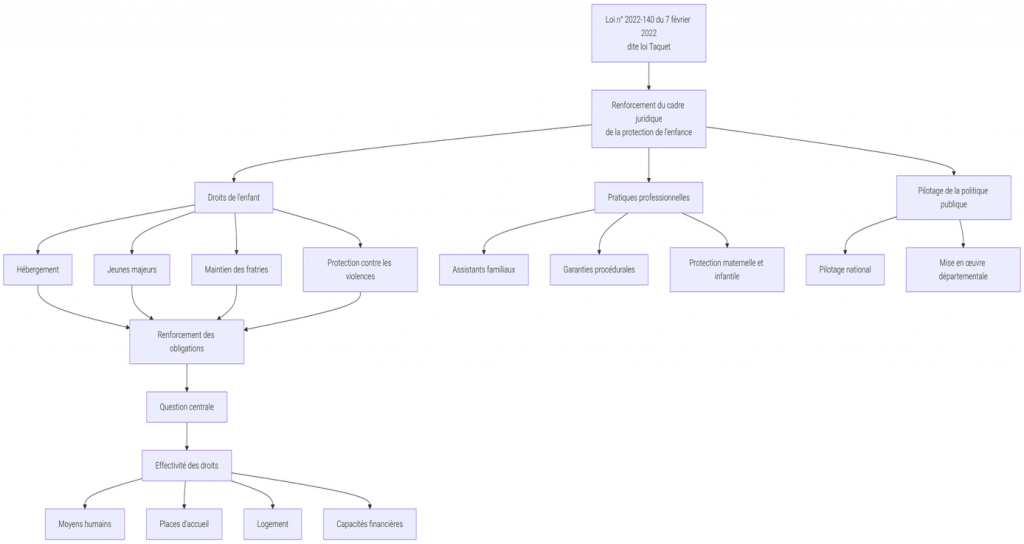
The law thus intervenes on several dimensions: reception conditions, the maintenance of family ties, protection against violence, procedural guarantees, the situation of foster carers and preparation for autonomy.
These provisions have one thing in common: they are no longer limited to determining who is responsible for the child; they are more interested in determining what this protection should actually guarantee. It is this shift that allows us to understand the scope of the reform. The issue is no longer just institutional. It also becomes legal: when an obligation is enshrined in law, its violation can be controlled and, in certain cases, challenged before the judge.
The Taquet law therefore strengthens the level of requirements applicable to child protection without fundamentally changing its organization. However, this development creates a tension: the more precise the national standard, the more important the question of the means necessary to comply with it becomes.
Appendix n°1: Diagram of the provisions of the Taquet law
Diagram based on the analysis of Law No. 2022-140 of 7 February 2022 on the protection of children, the Code of Social Action and Families and the case law of the Council of State. Formatting using the Mermaid Online schema builder
- Accommodation: when an administrative practice becomes a question of law
The use of hotels is a particularly revealing example of this tension. A temporary accommodation solution could be used when no suitable place was immediately available. The problem arises when this exceptional solution becomes sustainable when a hotel does not necessarily provide the same conditions of educational support as a specialized establishment or a host family.
The law of 7 February 2022 sought to change precisely this situation. Article 7 of the Act created Article L. 221-2-3 of the CASF. The principle laid down by the new legal framework is that the minors and young people concerned must be accommodated in structures covered by the ordinary child protection system. The derogatory possibilities are limited and regulated over time. [1]
It is therefore more precise to speak of a legal framework for the use of derogatory accommodation than of a simple « hotel ban ». The legislator establishes a hierarchy between the reception solutions: the authorised structure is the rule and the other solutions must remain exceptional and temporary.
The time limit provided for in Article 7 is itself revealing. The new rule did not come into force immediately: the law provided for an entry into force on the first day of the twenty-fourth month following its publication. [2]
This period may be interpreted as a period of adaptation necessary to bring the system into compliance. The legislator could modify the legal rule, but it could not instantly create the reception places necessary for its application. The delay therefore reflects a structural difficulty: the standard can be modified quickly, while the administrative capacity necessary for its application requires time.
The effectiveness of the reform must therefore be assessed beyond the existence of the rule. Hotel accommodation situations continued to be reported after the entry into force of the new system, in particular due to the lack of reception facilities and professionals. [3]
Appendix n°2: The framework for the use of derogatory accommodation: from standard to effectiveness. Source: Personal elaboration based on Article 7 of Law No. 2022-140 of 7 February 2022 on the protection of children and Article L. 221-2-3 of the Code of Social Action and Families (CASF). Formatting using the Mermaid Online schema builder.
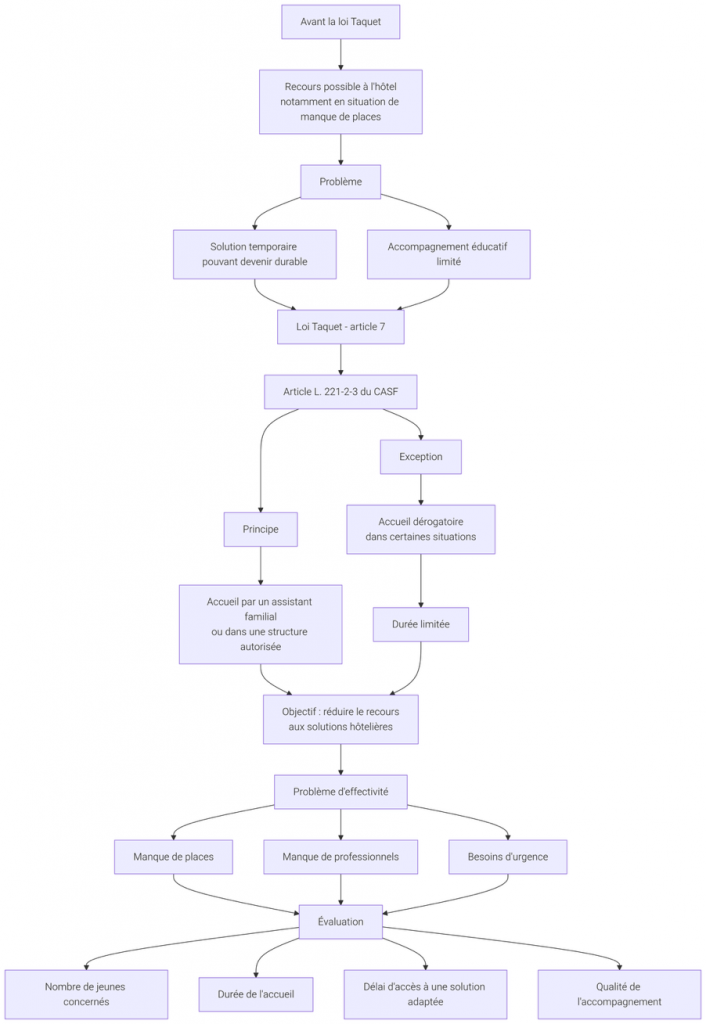
The legal issue then becomes that of the effectiveness of the obligation. If the derogatory remedy persists, it is not sufficient to note that the law has limited it. It must be determined whether the conditions for compliance with the rule really exist: number of places available, referral time, presence of professionals, educational support and duration of the temporary solution.
Hotel accommodation is therefore a particularly clear indicator of the limits of the reform : the law may make a practice legally exceptional, but it cannot, on its own, produce the material capacities that should make it possible to do without it.
Areas for improvement:
This difficulty makes it possible to identify several levers for action. The first would be to strengthen the national monitoring of the use of derogatory solutions, with data allowing the comparison of situations between departments. The second would be to develop appropriate reception capacities, in particular places that allow for rapid response to emergency situations. Finally, when temporary care remains legally possible, its educational framework should be an essential indicator of the effectiveness of the reform.
- The majority: transforming a legal break into an accompanied transition
The increase to 18 years of age is another major point of the reform. Before the Taquet law, the majority could constitute a significant break in the care pathway of some young people leaving the ASE. The reform seeks to reduce this disruption by strengthening the care of young adults.
Article 10 of the Law amended Article L. 222-5 of the CASF. The scheme concerns in particular people under 21 years of age who have actually been taken into the care of the ASE before they reach the age of majority and who do not have sufficient resources or family support.
This provision is not simply a recommendation to the departments. It creates a legally identifiable right, the conditions of which can be controlled.
The decision of the Council of State of 16 October 2024 is particularly important in this regard. The judge specified that young adults under the age of 21 who were actually cared for by the ASE before they reached the age of majority were entitled to new care until the age of 21 when they did not have sufficient resources or family support. [4]
This decision shows that the Taquet law has effects that go beyond the legislative text alone. The administrative judge participates in the concrete definition of the new law. The legalization of child protection therefore also involves litigation: when a community refuses to take care of it, the judge may be led to determine whether the legal conditions are met.
But the right to care again raises the question of means. Care up to the age of 21 concretely presupposes housing, educational support, access to training or employment and, depending on the situation, administrative and health support.
The audits carried out by the regional audit chambers also show that implementation remains uneven. A report published in 2025 notes, for example, that support for young adults has become more systematic in some departments, but that it is not always long-term and that preparation for release remains insufficient.[5]
The reform therefore appears here to be more advanced in the field of legal recognition of the right than in that of its material realization.
- Siblings: strengthening an existing guarantee rather than creating a new right
The question of siblings illustrates another dimension of the Taquet law. Article 5 amends article 375-7 of the Civil Code in order to reinforce the principle that the child must, as far as possible, be cared for with his or her brothers and sisters, unless his or her interests require another solution.
The interest of this provision is therefore not only symbolic. It legally reinforces the consideration of fraternal ties in placement decisions
But here again, the legal rule clashes with the available capacities. Welcoming several children from the same sibling group requires having foster families or establishments capable of accommodating them together.
The question of siblings thus shows a general characteristic of the Taquet law: the recognition of a right can strengthen the legal protection of the child without automatically guaranteeing the material conditions for its exercise.
- Broader reform: violence, procedural safeguards and governance
However, the Taquet law cannot be reduced to accommodation and young adults. It also includes provisions relating to protection against violence, procedural guarantees in educational assistance, the profession of foster carers, the PMI, the management of child protection policy and unaccompanied minors. This diversity shows that the reform acts simultaneously on three levels:
- children’s rights;
- professional practices;
- the organisation and management of public policy.
This architecture is important for understanding the scope of the law. The legislator seeks to strengthen protection without removing the existing institutional distribution.,The reform is therefore less a decentralisation reform than an attempt to strengthen the national framework for decentralised public policy. It is precisely this characteristic that explains some of its difficulties in application.
- The central problem: strengthening the law without fundamentally changing decentralization
The main limitation of the reform appears when its legal ambition is compared with the institutional organisation of the ASE. The department remains the central player in the implementation. The obligations are defined nationally, but their fulfilment depends on different means and territorial organisations.
This situation does not mean that decentralization is necessarily incompatible with equality before the law. However, it creates a risk: an identical right can produce different effects depending on the territory in which it is to be applied.
The DREES data show the extent of the system concerned. At the end of 2024, 392,600 children and young people under the age of 21 were receiving at least one CSA measure.[6]
At this stage, the effectiveness of a reform cannot be assessed solely on the basis of the legislative text. It is therefore necessary to distinguish three levels:
- The standard: what does the law require?
- Implementation: how have departments adapted their practices?
- Effectiveness: have the children actually benefited from the rights recognized?
- Four years on: moving from legal compliance to effectiveness assessment
Four years after the promulgation of the law, its assessment cannot consist solely of drawing up a list of new provisions. The analysis must now focus on their effects. For accommodation, it is necessary to examine:
- the number of young people still accommodated in derogatory solutions;
- the duration of these receptions;
- the time needed to access a suitable solution;
- the effective presence of professionals;
- the quality of educational follow-up.
For young adults, the assessment should focus on:
- the number of young people actually receiving care;
- the duration of the support;
- access to housing;
- access to training and employment;
The possibility of resuming care when the young person’s situation deteriorates. This approach is consistent with the recent observations of the regional audit chambers, which underline that the legal framework is now more ambitious but that its implementation remains partial in some territories.
Three orientations can be identified:
First, strengthen national evaluation: The State could develop common indicators to measure the application of the main obligations of the Taquet law in each department.
Secondly, better articulate rights and resources: When a new legal obligation is imposed on the departments, the capacities necessary for its application must be identified and financially supported.
Thirdly, strengthen the continuity of pathways: The evaluation should not focus solely on the presence of care, but on its stability and results: housing, training, health, maintenance of family ties and autonomy.
The objective would therefore not be to completely recentralise child protection, but to guarantee that a minimum set of rights is effectively guaranteed throughout the country.
Conclusion
The Taquet law does not constitute an institutional overhaul of child protection. It maintains an organization in which departments remain primarily responsible for the implementation of ASE. Rather, its contribution lies in strengthening the level of legal requirements applicable to this public policy.
However, the study of hotel accommodation, the care of young adults and the retention of siblings shows that the strengthening of a right does not necessarily guarantee its effectiveness. In each of these areas, the legislator has sought to make the obligations more precise. But their application still depends on material and human capacities that remain largely territorialized.
The case law of the Council of State also shows that this juridicization produces concrete effects: the administrative judge now participates in the definition and guarantee of certain rights resulting from the reform.
The central question is therefore no longer just whether the Taquet law has strengthened the rights of protected children. It consists of determining the extent to which these rights can be effectively guaranteed in a system where the norm is national but where the means of its implementation remain largely departmental.
The Taquet law thus appears to be an ambitious reform from a legal point of view, but whose success now depends less on the adoption of new standards than on the ability of the institutions to make them effective.
Bibliography :
Legal texts:
- Law No. 2022-140 of 7 February 2022 on the protection of children, Official Journal of the French Republic, No. 0032, 8 February 2022. Available online at: https://www.legifrance.gouv.fr (accessed August 10, 2026).
- Code of Social Action and Families, Articles L. 221-2, L. 221-2-3, L. 222-5 and L. 222-5-1. Available on: https://www.legifrance.gouv.fr. Accessed August 10, 2026.
- Civil Code, Article 375-7. Current version available at: https://www.legifrance.gouv.fr (accessed August 10, 2026).
Case law:
- Council of State, 16 October 2024, No. 475849, decision on the right to new care for young adults who have been entrusted to the ASE before they reach the age of majority. Available online at: Council of State – https://www.conseil-etat.fr. (accessed August 10, 2026).
Parliamentary Business:
- Gontard, G. (2026, July 2). Publication of the latest decrees implementing the Law on the Protection of Children [Oral Question No. 1232S]. Senate. Available on: https://www.senat.fr/questions/base/2026/qSEQ26071232S.html.
Institutional data and reports:
- Tarayoun, Tedjani, with Élisa Abassi, Moussa Keita and Klara Vinceneux, Child welfare. Beneficiaries, measures and associated departmental expenditure – 2026 edition, DREES, Les Dossiers de la DREES, n° 138, 30 June 2026. Available online at: https://drees.solidarites-sante.gouv.fr/publications-communique-de-presse/les-dossiers-de-la-drees/260630-aide-sociale-enfance-2026? (accessed August 10, 2026).
- Court of Auditors / Regional Chamber of Auditors, report on child protection and/or care for young adults.
Appendices :
Appendix 1 Diagram of the provisions of the Taquet law:
Source: Diagram based on the analysis of Law No. 2022-140 of 7 February 2022 on the protection of children, the Code of Social Action and Families and the case law of the Council of State. Formatting using the Mermaid Online schema builder
Appendix 2 The framework for the use of derogatory accommodation: from standard to effectiveness
Source: Personal elaboration based on Article 7 of Law No. 2022-140 of 7 February 2022 on the protection of children and Article L. 221-2-3 of the Code of Social Action and Families (CASF). Formatting using the Mermaid Online schema builder.
[1] Law No. 2022-140 of 7 February 2022 on the protection of children
[2] Ditto
[3] M. Battaglia, « They are the most vulnerable of the vulnerable »: these young people placed in hotels as part of child welfare », Le Monde, 3 April 2025
[4] Conseil d’État, « Analyse n° 475849 », 16 Oct. 2024, ArianeWeb, 475849CE, 16 Oct. 2024. Available on: http://www.conseil-etat.fr/fr/arianeweb/CE/analyse/2024-10-16/475849
[5] Regional Chamber of Auditors Centre-Val de Loire, Department of Indre – Preparation for discharge from child protection: measures relating to young adults, 13 March 2025, Court of Auditors, available online: https://www.ccomptes.fr/fr/publications/departement-de-lindre-la-preparation-la-sortie-de-la-protection-de-lenfance-les (accessed on 11 August 2026).
[6] Tedjani Tarayoun, « End of 2024, 392,600 children and young people under 21 benefit from a child welfare measure », DREES, 20 April 2026, available online: https://drees.solidarites-sante.gouv.fr/communique-de-presse-jeux-de-donnees/jeux-de-donnees/fin-2024-392-600-enfants-et-jeunes-de-moins-de